
Published: March 2020 | Last Updated:June 2026
© Copyright 2026, Reddog Consulting Group.

TL;DR:
- A customer persona is a research-based profile that reveals why customers buy, not just who they are. It combines demographic and psychographic data to guide marketing, sales, and product decisions. Personas should be limited to three to five active profiles and reviewed regularly to stay relevant.
A customer persona is a semi-fictional, research-based archetype that represents your ideal customer by synthesizing qualitative and quantitative data about their goals, behaviors, pain points, and motivations. Unlike a basic demographic profile, a well-built persona reveals why customers buy, not just who they are. Marketing professionals and business owners who understand what is a customer persona gain a concrete tool for sharpening messaging, aligning teams, and improving conversion across every channel. Tools like HubSpot, Adobe, and Acquia have each published frameworks that confirm personas are among the highest-leverage assets in a marketer’s toolkit.
A customer persona is built from two distinct layers: demographics and psychographics. Demographics tell you the surface facts: age, location, job title, income. Psychographics tell you what actually drives decisions: goals, fears, frustrations, and motivations.

Confusing demographics with personas is one of the most common mistakes marketers make. HubSpot illustrates this clearly: “woman, 35” is a demographic. “She struggles to save 8 hours weekly on manual reporting” is a persona. The second version gives your marketing team something to work with.
An effective persona includes the following core components:
Psychographic triggers are what separate a useful persona from a demographic checklist. Fear of failure, desire for status, and time pressure are examples of motivators that shape purchasing behavior far more than age or zip code.
Pro Tip: When building your persona, ask “why does this person care?” after every data point you add. If you cannot answer that question, the data point is decoration, not insight.
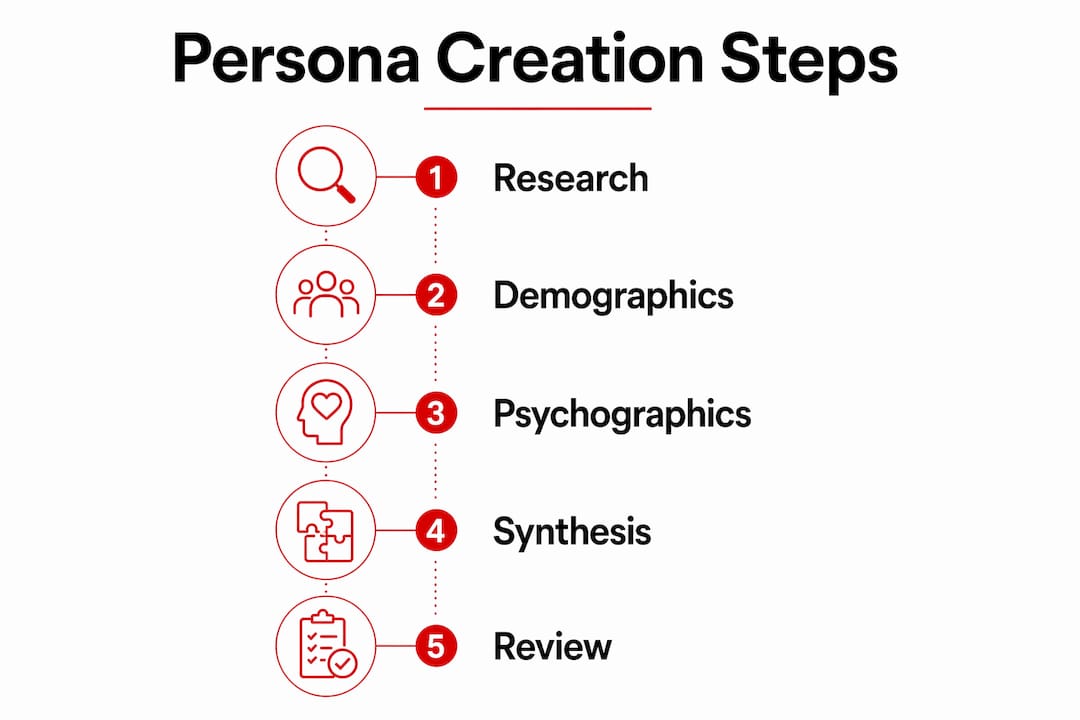
Building a persona that actually gets used requires a structured process. Skipping steps leads to profiles built on assumptions rather than evidence, and assumption-based personas produce generic marketing that converts no one.
The five phases of persona creation are data collection, pattern identification, audience segmentation, profile building, and team validation. Here is how each phase works in practice:
Collect data from real sources. Pull from CRM records, customer surveys, sales call notes, and direct interviews. Avoid relying on internal assumptions. Talk to actual customers and prospects to surface language, frustrations, and goals you would never guess from a spreadsheet.
Identify behavioral patterns. Look for recurring themes across your data: common objections, shared goals, similar buying timelines, or consistent channel preferences. Patterns, not outliers, form the foundation of a persona.
Segment your audience. Group customers by shared motivations and behaviors, not just demographics. Two customers can be the same age and industry but buy for completely different reasons. Segment by the “why,” not the “who.”
Build the profile. Give your persona a name, a job title, a daily routine, and a core frustration. Bringing personas to life with names, stories, and images helps teams relate to them as real people rather than abstract data points.
Validate across teams. Share the draft persona with sales, product, and customer success. Each team will catch gaps or inaccuracies that marketing alone would miss. Validation turns a marketing document into a company-wide asset.
Limiting active personas to 3–5 prevents what practitioners call “persona bloat.” When every edge-case customer gets their own persona, messaging becomes fragmented and teams lose focus. If two personas share the same core motivations, merge them.
Pro Tip: Treat personas as living documents and review them every 6–12 months. Markets shift, customer priorities change, and a persona built in 2023 may be misleading your team in 2026.
The terms “buyer persona” and “user persona” are often used interchangeably, but they describe different people with different priorities. Understanding the distinction sharpens both your marketing and your product strategy.
Buyer personas focus on purchase decision-makers, the people who evaluate options, control budgets, and sign off on purchases. User personas represent the people who actually use the product day to day, whose priorities center on experience, usability, and outcomes.
In B2C contexts, the buyer and the user are often the same person. In B2B, they frequently are not. A procurement manager buying project management software is the buyer. The team using it every day represents the user personas. Effective B2B marketing requires messaging that speaks to both.
| Attribute | Buyer persona | User persona |
|---|---|---|
| Primary focus | Purchase decision and ROI | Product experience and usability |
| Key questions | “Does this solve our business problem?” | “Does this fit into my daily workflow?” |
| Relevant in | B2B sales cycles, procurement | SaaS, product design, UX research |
| Motivations | Cost, risk reduction, vendor trust | Ease of use, time savings, reliability |
| Content that resonates | Case studies, ROI calculators, demos | Tutorials, onboarding guides, feature updates |
For CPG brands selling through retail and B2B ecommerce channels, this distinction matters at the channel level. The retail buyer at a regional grocery chain is a buyer persona. The end consumer picking your product off the shelf is a user persona. Both require tailored messaging.
Customer personas are strategic assets, not just marketing documents. Personas humanize data, creating a shared language that marketing, sales, and product teams can all use to make faster, more consistent decisions.
Without a shared persona framework, teams default to their own assumptions about who the customer is. Marketing writes for one audience. Sales pitches to another. Product builds for a third. The result is misaligned messaging, wasted spend, and a customer experience that feels inconsistent.
Here is where cross-team persona adoption pays off most directly:
Adobe’s guidance on internal persona adoption emphasizes that personas only deliver value when the entire organization treats them as a shared reference point. A persona that lives only in a marketing deck is not a strategic asset. It is a document.
The biggest pitfall is persona bloat combined with stale data. Teams that build 12 personas and never update them end up with a library of fictional characters that no longer reflect real customers. Keep the set small, keep it current, and tie every persona to a real data source you can revisit.
For CPG brands managing multichannel lead generation, personas also clarify which channels reach which buyer type, reducing wasted spend on audiences that will never convert.
A customer persona is only as useful as the psychographic depth behind it and the cross-team adoption that puts it to work.
| Point | Details |
|---|---|
| Definition matters | A persona is a research-based archetype built on motivations and behaviors, not just demographics. |
| Psychographics drive results | Emotional triggers like fear of failure or desire for efficiency outperform demographic data in conversion. |
| Limit to 3–5 personas | More than five active personas creates messaging fragmentation and reduces team focus. |
| Validate across teams | Sales, product, and customer success each catch gaps that marketing alone will miss. |
| Update every 6–12 months | Personas built on outdated data mislead teams and erode competitive accuracy. |
Most persona projects I have seen fail at the same point: they stop at demographics and call it done. A brand will hand me a “persona” that says “Female, 28–45, health-conscious, shops at Whole Foods.” That is a segment description. It is not a persona.
The shift that actually changes marketing output is when you get to the psychographic layer. What is she afraid of? What does she tell herself when she puts your product back on the shelf? What would make her feel confident enough to try something new? Those answers come from interviews and CRM pattern analysis, not from census data.
I have also seen what happens when personas stay in the marketing department. Sales keeps pitching on price. Product keeps building features nobody asked for. The moment a CPG brand brings its persona into a cross-functional meeting and says “this is who we are solving for, and here is what she actually cares about,” the conversation changes. Decisions get faster. Disagreements get shorter.
The other thing I push hard on is treating personas as living documents. Markets move. Consumer priorities shift. A persona you built before a supply chain disruption or a category entrant may be pointing your team in the wrong direction. Build in a review cycle. Treat it like a financial forecast, not a brand style guide.
— Reddog
Reddog works with emerging and growth-stage CPG brands in the $500K–$20M revenue range that need more than a marketing framework. We connect persona research directly to channel strategy, pricing decisions, and contribution margin analysis. Knowing your buyer persona is step one. Knowing which channel reaches that buyer at a profitable cost is where growth actually happens.
If you are a CPG founder or operator ready to connect customer insight to real retail execution, book a free 30-minute strategy call with the Reddog team. We will review your channel economics, margin structure, or growth planning together, with no obligation and no generic advice.
A customer persona is a research-based profile that represents your ideal customer, including their goals, frustrations, and buying motivations. It goes beyond demographics to explain why customers make purchasing decisions.
Most businesses should maintain 3–5 active personas. More than five creates messaging fragmentation and makes it harder for teams to stay aligned on who they are targeting.
A buyer persona represents the person who makes the purchase decision, while a user persona represents the person who uses the product. In B2B contexts, these are often different people with different priorities.
Personas should be reviewed and updated every 6–12 months. Regular validation keeps them accurate as market conditions, customer priorities, and competitive dynamics change.
A good persona combines demographic data with psychographic depth, including specific pain points, emotional triggers, and behavioral patterns. It is built from real customer interviews and CRM data, not internal assumptions.
Leave a comment: