
Published: March 2020 | Last Updated:February 2026
© Copyright 2026, Reddog Consulting Group.

Maintaining healthy profit margins as a CPG brand selling online is tougher than it looks. Each marketplace comes with its own set of rules, costs, and challenges that can quickly eat away at the money you make. Without the right strategies, you miss out on sales, lose control over pricing, and watch your margins disappear.
The good news is that there are actionable ways to protect your profits and grow your business. By fine-tuning your listings, analyzing data, and managing costs smarter, you put yourself in a much stronger position to succeed. These steps are built around proven methods that leading brands use to maximize long-term profitability.
Get ready to discover practical insights that can help you transform your approach—so you can turn every channel into a reliable source of profit, not a drain on your resources.
| Key Insight | Explanation |
|---|---|
| 1. Customize Listings for Each Marketplace | Tailor product titles, descriptions, and images for Amazon, Walmart, and Google Shopping to improve visibility and conversions. |
| 2. Leverage Data for Pricing Decisions | Analyze sales patterns and competitor pricing to optimize prices and protect your margins effectively. |
| 3. Improve Inventory Flow to Maximize Sales | Ensure product availability across channels to enhance sales velocity and minimize markdown risks. |
| 4. Design Promotions to Protect Margins | Craft targeted promotions that drive incremental sales without eroding your contribution margin. |
| 5. Reduce Hidden Costs to Improve Profitability | Audit and manage hidden costs across channels to uncover and mitigate major profit drains. |
Every marketplace operates differently. Amazon shoppers behave differently than Walmart customers, and both differ from Google Shopping buyers. Your product listing must speak to each audience in their language.
When you optimize product listings across channels, you’re not simply copying and pasting the same content everywhere. You’re customizing titles, descriptions, images, prices, and promotional offers to match how customers actually search and shop on each platform. Customizing product details for each marketplace directly impacts visibility and conversion rates.
Each marketplace has its own algorithm, search behavior, and consumer expectations. Amazon prioritizes keyword density and A9 search logic. Walmart rewards competitive pricing and fulfillment speed. Google Shopping focuses on product data accuracy and image quality. Miss these nuances, and your listings underperform.
For a CPG brand managing $500K to $20M in revenue, this isn’t theoretical. Poor listings kill your contribution margin. You’re paying for traffic that doesn’t convert, or worse, you’re not getting traffic at all.
Marketplace-specific optimization isn’t optional—it’s the difference between a listing that sells and one that sits invisible in search results.
Start by understanding what each platform rewards:
Conduct keyword research specifically for each platform. The terms shoppers use on Amazon differ from Walmart searches. Tools like Helium 10 or Jungle Scout work for Amazon, while Walmart’s marketplace analytics reveal search trends on their platform.
Images matter differently across channels. Amazon allows 9 images; use all of them with lifestyle shots, close-ups, and comparison visuals. Walmart’s mobile-first audience needs clean, scannable images. Google Shopping requires consistent, high-quality product photos.
Price positioning shifts by channel. You may position premium on DTC, competitive on Amazon, and value-driven on Walmart. Your pricing strategy directly affects margin and inventory velocity across channels.
Pro tip: Use marketplace data and analytics to continuously refine your listings; CPG brands that monitor performance metrics monthly see 20-40% higher conversion rates than those making annual adjustments.
Guessing at pricing is expensive. Most CPG brands leave money on the table because they don’t leverage the data sitting right in front of them. Real pricing power comes from understanding what your data actually tells you.
Data-driven pricing means analyzing sales patterns, competitor pricing, consumer price sensitivity, and promotion effectiveness across your channels. When you understand these patterns, you stop making pricing decisions based on gut feel and start making them based on contribution margin reality.
Your margin erosion isn’t random. It comes from specific places—promotions that don’t drive incremental volume, prices that don’t match channel economics, or inventory sitting too long and requiring clearance. Advanced analytics reveals exactly where margin leaks happen by showing you the relationship between price, volume, and actual profitability.
Consider this: a 5 percent price increase on a product with 40 percent margins increases profit by over 12 percent (assuming volume holds steady). But if you don’t have data showing customer price sensitivity, you might drop price instead, destroying margin.
Data reveals that most CPG brands underprice by 10-15 percent on their own direct channels while overinvesting in unprofitable promotions on marketplaces.
Start by collecting the right metrics from each channel:
Use this data to conduct what CPG analysts call trade promotion optimization. This means testing price adjustments in small segments first, measuring the impact on volume and margin, then scaling what works.
For example, if you run a promotion that discounts 30 percent to drive 20 percent volume lift, your contribution margin actually declines. But if a smaller 10 percent discount drives 15 percent volume lift, you’ve found a better promotional threshold.
Dynamic pricing tools let you adjust prices across channels based on real-time demand and inventory levels. If you’re sitting on excess inventory in a warehouse, lower your DTC price slightly to move it. If Amazon inventory is turning slowly, test a modest price reduction before resorting to deep discounting.
Pro tip: Review your pricing and promotion data monthly, not annually—brands that adjust pricing quarterly based on actual channel economics see 15-25 percent margin improvement within six months.
Stockouts kill sales. When your product isn’t available, customers buy from competitors, and you lose not just that transaction but also the margin you needed. Availability is a silent profit killer most brands don’t track closely enough.
Product availability goes beyond just having stock. It means having the right inventory in the right place at the right time across Amazon, Walmart, your own website, and wholesale partners. When inventory flows smoothly across channels, you maximize sales velocity and minimize markdown risk.
When you don’t have visibility into demand patterns across channels, you make inventory decisions in the dark. You might overstock one channel while understocking another, tying up cash in dead inventory while missing sales elsewhere.
Improve inventory flow by integrating demand data from all your sales channels. Real-time inventory visibility across multiple channels prevents stockouts and allows you to rebalance stock based on actual shopper behavior, not forecasts from three months ago.
Demand sensing uses point-of-sale data, promotional calendars, and real-time sales trends to predict what customers will buy next. When you know demand is increasing, you can order stock before you run out.
CPG brands with integrated inventory systems see 30-40 percent fewer stockouts and 15-25 percent faster inventory turnover than those managing channels separately.
Start with these actionable steps:
For a brand managing $500K to $20M in revenue, even small inventory improvements compound quickly. A 10 percent reduction in excess inventory frees up cash for growth. A 5 percent improvement in fill rate (availability) directly increases top-line sales.
Prioritize your fastest-turning SKUs first. If you sell 500 units per month on Amazon and it takes two weeks to replenish, you need 250 units of safety stock minimum. But if you reduce lead time to one week, you only need 125 units, freeing up thousands in working capital.
Pro tip: Audit your inventory levels monthly and calculate how much cash is tied up in slow-moving SKUs—redirect that capital to products turning 8-12 times annually instead of 2-3 times.
Promotions feel like a quick sales boost, but most CPG brands run them wrong. You discount heavily, volume spikes temporarily, then margins collapse. The problem isn’t promotions themselves—it’s running them without understanding your actual customer response.
The right promotions drive incremental volume while protecting your contribution margin. Wrong promotions just steal from future sales at lower prices. Understanding promo sensitivity by customer segment reveals which discounts actually work and which ones just destroy profit.
When you discount 30 percent across all channels to all customers, you’re subsidizing buyers who would have paid full price anyway. These customers were going to buy your product regardless. You’ve just given them free money.
Segmentation changes everything. Price-sensitive customers respond to discounts. Premium buyers ignore discounts and buy based on brand, quality, or convenience. When you know which segment you’re targeting, you can design promotions that move incrementally without destroying margin.
A 20 percent discount that drives 15 percent volume increase destroys margin. A 10 percent discount that drives 25 percent volume increase protects it. The math matters more than the discount depth.
Start by analyzing your customer data:
For example, if your regular buyer converts at 3 percent and a 15 percent discount bumps conversion to 4 percent, that’s incremental. But if your price-sensitive segment converts at 6 percent regularly and a 15 percent discount only moves it to 7 percent, the discount isn’t working hard enough.
Channel economics matter too. Amazon takes 15 percent commission plus FBA fees. Walmart charges fulfillment costs. Your DTC channel has zero marketplace fees. A 10 percent promotion on DTC might still protect margin, but the same promotion on Amazon destroys it because of the fee structure.
Run promotions against specific inventory problems, not as default tactics. If you’re holding 60 days of inventory on a slow-moving SKU, a targeted promotion makes sense. If inventory is turning normally, save your margin.
Pro tip: Track the contribution margin per promotional dollar spent, not just sales lift—brands that measure this metric typically discover 40-50 percent of their promotions actually destroy profitability.
Your profit statement shows revenue and obvious costs, but the hidden costs are what actually kill your margins. Amazon fees, 3PL storage, advertising spend, and inefficient logistics don’t feel like margin leaks until you calculate them together.
Hidden costs hide because they’re spread across departments. Marketing owns advertising spend. Operations owns fulfillment fees. Finance owns inventory carrying costs. Nobody owns the total picture. When you measure each channel’s actual contribution margin, you discover which costs are eating your profit.
Every ecommerce channel has a cost structure that traditional accounting misses. Amazon takes commission plus fulfillment fees plus advertising spend. Walmart charges fulfillment costs plus data fees plus promotional allowances. Your DTC site has payment processing fees, email marketing software, and customer acquisition cost.
When you add these together, channel profitability often reverses. The channel generating highest revenue might generate lowest profit. Understanding the true cost of each marketing channel prevents you from scaling unprofitable business.
Most CPG brands discover that one channel generates 40 percent of revenue but only 15 percent of profit because hidden costs are silently compressing margins.
Start by auditing these specific cost categories:
For a brand doing $500K to $20M in revenue, these costs often add 30-50 percent to your true cost of goods sold. A product with 45 percent gross margin might have only 20 percent contribution margin after hidden costs.
Calculate contribution margin by channel monthly. Start with revenue, subtract cost of goods sold, subtract all channel-specific costs, and you get contribution margin. This is your real profit number. Most brands find that optimizing these hidden costs improves bottom-line profit by 15-25 percent without changing revenue at all.
Prioritize reducing the highest-impact hidden costs first. If Amazon advertising is 8 percent of Amazon sales, reducing ACOS by 20 percent improves margin dramatically. If 3PL storage is 12 percent of cost, improving inventory turns saves real money.
Pro tip: Build a monthly contribution margin P&L by channel showing revenue, COGS, and all channel-specific costs—brands using this metric catch hidden cost leaks six months faster than those using standard accounting.
Expansion feels exciting until your cash runs dry. Most CPG brands overextend into new channels without understanding the working capital requirements. You need inventory upfront, but payment comes 30, 60, or 90 days later. That gap kills companies.
Retail expansion requires a different financial model than ecommerce. Ecommerce lets you test with small inventory commitments. Retail requires committed shelf space, which means committed inventory investment. When you expand without aligning growth with cash flow reality, you become cash poor at the moment you need capital most.
A brand growing from $2M to $5M in revenue looks successful on paper. But if that growth requires $800K in additional working capital and you only have $200K available, you’re in trouble. Revenue growth that destroys cash flow is actually destroying your business.
Retail expansion has specific cash demands that ecommerce doesn’t. You need initial inventory to fill shelves. Retailers often pay net-30 or net-60, meaning 30 to 60 days after delivery. Your suppliers want payment upfront or net-15. That creates a cash flow gap you must fund with working capital.
A retailer buying $100K of inventory at net-60 terms means you fund that inventory for two months before seeing cash, while your supplier may demand payment in 15 days.
Start by understanding your current ecommerce profitability and cash cycle:
Disciplined retail expansion requires careful financial planning that protects your liquidity while building sustainable growth.
Consider this scenario: a brand does $3M annual DTC revenue with 35 percent contribution margin. They want to add Walmart distribution generating projected $2M revenue. But Walmart requires 90 days of initial inventory investment plus 60-day payment terms. That’s roughly $300K tied up in working capital for four months before positive cash flow kicks in.
Most brands underestimate this requirement. They project revenue without modeling the working capital gap. When cash gets tight, they cut corners on inventory or miss replenishment windows, which kills their retail relationship.
Solve this by forecasting your monthly cash position across all channels 12 months ahead. Include inventory requirements, payables, and receivables. Identify the months where cash dips below minimum operational needs. Either adjust your expansion timeline or secure additional financing before you need it.
Pro tip: Build a 12-month rolling cash flow forecast before expanding to any new channel—brands that do this catch funding gaps three months early instead of discovering them in crisis mode.
Below is a comprehensive table summarizing the article’s strategies and methodologies for optimizing e-commerce operations and improving financial outcomes.
| Section | Guidelines | Key Benefits |
|---|---|---|
| Optimize Product Listings for Each Marketplace | Tailor content such as titles, descriptions, and images to match specific platform behaviors. | Increased visibility and conversion rates. |
| Use Data to Improve Pricing and Margins | Analyze sale patterns and competitor pricing to refine pricing strategy. | Enhanced profitability and minimized margin erosion. |
| Enhance Product Availability and Inventory Flow | Integrate demand data across channels to align stock levels with demand. | Reduced stockouts, lower holding costs, and improved cash utilization. |
| Leverage Promotions Without Eroding Margins | Create customer-segmented promotions and monitor their impact on margin. | Maximized revenue without undermining profitability. |
| Reduce Hidden Costs Across Channels | Audit channel-specific costs including fees, logistics, and marketing. | Identified cost-reduction opportunities, leading to improved margins. |
| Align Retail Expansion With Cash Flow Goals | Forecast inventory costs and payment cycles for expansion projects. | Sustainable growth aligned with financial capacity. |
Scaling your CPG brand across Amazon, Walmart, DTC, and retail channels comes with complex challenges like optimizing contribution margin, managing inventory flow, and navigating hidden fees. If you are struggling with margin compression, pricing strategy, or cash flow timing as outlined in the article “6 Ways to Increase Ecommerce Sales for CPG Brands,” you are not alone. Many brands leave money on the table because they lack visibility into each channel’s true profitability and operational nuances.
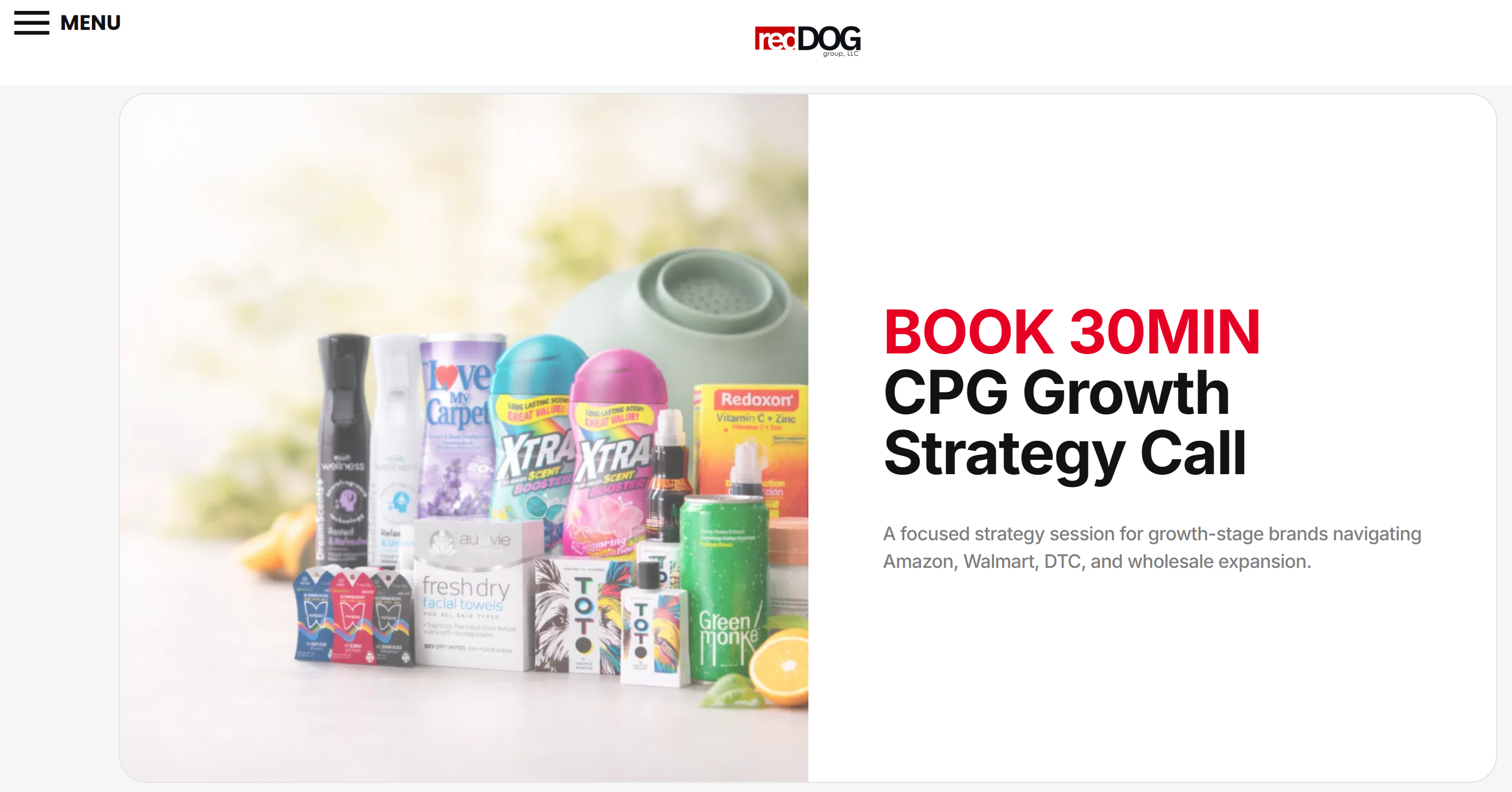
RedDog Group specializes in helping emerging and growth-stage CPG brands decode marketplace economics and build scalable retail expansion plans that protect margins while growing revenue. Our Houston-based consultancy combines deep knowledge of Amazon FBA fees, Walmart WFS margins, and the full retail supply chain to deliver measurable improvements in conversion rates, inventory velocity, and cash flow. Learn how to stop margin leaks and unlock profitable growth strategies designed specifically for brands in the $500K to $20M revenue range by visiting our consulting offer. Do not wait until hidden costs erode your profits. Take control now and partner with experts who understand the real retail complexity your brand faces.
To optimize product listings, customize titles, descriptions, images, prices, and promotional offers to match the search behavior of customers on each platform. Start by conducting keyword research specific to each marketplace to increase visibility and conversion rates.
Analyze sales velocity, competitor pricing, and promotion effectiveness for each channel to derive insights on price sensitivity. Implement trade promotion optimization tests to find the right balance that drives volume without sacrificing margins.
To enhance product availability, integrate demand data from all sales channels to ensure you have the right inventory levels at the right time. Set reorder triggers based on sales velocity and monitor inventory turnover rates weekly for better stock management.
Use targeted promotions that cater to specific customer segments to drive incremental sales while protecting your contribution margin. Test lower discount levels initially, measuring the impact on volume and margins to find the most effective promotion strategy.
Hidden costs can include marketplace commissions, fulfillment, advertising spend, and inventory carrying costs. Audit these categories monthly to uncover any profit-eating inefficiencies, enabling you to adjust your strategy for improved margins.
Plan retail expansion by calculating your cash conversion cycle to ensure you have enough working capital for initial inventory investments. Model your monthly cash needs 12 months in advance to identify potential cash flow gaps before they impact your operations.
Leave a comment: