
Published: March 2020 | Last Updated:March 2026
© Copyright 2026, Reddog Consulting Group.

Your brand can spend six figures on professional photography, polished ad copy, and studio-produced video, and still lose the sale to a competitor whose product page is packed with real customer photos and unfiltered reviews. That is not a creative failure. It is a distribution-of-trust problem. UGC can lift conversion rates by 25-40%, and 91% of shoppers now seek out user-generated content before they buy. For CPG ecommerce managers and brand owners, understanding how to build a systematic UGC engine is no longer optional. It is the difference between a product listing that converts and one that just exists.
| Point | Details |
|---|---|
| UGC boosts sales and trust | User-generated content can raise ecommerce conversions by up to 40% and strongly increases shopper trust. |
| Automate your UGC flywheel | Automated triggers, smart incentives, and multichannel distribution make managing UGC easier and more scalable. |
| Prioritize authenticity and compliance | Focus on verified, raw UGC and use strong permissions and AI moderation to protect your brand and reputation. |
| Tailor UGC to your audience | Different CPG segments respond best to specific formats like detailed reviews or in-store photo posts. |
User-generated content (UGC) is any content created by real customers rather than the brand itself. That includes written reviews, star ratings, customer photos, unboxing videos, social media posts, and Q&A threads on product pages. The key word is real. Shoppers in 2026 are sophisticated enough to spot a staged lifestyle photo from a mile away, and they discount it accordingly.
What makes UGC so powerful is the psychology behind peer validation. When a shopper sees someone who looks like them using a product and sharing an honest opinion, the cognitive barrier to purchase drops significantly. This is not a soft, feel-good metric. 82% of shoppers say UGC improves their brand perception, and 79% say it directly influences their purchasing decisions.
Here is what high-performing UGC looks like in practice:
“The most persuasive voice in your marketing mix is not yours. It belongs to the customer who already bought, used, and loved your product.”
Traditional brand voice content struggles because it is inherently self-serving. Even the most well-crafted copy carries an implicit bias that shoppers recognize. Peer-driven stories carry no such baggage. If you want to increase ecommerce sales for CPG brands, building a UGC foundation is one of the highest-leverage moves available. Pair that with a structured ecommerce growth workflow and you create a compounding trust asset that paid media simply cannot replicate.
Applying ecommerce merchandising best practices alongside UGC integration ensures that authentic content is placed where it actually influences the buying decision, not buried at the bottom of a product page.
The performance data behind UGC is hard to ignore. Brands that integrate UGC into their product detail pages and checkout flows see conversion increases of 25-40% and revenue per session uplifts of 5-6%. Those are not marginal gains. For a brand doing $2M in annual ecommerce revenue, a 5% revenue-per-session lift translates to $100,000 in incremental top-line without adding a single new visitor.

| Metric | Without UGC | With UGC |
|---|---|---|
| Conversion rate lift | Baseline | +25% to +40% |
| Revenue per session | Baseline | +5% to +6% |
| Customer acquisition cost | Baseline | Up to -50% |
| Content production cost | High | 50-75% lower |
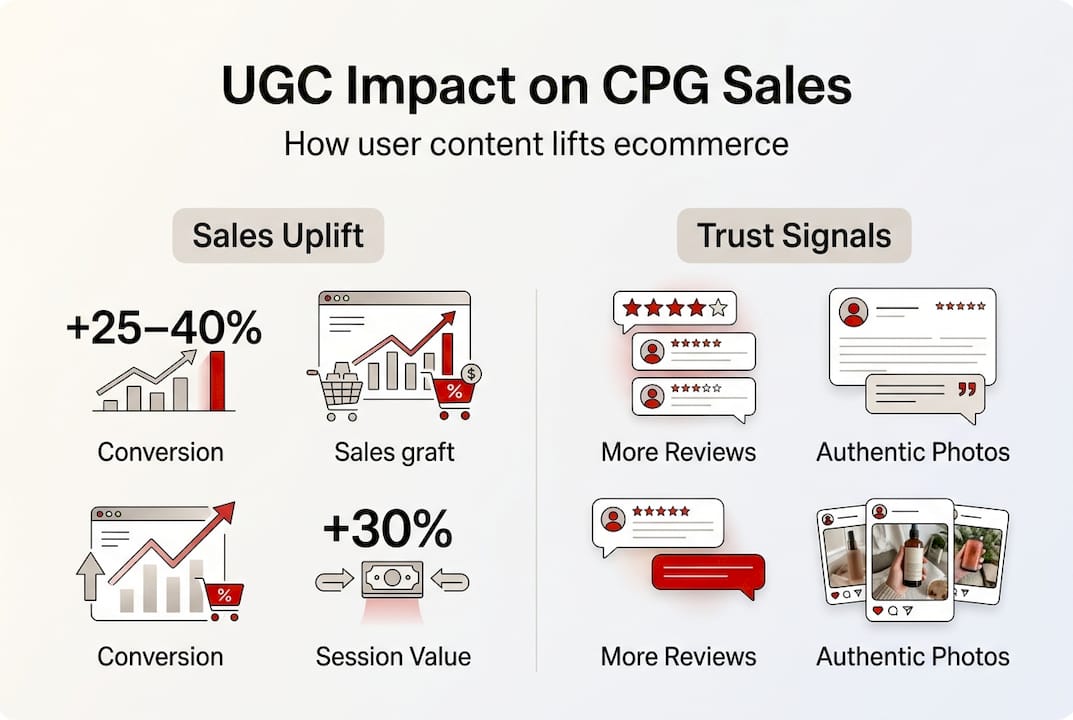
The cost angle is where CPG brands often miss the full picture. UGC costs 50-75% less to generate than professional content and can reduce customer acquisition cost (CAC) by up to 50%. When you factor in the margin pressure that most CPG brands face across Amazon FBA fees, Walmart WFS compression, and 3PL storage costs, a content strategy that performs better and costs less is a genuine competitive advantage.
Stat to remember: Brands using UGC in paid social ads report 4x higher click-through rates compared to brand-produced creative. That means your ad budget goes further when the creative comes from your customers.
To increase ecommerce conversion rate sustainably, UGC needs to be treated as a performance asset, not a nice-to-have. Use the ecommerce growth checklist for CPG brands to audit where UGC is currently missing from your funnel and prioritize the highest-traffic pages first. Review the UGC performance case studies to benchmark your category against real-world results.
Building a sustainable UGC program requires a repeatable system. A 4-step flywheel covers the full cycle: activation, collection, rights management, and distribution. Each step feeds the next, and the whole system compounds over time.
| Approach | Scalability | Cost | Quality control |
|---|---|---|---|
| Manual UGC collection | Low | High (labor) | High |
| Automated UGC platform | High | Medium (SaaS) | Medium to high |
| Hybrid (AI + human review) | Very high | Optimized | Highest |
Pro Tip: Automate your post-purchase SMS sequence to request a photo review with a loyalty point reward attached. Pair that with AI moderation to filter spam and off-brand content before it ever reaches your team. This setup can generate hundreds of verified reviews per month with minimal manual effort.
Top CPG brands layer verified UGC directly onto product detail pages above the fold, not in a tab that requires a click. Visibility drives engagement. To optimize your ecommerce site for UGC impact, treat customer content as a primary design element, not an afterthought. As you scale ecommerce for omnichannel success, the same UGC assets can feed your wholesale sell-in decks and retail partner co-op programs.
Not all UGC is created equal. The formats that consistently drive the most trust and conversion in CPG ecommerce follow a clear hierarchy.
Pro Tip: Raw, unpolished UGC consistently outperforms studio content for purchase intent. Resist the urge to over-curate. A real customer’s imperfect video is worth more than a perfect brand asset in most CPG categories.
New CPG brands often make the mistake of incentivizing volume over quality, which floods their review section with one-sentence submissions that do nothing for conversion. Use sales optimization tactics for ecommerce to structure your incentive program around content quality metrics, not just submission counts. Also watch for fake reviews, which platforms are increasingly penalizing in 2026 with algorithmic suppression.
Scaling a UGC program without a compliance framework is a liability. The risks are real and the consequences range from brand damage to legal exposure.
“Transparency in how you handle criticism is more persuasive than a wall of five-star reviews. Shoppers trust brands that engage honestly with imperfect feedback.”
For ecommerce SEO quick wins, UGC also contributes fresh, keyword-rich content to your product pages organically, which search engines reward. Review the managing UGC copyright issues framework before you scale any paid amplification of customer content.
Most CPG brands we work with at RedDog Group have the raw material for a strong UGC program. They have real customers, real purchase data, and real product experiences worth sharing. What they often lack is the structured system to activate, collect, and distribute that content in a way that actually moves margin-positive revenue.
We help growth-stage CPG brands build ecommerce strategies that treat UGC as a performance channel, not a marketing checkbox. From contribution-margin analysis across Amazon, Walmart, and DTC to operational frameworks that scale without bloating your cost structure, our work is built around what actually drives profitable growth. If your brand is in the $500K to $20M revenue range and you are ready to turn customer voices into a compounding sales asset, explore what RedDog Group offers and let’s build something that performs.
Post-purchase SMS and email sequences are the highest-converting collection triggers, followed by branded hashtag campaigns on TikTok and Instagram. Activation via post-purchase incentives and hashtags consistently drives the strongest UGC volume and quality for CPG brands.
Use verified purchaser badges, combine AI and human moderation, and always collect explicit rights from contributors before repurposing their content. Explicit permission and moderation are the two non-negotiables for any brand scaling a UGC program responsibly.
Handled transparently, negative UGC actually builds trust rather than eroding it. Shoppers who see a brand respond professionally to criticism are more likely to buy than those who see only perfect reviews. Negative UGC handled transparently is a proven trust signal.
For conversion rate impact, UGC consistently outperforms paid ads. Paid ads are faster for building initial awareness, but UGC outperforms paid ads when the goal is moving a warm shopper from consideration to purchase.
UGC is 50-75% less expensive than professionally produced content and typically delivers 2-3x better performance on conversion metrics, making it one of the highest-ROI content investments available to CPG brands.
Leave a comment: