
Published: March 2020 | Last Updated:August 2026
© Copyright 2026, Reddog Consulting Group.

The channel groups that matter for most CPG brands break into five buckets: direct owned channels (your website, your app), marketplaces (Amazon, Walmart Marketplace), retail and wholesale (grocery, distributors, big-box), field and direct-store-delivery routes, and digital/social/partner channels (social commerce, affiliates, resellers). The fastest way to pick your mix isn’t to test all five. It’s to run a three-part filter: which channel protects your margin, which one already shows proof of repeat purchase, and which one reaches customers who aren’t finding you anywhere else.
That’s the whole decision, distilled. Everything past this point is about execution, because picking the wrong channel mix is one of the most common ways CPG brands burn cash before they ever find product-market fit. We’ve watched brands chase marketplace visibility while their DTC contribution margin was quietly bleeding out from unmeasured return costs.
Before testing anything, run your shortlist through this filter:
Choosing the right sales channel mix comes down to modeling contribution margin per channel first, then proving repeat purchase before adding operational complexity.
| Point | Details |
|---|---|
| Margin comes first | Model contribution margin, including fees and returns, before testing any new channel. |
| Prove repeat on owned channels | Establish repeat purchase behavior on DTC before expanding into retail or marketplaces. |
| Pilot with defined KPIs | Test channels for 4 to 8 weeks tracking CAC, contribution margin, and repeat rate. |
| Add retail only when cash allows | Bring in trade spend-heavy channels once working capital can absorb the payment cycle. |
| Get a margin-first review | Reddog helps CPG brands from $500K to $20M model channel-level contribution margin before scaling. |
A sales channel is any path a product takes from your business to a paying customer, whether that’s your own website, a distributor’s truck, or a marketplace listing. The most useful split for planning purposes is direct versus indirect. Direct channels put you in control of the transaction and the customer relationship. Indirect channels hand that relationship, and often the pricing, to a partner in exchange for reach you couldn’t build alone.
From there, three practical groupings cover almost every CPG sales path:
Owned channels are your DTC website, your branded app, and any storefront you fully control. You set pricing, own the customer data, and keep every dollar of margin the channel structure allows.
Partner channels include distributors, wholesalers, and modern trade accounts like regional grocery chains. You trade margin and pricing control for shelf space and logistics you couldn’t build yourself.
Marketplace channels are third-party platforms like Amazon and Walmart Marketplace, where you get instant access to a massive, already-shopping audience in exchange for referral fees, fulfillment costs, and someone else owning the search experience.
BeatRoute’s route-to-market guide identifies six distinct distribution architectures, from direct sales to van-based DSD models, and notes that most brands ultimately run three or four of these in parallel rather than betting on one. That’s worth sitting with: the winning move usually isn’t picking a channel, it’s picking a combination sized to your product’s outlet segments.
Here’s a working taxonomy you can use as a checklist. Each entry includes who typically owns the customer relationship and a rough sense of how fast you’ll see first revenue.
Indeed’s rundown of common sales channels covers a similarly broad list and is worth a scan if you want a quick second reference point for terminology.
Run every candidate channel through five filters before committing budget: product fit, margin behavior, where your customer already discovers products like yours, your operational capacity to service the channel, and the cash flow impact of that channel’s payment terms.
Here’s a practical framework for turning those five filters into a decision:
Before piloting a new channel, get answers to these questions in writing:
Pro Tip: Map your channel ramp costs before you commit. DTC channels ramp slowly as customer acquisition cost climbs; retail typically requires slotting fees and trade terms paid upfront; Amazon layers referral fees on top of ad spend from day one. Each has a different cash-flow shape, not just a different margin number.
A workable prioritization rule: prove repeat purchase on your owned channel first, because that’s the cleanest signal you have real product-market fit. Defend branded search on marketplaces once competitors start bidding on your name. Only add retail once cash flow can absorb trade spend without starving your working capital.

Multichannel means running several separate sales paths that don’t necessarily talk to each other, as explained in this multichannel marketing strategy guide. Omnichannel means unifying those paths into one connected customer journey, where a shopper can discover on social, research on your site, and buy in-store without friction. Multichannel is usually the right starting point for young brands. Omnichannel becomes worth the operational investment once you have enough channel volume to justify the integration cost.
An HBR study of 46,000 shoppers found that customers who interact with a brand across multiple channels spend more and show meaningfully higher lifetime value than single-channel buyers. That’s a strong argument for building toward omnichannel once your channel mix stabilizes, but it doesn’t mean you should force integration before you have proof that each individual channel works on its own.
| Channel category | Best for | Customer reach | Control over branding & pricing | Margin / cost-to-serve | Ops complexity | Time to first revenue |
|---|---|---|---|---|---|---|
| Owned DTC | Brands needing customer data | Narrow, self-built | Full | High, but you fund all CAC | Low to moderate | Slow ramp |
| Marketplace (Amazon/Walmart) | Products with existing search demand | Very wide | Low | Compressed by fees + ads | Moderate | Fast |
| Wholesale/distributor | Brands scaling shelf presence | Wide, geography-driven | Low | Moderate, thin per unit | High | Moderate, 60 to 90 day payment cycle |
| Social/live commerce | Visual, impulse-friendly products | Wide, platform-dependent | Moderate | Variable, algorithm-sensitive | Moderate | Fast but inconsistent |
Testing a new channel doesn’t need to be complicated, but it does need structure:
Pro Tip: Watch for channel conflict before it becomes a pricing war. If your DTC price undercuts your wholesale account’s shelf price, that account will notice fast. And when you calculate CAC, use blended CAC across all channels, not channel-isolated numbers, because a customer who discovers you on social and buys on Amazon still cost you a social dollar.
Contribution margin by channel is what’s left after you subtract every channel-specific cost, not just COGS, from revenue. That means mapping referral fees, fulfillment costs, returns, trade spend, and fully-loaded customer acquisition cost to each channel’s own P&L line, because the same SKU can look profitable in one channel and barely break even in another.
An industry channel-margin analysis illustrates this with a single CPG SKU carrying 32% COGS. Same product, same cost of goods, three very different profit outcomes depending on channel.
Here’s the checklist we walk clients through before they commit budget to a new channel:
Endless Commerce’s contribution-margin framework offers a useful set of benchmarks for building these calculations if you’re modeling this for the first time.
Pro Tip: Slotting fees and trade spend rarely belong entirely to the order that triggered them. Amortize a $15,000 slotting fee across the projected 12-month volume for that account, not the first shipment, or your first-order margin will look artificially disastrous.
Pro Tip: “CAC” without the word “fully-loaded” in front of it usually understates the real number. Include everything: ad spend, agency retainers, creative costs, and the portion of your team’s time spent managing that specific channel.
If you want a deeper operational breakdown of running these calculations across a live multichannel setup, our guide to multichannel retailing success walks through the governance side of managing this without letting channels cannibalize each other.
Track these KPIs through every pilot phase:
For a deeper look at building the reporting behind these numbers, our post on analyzing sales data for multichannel growth covers which dashboards actually matter versus which ones just look busy.
The mistake we see most often isn’t picking the wrong channel. It’s picking the right channel at the wrong time, before the brand has proven its unit economics anywhere. Founders get excited about marketplace visibility or a big-box retail meeting and skip the step of proving repeat purchase on a channel they can actually control and measure cleanly.

The pattern that works looks different: prove out contribution margin and repeat rate on an owned channel first, then use that proof, real numbers, not projections, to negotiate better terms with distributors and retail buyers. Brands that scale DTC first and use that data to walk into wholesale and retail conversations tend to negotiate from strength instead of hope. They know their real CAC, their real return rate, and their real margin before someone else’s fee structure gets layered on top.
Governance matters here too. Once you’re running three or four channels, someone needs to own pricing consistency and channel conflict resolution, or your best wholesale account will find your DTC site underselling them within a quarter.
If you’re running a CPG brand generating revenue across Amazon, Walmart, DTC, wholesale, or a mix of these, the question isn’t whether you have enough channels. It’s whether each one is actually contributing margin once every fee, return, and trade dollar is accounted for. That’s the exact gap Reddog exists to close for growth-stage brands.
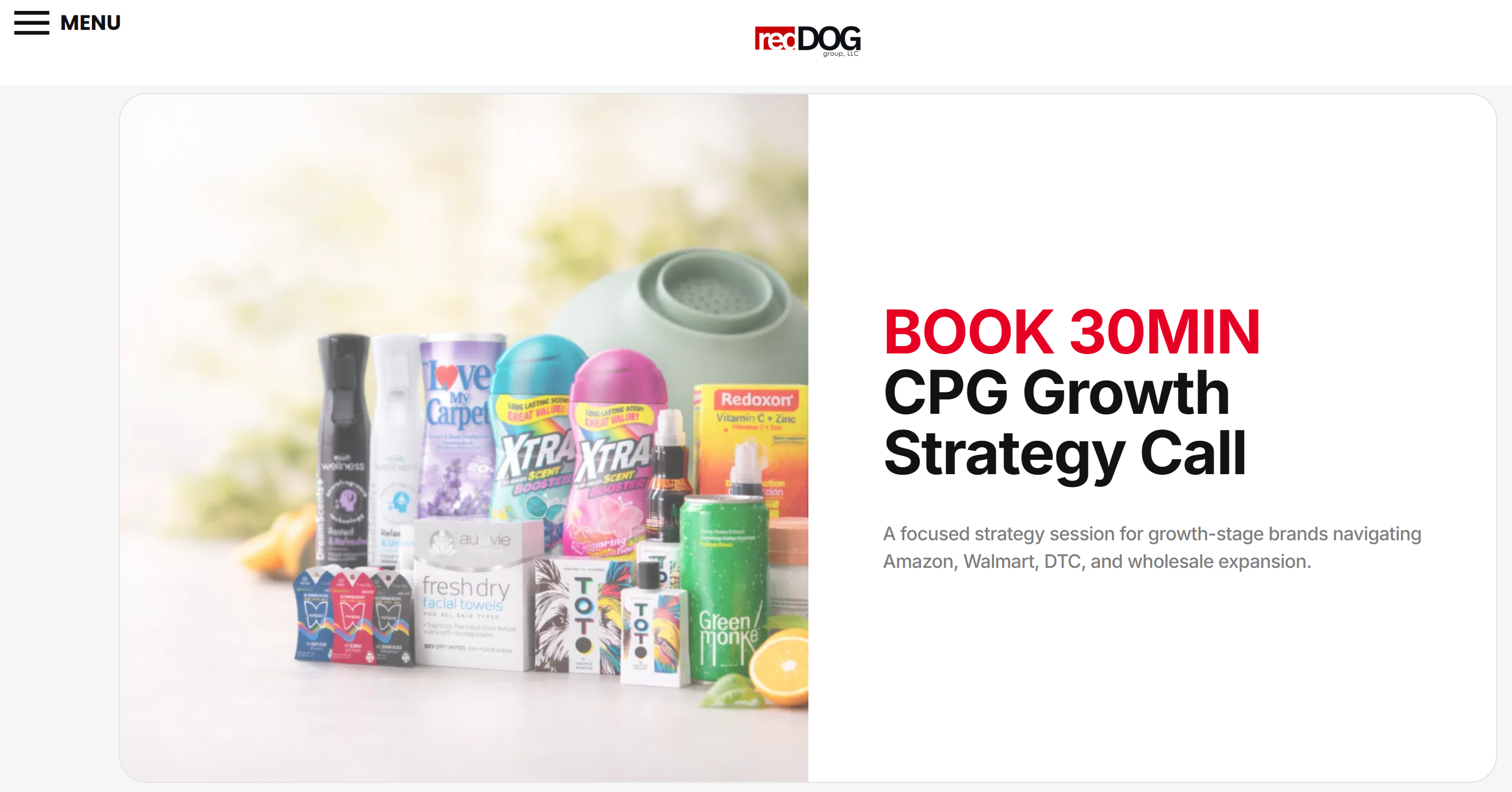
We work with CPG founders and operators generating between $500,000 and $20 million in revenue who are ready to make channel decisions based on real contribution-margin data instead of gut instinct. If that sounds like where you are, a free 30-minute strategy call is the right next step. We’ll walk through your current channel mix, look at where margin is leaking, and talk through inventory velocity and growth planning for whichever channel makes sense to prioritize next.
You’re a fit for this call if:
Book your free strategy call and come with your current channel breakdown handy. We’ll do the rest.
Leave a comment: