
Published: March 2020 | Last Updated:August 2026
© Copyright 2026, Reddog Consulting Group.

There are four types of fulfillment models: in-house (self-fulfillment), third-party logistics (3PL/outsourced), dropshipping, and hybrid. If control over packaging and quality matters most, in-house wins. If you need geographic reach and scale without building warehouses, 3PL is your model. If capital is tight and you’re testing new SKUs, dropshipping gets you there fastest. If your channel mix is complex, a hybrid approach usually beats forcing everything through one system.
We work with CPG brands every day who treat this as a permanent identity decision when it’s really a stage-based operational choice. The model that made sense at $800,000 in revenue often breaks at $4 million, and the most common fulfillment categories each carry distinct cost structures, control trade-offs, and growth ceilings.
Here’s the quick map:
Read on for the full operational breakdown of each model, then use the decision checklist near the end to figure out which one your brand actually needs right now.
The right fulfillment model depends on order volume, SKU complexity, and channel mix, and the choice should shift as a brand moves from early stage to regional to national scale.
| Point | Details |
|---|---|
| Four core models exist | In-house, 3PL/outsourced, dropshipping, and hybrid each fit different volume and control needs. |
| Returns cost more than expected | Reverse logistics is a major, often underestimated cost driver across every fulfillment model. |
| Use TCF to compare options | A Total Cost of Fulfillment model captures fixed and variable costs that a simple rate card hides. |
| CM3 reveals real channel profit | Calculating contribution margin by channel often exposes fulfillment costs misallocated to the wrong channel. |
| RedDog reviews the numbers with you | RedDog Group offers a free call to walk through contribution margin, TCF, and inventory velocity. |
A fulfillment model is the operational system a brand uses to get an order from “placed” to “delivered,” and every model, regardless of who runs it, has to manage the same sequence of steps. Understanding this baseline matters because it’s how you’ll compare cost and risk across in-house, 3PL, dropshipping, and hybrid setups later in this guide.
Most fulfillment operations run through five to seven distinct stages, depending on how granular you get:
Pro Tip: *Run a “reverse fulfillment audit” once a quarter. Track your average cost per returned unit, not just your return rate.
Running fulfillment in-house means you own the entire chain: warehouse space, staff, a warehouse management system (WMS), carrier contracts, and your own returns desk. Nothing gets outsourced, which means nothing gets diluted, but it also means every fixed cost sits on your balance sheet whether volume is high or low that month.
The cost profile is dominated by fixed overhead. Rent, staff wages, racking, forklifts, and software licensing don’t flex down in a slow month the way a 3PL’s variable per-order fee does. That’s the core trade-off: in-house fulfillment rewards volume predictability and punishes volatility.
Advantages:
Disadvantages:
In-house tends to work best for low-volume boutique brands, or brands with SKUs that demand meticulous QC (fragile, perishable, or configurable products) where a hands-off model introduces unacceptable risk. As order volume climbs into the low thousands per month, the math often flips: the labor and space costs that once felt manageable start eating into contribution margin faster than a comparable 3PL fee schedule would.
Watch for three warning signs that it’s time to reconsider: seasonal peaks you can’t staff for without overtime, a rising error rate that’s starting to show up in customer complaints, or an expansion plan that’s stalled because your current facility has hit its physical capacity. Our retail fulfillment breakdown goes deeper into how DSD and retail compliance specifically change the in-house calculation.
Outsourcing to a 3PL trades fixed overhead for a variable cost structure, and that trade is exactly why most growth-stage CPG brands eventually make the switch. Instead of leasing warehouse space and hiring a pick team, you pay fees tied to actual activity.
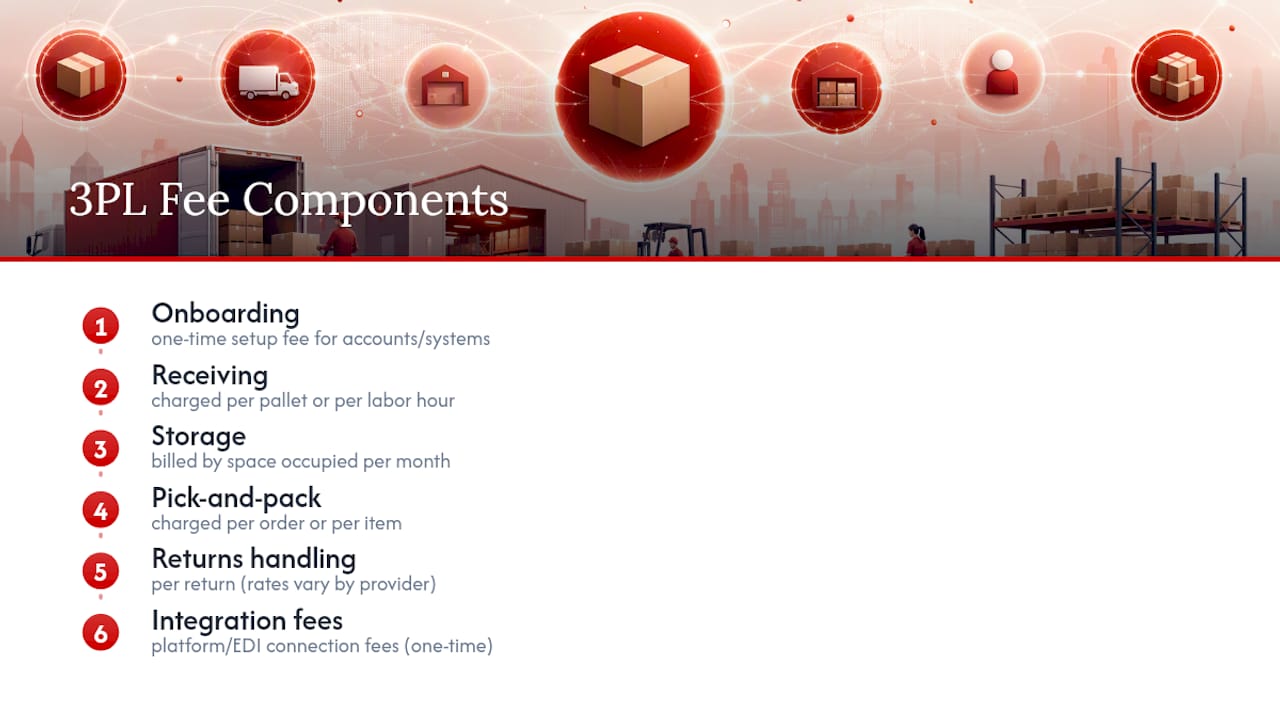
A typical 3PL fee schedule includes various fees such as onboarding to set up accounts and systems, receiving charges often per pallet or labor hour, storage fees typically billed by space occupied per month, pick-and-pack fees charged per order or item, returns handling fees which vary by provider, and integration fees for platform connections.
The benefits are real: rapid geographic scale through multi-distribution-center networks, a cost structure that flexes with your actual order volume, and access to retailer compliance expertise most in-house teams don’t have time to build. This matters more than it sounds. Delivery-speed expectations among online shoppers keep tightening, and a single-warehouse in-house operation simply can’t match a 3PL’s regional distribution network on transit time.
The risks are just as real. You lose direct control over packaging quality and pick accuracy. Your operation becomes dependent on the 3PL’s system integration and service-level agreement (SLA) performance. And seasonal storage spikes catch brands off guard when Q4 inventory builds trigger cubic-foot storage charges nobody modeled in advance.
Before signing with any 3PL, ask for the full fee schedule in writing, not a summary. Request a peak-season storage policy specifically, not a general rate card. Ask what their EDI and retailer-compliance capabilities look like if you’re selling into big-box retail. And if possible, run a small integration trial before committing volume.
Pro Tip: Model a worst-case Q4 storage scenario before you sign anything. Take your peak inventory volume, multiply by the 3PL’s cubic-foot rate, and compare that number to what a slow month would cost you. If the spread is bigger than your seasonal cash cushion, negotiate a cap before you commit.
For a deeper look at how 3PL relationships integrate with broader channel strategy, our guide to third-party logistics for CPG brands walks through the evaluation process in more detail.
Dropshipping flips the ownership model entirely. You never hold inventory. When a customer orders, the request routes to a supplier or manufacturer who ships directly to the customer, and you never touch the product.
The appeal is obvious: minimal capital outlay, fast assortment expansion, and almost no upfront inventory risk. You can list a hundred new SKUs without warehousing a single unit of any of them.
The trade-offs are just as significant:
Dropshipping structurally limits control over shipping speed and returns handling, which makes it a reasonable choice for low-risk product testing or an endless-aisle strategy where you’re offering rare or oversized SKUs that don’t justify holding inventory. It’s rarely the right long-term core model for a premium CPG product line, where packaging experience and delivery speed are part of what the customer is paying for. If you’re using dropshipping to test new SKU concepts before committing capital, that’s a legitimate application. The marketplace growth dynamics around assortment expansion are worth understanding if you’re leaning on dropship purely to widen your catalog rather than to build a durable revenue line.
Most growth-stage CPG brands eventually land here, whether they plan to or not. Hybrid fulfillment means running two or more models simultaneously, matched to specific SKUs, regions, or channels instead of forcing every order through one system.

Common architectures look like this: a brand keeps its highest-velocity core SKUs in-house for quality control, while routing regional or overflow demand to a 3PL. Or a brand fulfills retail distribution center replenishment in-house, while a 3PL absorbs DTC order spikes during promotional periods, so the in-house team never has to staff up and down for volatile ecommerce demand.
The mechanics require real infrastructure. You need an order management system (OMS) that can route orders correctly based on rules you define, whether that’s by SKU, shipping destination, or order volume threshold. You need allocation rules that decide which facility fulfills which order without creating conflicts. And you need a single source of truth for inventory, because nothing breaks a hybrid model faster than two systems each believing they have stock that’s already been sold.
The benefits are flexibility, peak-demand smoothing, and the ability to optimize each channel independently rather than compromising your whole operation for the sake of one channel’s requirements. The costs are integration complexity and the real risk of inventory duplication if your systems don’t reconcile frequently.
A basic hybrid implementation checklist:
The right fulfillment model isn’t a philosophy. It’s a calculation based on your order volume, SKU complexity, channel mix, and cash position, and it should change as those variables change.
Start with these decision criteria:
The most useful comparison tool is a Total Cost of Fulfillment (TCF) model. This means adding up every real cost, fixed real estate and labor for in-house, or onboarding, storage, and per-order fees for 3PL, and comparing the total against your actual order volume, not a hypothetical one. A properly built TCF framework exposes costs that look small individually but compound at scale, like seasonal storage spikes or per-line pick fees that scale faster than expected.
Layer in channel contribution margin (CM3) on top of TCF. CM3 measures what’s left after channel-specific costs, including fulfillment, are subtracted from revenue. Calculating CM3 separately for DTC, Amazon, and retail often reveals that a channel you assumed was profitable is actually being subsidized by fulfillment costs you never allocated to it correctly.
As a rough stage-based guideline: brands with relatively low order volumes often do fine in-house or with a light dropship test strategy. As order volumes increase to a moderate range, regional 3PL or hybrid setups typically start outperforming pure in-house on cost and speed. At higher volumes and especially when shipping nationally across multiple channels, a national 3PL network or full hybrid model usually becomes the more defensible choice.
Pro Tip: When benchmarking a 3PL against your current in-house cost, ask for exact onboarding fees, seasonal storage rates, and per-line pick-and-pack pricing in writing before you compare numbers. Verbal estimates almost always undercount real cost. Our fulfillment optimization guide walks through building this comparison step by step.
Contribution-margin-first analysis changes fulfillment decisions in ways abstract pros-and-cons lists never capture. When we build a CM2 or CM3 view for a client, fulfillment cost allocation is almost always where the real story is. A brand selling the same SKU on Amazon FBA and through DTC often assumes similar margins across both, until the fulfillment cost allocation reveals FBA fees are quietly consuming twice the margin of the DTC channel.
The pitfalls we run into most often:
The diagnostics we recommend running immediately: a SKU velocity threshold review to flag which products no longer justify their storage footprint, a full TCF run comparing your current model against at least one alternative, and SKU-level profitability broken out by channel rather than blended across your whole catalog.
The brands that scale most cleanly aren’t the ones with the “best” fulfillment model. They’re the ones that recalculate contribution margin by channel often enough to catch a leak before it becomes a pattern.
The conventional advice on fulfillment models treats this like picking a permanent operational philosophy: you’re an “in-house brand” or a “3PL brand.” That framing costs brands money. The research on stage-based transitions is clear: brands that move from in-house to hybrid or 3PL as they scale, rather than defending their original setup out of habit, protect margin better than brands that treat their first choice as permanent.
What’s overrated is the pros-and-cons list approach that compares models in the abstract. What actually matters is running the Total Cost of Fulfillment math against your real order volume and SKU mix, then recalculating channel contribution margin often enough to catch drift before it compounds. A model that worked at $1 million in revenue can quietly bleed margin at $5 million if nobody reruns the numbers.
Prioritize this first: build your TCF comparison and your channel-level CM3 before you touch a fulfillment contract. The model decision should follow the math, not precede it.
— Reddog
Choosing between in-house, 3PL, dropshipping, and hybrid fulfillment gets a lot clearer once you see the actual contribution margin behind each channel, not just the fee schedule on a 3PL’s rate card. RedDog Group runs a free 30-minute strategy call built specifically for that gap: a practical look at your contribution margin by channel, a quick Total Cost of Fulfillment scan, and a review of where inventory velocity or storage costs might be quietly compressing margin.
This session is for CPG founders and operators, typically in the $500,000 to $20 million revenue range, who want a clear-eyed read on their fulfillment and channel economics before making a change. There’s no pitch deck and no pressure. It’s a working session focused on your actual numbers.
If that’s useful to where your brand is right now, book your free strategy call and bring your current order volume and channel mix. That’s enough for a productive first conversation.
Leave a comment: