
Published: March 2020 | Last Updated:May 2026
© Copyright 2026, Reddog Consulting Group.

TL;DR:
- Choosing the right scaling model is crucial to maintaining margins, avoiding burnout, and ensuring sustainable growth.
- Different business types require tailored frameworks; monitoring unit economics and operational readiness guides effective model selection.
Choosing the wrong scaling model doesn’t just slow your growth. It can destroy margins, burn out your team, and leave you with a company that’s too big to manage and too small to compete. Understanding the distinct types of business scaling models is one of the most consequential decisions you’ll make as a founder. Scaling focuses on keeping costs flat while revenue climbs, which makes it fundamentally different from simply growing. Get the model right, and operational leverage works in your favor. Get it wrong, and every dollar of new revenue costs more than the last.
| Point | Details |
|---|---|
| Scaling isn’t the same as growth | True scaling adds revenue without proportionally increasing costs, making model selection critical from day one. |
| Unit economics come first | A healthy LTV to CAC ratio of 3:1 or higher predicts whether a model will hold up under pressure. |
| Model fit matters by business type | SaaS, marketplace, product, and service businesses each require distinct scaling frameworks to succeed. |
| Operational systems must come before speed | Documented processes and clear decision rights prevent chaos when demand outpaces infrastructure. |
| Know when to pivot your playbook | Disrupting your own scaling model before KPIs decline is smarter than reacting after the damage is done. |
Before you can evaluate which scaling model fits your business, you need a framework for comparison. Most founders pick a model because it worked for a company they admire, not because it fits their actual economics. That’s a costly shortcut.
Here are the dimensions that matter most when assessing models for business development:
Pro Tip: Before committing to a scaling model, map your gross margin by product or service line. If your margin is under 40%, aggressive scaling models like blitzscaling will burn through capital faster than revenue can cover. Your model choice must reflect your actual margin structure, not an idealized version of it.
Bootstrapped scaling is organic, capital-efficient, and deliberately paced. You fund growth from operating revenue rather than external investment. The advantage is control. The limitation is speed.
This model forces discipline. Every dollar reinvested must earn its place, which tends to produce founders with sharp instincts for unit economics. The tradeoff is that you cede market share to better-funded competitors during windows of rapid market growth. For CPG brands building regional distribution or direct-to-consumer channels, bootstrapped scaling often works well in the early stages because it forces contribution-margin clarity before expanding to new channels.
Blitzscaling, a term popularized by LinkedIn co-founder Reid Hoffman, means prioritizing rapid market domination at the explicit cost of short-term efficiency. You scale fast, accept waste, and bet that market dominance will eventually produce profitability.

This model requires venture capital, a winner-take-all market structure, and a team that can operate in chaos. It works for fintech platforms, social networks, and marketplace businesses where network effects create defensible moats. It rarely works for CPG, service businesses, or any company without a clear path to 70%+ gross margins. The failure mode is brutal: high burn rate, no dominant position, and a margin structure that never recovers.
Slow scaling is the underrated model. It prioritizes operational stability, cash flow health, and team readiness over speed. You grow when systems can support it, not when opportunity pressures you.
Businesses that reinvest profits into infrastructure before demand spikes consistently outperform those that scale reactively. The operational logic is simple: fix the foundation, then add floors. This model suits service businesses, regional CPG brands, wholesale distributors, and any company where operational execution is the product itself.
Platform scaling exploits network effects. The more users or participants you attract, the more valuable the platform becomes for everyone on it. Think two-sided marketplaces, app ecosystems, or multi-vendor retail platforms.
The key economic insight is that each market demands separate unit economics validation before you scale supply and demand simultaneously. Getting that balance wrong produces a platform with too many sellers and not enough buyers, or vice versa. For brands scaling through marketplace channels, understanding this dynamic is critical before investing in CPG marketplace growth.
SaaS scaling is built on retention, expansion revenue, and gross margin discipline. Venture-backed SaaS companies achieve massive scale by targeting 80% or higher gross margins and obsessing over churn from day one.
The model works because revenue is predictable and compounding. A customer retained for three years generates 3x the lifetime value of a one-year subscriber at the same price point. Expansion revenue, meaning upsells and cross-sells to existing accounts, reduces dependence on new customer acquisition and dramatically improves LTV to CAC ratios. Slack and Zoom both built dominant positions by combining strong product-led growth with low early churn.
Product-led growth (PLG) makes the product itself the primary driver of acquisition, retention, and expansion. Users discover value through free trials or freemium tiers and convert when the product proves itself.
The model reduces sales costs and shortens conversion cycles, but only if the product genuinely delivers value without hand-holding. PLG works exceptionally well for software, productivity tools, and consumer apps. It struggles when the product requires significant onboarding, customization, or consultative selling. The critical metric to watch is time to value: how quickly a new user experiences the core benefit that makes them stay.
Sales-led growth (SLG) puts a human sales team at the center of acquisition. Enterprise software, high-value B2B services, and complex product categories typically require this model because buyers need consultative guidance before committing.
The tradeoff is cost. A well-run SLG motion requires a full sales stack: SDRs, account executives, sales engineers, and customer success managers. That adds up fast. B2B models using pilot-to-expand strategies typically target ROI proof within 6 to 12 months to justify expansion. Without that proof, deals stall and CAC balloons.
Franchise scaling transfers operational execution to third-party operators while you maintain brand standards, supply chain control, and fee income. It’s capital-light expansion with significant operational complexity.
The model works best for businesses with replicable, documented operations and strong brand equity. Licensing follows similar logic: you monetize intellectual property or proprietary systems without building out direct operations in every market. Both models shift execution risk to partners, but brand risk remains yours entirely.
Expanding into new geographies or retail channels is one of the most common business expansion techniques for CPG brands, but it’s also one of the most misunderstood. Adding a new market or channel does not automatically translate into scalable growth.
International expansion demands its own unit economics validation and often requires entirely different operational models. The same is true for domestic channel expansion: moving from DTC to wholesale, or from regional grocery to national retail, requires a full rethink of pricing architecture, inventory velocity, and logistics costs. Our retail scaling guide covers this in depth.
Different business contexts call for different models. Here’s how the major types compare across key dimensions:
| Scaling model | Speed | Risk level | Cost structure | Best suited for |
|---|---|---|---|---|
| Bootstrapped | Slow | Low | Variable with revenue | CPG, services, early-stage |
| Blitzscaling | Very fast | Very high | High burn, capital-intensive | Marketplace, consumer tech |
| Slow/sustainable | Moderate | Low to medium | Controlled, margin-first | Service, wholesale, CPG |
| Platform/marketplace | Fast (if network tips) | High | High initial, then efficient | Two-sided markets, ecosystems |
| SaaS/subscription | Fast | Medium | High gross margin, recurring | Software, subscription products |
| Product-led growth | Fast | Medium | Low CAC, product-first | Software, consumer apps |
| Sales-led growth | Moderate | Medium to high | High CAC, relationship-driven | Enterprise B2B, complex products |
| Franchise/licensing | Moderate | Medium | Capital-light, brand-dependent | Replicable service, retail concepts |
| Geographic expansion | Moderate | High if underprepared | Market-dependent | Established brands with proven unit economics |
The most common mistake is treating this as a permanent choice. Most successful companies use hybrid approaches, combining bootstrapped discipline early with sales-led execution mid-stage, or layering product-led acquisition onto an existing sales motion. The model should evolve as the business matures.
Knowing which model fits your stage is one problem. Knowing when to change course is harder.
Pro Tip: Build a simple one-page model scorecard with your current LTV to CAC, gross margin by channel, and month-over-month revenue consistency. Review it quarterly. The numbers will tell you when your current scaling model is losing its effectiveness before your gut does.
I’ve worked with enough CPG founders to know that the scaling model conversation usually happens too late. By the time someone asks “which model should we be using?”, they’re already dealing with the consequences of having picked the wrong one without realizing it.
The most common pattern I see is founders who bootstrapped successfully to $2M or $3M in revenue and then tried to blitzscale their way to $10M by flooding money into paid acquisition. The unit economics never supported it. Value creation depends on balancing opportunity with discipline, and that balance is different at every stage.
What I’ve learned is that operational leverage is not a feature you add later. It has to be built into the model from the start. When poor processes spread faster than good ones, you get growth chaos: more revenue, more complexity, worse margins, and a team that’s exhausted and confused about who decides what.
The other thing I’d push back on is the idea that switching scaling models means admitting failure. It doesn’t. The best operators I know treat their scaling model like a working hypothesis. They test it, measure it, and change it when the data says it’s not working. That’s not failure. That’s discipline.
Focus on scalable unit economics. Everything else follows.
— Reddog
If you’ve read this far, you already know that picking the right scaling framework isn’t academic. It directly affects your margins, your operations, and your ability to grow without hemorrhaging cash.
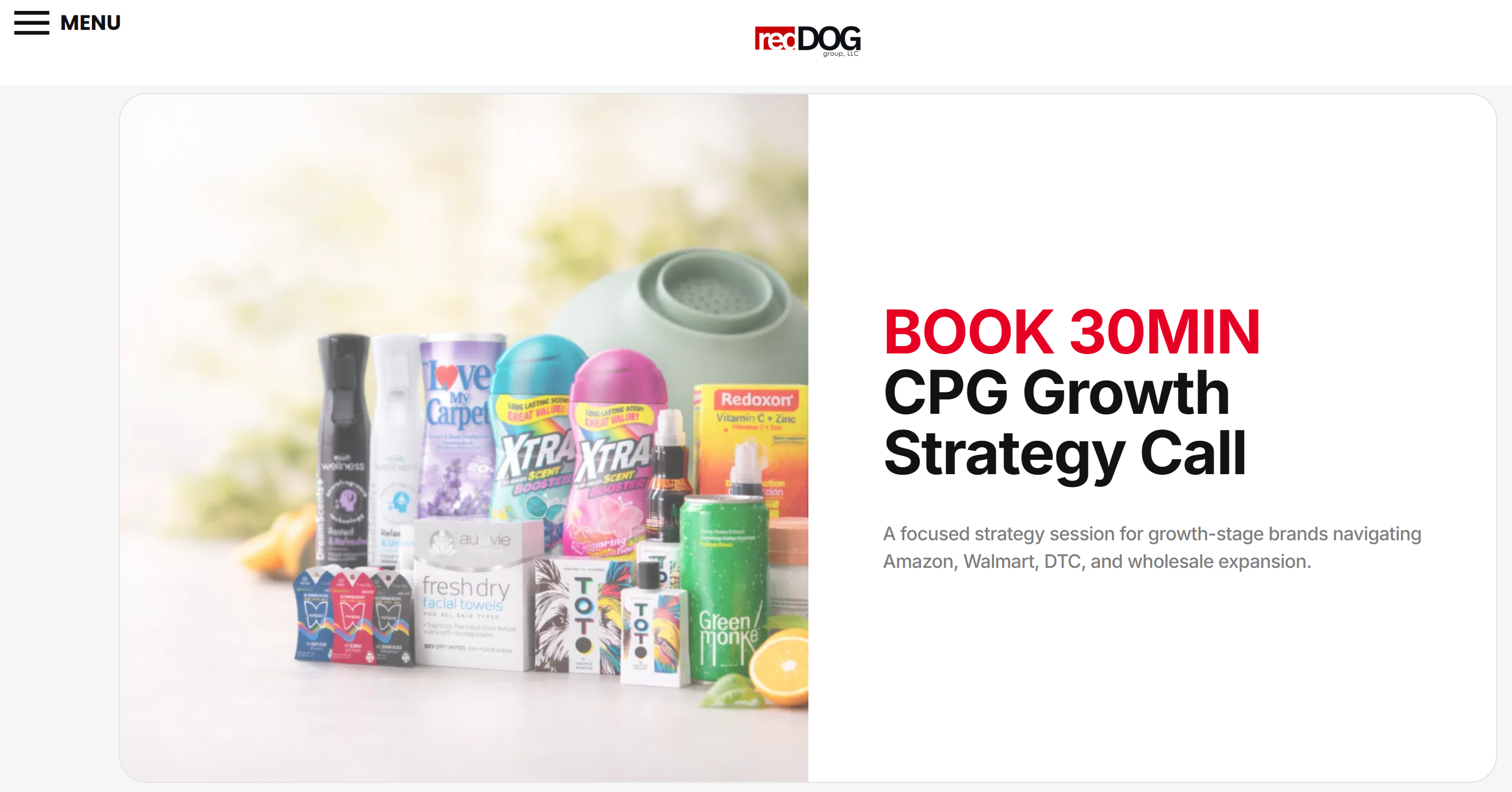
At Reddog, we work with CPG brands in the $500K to $20M range that are serious about scaling profitably, not just scaling fast. If you’re unsure which model fits your current stage, or if you suspect your current approach is creating margin leaks you haven’t fully diagnosed, a focused conversation can clarify a lot in a short time. We offer a free 30-minute strategy session covering contribution margin, channel economics, inventory velocity, or growth planning. Book your strategy call and we’ll review where your model stands and what, if anything, needs to change.
The main types include bootstrapped scaling, blitzscaling, slow and sustainable scaling, platform and marketplace scaling, SaaS and subscription models, product-led growth, and sales-led growth. Each suits different business types, capital structures, and growth stages.
Start with your unit economics, specifically your LTV to CAC ratio and gross margin by channel. Businesses with high gross margins and recurring revenue fit subscription or PLG models best, while capital-efficient CPG or service businesses typically do better with bootstrapped or slow scaling approaches.
Growth often increases revenue and costs at the same rate. Scaling increases revenue while keeping marginal costs relatively flat, which is what creates operational leverage and improving margins over time.
If your LTV to CAC ratio drops below 2:1 for two consecutive quarters, or if operational complexity is rising faster than revenue, those are clear signals your current model needs adjustment. Waiting for obvious decline before acting makes the transition more expensive.
Yes, and most successful companies do. A CPG brand might use bootstrapped discipline internally while pursuing marketplace scaling on Amazon and Walmart simultaneously. The key is tracking contribution margin by channel so you know which model is actually generating profit.
Leave a comment: