
Published: March 2020 | Last Updated:June 2026
© Copyright 2026, Reddog Consulting Group.

TL;DR:
- Ecommerce KPIs are goal-oriented metrics that reveal whether an online store is growing or losing profit. Tracking 5 to 7 key KPIs, especially conversion rate and gross margin, guides effective decision-making and improves profitability. Regular reviews at appropriate cadences help identify problems early and optimize overall business health.
Ecommerce key performance indicators are goal-driven, actionable metrics that tell you whether your online store is growing, stalling, or quietly losing margin. Most operators track too many numbers and act on too few. The top ecommerce KPIs worth your attention in 2026 are the ones tied directly to a business outcome: conversion rate, average order value, LTV:CAC ratio, cart abandonment rate, and gross margin by channel. Tools like Shopify Analytics and Google Analytics 4 surface these numbers daily, but only goal-driven metrics qualify as true KPIs. Everything else is noise.
The most critical ecommerce key performance indicators fall into four categories: acquisition, conversion, retention, and profitability. Each category answers a different question about your business health. Tracking one KPI from each category gives you a complete picture without overwhelming your team.
Conversion rate measures the percentage of visitors who complete a purchase. The global average sits at 2.5–3.0%, with top-performing stores hitting 4.7% or higher. A conversion rate below 2% signals a checkout, pricing, or trust problem worth fixing before scaling ad spend.

Average order value (AOV) tracks how much each customer spends per transaction. Raising AOV through bundling or upsells increases revenue without adding acquisition cost. For CPG brands on Amazon or DTC, AOV directly affects whether a channel is profitable after fees and fulfillment.
LTV:CAC ratio compares customer lifetime value to customer acquisition cost. The industry benchmark is 3:1, meaning you earn $3 for every $1 spent acquiring a customer. High-growth businesses target a 4:1 to 5:1 ratio for sustainable profitability.
Cart abandonment rate reveals how many shoppers add items but never check out. The global average is 70.22%, but top retailers reduce this to 55–60% with optimized checkout flows. A high abandonment rate is often a checkout friction problem, not a demand problem.
Revenue per visitor (RPV) combines conversion rate and AOV into a single number. It tells you exactly how much each website visit is worth in dollars. RPV is the clearest single metric for comparing traffic quality across channels.
Gross margin by channel shows what you actually keep after cost of goods and channel fees. Focusing only on revenue can hide low-margin customers and unprofitable channels. A brand doing $2 million on Amazon may net less than one doing $800,000 DTC after FBA fees and ad spend.
Repeat purchase rate measures how often customers come back. For CPG brands, this is the clearest signal of product-market fit. A repeat purchase rate above 30% typically indicates a brand with real retention power.
Not all metrics are KPIs. Only goal-driven, actionable metrics qualify as KPIs. Pageviews, social followers, and email list size are metrics. Conversion rate and gross margin are KPIs. The distinction matters because teams that track vanity metrics make decisions based on activity, not outcomes.
The right number of KPIs to track is small. Most ecommerce operators should focus on 5–7 KPIs tied to their single top business goal. More than that creates analysis paralysis. Fewer than five leaves blind spots in acquisition, conversion, or profitability.
Segmenting KPIs by traffic source, device, and customer type reveals patterns that aggregate numbers hide. A 2.8% conversion rate looks acceptable until you see that mobile converts at 1.4% and desktop at 4.2%. That gap points directly to a mobile checkout problem.
Pro Tip: Set up a single KPI dashboard in Google Analytics 4 or Shopify Analytics that shows your 5–7 core metrics at a glance. Review it before any budget or inventory decision, not after.
KPI review frequency should match the decision type. Daily reviews suit operational KPIs like conversion rate and ad spend. Weekly reviews fit tactical KPIs like AOV and cart abandonment. Monthly reviews work for strategic KPIs like LTV:CAC and gross margin by channel. Mixing cadences creates confusion about which numbers require action now versus next quarter.
Some KPIs pull in opposite directions. Understanding those trade-offs prevents you from optimizing one number while quietly damaging another.
The LTV:CAC ratio and customer acquisition cost (CAC) are directly linked. Cutting CAC by targeting cheaper audiences often reduces LTV because lower-intent customers churn faster. A brand that drops CAC from $40 to $25 but sees LTV fall from $120 to $60 has made its ratio worse, not better.
Gross margin by channel is the most accurate profitability indicator. Top-line revenue growth on a low-margin channel like Amazon can mask the fact that DTC or wholesale is carrying the business. Reddog consistently finds that brands chasing Amazon revenue are often subsidizing that channel with margin earned elsewhere.
Cart abandonment rate and add-to-cart rate work together. A high add-to-cart rate with a high abandonment rate means shoppers want the product but something stops them at checkout. Common causes include unexpected shipping costs, forced account creation, or a slow mobile checkout page.
Pro Tip: Run a channel-by-channel gross margin analysis quarterly. Include all fees, ad spend, and fulfillment costs. The channel that looks best on revenue often looks worst on margin.
| KPI | 2026 Benchmark | Business Impact |
|---|---|---|
| Conversion rate | 2.5–3.0% average, 4.7%+ top | Direct revenue driver; low rate signals checkout or trust issues |
| LTV:CAC ratio | 3:1 standard, 4:1–5:1 high-growth | Measures acquisition efficiency and long-term profitability |
| Cart abandonment rate | 70.22% average, 55–60% top | High rate indicates checkout friction or pricing surprises |
| Gross margin by channel | Varies by channel | Reveals true profitability after fees and fulfillment costs |
| Repeat purchase rate | 30%+ signals strong retention | Indicates product-market fit and customer loyalty |
The best ecommerce KPIs for your store depend on your current business goal. Tracking the wrong KPIs for your stage wastes time and can push you toward the wrong decisions.
For growth-focused stores:
For retention-focused stores:
For funnel optimization:
For financial health:
A balanced KPI dashboard should span sales, marketing, finance, and customer experience. That does not mean tracking 30 numbers. It means having at least one KPI from each category so no major leak goes undetected. For most growth-stage CPG brands, an 8–12 KPI set covers all four areas without overwhelming the team.
For brands working to increase ecommerce conversion rates, starting with conversion rate and cart abandonment rate as paired KPIs gives the clearest picture of where the funnel breaks down.
The most effective approach to ecommerce KPI tracking is choosing 5–7 goal-driven metrics, reviewing them at the right cadence, and always measuring gross margin by channel rather than top-line revenue alone.
| Point | Details |
|---|---|
| Choose goal-driven KPIs | Track 5–7 KPIs tied to one business goal to avoid analysis paralysis. |
| Use LTV:CAC as your profitability signal | A 3:1 ratio is the industry standard; target 4:1–5:1 for high-growth stages. |
| Segment before you act | Break KPIs by channel, device, and customer type to find the real problem. |
| Review at the right cadence | Daily for operational, weekly for tactical, monthly for strategic KPIs. |
| Gross margin beats revenue | Channel-level margin analysis reveals profit leaks that top-line numbers hide. |
Most ecommerce teams I work with at Reddog are not tracking too few metrics. They are tracking too many, but reviewing them too infrequently to act on any of them. A dashboard with 40 metrics reviewed once a month is not a performance system. It is a reporting habit.
The North Star KPI framework is the most practical fix I have seen work consistently. You pick one primary metric that best represents your current business goal, then support it with 4–6 diagnostic KPIs that explain why that number is moving. For a growth-stage CPG brand, the North Star might be LTV:CAC. For a brand with a retention problem, it might be repeat purchase rate. Everything else gets reviewed monthly, not weekly.
The other mistake is treating revenue as a health metric. Revenue tells you how much came in. Gross margin by channel tells you how much you kept. I have reviewed brands doing $5 million in annual revenue that were effectively breaking even because Amazon fees, ad spend, and 3PL costs consumed the margin. The revenue number looked great. The contribution margin told a different story.
Pick your North Star. Build your diagnostic KPIs around it. Review at the right cadence. That is the entire system.
— Reddog
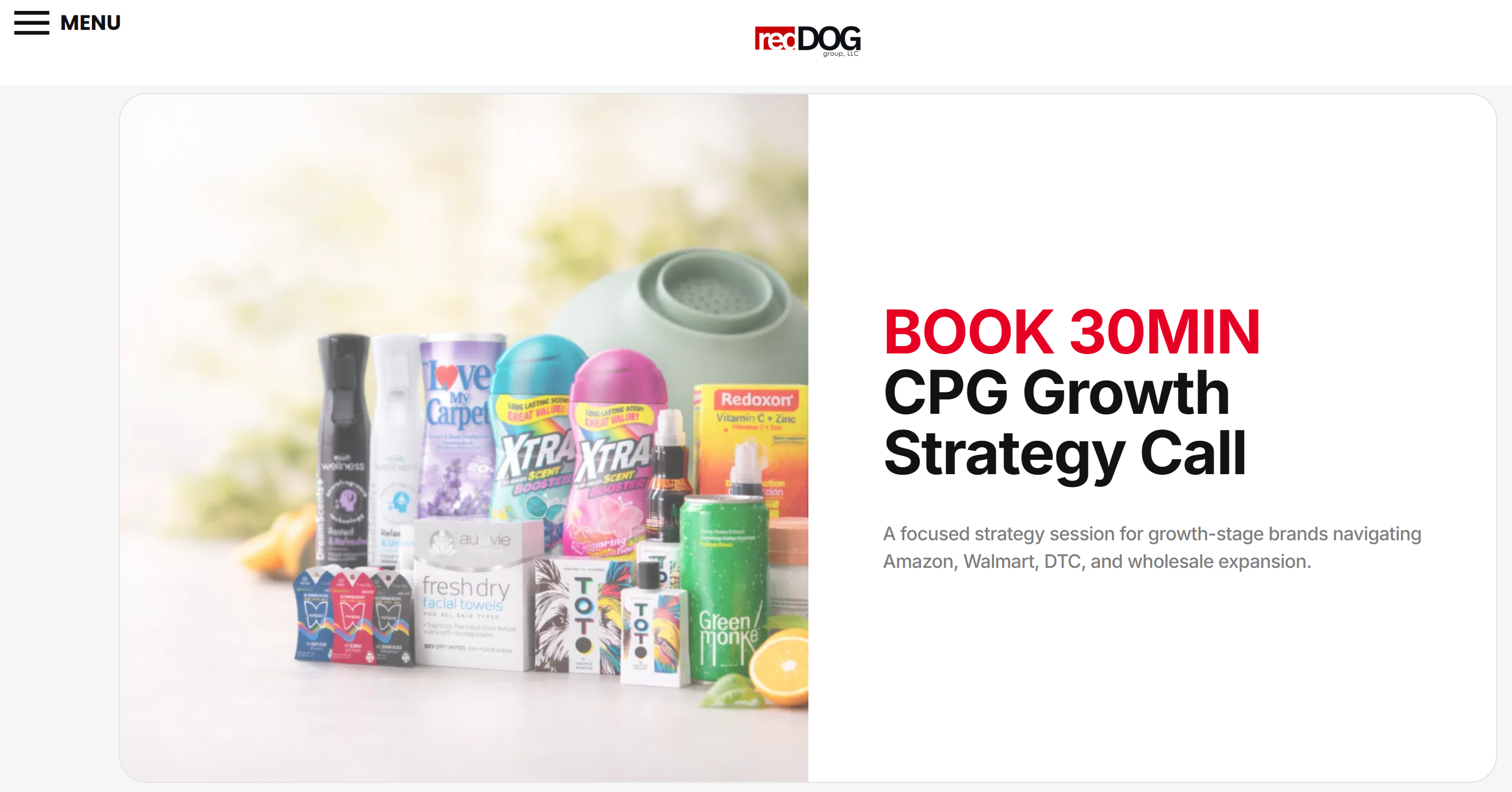
Reddog works with CPG brands in the $500K–$20M revenue range that need clarity on which metrics actually drive profit. If your team is tracking revenue but losing margin, or scaling ad spend without a clear LTV:CAC picture, a focused KPI review can identify exactly where the leaks are. Our ecommerce growth strategy work starts with contribution margin by channel, not top-line numbers.
Qualified CPG founders and operators can book a free 30-minute strategy call through our CPG retail growth offer. The session covers contribution margin, channel economics, inventory velocity, or growth planning, depending on where you need the most clarity. No pitch. Just a practical review of your numbers.
The most critical ecommerce KPIs are conversion rate, LTV:CAC ratio, cart abandonment rate, gross margin by channel, and repeat purchase rate. Each one ties directly to a measurable business outcome in acquisition, conversion, or profitability.
Most ecommerce operators should track 5–7 KPIs tied to their primary business goal. A balanced dashboard covering sales, marketing, finance, and customer experience typically requires 8–12 KPIs total.
The global average conversion rate is 2.5–3.0%, with top-performing stores reaching 4.7% or higher. A rate below 2% signals a checkout, pricing, or trust issue that should be fixed before increasing ad spend.
The industry standard LTV:CAC ratio is 3:1. High-growth ecommerce businesses target a 4:1 to 5:1 ratio to confirm that customer acquisition spend is generating sustainable long-term profit.
Operational KPIs like conversion rate should be reviewed daily, tactical KPIs like AOV weekly, and strategic KPIs like gross margin monthly. Matching review cadence to decision type prevents reactive decisions based on short-term noise.
Leave a comment: