
Published: March 2020 | Last Updated:June 2026
© Copyright 2026, Reddog Consulting Group.

TL;DR:
- Competitor analysis helps brands identify strategic gaps and allocate resources more effectively.
- It is most valuable when conducted regularly using structured frameworks like SWOT, positioning maps, and feature matrices.
- Most brands fail to translate competitive insights into actionable decisions, limiting their growth potential.
Competitor analysis is the systematic process of evaluating rivals to uncover strategic opportunities and threats that inform smarter business decisions. Known formally as competitive intelligence, it gives business owners and marketing professionals a structured view of where the market is moving, what customers are choosing, and where gaps exist that your brand can fill. Frameworks like SWOT analysis, positioning matrices, and feature comparison grids are the standard tools of the trade. Monitoring platforms like RivalSense and product strategy tools like Productboard have made this process faster and more continuous. The brands that treat competitor analysis as an ongoing discipline rather than a one-time project consistently find more white space, waste less budget, and grow with more confidence.

Competitor analysis works best when it is built around a defined set of frameworks rather than ad hoc research. The three most widely used structures are SWOT analysis (Strengths, Weaknesses, Opportunities, Threats), positioning maps that plot competitors on two key dimensions such as price versus quality, and feature comparison matrices that score rivals across product attributes. Each framework answers a different question. SWOT reveals relative vulnerabilities. Positioning maps expose crowded and uncrowded market segments. Feature matrices show where you are at parity and where you are genuinely differentiated.
Identifying the right competitors is the first practical step. Direct competitors solve the same problem for the same customer. Indirect competitors solve the same problem differently or serve an adjacent customer. Both matter. A CPG brand selling protein bars on Amazon competes directly with other protein bar brands but indirectly with meal replacement shakes and even convenience store snacks. Ignoring indirect competitors is one of the most common blind spots in early-stage analysis.
Data sources for competitor research include competitor websites, customer reviews on Amazon and Google, pricing pages, job postings (which reveal strategic priorities), and social media ad libraries. Each source tells a different part of the story. Pricing pages reveal positioning intent. Job postings reveal where a competitor is investing. Customer reviews reveal what buyers actually value versus what marketing claims.
| Competitor dimension | Data source | What it reveals |
|---|---|---|
| Pricing strategy | Competitor website, Amazon listings | Market positioning, margin assumptions |
| Product features | Product pages, app stores, reviews | Table-stakes vs. differentiating capabilities |
| Customer sentiment | Amazon reviews, Google reviews, Reddit | Unmet needs, recurring complaints |
| Marketing messaging | Ad libraries, landing pages, social | Positioning claims, audience targeting |
| Strategic direction | Job postings, press releases | Investment priorities, expansion plans |
Pro Tip: Focus your analysis on three to five critical dimensions rather than cataloging everything. Analysis paralysis is real, and a 40-row comparison matrix rarely drives a decision. Pick the factors that most directly affect your customer’s purchase decision and go deep on those.
The clearest value of competitor analysis is enabling leadership teams to confidently allocate resources instead of relying on intuition. When you know a competitor is outspending you on paid search but underperforming on organic content, you have a concrete basis for shifting budget. When you know a rival’s top customer complaint is slow delivery, you have a positioning angle that costs nothing to claim. These are not abstract benefits. They are the specific decisions that separate brands growing with purpose from brands reacting to quarterly results.
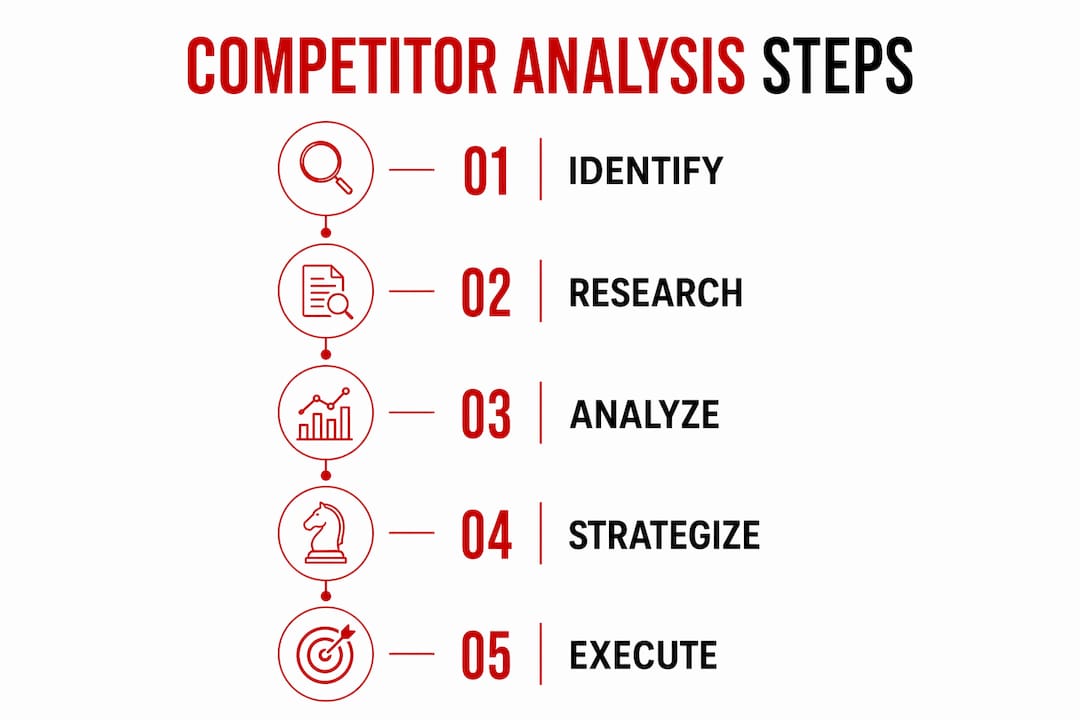
One of the most underrated applications is identifying white space. Successful brands find gaps in competitor offerings and position around them, which shortens sales cycles and reduces customer acquisition costs. A CPG brand that discovers no competitor is emphasizing clean ingredient sourcing in their Amazon listings has found a positioning angle that can drive both conversion rate and repeat purchase. That insight does not come from internal brainstorming. It comes from structured competitive research.
Product roadmap decisions are another high-value application. Regular competitive intelligence prevents product teams from building features in a vacuum and keeps the roadmap aligned with what the market actually needs. The risk without this discipline is feature parity: spending development resources to match what competitors already do rather than building what they cannot. Companies that adopt quality management supported by competitor benchmarking see average annual market share increases of 13.7%. That figure reflects the compounding effect of consistently making better-informed decisions across pricing, product, and marketing.
Competitor analysis also plays a direct role in investor and board conversations. When a founder can show that their positioning targets a segment no competitor owns, and back it with data, the credibility of the growth plan increases substantially. This is especially true for CPG brands seeking distribution expansion or retail placement, where buyers want evidence that the brand has a defensible market position.
The most damaging mistake is treating competitor analysis as a one-time project. Markets shift, competitors pivot, and new entrants appear. Experts recommend refreshing competitor analysis quarterly to annually depending on how fast your category moves. Consumer packaged goods brands operating on Amazon or Walmart should lean toward quarterly given how rapidly pricing, listings, and promotional strategies change on those platforms.
The second major pitfall is what consulting practitioners call “copycat syndrome.” This happens when a brand sees a competitor doing something and immediately tries to replicate it without asking whether it fits their own positioning or customer base. Viewing competitor analysis as a check-the-box exercise misses its real value in strategic differentiation. The goal is not to mirror competitors. It is to understand them well enough to move in a direction they are not.
Common best practices worth building into your process:
Pro Tip: Integrate competitor intelligence into your existing strategic planning calendar rather than running it as a standalone project. Tie it to your quarterly business review or annual planning cycle so findings automatically feed into budget and roadmap decisions.
Competitive intelligence that changes decisions delivers real return on investment. The brands that extract the most value are the ones that translate findings directly into marketing copy, sales tools, and product priorities rather than filing reports that no one reads. Here is how that translation works in practice.
Messaging refinement is the fastest win. When you map competitor messaging and find that every brand in your category leads with “natural ingredients,” you know that claim is table stakes, not a differentiator. Claiming it does not help you stand out. Analyzing competitor messaging gaps allows brands to claim unique market positions that shorten sales cycles and reduce customer acquisition costs. The brand that leads with “third-party tested for heavy metals” in a category where no one else makes that claim owns a specific, credible position.
Sales enablement is another direct application. Battle cards, which are one-page documents that compare your brand to a specific competitor on the dimensions buyers care about most, are built entirely from competitor research. Objection handling guides follow the same logic. When your sales team knows that a competitor’s top complaint is inconsistent product quality, they can address that concern proactively in conversations with buyers and distributors.
For product teams, the application is roadmap prioritization. Competitive intelligence is not about matching every feature but about identifying which capabilities uniquely attract and retain customers. Tools like Productboard allow product teams to tag customer feedback by competitor mention and surface patterns that inform which features to build next. RivalSense automates competitor data collection across multiple channels, reducing the manual effort of monitoring and freeing teams to focus on interpretation rather than data gathering.
| Competitor insight | Marketing application | Product application |
|---|---|---|
| Competitor has weak reviews on delivery speed | Highlight fulfillment reliability in ads | Prioritize 3PL or FBA optimization |
| No competitor claims ingredient transparency | Lead with third-party testing in copy | Add QR code linking to lab results |
| Competitor pricing is 20% higher | Test premium positioning or value messaging | Evaluate cost structure for margin room |
| Competitor ignores a customer segment | Target that segment with dedicated campaigns | Build features that segment needs |
For CPG brands specifically, understanding how competitors are positioned on Amazon and Walmart listings, including their keyword strategies, image stacks, and A+ content, is a form of competitor analysis that directly affects organic rank and conversion rate. Reddog’s approach to retail analytics and marketplace growth treats this channel-level intelligence as a core input to listing optimization and pricing strategy, not an afterthought.
Competitor analysis delivers the most value when it changes specific decisions, not when it confirms what you already believe.
| Point | Details |
|---|---|
| Define the right scope | Track three to five core competitors across direct and indirect categories to avoid noise. |
| Use structured frameworks | SWOT, positioning maps, and feature matrices each answer different strategic questions. |
| Refresh on a regular cadence | Quarterly updates are the minimum for fast-moving categories like CPG and marketplace retail. |
| Connect insights to actions | Every analysis cycle should produce at least one changed decision or validated hypothesis. |
| Target white space, not parity | Build toward gaps competitors ignore rather than matching what they already do well. |
Most brands I work with have done some form of competitor analysis. Almost none of them have done it in a way that actually changed a decision. They have spreadsheets with competitor pricing. They have screenshots of rival websites. What they do not have is a clear answer to the question: “What did we do differently because of this research?”
That gap is the real problem. Competitor analysis delivers most value when it informs specific strategic questions and changes actions rather than confirming assumptions. The brands that get this right are not necessarily doing more research. They are asking sharper questions before they start. “Where is our competitor weakest with the customer segment we most want to win?” is a better starting question than “What are our competitors doing?”
The other thing I see consistently is brands confusing monitoring with analysis. Monitoring is watching what competitors do. Analysis is deciding what to do about it. Continuous competitor monitoring reveals early market shifts before internal metrics catch them, which is genuinely valuable. But monitoring without a decision framework just produces anxiety, not strategy.
For CPG brands specifically, the white space opportunity is almost always larger than founders expect. Categories that look crowded on the surface often have significant gaps in customer segment coverage, price tier positioning, or channel presence. Finding that space requires looking at competitors with discipline and honesty, not just optimism. The brands that do this well spend less on customer acquisition and grow faster because they are not fighting for the same ground everyone else is standing on.
— Reddog
Reddog works with CPG brands in the $500K to $20M revenue range that need more than a competitor spreadsheet. Our work starts with understanding what each channel actually contributes to margin, and competitor intelligence is a core input to that analysis. When we know where rivals are priced, how they are positioned on Amazon and Walmart, and where their customer reviews reveal unmet needs, we can build a growth plan that targets real opportunity rather than crowded ground. That analysis feeds directly into omnichannel growth strategy, listing optimization, pricing decisions, and retail expansion planning.
If you are a CPG founder or operator who wants a clear-eyed look at your competitive position and what it means for your margin and growth trajectory, book a free 30-minute strategy call with Reddog. We will focus the conversation on your specific channels, contribution margin, and where the most defensible growth opportunity sits for your brand.
Competitor analysis identifies where rivals are strong, where they are weak, and where market gaps exist that your brand can claim. It gives leadership teams the evidence needed to allocate resources toward differentiated positions rather than crowded ones.
Experts recommend refreshing competitor analysis quarterly to annually depending on industry volatility. CPG brands operating on Amazon or Walmart should update their analysis at least quarterly given how rapidly pricing and listing strategies shift.
SWOT analysis, positioning maps, and feature comparison matrices are the three most widely used frameworks. Each answers a different strategic question, and using all three together gives a more complete picture than relying on any single tool.
The most common mistake is treating competitor analysis as a one-time project rather than an ongoing discipline. Viewing it as a check-the-box exercise prevents brands from using it to drive real strategic differentiation and profitability.
Competitor analysis reveals messaging gaps that allow brands to claim unique positions in the market. When every competitor leads with the same claim, the brand that identifies and owns a different angle reduces customer acquisition costs and improves conversion rates.
Leave a comment: