
Published: March 2020 | Last Updated:May 2026
© Copyright 2026, Reddog Consulting Group.

TL;DR:
- Most startups mistake growth for scaling, which involves increasing revenue faster than costs.
- Before scaling, founders must verify unit economics, document systems, and assess operational readiness.
- Effective scaling requires deliberate planning, structured communication, and founder leadership transition.
Most founders confuse growth with scaling. Growth means adding revenue by adding resources at roughly the same rate. Scaling means growing revenue faster than costs. That distinction sounds simple, but getting the step by step business scaling sequence wrong is precisely why premature scaling fails most startups before they ever hit their potential. This guide gives you the exact operational framework to assess readiness, build your foundation, execute your plan, and measure progress. No theory. No vague advice. Just the actual steps.
| Point | Details |
|---|---|
| Verify unit economics first | Your LTV/CAC ratio must exceed 3.0 and CAC payback must be under 12 months before scaling. |
| Document systems before hiring | Build SOPs for high-volume and error-prone processes before adding headcount or channels. |
| Hire leadership in sequence | Bring on team leads at 20 to 25 employees and VPs at 40 to 50 to avoid structural collapse. |
| Track weekly, adjust quarterly | Review financial and operational KPIs weekly, and revisit your scaling strategy every 90 days. |
| Founder mindset shift is non-negotiable | Moving from operator to architect is the single most overlooked constraint in scaling a startup. |
Before you spend a dollar scaling, you need to know whether your business is actually ready. Most founders skip this part and pay for it later. Scaling a broken model just produces a bigger broken model, faster.
The first signal to look for is sustained revenue growth. Six-plus months of consistent revenue increases, paired with a team that feels overwhelmed by demand, is a reliable indicator that the market is pulling you forward. That is the kind of readiness you can build on.
The second signal is your unit economics. These are the numbers that tell you whether the business actually makes money on each customer, not just in aggregate. The benchmarks that matter:
Unit economics below these thresholds mean scaling will accelerate your path to insolvency, not profitability. Fix the model first.
The third signal is founder readiness. This one is personal, and most founders underestimate it. Scaling requires you to shift from doing the work to building and managing systems. If you cannot genuinely delegate today, you will become the bottleneck tomorrow.
Pro Tip: Build a one-page readiness scorecard with these three categories: revenue trend, unit economics, and operational capacity. Score each 1 to 5. If your total is below 10, do not scale yet. Strengthen the weak areas first.
Assuming your readiness check passes, the next stage is preparation. This is the stage most founders rush through because it feels like “internal work” rather than growth. That instinct costs them significantly.

The first task is documenting your Standard Operating Procedures. Spend at least 30 days building SOPs for your highest-volume and most error-prone processes before you attempt to scale. Think about your order management workflow, your customer onboarding sequence, your returns process, and your vendor communication cadence. The goal is simple: a new hire should be able to follow the SOP and reach near-veteran effectiveness within 90 days. If your SOPs cannot accomplish that, they are not finished.
The second task is building the right organizational structure for your stage. Here is the sequencing that works:
This organizational structure evolution is not optional. Companies that try to stay flat past 30 or 40 people end up with coordination failures that show up as missed deadlines, poor product quality, and high turnover.
The third task is implementing a performance management system. OKRs (Objectives and Key Results) work well at the company and department level. KPIs should be set at the team and individual level. The combination creates alignment without requiring the founder to approve every decision.
| Tool | Best used for | When to introduce |
|---|---|---|
| OKRs | Company and department goals | 25 to 30 employees |
| KPIs | Individual and team performance | 15 to 20 employees |
| SOPs | Process execution and onboarding | Before scaling begins |
| Operations manual | Cross-functional coordination | 75 to 100 employees |
Pro Tip: When writing SOPs, focus on the “why” behind each step, not just the “what.” People follow instructions better when they understand the purpose. It also makes the SOP easier to update as the business evolves.
Understanding the types of scaling models available to you at this stage helps you choose the right structure before you commit to a specific path.
Execution is where the strategy gets real. This is also where the majority of cash gets burned if you are not careful. A well-built business scaling roadmap keeps you from funding growth with money you do not have.
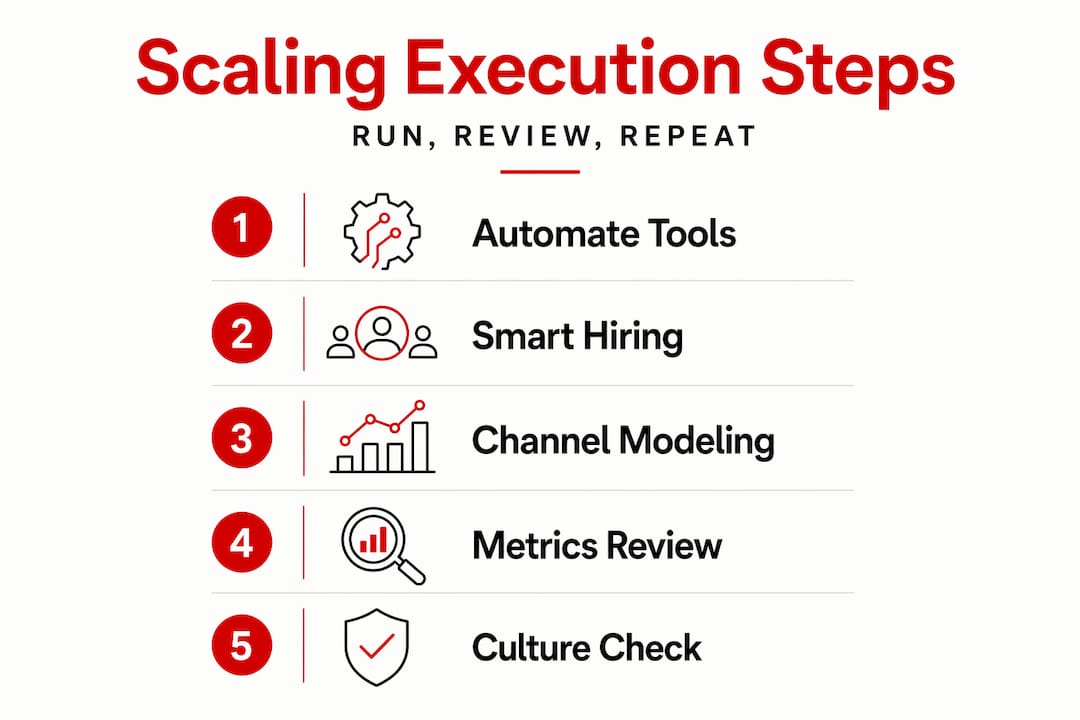
Start with technology before headcount. Automated HR and finance tools free your team from administrative work that does not create revenue. Payroll automation, contract management, and expense tracking are not glamorous, but they prevent the kind of compliance and coordination failures that slow everything down at scale. Invest in these systems before you hire your next 10 people, not after.
Then align your hiring to your growth phases. A common mistake is hiring for the business you want instead of the business you have. Each hire should solve a specific, documented constraint. Before you post a job listing, ask: what metric will this person directly improve, and by when will I know if they are succeeding?
On the financial side, your execution plan needs a cash bridge. Know how many months of runway you have at your current burn rate, and model out what happens to cash flow when you double hiring or launch a new channel. Scaling with poor unit economics does not just slow growth. It kills the company.
When it comes to sales and marketing, let your unit economics guide your channel investment. If paid social delivers a CAC payback of eight months and trade shows deliver 18 months, the answer is obvious. Apply that same logic to every channel you consider adding. For CPG founders specifically, expanding from DTC into wholesale or Amazon requires a clear-eyed look at contribution margin per channel, not just top-line revenue.
Pro Tip: Before entering a new sales channel, model the full unit economics including fees, freight, returns, and payment terms. A channel that looks profitable on gross margin can easily destroy contribution margin once all costs are included.
Scaling is not a project with a finish line. It is an ongoing operating mode that requires regular calibration. The companies that scale well treat monitoring as a core management discipline, not an afterthought.
Weekly metrics reviews should cover a short list of leading and lagging indicators: revenue against target, CAC trends, gross retention, inventory velocity (for product businesses), and headcount cost as a percentage of revenue. These numbers tell you whether your scaling levers are working before problems become crises.
Retention data deserves segmented analysis. Do not just track overall churn. Break it down by customer cohort, acquisition channel, and product line. The same logic applies to employee retention. When attrition clusters around a specific team or manager, that is a structural signal, not a random event.
Here is how intentional monitoring compares to reactive management:
| Approach | Cadence | Outcome |
|---|---|---|
| Reactive | When problems surface | Firefighting, margin erosion |
| Intentional | Weekly KPI reviews, quarterly strategy check | Early course correction, protected margins |
| Data-driven | Segmented cohort and retention analysis | Precision decisions, reduced waste |
Culture is the other thing that erodes quietly during rapid scaling. As you add people, your direct influence on day-to-day behavior shrinks. Communication systems need to evolve from informal daily standups to more structured formats. All-hands meetings often shift from weekly to biweekly or monthly at larger team sizes, while written documentation and async communication carry more of the cultural load. The founders who protect their culture through this shift are the ones who deliberately design how values are communicated, not just assumed.
I have worked with founders across a wide range of revenue stages, and the pattern I keep seeing is this: the real scaling bottleneck is almost never the product, the market, or the capital. It is the founder.
The transition from operator to leader is described in a lot of business books, but it is genuinely underestimated until you are living it. I have seen founders with exceptional products and strong demand stall at $5M in revenue because they could not let go of sales calls, hiring decisions, or daily operational approvals. The business is not scaling because the founder’s calendar is full of work that should belong to someone else.
What I have found actually works is forcing the transition deliberately rather than waiting until you are overwhelmed. Hire your first VP before you think you need one. Document your decision-making frameworks so your team can make calls without you. Accept that a decision made at 80% of your quality, made 10 times faster by someone else, is almost always the better outcome.
The other hard lesson is about unit economics. I have watched brands scale aggressively into new channels with gross margins that looked acceptable until you factored in Amazon FBA fees, Walmart slotting costs, freight, and returns. The top line grew. The company ran out of cash. Scaling a startup without contribution-margin clarity is not a growth strategy. It is a faster path to the same problem.
Build the scalability foundation before you accelerate. The founders who do this work first are the ones still standing two years into their scaling push.
— Reddog
Scaling a CPG brand across channels like Amazon, Walmart, DTC, and wholesale requires more than a growth checklist. It requires a clear picture of what each channel actually contributes to your margin. At Reddog, we work with founders in the $500K to $20M revenue range to build exactly that clarity.
If you are ready to move beyond top-line thinking and get a real read on your contribution margin, channel economics, and inventory velocity, book a free 30-minute strategy call with the Reddog team. We will review your current growth setup and identify where your scaling levers are working and where margin is leaking. No pitch. Just practical analysis built around your numbers.
Business scaling means growing revenue faster than costs by building repeatable systems and processes. Unlike simple growth, scaling creates leverage so each new dollar of revenue costs less to produce than the last.
You are ready to scale when you have at least six months of consistent revenue growth, an LTV/CAC ratio above 3.0, a CAC payback under 12 months, and gross retention above 90%. Operational capacity under strain from demand is another strong signal.
The most common mistake is scaling before unit economics are solid. Scaling bad economics accelerates financial pressure rather than solving it. The second most common mistake is the founder holding onto operational control for too long, which creates a ceiling on the company’s growth rate.
Prioritize SOPs for your highest-volume and most error-prone processes. A well-built SOP system should allow a new hire to reach near-veteran effectiveness within 90 days, which signals your processes are ready to support scale.
Transition your communication systems intentionally as your team grows. All-hands meetings, decision-making frameworks, and written documentation all need to evolve. Culture does not survive scaling by accident. It survives through deliberate design and structured communication cadences that carry your values into a larger organization.
Leave a comment: