
Published: March 2020 | Last Updated:May 2026
© Copyright 2026, Reddog Consulting Group.

TL;DR:
- Most founders mistakenly believe brand positioning is just a tagline, but it actually shapes the mental space customers assign to a brand through associations and feelings. Effective positioning requires thorough market research, competitor mapping, and honest differentiation, ensuring the brand’s core relevance and defensibility. Embedding this positioning into every touchpoint and internal decision solidifies market perception and creates a genuine competitive advantage.
Most founders think brand positioning is a tagline. It isn’t. Your positioning is the mental space your brand occupies in your customer’s mind, built from associations, expectations, and feelings accumulated over time. Getting that space wrong — or leaving it to chance — means you compete on price by default. This step by step brand positioning guide walks you through the preparation, decision-making, and execution required to claim a defensible market position, specifically for consumer brands that need to grow with purpose and not just volume.
| Point | Details |
|---|---|
| Positioning is not a slogan | It’s the mental space customers associate with your brand, shaped by behavior over time. |
| Research before you write | Deep audits of your market, competitors, and audience must precede any positioning statement. |
| Exclusion creates focus | Defining what your brand says no to makes your position stronger and more defensible. |
| The statement is an internal tool | Your positioning statement guides internal decisions. It is not advertising copy. |
| Consistency builds equity | Positioning only becomes reputation when every touchpoint reinforces the same message. |
Before you write a single word of positioning copy, you need a clear picture of where you actually stand. Most brands skip this step or rush through it. That’s the single biggest reason positioning fails.
A brand audit examines how your brand is perceived internally by your team and externally by your customers and market. Gather customer reviews, run short surveys, interview your top buyers, and pull your Amazon or Walmart review data if you sell there. You’re looking for patterns: what words do customers use, what problems do they say you solve, and where does their language diverge from yours? That gap is where positioning problems live.
The importance of brand positioning becomes obvious the moment you see how differently customers describe your product compared to how your team does.
A positioning map plots brands on two axes representing attributes your customers care about. Price vs. quality is the classic version, but you can map any two meaningful dimensions relevant to your category. The goal is to find gaps: spaces where customer demand exists but no brand has clearly claimed the territory.
Here’s a simple overview of the core research assets you need before moving forward:
| Research Asset | What It Reveals | Useful Tools |
|---|---|---|
| Customer interviews | Language, pain points, unmet desires | Calendly, Zoom, Google Forms |
| Competitor review mining | Gaps, weaknesses, price sensitivity | ReviewMeta, Helium 10 |
| Positioning map | Visual white space in the market | FigJam, Miro, pen and paper |
| Brand perception survey | External vs. internal perception gaps | Typeform, SurveyMonkey |
| Social listening | Real-time sentiment and associations | Brandwatch, Sprout Social |
Pro Tip: Don’t just study your direct competitors. Study the brands your audience admires in adjacent categories. The vocabulary and values they respond to there often translate directly to yours.
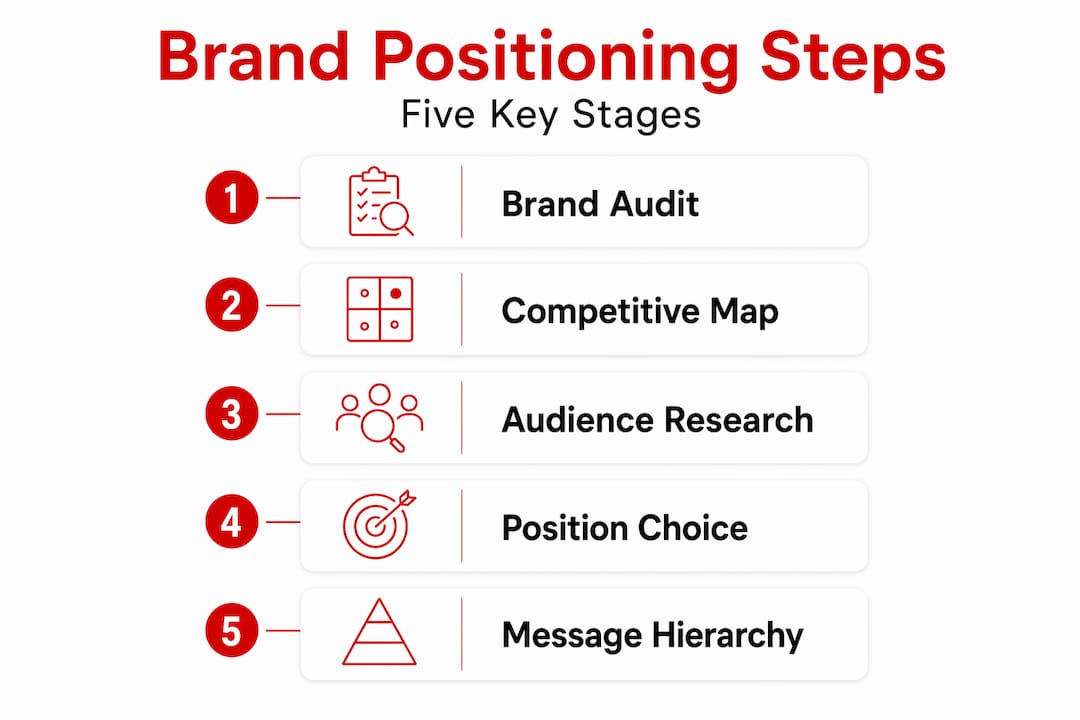
A comprehensive brand positioning process typically runs through six structured steps, and competitive mapping plus audience research form the foundation of all of them. Skipping this stage doesn’t save time. It guarantees rework later.
Once you understand the market, you face the hardest part of the brand positioning process: making a real choice. Not every brand needs to be the premium option. Not every brand should compete on ingredients or sustainability. What matters is that you choose a position that is relevant to your buyer, deliverable by your operations, and not already owned by a better-resourced competitor.
Before committing to a direction, run every candidate positioning angle through these three questions:
Strong brands define what they say no to. That exclusionary discipline is what creates focus. If your positioning could describe three other brands in your category, it isn’t positioning. It’s a description.
Here’s how different positioning frames compare at a practical level:
| Positioning Frame | Potential Strength | Primary Risk |
|---|---|---|
| Quality or premium | High margins, loyal buyers | Requires consistent product delivery |
| Value or accessibility | Volume, broad reach | Margin compression, hard to exit |
| Purpose or values-led | Emotional loyalty, community | Must be authentic or it backfires |
| Ingredient or formulation | Credibility, category authority | Easily copied if not patented |
| Experience or service | Differentiation beyond product | Hard to scale consistently |
Aspirational positioning — claiming a premium or purpose-led space you haven’t earned yet — is one of the most common mistakes emerging brands make. Buyers and retailers both see through it quickly. Your position must reflect brand truth to hold up under scrutiny.
Pro Tip: Test your candidate position with this scenario: imagine a buyer reading your claim and then experiencing your product for the first time. If those two moments don’t match, you don’t have a position yet. You have a wish.
Your positioning statement is an internal document. It is not a tagline, not a homepage headline, and not an advertising line. Its job is to align your team around a single, agreed-upon definition of who you serve, what you offer, why it matters, and why you’re credible.
The standard formula that professional positioning uses is: “For [target audience] who have [need], [brand] is the [category] that [benefit] because [proof].” Every word earns its place. The “because” clause is especially critical. It’s the proof point that makes the claim believable rather than just promotional.
A strong statement passes these tests:
The messaging hierarchy flows directly downward from this statement. Your value proposition pillars (usually three) each expand one element of the positioning statement. Your key messages support each pillar. Your tagline, if you have one, is a distilled public expression of the whole structure. Skipping these layers creates disconnected messaging where your Amazon listing, retail packaging, and social content all sound like they belong to different brands.
Pro Tip: The positioning statement should be stress-tested against your top two or three competitors before it’s finalized. If a competitor could adopt your statement without lying, rewrite it.
Writing the statement is the easy part. Embedding positioning into daily business behavior is where most brands fall short. Your brand positioning strategy only becomes real market perception when every customer interaction reflects the same core idea.

Positioning informs far more than your marketing copy. It shapes your pricing architecture, your product naming conventions, your packaging design brief, your customer service tone, and even your hiring criteria. A brand positioning itself on expertise and transparency should hire customer service reps who explain rather than deflect. A brand positioned on accessibility should have a pricing structure that doesn’t undermine that promise at the shelf.
Brands that don’t re-evaluate positioning within 12 to 24 months risk losing differentiation and competing on price. Markets move. Competitors copy. Customer expectations evolve. Verification is not a one-time activity.
Here’s a practical monitoring framework:
| Activity | Frequency | What You’re Measuring |
|---|---|---|
| Customer perception survey | Every 12 months | Awareness, word association, perceived quality |
| Competitor positioning audit | Every 6 months | New entrants, category language shifts |
| Internal alignment check | Every quarter | Are team decisions reflecting the position? |
| Digital and AI brand audit | Every 6 months | Consistency across platforms and AI search results |
Ongoing steps for maintaining alignment:
AI and search tools assess brands by the consistency of their messaging across platforms. Inconsistent positioning doesn’t just confuse customers. It reduces your visibility in AI-driven search environments where brand clarity is becoming a ranking factor.
Pro Tip: Treat your positioning statement as a decision filter, not a document that lives in a folder. Before any major product, pricing, or channel decision, ask: does this move reinforce or undermine our position?
I’ve worked with a lot of emerging CPG brands, and the pattern I see most often is this: founders write a positioning statement before they truly understand their customer. They workshop a phrase, it sounds good in the room, and it gets printed on the deck. Six months later, retail buyers are confused, Amazon conversion is flat, and nobody can explain why the brand isn’t gaining traction.
The real problem is that positioning is co-authored with your customer. You don’t get to declare it. You earn it through consistent behavior, honest product delivery, and showing up the same way across every touchpoint over time. The brands that do this well treat their positioning statement less like a creative output and more like a standing operating procedure.
I also think founders underestimate how much courage good positioning requires. Saying “we are not for everyone” feels risky when you’re at $2M in revenue and need to grow. But the alternative, trying to appeal to everyone, guarantees you’re the first choice of no one. I’ve watched brands double their conversion rates by narrowing their positioning and getting specific about who they serve. The clarity cost them some potential buyers. It won them a real audience.
The organizations that make positioning work are the ones that let it filter internal decisions, not just external messages. When your positioning shapes what you say yes and no to in product development, sales conversations, and channel strategy, it becomes a genuine competitive advantage.
— Reddog
A positioning exercise that stays on paper doesn’t move product. At Reddog, we work with CPG founders and operators in the $500K to $20M range who need their brand strategy to connect directly to margin, channel performance, and retail expansion. We don’t separate positioning from the business decisions it should be driving.
If you want to pressure-test your current brand position, understand how it maps to your channel economics, or build a multichannel brand strategy that holds together across Amazon, Walmart, and brick-and-mortar, a focused conversation is the right place to start. Book a free 30-minute strategy call with the Reddog team. We’ll review your current positioning, identify where it may be leaking margin or losing clarity, and give you a concrete starting point for what to fix first.
Brand positioning is the mental space your brand occupies in a customer’s mind, formed by associations, feelings, and expectations built through consistent brand behavior. It is not a tagline or logo. Those are expressions of your position, not the position itself.
A thorough brand positioning process typically follows five to six steps: brand audit, competitive mapping, audience research, differentiation selection, positioning statement development, and operationalization. A full positioning workshop covering all these steps can span six to eight hours.
A positioning statement should follow the formula: “For [audience] who have [need], [brand] is the [category] that [benefit] because [proof].” It must be specific enough to exclude some buyers and include a credible reason to believe the core claim.
You should conduct a formal brand perception review every 12 to 24 months. Brands that wait longer than that risk losing differentiation and defaulting to price-based competition as the market shifts around them.
In CPG, positioning drives shelf placement, retail buyer conversations, Amazon listing performance, and customer repurchase. Brands without clear positioning struggle to justify price points, win placement, or build loyalty because buyers and retailers can’t quickly understand why the product deserves a spot in their life or store.
Leave a comment: