
Published: March 2020 | Last Updated:August 2026
© Copyright 2026, Reddog Consulting Group.

Start with a prioritized, platform-specific idea list mapped to your primary business goal, then test it for one week before scaling. That single move, choosing three ideas tied to a real KPI instead of posting whatever feels current, separates brands that grow their social presence from brands that just stay busy on it.
Here are two examples you can adapt today. For discovery: “We changed one thing about this recipe and the internet has opinions. Tell us we’re wrong in the comments.” For conversion: “Back in stock for 48 hours only. Tap the link before your size disappears again.”
To execute this fast:
Pro Tip: Resist the urge to change your creative mid-test. A weak idea given a full week tells you more than five strong ideas given a single day each.
Social media marketing ideas only compound into growth when each one is tied to a specific business goal, tested for a fixed window, and measured against a real conversion or retail signal rather than engagement alone.
| Point | Details |
|---|---|
| Match format to goal | Use Reels and trend content for awareness, polls and AMAs for community, UGC and carousels for conversion. |
| Prioritize UGC | UGC-driven content shows dramatically higher conversion in Emplifi’s benchmark data, making it worth systematic collection. |
| Test before scaling | Run any new idea for one to two weeks with a defined metric and decision rule before increasing frequency. |
| Track retail signals | Coupon redemptions, share of voice, and direct buy inquiries matter more for CPG brands than raw likes. |
| Get the margin math right | Reddog Group helps CPG founders connect content performance to contribution margin and channel economics through a free 30-minute strategy call. |
The format you choose should follow the outcome you need, not the other way around. Awareness campaigns lean on Reels and short-form video because they travel to non-followers through recommendation feeds. Community-building leans on polls, comments, and AMAs because those formats reward two-way exchange. Conversion work leans on shoppable posts, carousels, and retargeted UGC because they shorten the path from scroll to checkout.
| Business Goal | Best-Fit Formats | What to Track |
|---|---|---|
| Brand awareness | Reels, TikTok, trend participation | Reach, shares, follower growth |
| Community and engagement | Polls, AMAs, comment prompts | Comments, saves, reply rate |
| Trial and consideration | UGC, tutorials, influencer collabs | Click-through, video completion |
| Conversion and sales | Shoppable posts, carousels, live shopping | Add-to-cart, conversion lift |
Pro Tip: If your team is stretched thin, staff the goal with the highest revenue impact first. A brand with two people running social should own conversion-stage content before chasing viral awareness plays.
Instagram and TikTok tend to reward younger, visually driven CPG audiences, while Facebook still carries weight for live video and older demographics, and LinkedIn works almost exclusively for B2B distribution and founder credibility plays.
Comments and shares are the cheapest signal you have that people actually care what you posted, and they’re the raw material for almost everything downstream: testimonials, UGC, retargeting audiences, even product feedback. Sprinklr’s research found that cultural presence and narrative intent correlate more strongly with follower growth than raw posting frequency, which means a smaller number of well-timed, conversation-starting posts often beats a crowded, generic calendar.
Here’s a working list of engagement formats worth testing, drawn in part from the practical post concepts Sprout Social has documented across brand accounts:
Before you launch any of these, set a clear goal for what “success” looks like: comment volume, reply rate, or a specific number of UGC submissions you can repost later. Build a light moderation plan too. Assign someone to respond within the first hour, since early replies are what teach the algorithm (and your audience) that the post is worth engaging with. And flag any strong organic response for your UGC pipeline immediately. A great comment thread today is a testimonial post next week.
Pro Tip: Post comment-driven content when your audience is scrolling casually, not rushing. Early evening and weekend mornings tend to generate longer comment threads than the traditional 9 AM “optimal posting time” slot everyone defaults to.
Short-form video is where discovery happens now, and the data backs that up. Emplifi’s benchmark work shows Instagram Reels and carousels driving the highest median post interactions among FMCG food brands, with Reels posts pulling a median of 35 interactions and carousels close behind at 37. Facebook Live and standard video also outperformed other Facebook formats in the same dataset, which tells you live and native video are still underused levers on that platform specifically.
A few formats worth briefing to your team or a creator partner this month:
Platform mechanics matter here. TikTok rewards a hook in the first two to three seconds and native, unpolished editing. Instagram Reels tolerates slightly more production value but still punishes anything that looks like a repurposed ad. Facebook Live works best when you announce it 24 to 48 hours ahead and treat the comments as the main event, not an afterthought.
For a low-budget shoot, keep it simple: natural light near a window, a phone on a $15 tripod, one clear hook line spoken in the first three seconds, and captions burned in for sound-off viewers. Caption examples worth testing: “We didn’t expect this reaction” or “POV: you just found your new favorite snack.” Both work as text overlays and as the caption itself.

Pro Tip: Shoot three hook variations for every video before you edit anything. The hook decides 80 percent of whether the video gets watched past the first three seconds, and it’s the cheapest thing to test.
User-generated content converts better than almost anything a brand produces internally. Emplifi’s dataset found brands using UGC saw conversion rates increase nearly 20 times over, which is a strong argument for building a repeatable collection system rather than treating UGC as an occasional bonus.
A simple workflow to run this month:
One permission note worth repeating to your team: always get explicit consent before republishing customer content commercially, even when a hashtag or tag technically grants informal rights. It costs you nothing and it removes a headache later. Reddog’s guide to social proof strategy covers this workflow in more depth, and the broader case for UGC as a conversion lever is laid out well in this social proof engagement research.
Pro Tip: Keep a standing folder of every piece of UGC you’ve collected and cleared for reuse. Six months from now, that folder is your fastest source of “new” content on a slow week.
A well-run contest does two things at once: it spikes short-term engagement and it builds a list of engaged followers you can retarget later. The mechanics matter more than the prize.
A basic contest template:
For influencer or creator partnerships, a short brief keeps expectations aligned on both sides:
Account takeovers, letting a creator or even a customer run your Stories for a day, work particularly well for brands trying to reach a new audience segment without building it organically first.
Measure all of this the same way: track reach and engagement rate during the activation window, estimate earned media value against what the same reach would have cost as paid media, and, most importantly, track conversion through unique promo codes or UTM-tagged links so the contest isn’t just a vanity-metrics exercise.
Pro Tip: Negotiate usage rights into every influencer contract up front. Paying slightly more for the right to repost creator content as paid media is almost always cheaper than commissioning new ads from scratch.
One long asset can carry an entire week of content if you break it apart deliberately instead of posting it once and moving on. The Matchbox’s research on breakout CPG brands identifies repurposing long-form into short-form as one of four core content engines that scale distribution, alongside founder-led content, influencer pipelines, and UGC.
A practical repurpose flow:
Series formats consistently outperform ad-hoc posting because they train your audience to come back. A weekly “founder diary” segment, a recurring “how it’s made” series, or a standing Tuesday tips format all build the same habit: followers check in because they know something’s coming.
A simple four-post example: Monday, a 45-second clip from a founder Q&A. Wednesday, a carousel pulling three insights from that same Q&A. Friday, a UGC repost tied to the topic discussed. Sunday, a poll asking followers what they want covered next.
Product drops need sequencing, not a single announcement post. A launch sequence that consistently performs: a teaser post five to seven days out that hints without revealing, a launch-day post with clear purchase intent and a direct link, a UGC amplification wave once early buyers start posting, and a retargeting push toward anyone who engaged but didn’t convert.
Shoppable formats worth building into your regular rotation:
Track the commerce metrics that actually reflect sales impact rather than vanity reach: conversion lift during the launch window, average order value, add-to-cart rate, and coupon redemption counts tied to that specific campaign. Emplifi’s benchmark data puts Instagram’s median engagement rate for FMCG food brands around 3.8%, which is a reasonable baseline to judge whether a launch post is actually outperforming your typical content or just riding normal traffic.
A content calendar only works if it maps objective to format to metric, not just date to post. A lean seven-post week might look like this:
| Day | Objective | Format | KPI to Watch |
|---|---|---|---|
| Monday | Awareness | Reel or trend participation | Reach, shares |
| Tuesday | Engagement | Poll or comment prompt | Comment volume |
| Wednesday | Trial | Tutorial or how-to | Saves, video completion |
| Thursday | Social proof | UGC repost | Profile visits |
| Friday | Conversion | Shoppable post | Click-through, add-to-cart |
| Saturday | Community | Behind-the-scenes | Reply rate |
| Sunday | Planning input | Audience poll for next week | Poll participation |
AI tools can speed up ideation and first-draft captions, but they need guardrails. Useful prompts include asking for five hook variations on a single product benefit, or ten caption angles for the same photo aimed at different customer segments. Where they fail is factual accuracy and brand voice consistency, so:
Firebelly Marketing’s 2026 predictions flag a rising trust gap around AI-generated content specifically, which is yet another reason customer voices and real UGC should carry more weight in your calendar than synthetic content, not less.
Measurement should track back to the goal you set at the start, not a generic dashboard of everything. Awareness campaigns live or die on reach and share count. Engagement campaigns should be judged on comment volume and reply rate. Conversion campaigns need to be tracked all the way to add-to-cart and, ideally, attributed sales through UTM parameters or unique promo codes.
For a baseline sense of what “good” looks like on FMCG food content, Emplifi’s Q2 2026 benchmark data puts median Instagram engagement around 3.8%, with carousels and Reels producing the strongest median interaction counts and Facebook Live outperforming standard Facebook video.
| Format | Typical Interaction Level | Best Use Case |
|---|---|---|
| Reels | High (median 35 interactions) | Discovery, trial |
| Carousels | Highest (median 37 interactions) | Education, storytelling |
| Facebook Live | Moderate (median 35 to 37 interactions) | Launches, real-time Q&A |
| Standard link posts | Lower | Traffic, announcements |
Watch attribution carefully. A post can drive strong reach without moving sales, and a quiet-looking post can be the one that pushed someone through checkout three days later, which is why unique tracking links matter more than raw engagement counts once you’re past the awareness stage. Reddog’s guide to multichannel KPI tracking walks through building that kind of attribution discipline in more detail.
Here’s a plug-and-play week you can adapt with your own products and voice.
Before anything publishes, run a quick checklist: thumbnail or cover frame chosen deliberately, caption ending on a clear call to action, tracking link built with UTM parameters, and scheduled for a time your own analytics show your audience is actually active.
Not every idea on this list deserves a spot in your calendar. Run each candidate through a quick filter: likely impact against effort to produce it, fit with your specific audience, and fit with the platform where you’re already seeing traction. An idea that scores high on impact but requires a production budget you don’t have this month should wait.
A simple test plan keeps this honest:
Once a format clears its test, scale it deliberately. Increase frequency by one post a week rather than doubling your output overnight, and keep a control post running occasionally so you can confirm the win holds over time rather than being a one-week fluke.
Seasonal and cultural moments give you a built-in reason to post that doesn’t require inventing a concept from scratch. National Coffee Day, back-to-school week, or a regional holiday tied to your product category all create natural conversation your audience is already having elsewhere online.
The trap is treating every marked date on a social media holiday calendar as mandatory. Sprinklr’s research found that brands winning on social focus on genuine cultural participation and narrative intent rather than volume, which means picking four or five moments that actually connect to your product beats posting about every minor observance on the calendar.
A workable approach: map the two or three major seasonal moments in your category (a food brand cares more about grilling season than National Hot Dog Day, unless that’s literally your product), plan content for those at least three weeks ahead, and leave room for smaller, timely reactions to trending cultural moments as they happen. The planned moments get production value. The reactive ones stay fast and rough, which is often what makes them feel authentic in the first place.
Don’t force a tie-in that doesn’t fit. A seasonal post that feels bolted onto your brand for the sake of relevance reads as filler, and audiences notice the difference between genuine participation and a marketing team checking a box.
A brand partnership works when both audiences get something they wouldn’t get from either brand alone. Two complementary CPG brands, a coffee company and a bakery brand, for instance, can co-create a limited bundle, cross-promote to each other’s followers, and split the content production cost.

Structure the partnership before you shoot anything. Agree on what each brand contributes (product, audience, production budget), who owns the final content, and how success gets measured on both sides. A lopsided partnership, where one brand’s audience is ten times the other’s, still works if the smaller brand contributes something the larger one lacks: a niche audience, a specific expertise, or access to a channel the bigger brand hasn’t cracked.
Account takeovers deserve a specific mention because they’re underused outside influencer marketing. Letting a respected customer, a category expert, or a smaller complementary brand run your account for a day introduces your audience to a voice they trust, borrowed rather than built. Set clear boundaries beforehand: what topics are off-limits, whether the takeover host can post freely or needs approval, and how you’ll measure whether it moved the needle on new follower quality, not just follower count.
The lowest-risk version of this is a joint Instagram Live between two brands or a guest Q&A slot in an existing AMA format you already run. Test the smaller version before committing to a full week-long takeover.
Not every post needs to sell something. Sharing relevant industry news, a new regulation affecting your category, a supply chain shift, or a notable competitor move, positions your brand as informed rather than purely promotional, and it gives your audience a reason to follow you for information, not just discounts.
Company updates work the same way when framed honestly. A new hire, a manufacturing milestone, a retail placement win, or even a supply hiccup handled transparently builds more trust than silence would. Customers increasingly expect brands to communicate like people running a business, not like a faceless catalog of products.
The format matters less here than the tone. A short, plain-spoken caption explaining what happened and why it matters to the customer outperforms a corporate press-release voice every time. If you just landed your product in a new retail chain, say so plainly and thank the customers whose demand made it happen. If a news story affects your category (a new food safety standard, a packaging regulation), a brief explainer post positions you as a resource rather than a brand chasing engagement.
Keep a light cadence here, roughly one industry or company update post every one to two weeks. More than that starts to crowd out the content that actually drives engagement and conversion, and less than that makes your brand feel like it only shows up when it’s selling.
Paid and organic social work best as one system, not two separate budgets run by two separate people. The strongest paid ad you’ll run this quarter is often an organic post that already proved itself, a UGC video with high engagement, a carousel that generated unusual save rates, or a launch post that outperformed your baseline.
A few integration ideas worth testing: boost your top-performing organic UGC post directly, rather than commissioning new ad creative from scratch, since it’s already validated with real engagement. Run retargeting campaigns specifically toward people who engaged with an organic post but didn’t click through, using that engagement itself as the audience signal. And test paid amplification behind a launch sequence’s UGC-amplification phase, when social proof is at its freshest and most convincing.
WordStream’s guidance on business-focused social media marketing makes the case that paid and organic should share the same KPI framework rather than being judged on separate scorecards, reach for organic, conversion for paid. Treating them as one funnel, awareness through organic and trend content, consideration through retargeted UGC, conversion through shoppable paid posts, gives you a cleaner read on what’s actually driving sales. Reddog’s paid social guide for retailers and brands covers the mechanics of that integration in more depth, including how to structure retargeting audiences off organic engagement data.
Most social content gets judged by engagement rate. The more useful question for a CPG brand is whether that content moved a retail conversation forward, whether it gave a buyer at a regional grocery chain a reason to say yes, or gave a distributor evidence that demand exists before the product ever hits their shelf.
A UGC wave tied to a product launch does more than lift engagement. It becomes proof of consumer pull that a founder can put in front of a retail buyer during a pitch meeting. The Matchbox’s framework on content as distribution captures this well: UGC and creator content aren’t just brand awareness plays, they’re the evidence that makes a wholesale or distribution conversation easier to win.
Pro Tip: Screenshot your strongest UGC and engagement metrics into a one-page sheet before every retail buyer meeting. Social proof closes distribution conversations faster than a spec sheet does.
Track intent-to-buy signals, not just likes: coupon redemption rates, share-of-voice against category competitors, and direct messages asking where to buy. Those three tell you more about retail readiness than a follower count ever will.
Social content only pays off when it’s connected to what it actually costs to sell through each channel, Amazon fees, Walmart WFS margin compression, 3PL storage, or wholesale terms. Reddog Group works with CPG brands generating $500K to $20M in revenue to map exactly what each channel contributes to profit, not just top-line sales, so the content ideas above translate into margin, not just impressions.
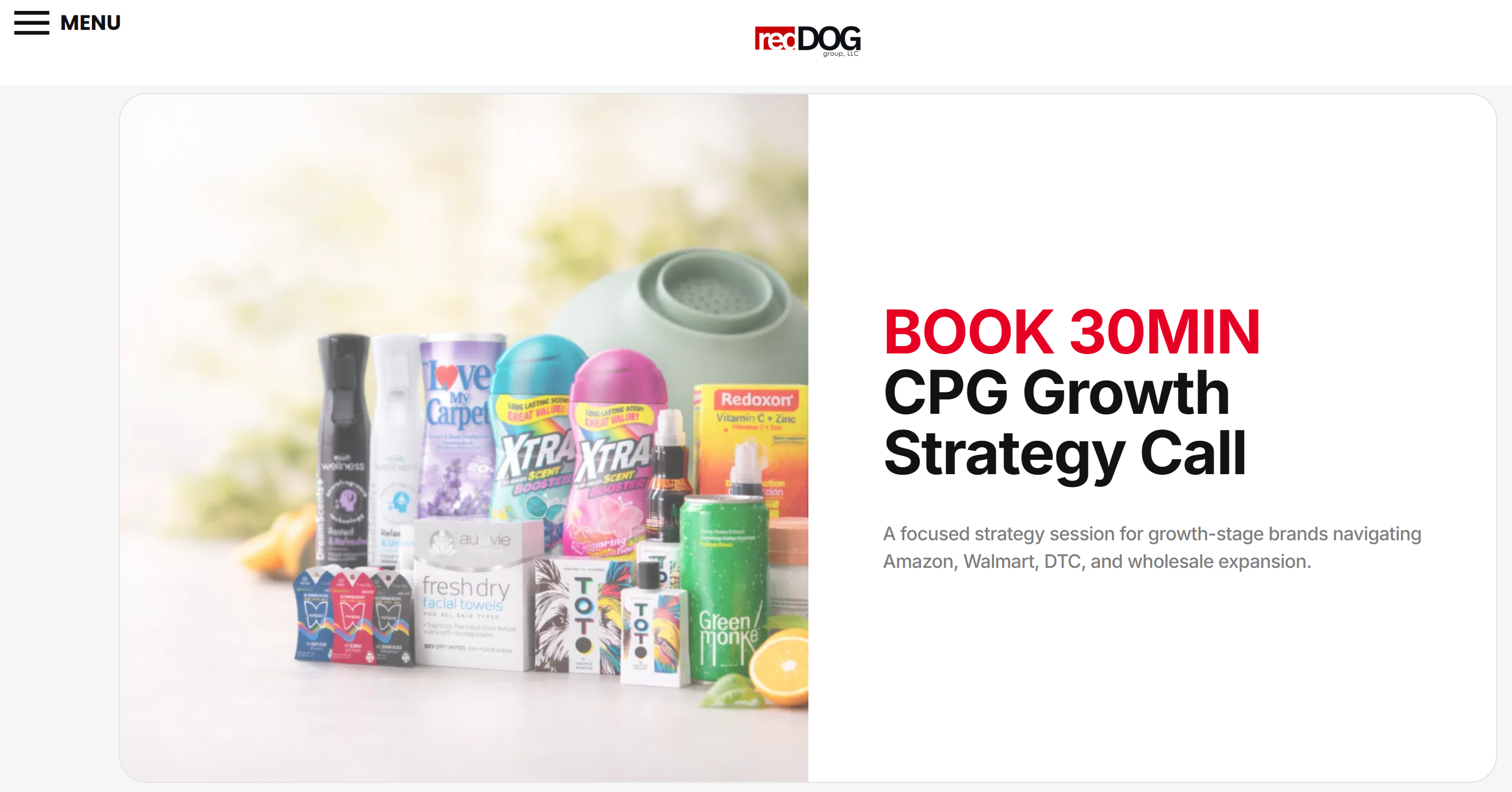
If you’re a founder or operator trying to figure out whether your next product launch, retail expansion, or marketplace push actually pencils out on contribution margin, a short conversation often surfaces the gap faster than another internal spreadsheet review. Reddog offers a free 30-minute strategy call built around exactly that: a practical, consultative look at your channel economics, inventory velocity, or growth plan, not a sales pitch. Book a strategy call to walk through where your margin is leaking and where it’s worth doubling down.
Leave a comment: