
Published: March 2020 | Last Updated:June 2026
© Copyright 2026, Reddog Consulting Group.

TL;DR:
- In 2025, SEO success depends on building citation presence within AI-generated Overviews rather than solely focusing on rankings. Brands must adopt Answer Engine Optimization (AEO) strategies and emphasize verifiable, structured content that AI systems can extract and cite. Measuring impressions, citations, and brand mentions provides a more accurate view of search visibility than traditional click-based metrics.
SEO trends in 2025 are defined by a single structural shift: Google’s AI Overviews have moved the competitive battlefield from ranking positions to citation presence inside AI-generated summaries. Organic clicks no longer tell the full story of search visibility. Brands that understand this shift, and build content strategies around it, are capturing attention even when users never click through to their site. Seer Interactive, Adobe, and analysts like Kevin Indig have all documented this transformation with hard data, and the implications reach every marketer managing an online presence today.
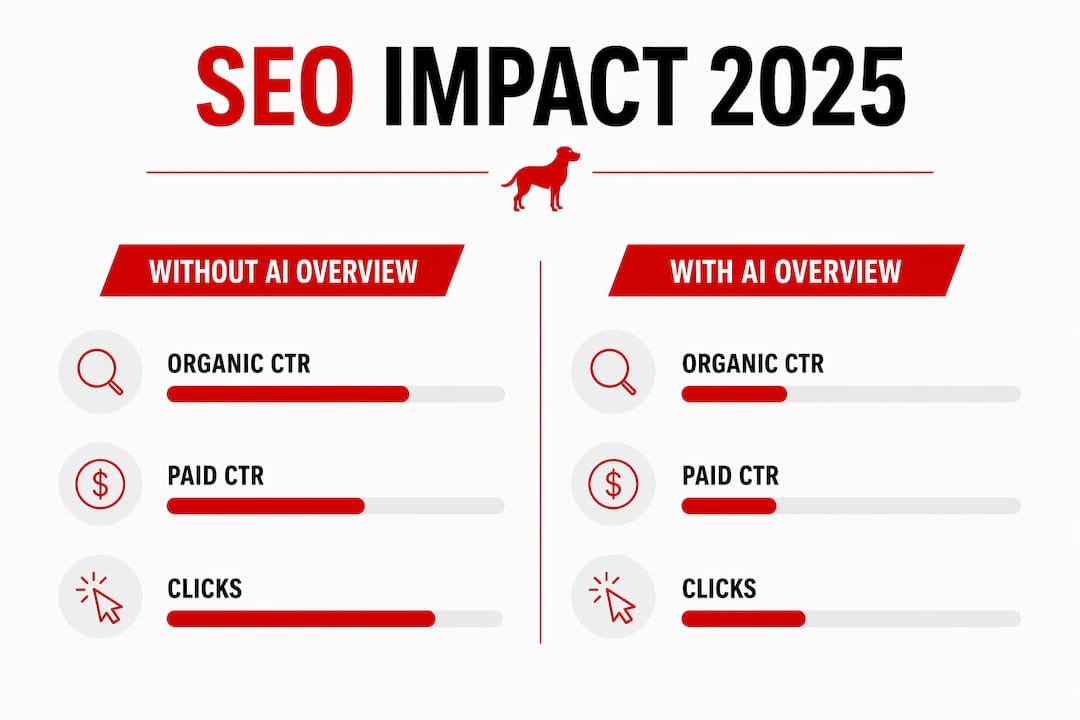
AI Overviews have produced the most measurable disruption in organic search behavior since Google’s Panda update. Organic CTR fell from 1.76% to 0.61% on queries where AI Overviews appeared, according to Seer Interactive’s analysis of 5.47 million queries and 2.43 billion impressions. That is a 61% decline, and it means that ranking on page one no longer guarantees the traffic it once did.

The picture is more nuanced than a simple collapse, though. CTR on AI Overview queries rebounded from a floor of 1.3% in December 2025 to 2.4% by February 2026, suggesting users are still clicking through when they want more depth than a summary provides. The gap between AIO and non-AIO query CTR remains significant, which means the queries most likely to trigger an AI Overview are also the queries where organic traffic is hardest to capture.
Paid search CTR has shifted as well. As organic results get pushed further down the page by AI summaries, paid placements above the fold are absorbing a larger share of clicks on commercial queries. For SEO teams, this changes the conversation with leadership: impressions and citation presence are now as meaningful as clicks when measuring whether a content strategy is working.
| Metric | Without AI Overview | With AI Overview |
|---|---|---|
| Organic CTR | ~1.76% | ~0.61% (2025 low) |
| CTR recovery (Feb 2026) | Stable | ~2.4% |
| Paid CTR impact | Baseline | Increased share |
| Strategic priority | Rankings | Citation presence |
Pro Tip: Set up a separate Google Search Console segment filtering queries where your pages appear but receive zero clicks. A high impression count with near-zero CTR on those queries is a strong signal that an AI Overview is intercepting traffic you used to own.
Answer Engine Optimization, or AEO, is the practice of structuring content so that AI answer engines, including Google’s AI Overviews, ChatGPT, and Perplexity, extract and cite your brand as a source. It is not a replacement for traditional SEO. It is a layer built on top of it, designed for a search environment where the answer often appears before the user ever sees a list of blue links.
AEO requires structuring content for AI extraction with answer-ready passages, clear definitional sentences at the top of each section, and self-contained evidence blocks that an AI system can lift without losing context. The difference between a page that gets cited and one that gets ignored often comes down to whether the first two sentences of a section directly answer the question the heading poses. Vague introductory paragraphs that build toward a point are invisible to AI extraction logic.
Practical AEO tactics include:
Pro Tip: Audit your five highest-traffic pages and check whether each H2 section opens with a direct, citable sentence. If the first sentence is contextual or transitional rather than declarative, rewrite it. That single change can increase your AI citation eligibility across your existing content library.
The timeline for AEO results is longer than traditional on-page SEO. Expect three to six months before citation presence becomes measurable, because AI systems need time to re-index and re-evaluate content after updates.
E-E-A-T, which stands for Experience, Expertise, Authoritativeness, and Trustworthiness, is Google’s framework for evaluating content quality through its Search Quality Rater Guidelines. The first “E” for Experience was added to signal that Google now distinguishes between content written by someone who has done something and content written by someone who has only researched it. That distinction matters enormously in an era when AI-generated content can mimic expertise without possessing it.
Building E-E-A-T compliance into a content strategy requires concrete, verifiable signals rather than vague claims of authority. Here is how to approach it systematically:
E-E-A-T is also the mechanism by which human-authored content differentiates itself from AI-generated content at scale. As AI content floods search results, the brands that invest in documented experience and transparent authorship will hold a structural advantage that pure content volume cannot replicate.
The visibility economy is the term Kevin Indig uses to describe the current SEO environment, where search visibility, brand influence, and trust matter more than click-through rankings alone. Adapting to it requires changes to how you measure success, how you structure content, and where you invest in brand authority.
Shift your KPIs. Adobe and Kevin Indig both emphasize moving from clicks to impressions, citations, and brand mentions as primary success metrics. If your brand appears in an AI Overview for a high-intent query, that is a measurable win even if the user does not click through. Build a reporting dashboard that tracks AI citation frequency alongside traditional rank tracking.
Develop content optimized for AI citation. AI agents shape user decisions before users visit a site, which means your content needs to be extractable, verifiable, and contextually clear. Treat every major content page as a potential AI source document. Structure it accordingly with direct claims, named entities, and source-backed data in the first 30% of the piece.
Invest in community-driven validation. Platforms like Reddit and YouTube boost trust and are part of the modern SEO strategy. Participating in niche forums, earning mentions in community threads, and building a YouTube presence creates social proof that AI systems recognize as a trust signal. This is not a shortcut. It is a long-term brand authority investment.
Run citation audits, not just rank reports. Brands that audit AI Overview citations and optimize for source presence recover faster from organic CTR declines. Use tools like Semrush, Ahrefs, or dedicated AI visibility trackers to monitor whether your content appears as a cited source in AI Overviews, not just whether it ranks on page one.
A practical ecommerce SEO approach for 2025 combines these citation-focused tactics with the foundational technical SEO work that has always mattered: site speed, structured data markup, and mobile performance. Neither replaces the other.
SEO in 2025 is a visibility and citation discipline, not a ranking discipline, and brands that measure only clicks are missing the majority of their actual search presence.
| Point | Details |
|---|---|
| AI Overviews cut CTR sharply | Organic CTR dropped 61% on affected queries; citation presence now drives brand visibility. |
| AEO complements traditional SEO | Structure content with direct definitions, question headings, and self-contained paragraphs for AI extraction. |
| E-E-A-T signals differentiate content | Author credentials, first-hand experience artifacts, and transparent updates build trust with both Google and AI systems. |
| KPIs must evolve | Track impressions, citations, and brand mentions alongside clicks to measure true search visibility. |
| Citation audits outperform rank reports | Monitoring whether your content is cited in AI Overviews reveals more about your actual visibility than position tracking alone. |
The brands that are struggling most right now are not the ones with bad content. They are the ones measuring the wrong things. When a client sees their organic clicks drop 40% and panics, the first question I ask is: did your impressions hold? If impressions are stable and clicks fell, you likely have an AI Overview intercepting your traffic, not a penalty or a ranking collapse. Those are completely different problems with completely different solutions.
What I have found actually works is treating citation audits as a monthly discipline rather than a one-time diagnostic. SEO teams that use citation audits rather than ranking reports understand their AI Overview presence far better, and they catch citation losses before they compound into traffic problems. Pair that with a content refresh calendar that prioritizes your highest-impression pages for AEO rewrites, and you have a workflow that addresses both the old SEO and the new visibility economy simultaneously.
The uncomfortable truth is that most content libraries were not built for AI extraction. They were built for human readers who scroll, skim, and click. Retrofitting that content for citation eligibility is not glamorous work, but it is the highest-return SEO investment most brands can make right now. Proprietary data, original case studies, and documented first-hand experience are the assets that AI systems cannot replicate from other sources. Build those into your content, and you create a citation moat that generic AI-generated content cannot cross.
— Reddog
Reddog works with CPG founders and operators who need their digital presence to do real commercial work, not just generate impressions. If your organic traffic metrics are shifting and you are not sure whether the cause is an AI Overview, a content gap, or a structural SEO issue, a focused review session can clarify the picture fast. Our SEO content strategy work is built around contribution-margin thinking: we look at which channels and content investments are actually driving profitable growth, not just top-line visibility numbers. If you are a CPG brand in the $500K to $20M range and want a practical 30-minute review of your current search visibility, channel economics, or content structure, book a free strategy call with the Reddog team at reddog.group. No pitch. Just a clear-eyed look at where your visibility stands and what is worth fixing first.
The most significant change is the widespread rollout of Google’s AI Overviews, which intercept organic clicks and shift the competitive focus from ranking positions to citation presence inside AI-generated summaries. Brands now need to optimize for Answer Engine Optimization (AEO) alongside traditional SEO.
Seer Interactive’s analysis of 5.47 million queries found that organic CTR fell from 1.76% to 0.61% on queries where AI Overviews appeared, a 61% decline. CTR partially recovered to 2.4% by February 2026 but remains below non-AIO query levels.
AEO is the practice of structuring content so AI answer engines like Google’s AI Overviews, ChatGPT, and Perplexity extract and cite your brand as a source. It requires direct definitional sentences, question-style headings, and self-contained evidence blocks.
Google’s E-E-A-T framework now prioritizes verifiable first-hand experience, transparent authorship, and source-backed claims. Content with named authors, original data, and documented update histories scores higher with both Google’s quality raters and AI extraction systems.
Track impressions, AI citation frequency, and brand mentions alongside traditional click and ranking data. Brands that monitor citation presence in AI Overviews rather than relying solely on rank reports get a more accurate picture of their actual search visibility.
Leave a comment: