
Published: March 2020 | Last Updated:March 2026
© Copyright 2026, Reddog Consulting Group.

PPC advertising drives up to 60% of Amazon sales revenue for CPG brands, yet most campaigns quietly erode profit margins through poorly managed spend and ignored backend costs. Texas CPG founders face a critical challenge: marketplace fee structures and margin compression demand a contribution margin-first approach to advertising. Without strategic PPC management aligned to profitability, brands risk unsustainable growth that looks impressive on top-line revenue but destroys cash flow and operational viability.
| Point | Details |
|---|---|
| PPC drives major revenue but requires margin-aware budgeting | PPC influences up to 60% of Amazon CPG sales but demands careful cost management to preserve profitability. |
| Marketplace fees compress margins significantly | Amazon and Walmart fees consume 30-40% or more of sales price, requiring channel-specific PPC strategies. |
| Common myths waste ad spend | Misconceptions about clicks, impressions, and universal strategies cause up to 30% wasted spend without backend analysis. |
| Multi-channel PPC needs tailored approaches | Each platform requires distinct bidding and targeting strategies for optimal margin protection. |
| Contribution margin focus improves ROI | Data-driven, profit-centered PPC campaigns can boost ROI by up to 25% compared to revenue-only tracking. |
PPC advertising dominates revenue generation for CPG brands selling on ecommerce platforms, particularly Amazon. For many brands, sponsored product ads and keyword campaigns account for the majority of daily sales velocity. This advertising model creates immediate visibility in crowded digital shelves where organic reach alone cannot sustain growth.
Yet this same revenue engine carries hidden costs. Marketplace fulfillment and referral fees consume substantial sales percentages before brands see profit. Amazon FBA fees, referral charges, and Walmart WFS costs stack quickly. When PPC spend gets layered on top, the actual contribution margin per sale shrinks dramatically. Many brands celebrate revenue growth while unknowingly operating campaigns that lose money on every conversion.
Prioritizing contribution margin over top-line sales creates sustainable growth. This means tracking what remains after all costs, not just what flows through the register. Brands that increase ecommerce sales for CPG brands profitably understand this distinction. They build campaigns around net profit, not gross revenue.
Consider these PPC impacts and margin challenges:
“PPC advertising can drive explosive revenue growth for CPG brands, but without rigorous margin analysis, that growth becomes a trap. Every click must be evaluated against its true cost to the business, including all marketplace fees and operational expenses.”
The path forward requires discipline. Track every dollar spent against every dollar kept. Build campaigns that protect margins while capturing market share. Understand that profitable growth beats explosive revenue every time.
Marketplace fee structures create the economic foundation for PPC profitability decisions. Understanding exactly how much each platform takes from every sale determines how much room exists for advertising spend. These fees are not negotiable for most emerging brands, making them fixed costs that must be planned around.
Amazon FBA fees and referral fees combined can consume 30-40% of product sales price, making PPC spend critical for margins. For a $20 CPG product, expect $6-8 to disappear immediately into Amazon’s ecosystem. Add another $3-6 for PPC costs on competitive keywords, and suddenly a $20 sale generates $6-11 in gross margin before considering COGS, shipping to Amazon, or operational overhead.

Walmart presents even tighter constraints. Walmart WFS fees commonly compress margins 5-10% more than Amazon FBA fees, requiring even stricter PPC controls. The promise of Walmart’s growing marketplace comes with higher fulfillment costs and different competitive dynamics. Brands that simply copy Amazon PPC strategies to Walmart often find campaigns underwater on contribution margin.
Here is how fees compare across platforms for a typical $20 CPG product:
| Platform | Referral Fee | Fulfillment Fee | Total Fees | Net Before PPC | PPC Budget Room |
|---|---|---|---|---|---|
| Amazon FBA | $3.00 (15%) | $4.50 | $7.50 (37.5%) | $12.50 | $2-4 (10-20%) |
| Walmart WFS | $3.00 (15%) | $5.50 | $8.50 (42.5%) | $11.50 | $1.50-3 (7.5-15%) |
| DTC (Self-Ship) | $0 | $2.50 (3PL) | $2.50 (12.5%) | $17.50 | $4-6 (20-30%) |
These numbers reveal tight margin windows. For Amazon, spending more than 15-20% of sales price on PPC pushes most products toward break-even or loss. Walmart narrows that window to 10-15%. DTC offers more breathing room but requires higher customer acquisition costs and lacks marketplace traffic.
Pro Tip: Audit your actual fee percentages monthly using platform reports. Fee structures change, product dimensions affect fulfillment costs, and category referral rates vary. What worked last quarter may be losing money today without you realizing it.
Margin compression directly dictates PPC campaign architecture. Brands must set maximum ACoS (Advertising Cost of Sale) targets based on contribution margin, not revenue. This requires marketplace fee optimization strategies that account for every platform’s unique cost structure. Ignoring this reality means scaling campaigns that destroy profitability while appearing successful on surface metrics.
Several widespread myths about PPC advertising lead Texas CPG brands to waste significant budget while believing they are investing in growth. These misconceptions persist because surface metrics like clicks and impressions feel like progress, even when backend analysis reveals margin erosion.
Myth 1: Increasing PPC spend always produces greater profit. Many brands treat PPC budgets as linear growth levers, assuming double the spend yields double the profit. Reality proves different. Diminishing returns kick in quickly as you exhaust high-intent keywords and expand into less qualified traffic. Spending $10,000 monthly might generate strong ROI, but jumping to $20,000 often cuts profit per sale by 30-40% as you bid on marginal keywords.
Myth 2: Click volume or impressions directly indicate profitability. High traffic feels validating, but clicks without contribution margin analysis mean nothing. A campaign generating 10,000 clicks monthly at $0.75 each costs $7,500. If those clicks convert at 5% and average $25 order value, you generate $12,500 in sales revenue. Sounds good until you subtract 35% in marketplace fees ($4,375) and realize you netted $625 on $7,500 spent. That is an 8% return before considering COGS.
Myth 3: PPC strategies are universal across marketplaces. Amazon tactics do not transfer cleanly to Walmart, and neither works for DTC social campaigns. Each platform has unique auction dynamics, customer intent signals, and fee structures. Applying one-size-fits-all approaches wastes budget on platforms where the strategy mismatches the environment.
Here is what these misconceptions actually cost:
The fix requires shifting perspective. View PPC spend through a contribution margin lens. Track what each campaign actually contributes to business profit after all costs. Build profit-focused PPC reports that reveal true performance rather than vanity metrics. Stop campaigns that look impressive but destroy margins. This discipline separates brands that scale profitably from those that grow broke.
Each major ecommerce channel requires distinct PPC approaches because auction dynamics, customer behavior, and fee structures differ fundamentally. Texas CPG brands attempting to replicate strategies across platforms leave money on the table or worse, fund losing campaigns without realizing it.
Amazon PPC centers on keyword-targeting within a closed ecosystem. Shoppers arrive with purchase intent, search specific terms, and convert quickly. Sponsored Products, Sponsored Brands, and Sponsored Display ads compete in auctions where relevance and bid amount determine placement. The platform’s 30-40% fee structure means aggressive bidding quickly erodes margins. Successful Amazon PPC requires tight keyword selection, negative keyword discipline, and constant bid adjustments based on conversion rate and contribution margin per ASIN.
Walmart PPC emphasizes sponsored product placements with different auction mechanics. The platform attracts more price-sensitive shoppers and offers less sophisticated targeting options than Amazon. Lower traffic volume means less data for optimization, but also less competition on many keywords. The critical factor is Walmart’s higher fulfillment costs, which compress the margin available for ad spend. Brands must bid more conservatively and focus on high-conversion placements rather than broad visibility.
DTC PPC relies heavily on social media retargeting and search campaigns outside marketplace ecosystems. Facebook, Instagram, and Google Ads drive traffic to owned properties where brands control the full customer experience. This approach carries zero marketplace fees but demands higher customer acquisition costs. Building audiences, creative testing, and funnel optimization become more important than keyword bidding. The tradeoff is higher upfront investment for potentially better lifetime value.
Here is how these channels compare strategically:
| Channel | Primary Focus | Fee Impact | Bidding Strategy | Typical ROI |
|---|---|---|---|---|
| Amazon PPC | Keyword targeting, high intent | 30-40% fees | Aggressive on converting terms, tight ACoS limits | 3-5x ROAS |
| Walmart PPC | Sponsored placements, price sensitivity | 35-45% fees | Conservative bids, placement focus | 2.5-4x ROAS |
| DTC PPC | Audience building, retargeting | 0% marketplace fees | Creative testing, funnel optimization | 4-6x ROAS |
Optimizing each channel requires tailored tactics:
Pro Tip: Test channel-specific tactics with 10-15% of total PPC budget before scaling. Run parallel campaigns for 30 days, analyze contribution margin per channel, then allocate budget to highest-performing approaches. Do not assume what works on Amazon will succeed on Walmart or DTC without validation.
Marketplace-specific PPC strategies recognize these differences and build campaigns accordingly. Brands that master CPG PPC optimization techniques across multiple channels create portfolio effects where each platform contributes optimally to overall profitability. The goal is not equal performance everywhere, but maximized contribution margin from the total advertising investment.
Contribution margin represents the true measure of PPC campaign success: what remains after subtracting all variable costs from revenue. For CPG brands, this means sales revenue minus marketplace fees, PPC costs, COGS, and relevant operational expenses. Tracking this metric rather than revenue or ROAS transforms campaign management from guesswork to precision.
Calculating contribution margin from PPC requires systematic tracking:
For example, a campaign generating $10,000 in sales might break down as follows: $10,000 revenue, minus $3,500 marketplace fees (35%), minus $1,800 PPC spend (18% ACoS), minus $3,200 COGS (32%), equals $1,500 contribution margin. That is a 15% contribution margin rate. Without this calculation, the 18% ACoS might seem acceptable, but the full picture reveals tight margins.
Here is how focusing on margin versus revenue impacts PPC budget allocation and ROI:
| Metric Focus | Budget Allocation Approach | Typical Outcome | ROI Improvement |
|---|---|---|---|
| Revenue Only | Spend on highest-revenue keywords | Wasteful campaigns, margin leaks | Baseline |
| ROAS Target | Aim for 3-4x return ratio | Better than revenue, misses cost structure | +10-15% |
| Contribution Margin | Allocate to highest net profit campaigns | Optimized spend, protected margins | +20-25% |
The data shows that brands shifting to contribution margin optimization improve ROI by up to 25% compared to revenue-focused approaches. This happens because margin-focused management quickly identifies and stops campaigns that look successful on surface metrics but lose money when all costs are factored in.
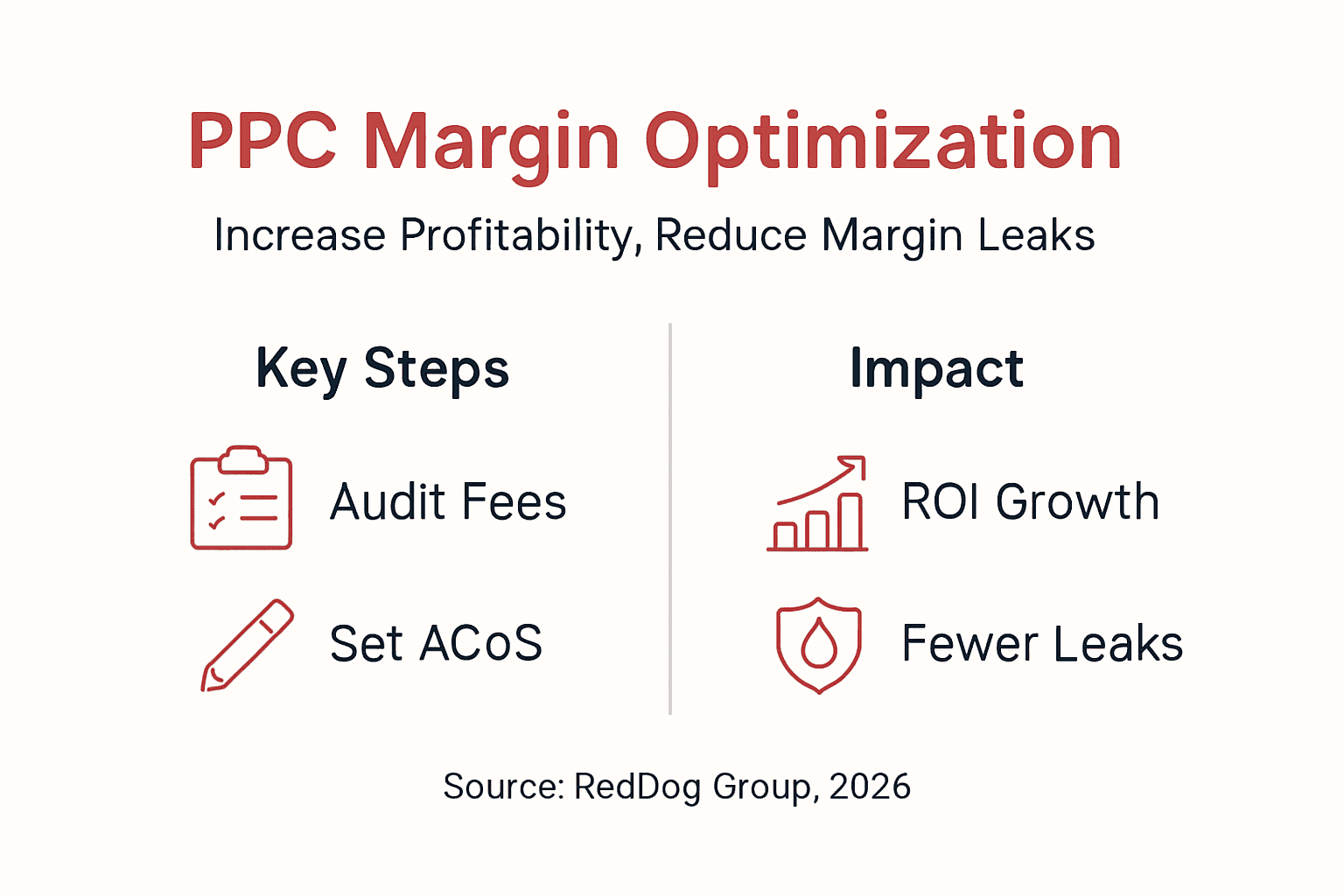
Pro Tip: Stop any campaign with negative contribution margin within 48 hours of identification. Do not wait to see if it improves. Redirect that budget to proven profitable campaigns immediately. Every day a losing campaign runs destroys cash and margin you will never recover.
Building this discipline requires better reporting infrastructure. Most platform dashboards show revenue and ROAS but hide the full cost picture. Use a CPG profit margin calculator to model campaign economics before scaling spend. Create custom PPC contribution margin reports that surface true profitability at the campaign and keyword level. Without these tools, brands fly blind, mistaking busy activity for productive growth.
PPC campaigns do not exist in isolation. They interact directly with inventory availability and cash flow cycles, creating operational constraints that can amplify or destroy advertising effectiveness. Texas CPG brands that ignore these connections waste budget and miss sales opportunities even when campaigns are technically well-optimized.
High PPC spend without sufficient inventory creates a painful scenario. Campaigns drive traffic and conversions, products sell out, then ads continue running to out-of-stock listings. You pay for clicks that cannot convert, waste budget, and damage organic ranking as Amazon or Walmart registers the stockout. Restocking takes weeks, during which time you lose momentum and ranking position. The result is expensive customer acquisition followed by forced campaign pauses that reset all progress.
Cash flow timing presents another critical constraint. PPC platforms charge immediately for clicks, but marketplace payouts lag by 14-30 days depending on platform and payment terms. This timing gap means brands need working capital to fund campaigns before revenue arrives. Scaling PPC spend by 50% might require $15,000-25,000 in additional cash float. Brands without adequate reserves hit cash flow walls that force campaign cuts right when momentum builds.
Operational best practices for integrating PPC with business constraints:
Ignoring these constraints produces predictable failures. Campaigns run dry on inventory, forcing emergency restocks at premium freight costs. Cash shortages lead to paused campaigns and lost ranking. Customers encounter out-of-stock experiences that damage brand perception. The margin gains from optimized PPC evaporate through operational costs and lost opportunities.
Smart brands treat PPC as part of an integrated system. They build ecommerce site optimization for profit strategies that synchronize advertising, inventory planning, and cash management. This systems thinking prevents the common scenario where marketing drives demand the business cannot profitably fulfill.
Allocating PPC budgets across channels and products requires a structured decision model that prioritizes contribution margin over convenience or gut feeling. This framework helps Texas CPG brands maximize profitability from total advertising investment by directing spend where it generates the highest net return.
The framework follows four key steps:
Audit current contribution margin by channel and product: Calculate true profit after all costs for each product on each platform. Identify which combinations generate positive margins above 15% and which operate below breakeven. This baseline reveals where PPC investment has room to scale versus where spending must be cut or restructured.
Establish channel-specific maximum ACoS targets based on fee structures: Use marketplace fee percentages to set hard caps on advertising costs. For Amazon with 35% fees and 30% COGS, maximum sustainable ACoS is approximately 15-18% to preserve 15-20% contribution margin. Walmart might require 12-15% ACoS caps. DTC can support 20-25% customer acquisition costs given zero marketplace fees.
Integrate inventory and cash flow constraints into budget planning: Map PPC budget increases to confirmed inventory arrivals and available working capital. Set monthly spend limits that align with operational capacity to fulfill demand without stockouts or cash crunches. Build buffer room for 20-30% demand variability.
Allocate budgets prioritizing highest contribution margin opportunities: Direct the largest budget percentages to product-channel combinations delivering the best net profit per dollar spent. Cut or minimize spending on campaigns operating below target margins. Test small budgets on new opportunities but scale only proven profitable approaches.
This systematic approach delivers measurable ROI improvements:
| Approach | Average ROI Lift | Implementation Complexity | Margin Protection |
|---|---|---|---|
| Intuitive Budget Splits | Baseline | Low | Poor |
| Revenue-Based Allocation | +8-12% | Medium | Fair |
| ROAS-Optimized Allocation | +12-15% | Medium | Good |
| Contribution Margin Framework | +15-25% | High | Excellent |
The data shows that brands implementing contribution margin-focused frameworks achieve 15-25% better ROI compared to intuitive budget decisions. This happens because the framework forces discipline around profitability rather than allowing spend to flow toward high-revenue but low-margin opportunities.
Pro Tip: Review budget allocations monthly using updated contribution margin data. Markets shift, fees change, and competition evolves. What was profitable last quarter may need adjustment today. Set calendar reminders for the first business day of each month to run this analysis.
This framework supports channel diversification strategies by revealing which channels deserve increased investment versus which should be deprioritized. It provides the analytical foundation for multi-channel PPC budgeting that scales profitably rather than just growing top-line revenue. For Texas CPG brands navigating multiple retail channels simultaneously, this structured approach prevents margin leakage while capturing growth opportunities.
Implementing margin-focused PPC management requires moving from theory to daily practice. These actionable steps help Texas CPG brand operators apply the frameworks and insights covered throughout this guide to real campaign management and business decisions.
Key implementation steps:
Pro Tip: Create a simple spreadsheet calculating contribution margin for your top 10 products across all channels. Update it weekly. This single tool will reveal more about campaign performance than any platform dashboard. When margin drops below 15% on any product-channel combination, investigate immediately and adjust campaigns within 24 hours.
Texas CPG brands face unique operational considerations that affect PPC strategy. Regional distribution networks, relationships with local retailers, and understanding of in-state customer preferences all influence which channels and tactics work best. Brands with strong Texas retail presence can use PPC to support wholesale relationships by driving online awareness that translates to in-store purchases. This multiplier effect makes DTC PPC more valuable than pure online metrics suggest.
The integration of these practices transforms PPC from a cost center to a profit driver. Brands that master contribution margin optimization find their advertising investment generates sustainable returns rather than impressive but unprofitable growth. They build ecommerce sales increase strategies that account for real business economics.
Successful PPC management also supports broader business objectives. Profitable campaigns fund conversion rate optimization for CPG investments that improve organic performance. Margin protection enables inventory investment in new products. Disciplined spending creates cash flow for building customer loyalty programs that reduce future acquisition costs.
The key is treating PPC as an integrated part of business strategy, not an isolated marketing tactic. Every campaign decision affects inventory needs, cash flow timing, and overall profitability. Brands that connect these dots build sustainable competitive advantages in crowded CPG markets.
Texas CPG brands navigating the complexity of multi-channel PPC profitability need more than generic marketing advice. RedDog Group provides specialized consulting that connects marketplace economics with operational reality, helping brands scale advertising profitably rather than just growing revenue.
Our approach starts with contribution margin analysis across all your channels. We audit Amazon, Walmart, and DTC campaigns to identify exactly where margin leaks hide and which tactics actually drive profit. This analysis reveals opportunities most brands miss because they track the wrong metrics.
We build CPG conversion rate optimization strategies that improve advertising ROI without increasing spend. Our frameworks help you increase ecommerce sales while protecting the margins that keep your business sustainable. We understand Texas retail dynamics and how online performance supports wholesale relationships and regional expansion.
RedDog Group specializes in emerging and growth-stage CPG brands in the $500K-$20M revenue range. We work with founders and operators who need structured, data-driven approaches to marketplace advertising that account for real business constraints. If you are ready to transform PPC from a cost center to a profit driver, explore our CPG retail growth consulting services.
Amazon charges combined FBA and referral fees typically totaling 30-40% of your product sales price, leaving limited room for profitable PPC spend. Walmart WFS fees generally run 5-10% higher than Amazon equivalents, compressing margins further and requiring even more conservative advertising budgets to maintain profitability.
Start by pulling detailed sales data from each platform and subtracting all marketplace fees, PPC costs, COGS, and operational expenses to calculate true net profit per campaign. Use a CPG profit margin calculator to model economics before scaling spend, and build custom reporting that surfaces contribution margin rather than just revenue or ROAS.
Many brands believe higher PPC spend automatically produces proportional profit increases, but diminishing returns typically waste 25-35% of budget on low-converting traffic. Focusing on clicks and impressions instead of backend profitability causes up to 30% of campaigns to run unprofitably. Applying universal strategies across Amazon, Walmart, and DTC without channel-specific customization typically reduces ROI by 15-25% compared to tailored approaches.
Sync PPC budget increases with confirmed inventory arrivals rather than forecasted shipments to avoid stockouts that waste ad spend. Maintain 60-90 days of inventory coverage and cash flow buffers of 1.5-2x your monthly PPC budget to handle marketplace payment timing gaps. Implement automated rules that reduce bids when inventory drops below 30-day supply to prevent paying for clicks that cannot convert.
Leave a comment: