
Published: March 2020 | Last Updated:April 2026
© Copyright 2026, Reddog Consulting Group.

TL;DR:
- Online reviews significantly influence ecommerce conversion, trust, and pricing power.
- Managing review quality, recency, and authenticity is essential for multichannel success.
- Using reviews strategically can reduce returns and improve profit margins.
Online reviews are quietly running your conversion numbers, and most CPG founders are not treating them that way. 62% of purchase variance in ecommerce is explained by review signals alone, yet brands continue to pour budget into ads while ignoring the review ecosystem sitting right on their product pages. This article cuts through the noise and gives you a practical, margin-focused framework for using reviews to lift conversion, reduce returns, protect compliance, and win better shelf positioning across Amazon, Walmart, DTC, and beyond.
| Point | Details |
|---|---|
| Reviews drive decisions | Customer reviews explain most differences in CPG ecommerce performance. |
| Quality and quantity matter | A mix of recent, authentic reviews across platforms builds the strongest brand trust. |
| Compliance is crucial | Ignoring FTC rules and allowing fake reviews can damage profits and reputation. |
| Leverage review insights | Use feedback patterns in reviews to reduce returns and improve profit margins. |
Reviews are not a soft marketing metric. They are a hard conversion driver, and the research backs that up clearly. When a shopper lands on your product page, reviews are doing more persuasion work than your copy, your images, or your price point in many cases. That is not an opinion. That is what the data shows.
The mechanism is straightforward. Positive reviews build trust with a standardized coefficient of β=0.52, meaning trust increases significantly as positive sentiment rises. On the flip side, negative reviews amplify perceived risk at β=-0.48, which means a cluster of bad reviews does not just annoy you. It actively pushes buyers away. For CPG brands selling consumables, supplements, food, or personal care products, perceived risk is especially high because customers cannot physically inspect the item before buying.
“The data is unambiguous: review sentiment shapes buyer psychology more than most brands realize. A single star improvement in average rating can shift conversion rates by double digits on competitive category pages.”
Here is what that means practically for your brand across channels:
For deeper context on how CPG review impact stats translate into real sales outcomes, the numbers are more significant than most brand leaders expect.
Not all reviews are equal, and not all platforms reward the same review signals. Understanding the mechanics behind review quality and volume across channels is where most brands find their biggest optimization gaps.
High ratings signal quality with a correlation of r=0.65 to purchase intent, but the platform context changes how that signal is weighted. Here is a quick comparison:
| Channel | What drives results | Volume threshold | Recency weight |
|---|---|---|---|
| Amazon | Verified purchase reviews, star rating, review velocity | 50+ for strong ranking | High (last 90 days) |
| Walmart | Star rating, review count, Q&A engagement | 20+ to appear credible | Medium |
| TikTok Shop | Video reviews, UGC (user-generated content), shares | 10+ video reviews | Very high |
| DTC site | Written depth, photo reviews, verified buyer badges | 15+ to reduce bounce | Medium |
The pattern is clear. Recency matters everywhere, but especially on Amazon and TikTok Shop. A product with 500 reviews that are two years old will underperform a competitor with 80 reviews from the past three months in many algorithm-driven contexts.
Here is a practical four-step process to audit and improve your review profile across channels:
For brands building out their full product page strategy, merchandising best practices and the ecommerce growth checklist are useful resources to layer alongside your review strategy.
Pro Tip: Focus your review requests on verified purchasers and prioritize recent reviews over total volume. A 4.7-star product with 60 reviews from the last 90 days will often outperform a 4.6-star product with 400 older reviews in algorithm-driven placements.
The review ecosystem has a fraud problem, and it is getting worse. Fake and AI-generated reviews now account for 30 to 40 percent of all review submissions across ecommerce platforms. That number should alarm you, not because you are generating them, but because your competitors might be, and because the regulatory environment is tightening fast.

The FTC updated its rules in 2024 and enforcement has continued into 2026. Incentivized reviews that tie compensation to positive sentiment are now explicitly banned. This includes giving free products in exchange for a guaranteed positive review, paying for reviews through third-party services, and suppressing or selectively removing negative reviews.
| Risk type | Platform signal | Potential consequence |
|---|---|---|
| Fake reviews (purchased) | Sudden volume spikes, generic language | Listing suppression, account suspension |
| Incentivized positive reviews | Review clusters from same IP or geography | FTC fine, platform ban |
| Review gating (hiding negatives) | Low negative review ratio despite high volume | Platform removal, legal exposure |
| AI-generated review content | Repetitive phrasing, no product specifics | Algorithmic demotion |
Here are four practices to avoid entirely in 2026:
Receipt verification is one of the most effective tools available to counter review fraud and demonstrate authenticity to both platforms and regulators. It ties review submissions to actual purchase receipts, which dramatically reduces manipulation.
For brands managing their Amazon presence, following Amazon brand guidelines is essential to staying compliant and protecting your listing integrity. Brands scaling across multiple platforms should also evaluate review response automation solutions to manage volume without sacrificing quality.
Pro Tip: Implement a receipt-based review request system for your DTC channel. It signals authenticity to shoppers, satisfies FTC requirements, and gives you a defensible audit trail if your review practices are ever questioned.
Once your review foundation is clean and compliant, the real opportunity is using reviews as a margin tool, not just a marketing asset. This is where most brands leave money on the table.
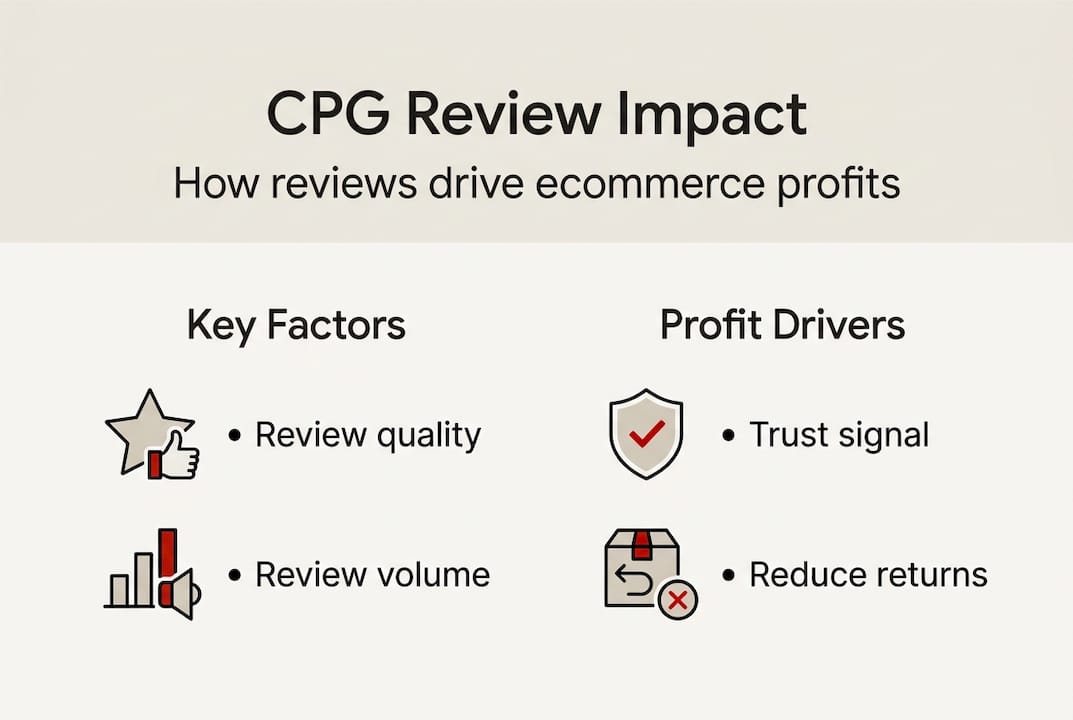
Negative reviews correlate with increased perceived risk at β=-0.48, which directly links to higher return rates and lower conversion. Fixing the issues that generate negative reviews is not just a customer service task. It is a margin improvement initiative.
Here is a four-step framework for review-driven margin optimization:
“Brands that treat review feedback as operational data, not just reputation management, consistently find 2 to 5 percentage points of margin improvement hiding in return rate reduction and product refinement cycles.”
For brands focused on reducing ecommerce returns, review analysis is one of the fastest ways to identify root causes. And for founders building a longer-term plan around scaling ecommerce profits, reviews belong in the financial model, not just the marketing deck.
Pro Tip: Take your top five recurring complaints and build them directly into your DTC FAQ and retail sell sheets. Addressing objections proactively in your listing copy reduces hesitation, improves conversion, and signals to retail buyers that you understand your customer.
Here is the uncomfortable truth: most review strategy advice stops at “get more reviews and respond to the bad ones.” That is not a strategy. That is maintenance.
The brands we see winning on review-driven growth are treating their review data the way a good operator treats their P&L. They are mining it for product signals, using it to shape listing copy, feeding it into their demand planning, and bringing it into buyer meetings as evidence of market fit. They are not chasing five stars. They are chasing actionable patterns.
The other missed opportunity is multi-platform orchestration. A strong Amazon review profile does not automatically transfer credibility to your Walmart page or your DTC site. Each channel needs its own review strategy, its own post-purchase flow, and its own engagement cadence. Brands that treat reviews as a single unified asset usually underperform on at least two of their four channels.
For brands serious about this, ecommerce account management guidance is a useful starting point for building the operational structure that makes review strategy sustainable at scale. The brands that pull ahead are not the ones with the most reviews. They are the ones who use reviews to make better decisions faster.
If the frameworks above resonate, the next step is putting them into practice across your actual channels with a margin-first lens.
At Reddog Group, we work with CPG brands in the $500K to $20M range to build review strategies that connect directly to contribution margin, not just star ratings. That means auditing your current review profiles across Amazon, Walmart, and DTC, identifying compliance gaps before they become penalties, and using review data to drive product and listing improvements that reduce returns and support premium pricing. If you are ready to treat your review ecosystem as a growth asset, our Amazon growth consulting team can build you a custom roadmap that ties review performance to real financial outcomes.
Reviews drive up to 62% of purchase decision variance by shaping trust and perceived quality across every platform where your product appears. Brands that actively manage their review profiles across channels consistently see higher conversion rates and stronger organic rankings.
With 30 to 40 percent prevalence across ecommerce platforms, fake or incentivized reviews can trigger FTC penalties, listing suppression, and long-term damage to consumer trust. The regulatory environment in 2026 leaves very little gray area for brands that cut corners.
Adopt receipt verification tools to tie reviews to actual purchases, avoid any form of review gating, and follow FTC guidelines on transparency and disclosure. Building a clean, verifiable review process protects your brand on every platform.
Not always. Negative reviews at β=-0.48 increase perceived risk, but brands that respond promptly and use the feedback to fix real product issues often see improved conversion and credibility over time. The damage comes from ignoring them, not from their existence.
Leave a comment: