
Published: March 2020 | Last Updated:March 2026
© Copyright 2026, Reddog Consulting Group.

Most CPG founders believe ecommerce growth comes from better marketing and product innovation. That’s only half the story. Supply chain efficiency drives 40% of marketplace performance, determining whether your brand scales profitably or bleeds cash through inventory mismanagement and fulfillment penalties. For brands selling on Amazon and Walmart, mastering supply chain logistics separates sustainable growth from expensive chaos. This guide reveals how strategic supply chain optimization unlocks marketplace success, protects margins, and builds the operational foundation for multi-channel expansion.
| Point | Details |
|---|---|
| Supply chain impact | Efficient supply chains boost marketplace performance by improving inventory velocity, reducing storage costs, and protecting margins. |
| DIO benchmark | Best in class operators maintain 30 to 40 days of inventory outstanding to balance availability with capital efficiency. |
| Fulfillment differences | Amazon FBA provides speed and broad SKU coverage while Walmart offers WFS for selected SKUs and MFN for merchant fulfillment. |
| Oversell prevention | Tight multi channel inventory management helps prevent overselling and improves the customer experience across marketplaces. |
Supply chain isn’t just logistics. It’s the operational engine that determines whether your CPG brand can maintain inventory velocity, preserve cash flow, and deliver consistent customer experiences across Amazon and Walmart. When your supply chain runs efficiently, you turn inventory faster, reduce storage costs, and free up capital for growth investments. When it falters, you face stockouts, excess inventory charges, and marketplace penalties that erode margins.
For CPG brands in the $500K to $20M range, inventory turnover benchmarks matter. Best-in-class operators achieve 30 to 40 days inventory outstanding (DIO), balancing product availability with capital efficiency. This benchmark reveals how well you’re managing the cash tied up in stock. Higher DIO means capital sits idle in warehouses instead of funding new product development or marketing. Lower DIO indicates strong demand forecasting and efficient replenishment cycles.
Marketplace fulfillment demands create unique supply chain pressure. Amazon customers expect two-day delivery as standard. Walmart shoppers increasingly demand the same speed. Your supply chain must support fast, accurate order fulfillment to maintain competitive positioning. Late shipments trigger performance penalties. Stockouts push customers to competitors. Overselling damages your seller rating and customer trust.
Effective ecommerce supply chain management becomes your competitive differentiator beyond product quality and brand marketing. Two brands with identical products compete on fulfillment speed, inventory availability, and operational reliability. The brand with tighter supply chain execution wins the buy box, earns better reviews, and scales more profitably. Your supply chain determines whether marketplace growth builds sustainable business or creates operational chaos.
Pro Tip: Calculate your current DIO by dividing average inventory value by cost of goods sold, then multiplying by 365. If you’re above 45 days, you’re likely carrying excess stock that’s draining working capital and increasing storage fees.
Amazon and Walmart require different fulfillment approaches based on their unique marketplace economics and customer expectations. Understanding these differences helps you allocate inventory strategically and optimize fulfillment costs across platforms.
Amazon FBA remains the default choice for most CPG brands seeking speed and SKU variety. FBA handles storage, picking, packing, and shipping while providing Prime eligibility that drives conversion rates. The service works well for brands with broad product assortments because Amazon’s fulfillment network supports fast delivery across hundreds of SKUs. You send inventory to Amazon warehouses, and they handle the operational complexity of order fulfillment.
Walmart offers two primary fulfillment paths. Walmart Fulfillment Services (WFS) mirrors FBA but typically gets used for top-performing SKUs where you want to guarantee two-day delivery and compete directly with Walmart’s retail assortment. WFS makes sense when you’re prioritizing specific products for growth on the platform. Walmart Merchant Fulfilled Network (MFN) gives you more control, letting you fulfill orders from your own warehouse or 3PL while maintaining flexibility for cross-channel inventory allocation.
The strategic differences between platforms shape your fulfillment decisions. Use FBA for broad SKU coverage on Amazon where Prime eligibility drives sales velocity. Deploy WFS for your hero products on Walmart where you’re making concentrated growth bets. Leverage MFN when you need inventory flexibility across multiple channels or when fulfillment economics favor self-managed logistics.
Prep services have become essential after Amazon tightened fulfillment requirements. Products must arrive at fulfillment centers properly labeled, packaged, and compliant with detailed specifications. Many brands now use specialized prep centers to ensure inventory meets Amazon’s standards before shipment. This extra step prevents rejection, delays, and non-compliance fees that damage profitability.
| Fulfillment Option | Best Use Case | Key Advantage | Consideration |
|---|---|---|---|
| Amazon FBA | Broad SKU assortment | Prime eligibility and speed | Higher fees for slow movers |
| Walmart WFS | Top-performing SKUs | Two-day delivery guarantee | Limited to priority products |
| Walmart MFN | Multi-channel flexibility | Inventory control | Requires reliable 3PL or warehouse |
| Multi-Channel Fulfillment | Cross-platform orders | Unified inventory pool | Additional per-order fees |
Your fulfillment strategy should match SKU priority, speed requirements, and multi-channel inventory needs. Don’t default to one solution across all products. Analyzing FBA economics per SKU reveals where the service adds value and where it destroys margins through excessive storage and fulfillment fees.
Pro Tip: Run a monthly SKU-level analysis comparing FBA fees against your 3PL costs. Slow-moving products with low sales velocity often cost more in long-term storage fees than they generate in gross profit. Pull these SKUs from FBA and fulfill them merchant-direct to protect margins.
Operational discipline separates profitable marketplace sellers from those constantly fighting penalties and stockouts. Walmart and Amazon enforce strict performance standards that directly impact your ability to compete and grow on their platforms.

On-Time In-Full (OTIF) delivery stands as the most critical compliance metric for CPG brands. Walmart requires OTIF rates above 95% to avoid financial penalties and maintain good seller standing. Amazon tracks similar metrics through its Inventory Performance Index and order defect rate. Falling below these thresholds triggers fee increases, buy box suppression, and potential account suspension.
Third-party logistics providers (3PLs) offer specialized expertise in maintaining compliance-heavy fulfillment operations. They understand the detailed requirements each marketplace imposes and build processes to ensure consistent OTIF performance. For brands in the $500K to $20M range, partnering with a capable 3PL often proves more cost-effective than building internal fulfillment capabilities while navigating complex marketplace rules.
Multi-channel inventory synchronization prevents the operational nightmare of overselling. When you sell the same SKU across Amazon, Walmart, your DTC site, and wholesale accounts, you need real-time inventory visibility to avoid promising products you can’t deliver. Integrated inventory management systems sync stock levels across all channels, automatically adjusting available quantities as orders come through each platform.
Supply chain resilience requires both diversified sourcing and predictive forecasting. Single-source manufacturing creates catastrophic risk when suppliers face production delays, quality issues, or capacity constraints. Building relationships with backup manufacturers in different regions provides insurance against disruption. You pay slightly higher per-unit costs for the security of continuous supply.
AI-powered demand forecasting transforms inventory planning from reactive guesswork to predictive science. Modern forecasting tools analyze historical sales patterns, seasonal trends, promotional impacts, and external market signals to predict future demand with increasing accuracy. These systems help you order the right quantities at the right time, reducing both stockout risk and excess inventory costs.
Here’s your operational excellence checklist:
“For $500K to $20M CPG operators, prioritizing OTIF above 95% protects marketplace standing while integrated inventory systems prevent the costly mistakes that damage customer trust and seller metrics.”
Operational excellence isn’t about perfection. It’s about building systems that maintain high performance consistently while quickly identifying and correcting issues before they escalate into major problems. Your logistics infrastructure should support growth without creating new operational complexity that overwhelms your team.
Pro Tip: Set up automated alerts when OTIF rates drop below 96% or when inventory levels fall to 15 days of supply. Early warning systems let you fix small problems before they become expensive crises.
You can’t optimize what you don’t measure. Supply chain performance requires systematic tracking of key metrics that reveal efficiency, risk exposure, and improvement opportunities.
Days Inventory Outstanding (DIO) measures how long capital sits tied up in inventory before converting to sales. Best-in-class CPG brands maintain 30 to 40 days DIO, indicating strong demand forecasting and efficient inventory turnover. Calculate DIO by dividing average inventory value by daily cost of goods sold. Higher numbers suggest overstocking or slow-moving products. Lower numbers might indicate stockout risk or exceptional demand.
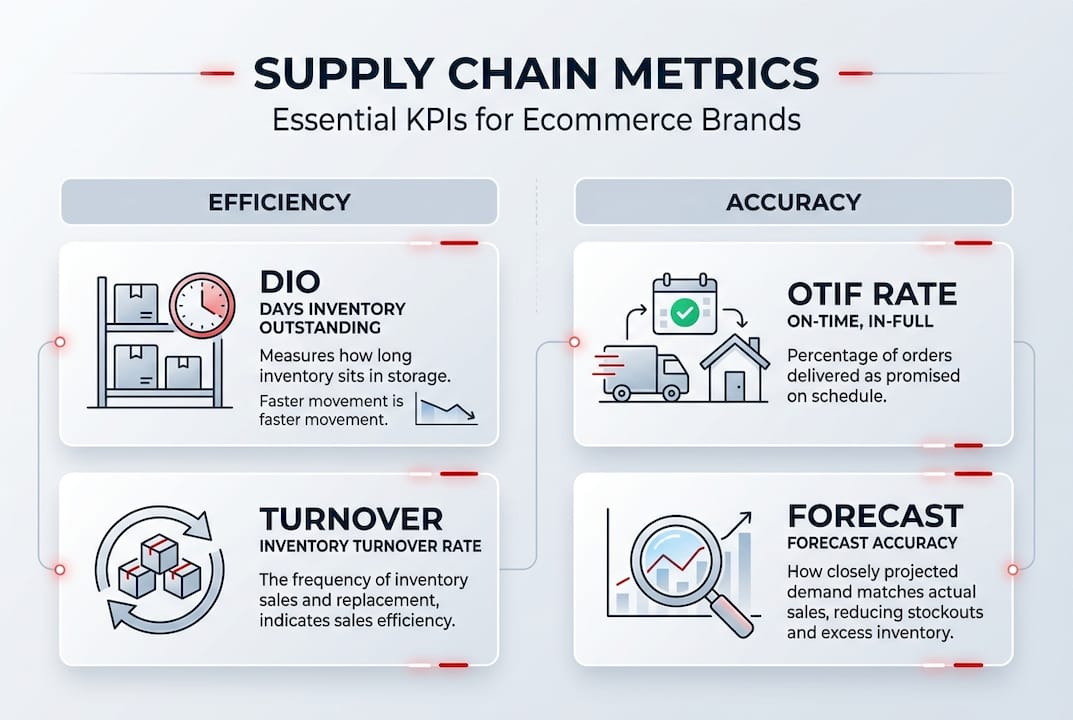
Inventory turnover ratio shows how many times you sell and replace inventory annually. Divide annual cost of goods sold by average inventory value. CPG brands should target 9 to 12 turns per year, though this varies by product category and shelf life. Higher turnover means you’re efficiently converting inventory to cash. Lower turnover signals excess stock, poor demand forecasting, or product-market fit issues.
OTIF rate tracks the percentage of orders delivered on time and complete. This metric directly impacts marketplace performance and customer satisfaction. Calculate it by dividing compliant deliveries by total deliveries. Target 95% or higher to avoid penalties and maintain competitive standing on Amazon and Walmart.
Forecast accuracy measures how well your demand predictions match actual sales. Calculate the percentage difference between forecasted and actual demand over specific periods. Improving forecast accuracy from 70% to 85% dramatically reduces both stockouts and excess inventory costs. Track this metric monthly and investigate significant variances to refine your forecasting models.
| KPI | Best-in-Class Target | What It Reveals | How to Improve |
|---|---|---|---|
| Days Inventory Outstanding | 30-40 days | Capital efficiency | Better forecasting, faster turnover |
| Inventory Turnover | 9-12 times/year | Stock velocity | Demand planning, SKU rationalization |
| OTIF Rate | >95% | Fulfillment reliability | 3PL partnership, process improvement |
| Forecast Accuracy | >85% | Demand prediction quality | AI tools, historical analysis |
Regular performance analysis identifies bottlenecks before they damage profitability. Review your supply chain metrics monthly, looking for trends rather than isolated data points. A single bad week might reflect temporary issues. Three consecutive months of declining OTIF rates signals a systemic problem requiring immediate attention.
Technology solutions automate much of the tracking and analysis work. Modern inventory management software integrates with your sales channels, providing real-time dashboards that surface performance issues as they emerge. These systems eliminate manual spreadsheet tracking while providing more accurate, timely data for decision-making.
Continuous improvement separates market leaders from competitors. Use your performance data to run controlled experiments. Test different reorder points, safety stock levels, or supplier lead times. Measure the results. Scale what works and abandon what doesn’t. This systematic approach to optimization compounds over time, creating significant competitive advantages.
Implement these measurement practices:
Ecommerce merchandising excellence depends on supply chain performance. You can’t promise fast delivery or maintain product availability without the operational backbone to support those commitments. Your metrics reveal whether your supply chain enables or constrains your growth ambitions.
Optimizing supply chain for ecommerce success requires specialized knowledge of marketplace fulfillment, inventory economics, and operational compliance. Most CPG brands in the $500K to $20M range lack the internal expertise to navigate Amazon FBA fee structures, Walmart OTIF requirements, and multi-channel inventory synchronization while simultaneously growing sales and managing cash flow.
RedDog Group helps emerging and growth-stage CPG brands build supply chain operations that support profitable marketplace expansion. We analyze your current fulfillment costs, identify margin leaks in your inventory management, and design strategies that balance growth with operational sustainability. Our approach focuses on contribution margin analysis, helping you understand what each channel and SKU actually contributes to profit after accounting for all fulfillment and storage costs. We work with brands navigating the complexity of selling on Walmart marketplace while maintaining Amazon performance, ensuring your supply chain supports multi-platform success without creating operational chaos. Whether you’re evaluating 3PL partners, optimizing FBA economics, or building forecasting capabilities, we provide the analytical frameworks and strategic guidance to make informed decisions that protect margins while enabling growth.
Meeting OTIF requirements above 95% while managing multi-channel inventory across platforms creates the primary operational challenge. Each marketplace enforces different compliance standards and fulfillment speed expectations that require specialized processes and systems.
FBA generally supports broad SKU assortments with Prime eligibility, while WFS works best for top-performing products requiring two-day delivery guarantees. Your fulfillment choice affects logistics complexity, per-unit costs, and inventory flexibility across channels.
Track Days Inventory Outstanding (DIO), inventory turnover ratio, OTIF rate, and forecast accuracy as your core supply chain KPIs. These metrics reveal capital efficiency, fulfillment reliability, and demand prediction quality that directly impact marketplace profitability.
Efficient supply chains reduce the capital tied up in inventory, lowering Days Inventory Outstanding and freeing cash for growth investments. Faster inventory turnover means you convert products to revenue more quickly, improving working capital and reducing storage costs.
Real-time inventory sync prevents overselling across Amazon, Walmart, DTC, and wholesale channels. Overselling damages seller ratings, triggers cancellations, and erodes customer trust while creating operational chaos in your fulfillment operations.
Leave a comment: