
Published: March 2020 | Last Updated:May 2026
© Copyright 2026, Reddog Consulting Group.

TL;DR:
- Most online marketplace growth depends on sequencing the stages of liquidity, trust infrastructure, and acquisition channels.
- Founders often fail because they apply tactics prematurely, neglecting supply quality and retention metrics.
Online marketplace growth is defined as the staged process of building supply-demand liquidity, establishing trust infrastructure, and scaling acquisition channels in the right sequence to generate sustainable revenue. Marketplaces represent over 56% of global ecommerce sales, and analysts project they will become the largest retail channel worldwide by 2027, valued above $5 trillion. That scale creates real opportunity, but most founders waste months applying the right tactics at the wrong stage. This online marketplace growth guide gives you the sequenced framework to avoid that mistake.
Marketplaces that solve liquidity first, then layer trust infrastructure, then scale acquisition channels grow 3 to 5 times faster than those running all three in parallel. That single sequencing insight separates founders who build durable businesses from those who burn budget on acquisition before the product is ready to retain anyone.
The three stages break down like this:
Zero to liquidity. Your only job is seeding quality supply before you chase demand. A buyer who arrives and finds nothing to purchase never comes back. Airbnb famously photographed early host listings themselves to raise supply quality before scaling demand. The lesson: curate before you advertise.
Liquidity to scale. Once buyers reliably find what they need and transact, shift focus to demand acquisition, retention loops, and supply quality improvement. This is where referral programs, email sequences, and paid acquisition start earning their cost. Running paid ads before this stage is a cash drain with no compounding return.
Scale to defensibility. At this stage, the goal is strengthening network effects and building a data moat. Your transaction history, search behavior data, and seller performance scores become assets competitors cannot replicate. Amazon’s recommendation engine and eBay’s seller feedback system are both products of this stage, not earlier ones.
Pro Tip: Map your marketplace to one of these three stages before your next planning cycle. Every tactic you consider should pass a single filter: does this solve the constraint of my current stage?
Most founders fail not because their tactics are wrong in isolation, but because they apply correct tactics at the wrong stage. A referral program launched before liquidity exists rewards users for inviting others into an empty room. See 7 real marketplace growth examples to understand how stage-specific strategy plays out across different business models.
Operational readiness is not a back-office concern. It is a growth lever. Marketplaces that skip payment architecture, tax compliance, and seller onboarding design early spend twice as much fixing those systems under pressure at scale.
Revenue model selection is the first structural decision. The three primary models are:
For a deeper look at choosing a revenue model that fits your margin structure, Reddog has a dedicated breakdown for small and growth-stage marketplace operators.
Payment infrastructure is the next layer. Stripe Connect is the most widely used turnkey solution for marketplace payment flows because it handles split payments, seller payouts, and compliance documentation within a single API. Stripe’s marketplace guide details the full build sequence including revenue model definition, regulatory compliance, and seller onboarding design.
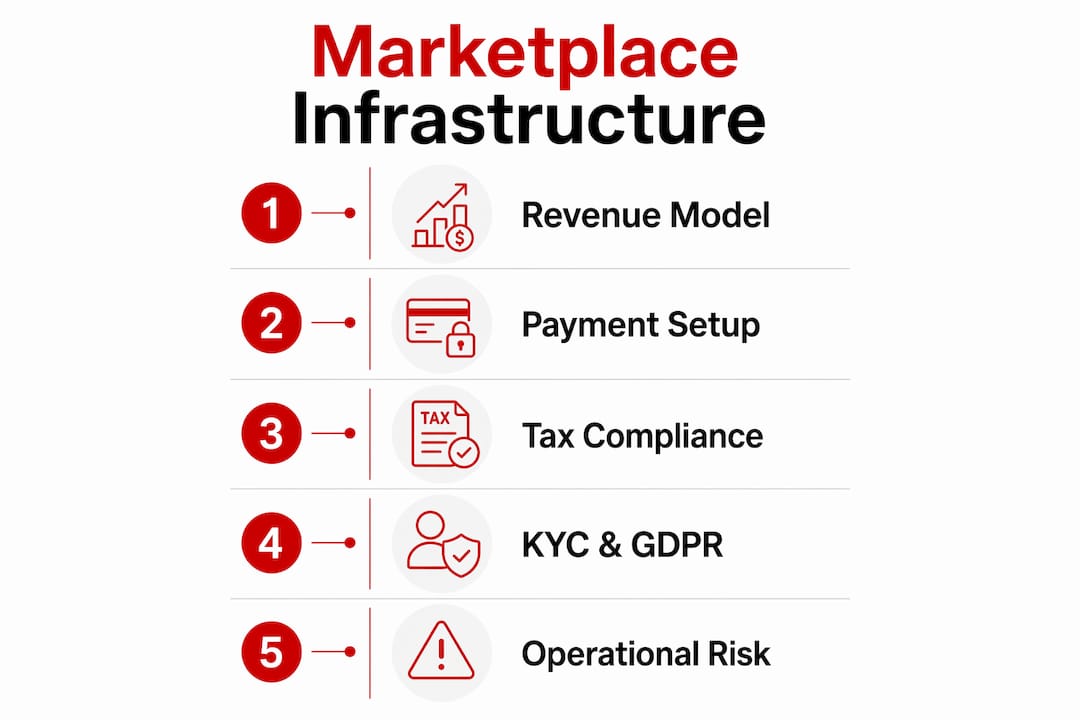
Tax and regulatory compliance deserves early attention, not a retrofit. The IRS requires Form 1099-K reporting for payments processed through marketplaces when gross payments exceed federal thresholds, with payment card transactions requiring a 1099-K regardless of amount. Failing to plan identity collection and tax reconciliation upfront creates costly compliance backlogs and seller churn at the worst possible time, during a growth peak.
Additionally, proposed IRS regulations provide relief from backup withholding for third-party network payments below $20,000 and 200 transactions, but payment card transactions remain unaffected. This distinction matters if your marketplace processes card payments at any volume.
| Infrastructure Layer | Key Action | Risk of Delay |
|---|---|---|
| Revenue model | Define take rate and fee structure before launch | Repricing post-launch damages seller trust |
| Payment flows | Implement Stripe Connect or equivalent early | Manual payouts break at scale |
| Tax compliance | Collect seller identity data from day one | Costly retrofits and seller churn |
| KYC and AML | Build verification into onboarding | Regulatory exposure and platform liability |
| Seller onboarding | Create quality control checkpoints | Low supply quality kills buyer retention |
Pro Tip: Treat KYC and GDPR/CCPA compliance as onboarding design problems, not legal problems. The earlier you embed identity collection into the seller signup flow, the less friction it creates for everyone.
Demand acquisition only compounds when the supply side is ready to convert it. With that constraint in mind, three channels consistently deliver the best return across marketplace growth stages.

Marketplace SEO is the highest-leverage organic channel for most platforms. Each product listing or service page is an indexed asset that compounds over time. Platform-specific metadata fields directly affect buyer discovery and conversion because each marketplace ranks listings differently based on backend attributes and keywords. Treating listing completeness as a systemized operational task, not ad hoc copywriting, is what separates top sellers from average ones. Reddog’s guide on marketplace SEO for CPG brands covers the specific metadata and keyword strategies that move rankings on Amazon and Walmart.
Referral programs on both the supply and demand sides are among the most cost-effective growth drivers available to marketplace operators. A seller referral program that rewards existing vendors for recruiting new ones solves the cold-start supply problem without paid acquisition costs. A buyer referral program with credit incentives drives repeat purchase behavior while expanding your user base.
Paid acquisition earns its place only after you can demonstrate a positive LTV to CAC ratio. Running Google Shopping or Meta ads before you have cohort retention data is guesswork with a budget attached. Once retention proves out, paid channels scale predictably.
For multi-channel sellers operating across Amazon, Walmart, and DTC simultaneously, the operational complexity compounds fast. Centralizing inventory, order management, pricing, and analytics into a single system is the only way to maintain accuracy and avoid profitability erosion across channels. Tools like Linnworks, Zentail, or ChannelAdvisor each address different parts of that centralization problem.
| Channel | Best stage to deploy | Primary constraint |
|---|---|---|
| Marketplace SEO | All stages | Listing completeness and metadata quality |
| Referral programs | Liquidity to scale | Incentive structure design |
| Paid acquisition | Scale stage only | Proven LTV:CAC ratio required |
| Multi-channel listing | Scale stage | Centralized system dependency |
Growth problems in marketplaces almost always trace back to one of three constraints: liquidity, trust, or acquisition. Diagnosing which one is limiting you requires looking at the right metrics, not just user counts.
Match rate, category fill rate, time-to-match, and cohort retention are the metrics that actually reveal where your growth is breaking. A high user count with a low match rate signals a supply or search quality problem. Strong match rates with poor cohort retention signal a trust or product experience problem. Acquisition-focused spending against either of those underlying issues produces no lasting result.
The most common and costly mistake operators make is expanding take rates before fixing liquidity. Raising commission percentages when supply-side economics are already thin breaks seller loyalty and reduces listing quality. Top-line revenue may look fine for a quarter while the supply base quietly degrades.
Here are the most frequent growth mistakes and how to address them:
“The marketplace that wins is not the one that grows fastest. It is the one that grows in the right order.”
Pro Tip: Build a simple monthly dashboard with match rate, 30-day buyer retention, and seller churn rate. Those three numbers will tell you more about your growth health than any top-line metric.
Sustainable marketplace growth requires solving liquidity first, building trust infrastructure second, and scaling acquisition channels only after retention proves out.
| Point | Details |
|---|---|
| Sequence growth stages | Solve liquidity before scaling demand; missequencing wastes budget and damages supply quality. |
| Build compliance early | Plan Form 1099-K reporting and KYC collection at launch to avoid costly retrofits later. |
| Use match rate as your core metric | Match rate and cohort retention reveal growth constraints more accurately than user counts. |
| Centralize multi-channel systems | Inventory, pricing, and analytics must sync across all channels to protect contribution margin. |
| Delay paid acquisition | Run paid ads only after cohort retention data confirms a positive LTV to CAC ratio. |
After working with CPG brands scaling across Amazon, Walmart, and DTC channels, the pattern Reddog sees most often is not a marketing problem. It is a sequencing problem wearing a marketing costume.
Founders arrive convinced they need better ads, a stronger influencer strategy, or a new channel. What they actually need is to fix their match rate or stop their seller churn before spending another dollar on acquisition. The tactics they want are correct in isolation. They are just being applied three stages too early.
The compliance piece catches almost everyone off guard. Most operators do not think about Form 1099-K architecture until their accountant raises a flag during tax season, at which point they are retrofitting identity collection into a system that was never designed for it. That retrofit costs real money and creates real friction for sellers who are already considering alternatives.
The brands that scale well share one trait: they are honest about which stage they are actually in. Not which stage they want to be in, or which stage their revenue suggests they should be in. The actual stage, measured by match rate, retention, and supply quality. That honesty is what makes the sequencing framework work. Without it, you are just running tactics in a vacuum.
Reddog works with CPG founders and operators in the $500K to $20M revenue range who need structured clarity on where their marketplace is actually breaking and what to fix first.
If you are unsure whether your current constraints are liquidity, trust, or acquisition, a focused 30-minute strategy call can give you a clear answer. Reddog reviews your contribution margin by channel, identifies where margin is leaking, and maps your growth stage against the right tactics. No generic advice. No broad recommendations. Just a practical look at your numbers and a clear next step.
Book your free strategy call and walk away with a concrete diagnosis of your marketplace growth constraints.
Solving liquidity is the first priority. Marketplaces that seed quality supply before scaling demand acquisition grow 3 to 5 times faster than those running all growth tactics simultaneously.
Paid acquisition should begin only after cohort retention data confirms a positive LTV to CAC ratio. Running ads before retention proves out produces traffic with no compounding return.
Match rate, category fill rate, time-to-match, and cohort retention are the core diagnostic metrics. User counts and GMV alone do not reveal whether growth is supply, demand, or trust constrained.
The IRS requires Form 1099-K reporting when gross payments exceed federal thresholds, with payment card transactions requiring a 1099-K regardless of amount. Marketplaces that do not plan identity collection at launch face costly compliance retrofits at scale.
Failing to centralize inventory, pricing, and analytics across channels is the most common profitability killer. Without a centralized management system, pricing errors and stockouts compound across every platform you operate on.
— Reddog
Leave a comment: