
Published: March 2020 | Last Updated:August 2026
© Copyright 2026, Reddog Consulting Group.

Omnichannel is a unified, data-driven approach to customer experience where every physical and digital touchpoint shares a single view of the customer in real time. The practical payoff is direct: less friction at every stage of the buying journey, higher retention, and cleaner margin visibility across channels. TechTarget defines omnichannel as the integration of all customer touchpoints so that data flows continuously rather than sitting in silos. McKinsey frames it as a strategic ambition, not a channel count. At Reddog, we see it as the operating model that separates brands growing profitably from those chasing top-line numbers at the expense of contribution margin.
The core mechanism is a unified customer identity. Every interaction — a website visit, a store scan, a customer service chat — writes back to a single profile. That profile travels with the customer across every channel, so the next touchpoint picks up exactly where the last one left off.
Three examples show what this looks like operationally:
The data flow that makes this possible follows a consistent pattern:
As Klaviyo’s practitioner analysis notes, a business with fewer channels but shared data is genuinely omnichannel. A business with ten disconnected channels is still multichannel. The distinction is the operating model, not the channel count.
The technology stack is not one platform. It is a set of connected systems, each with a specific job:
Pro Tip: You do not need all of these on day one. A Minimum Viable Integration of CDP plus OMS plus a single-point inventory sync delivers the majority of omnichannel value at a fraction of full-stack complexity. Start there, prove the model, then expand.
For teams evaluating platforms, Reddog’s omnichannel platform comparison guide walks through the tradeoffs between entry-level and enterprise orchestration tools without the vendor noise.
The three models differ on one axis that matters most: whether customer data and context are shared across channels.
A quick illustration of the same customer journey under each model:
The operational change required to move from multichannel to omnichannel is not adding channels. It is rebuilding the data architecture so channels share context. That is a harder project, but it is the one that actually moves metrics.
The benefits are measurable and they compound over time:
McKinsey’s analysis shows that the most successful omnichannel plays concentrate investment on one or two strategic ambitions — commerce, personalization, or ecosystem — rather than spreading resources across every channel simultaneously.
For CPG brands specifically, omnichannel integration also improves retailer relationships. Brands that can demonstrate clean sell-through data, accurate forecasting, and consistent on-shelf availability are more attractive trading partners. And as NIQ’s research highlights, brands using granular store/SKU/day-level data can unlock meaningful online revenue growth by closing assortment and availability gaps that sample-based data misses entirely.
1. More channels equals omnichannel. Adding a TikTok Shop or a retail media campaign does not make you omnichannel. Integration does. A brand with Amazon, Walmart, DTC, and wholesale that shares no customer data across those channels is multichannel at best.
2. Technology comes first, data strategy comes later. Buying a CDP before you have mapped your data sources and customer journeys is one of the most common and expensive mistakes. The platform cannot fix a broken data architecture. Map first, then build.
3. Omnichannel is only for large enterprises. FoodNavigator’s reporting on Circana data shows that only a small share of CPG brands feel comfortable with their omnichannel approach and have begun integrating KPIs. Most of those are not enterprise giants. The brands making progress are mid-market operators who started with a focused, margin-first integration rather than a full-stack overhaul.
4. Retail media solves poor availability. Spending on retail media while your on-shelf availability is inconsistent is burning margin. Retail media amplifies what is already working. Fix availability and assortment gaps first, then invest in amplification.
5. Omnichannel is a marketing project. It is an operating model change. Marketing owns the customer experience layer, but supply chain, IT, and finance all have to be at the table. Brands that treat it as a campaign initiative stall at the pilot stage.
1. Clarify customer journeys and KPIs (Quick win: 1–2 weeks, low effort) Map your top two or three customer journeys end to end. Identify where context breaks down between channels. Set the KPIs you will use to measure improvement before you touch any technology.
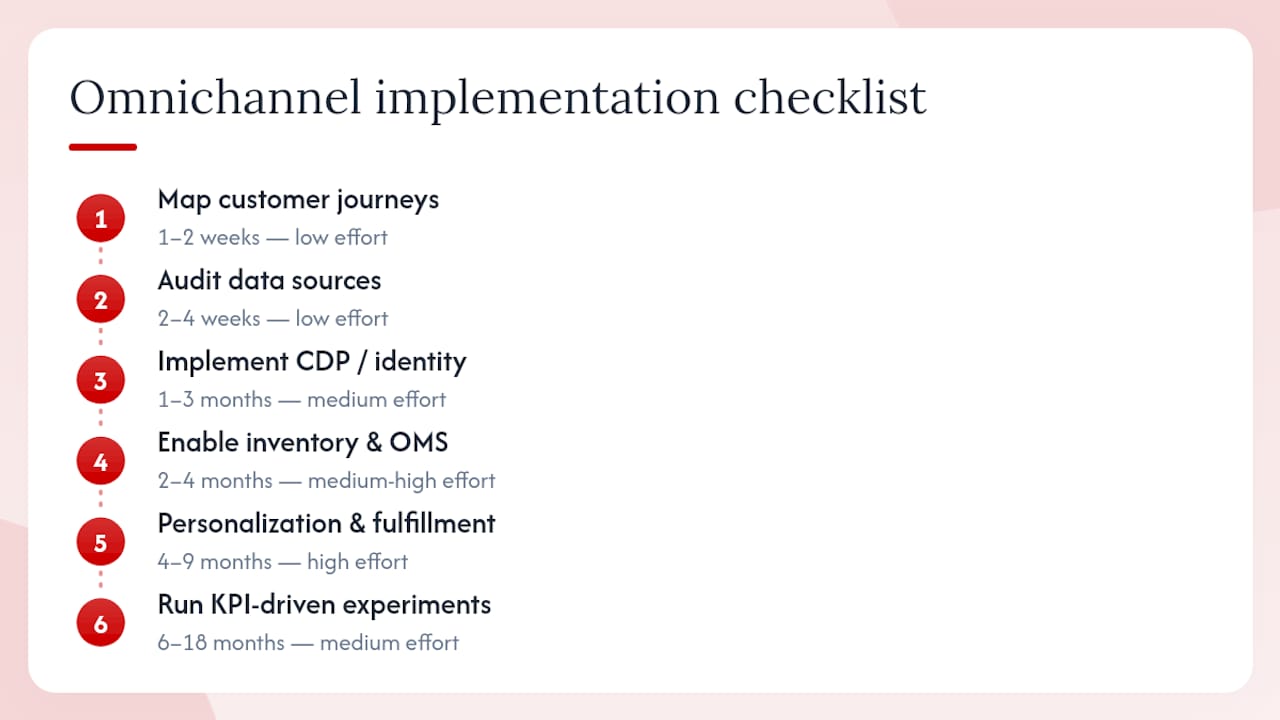
2. Audit and map your data sources (Quick win: 2–4 weeks, low effort) Inventory every system that holds customer, order, or product data. Identify duplicates, gaps, and the systems that need to connect. This audit is the foundation for every integration decision that follows.
3. Implement a CDP or identity layer (Medium: 1–3 months, medium effort) A CDP is the single highest-leverage investment in an omnichannel stack. It resolves customer identity across channels and makes unified profiles available to every downstream system. Start with your highest-volume channels.
4. Enable inventory visibility and OMS integration (Medium: 2–4 months, medium-high effort) Real-time SKU-level inventory shared across channels is the prerequisite for BOPIS, accurate availability messaging, and fulfillment orchestration. Maersk’s FMCG logistics analysis confirms that integrated logistics partnerships are what remove the visibility blind spots that erode customer trust.
5. Orchestrate personalization and fulfillment rules (Full rollout: 4–9 months, high effort) Once identity and inventory are unified, layer in orchestration: next-best-action logic, personalized offers, and fulfillment routing rules. This is where the revenue lift becomes visible.
6. Iterate with KPI-driven experiments (Ongoing: 6–18 months, medium effort) Run structured A/B tests on experience changes. Measure cross-channel conversion, AOV, and retention. Reddog’s omnichannel strategy process guide covers prioritization frameworks and sequencing for CPG brands navigating this rollout.
Pro Tip: For CPG brands, contribution margin by channel is the north star metric. Before investing in personalization orchestration, confirm that each channel’s economics support the investment. A channel generating volume but negative contribution margin does not need more traffic — it needs a pricing or cost-structure fix first.
For a deeper look at omnichannel marketing integration tactics specific to retail growth, Reddog’s blog covers alignment and integration approaches that connect marketing execution to operational outcomes.
Attribution is the hardest part of omnichannel measurement. When a customer sees an ad, visits a store, and buys online three days later, every channel wants credit. The practical answer is to measure at the customer level, not the channel level, and to track cross-channel journeys rather than last-touch conversions.
Avoid double-counting by assigning a single conversion to the customer journey, not to each touchpoint. Use holdout tests to validate whether a channel is genuinely driving incremental purchases or just capturing intent that would have converted anyway.
| KPI | Definition | Why it matters |
|---|---|---|
| Cross-channel conversion rate | Share of customers who convert after engaging across two or more channels | Measures the core omnichannel value proposition |
| Average order value (AOV) | Average revenue per completed transaction | Higher AOV in cross-channel journeys signals integration is working |
| Repeat purchase rate | Share of customers who buy again within a defined window | Tracks retention and experience quality |
| Customer lifetime value (LTV) | Projected total revenue from a customer over their relationship | The long-term margin metric that justifies omnichannel investment |
| Out-of-stock rate | Percentage of SKUs unavailable at point of demand | Directly tied to lost sales and customer trust |
| Fulfillment lead time | Average time from order placement to delivery | Operational efficiency metric that affects repeat purchase behavior |
| Returns rate | Share of orders returned | High returns often signal product information or availability mismatches |
| Cost-to-serve by channel | Fully loaded cost to fulfill and service a customer in each channel | The margin metric that reveals which channels are actually profitable |
Report operational KPIs (out-of-stock rate, fulfillment lead time) weekly. Review strategic KPIs (LTV, AOV, repeat purchase rate) monthly. Run experiments on one variable at a time and give each test at least four weeks before drawing conclusions.
The near-term trajectory is clear, and the brands investing now will have a structural advantage:
The priority for the next 12 months: get your data granularity right before you invest in personalization orchestration. Predictable inventory and accurate availability data are the foundation. Everything else builds on top of that.
Omnichannel is not a channel strategy — it is a data and operating model that unifies customer identity across every touchpoint to reduce friction, improve retention, and protect contribution margin.
| Point | Details |
|---|---|
| Definition | Omnichannel unifies customer data across all channels; integration, not channel count, is what defines it. |
| Highest-impact quick win | Audit your data sources and map customer journeys before touching any technology. |
| Minimum viable stack | CDP plus OMS plus single-point inventory sync delivers most of the value at manageable cost and effort. |
| First KPI to track | Cross-channel conversion rate and cost-to-serve by channel reveal whether integration is working and where margin leaks. |
| Reddog’s approach | Reddog helps CPG brands build margin-first omnichannel strategies across Amazon, Walmart, DTC, and wholesale. |
The conventional wisdom says to start with the customer experience and work backward. We agree with the direction, but most teams stop too early. They map the journey, identify the friction points, and then hand the project to marketing. What actually drives results is going one layer deeper: understanding what each channel contributes to margin before deciding where to invest in integration.
A brand that fixes its inventory visibility and gets accurate on-shelf availability data will see better omnichannel outcomes than a brand that launches a personalization engine on top of unreliable stock data. The technology is not the constraint. The data quality and the margin clarity are. Brands that treat omnichannel as a margin optimization project, not a marketing project, tend to build something that lasts.
Reddog works with CPG founders and operators in the $500K–$20M revenue range who are ready to move from channel presence to channel profitability. Our free 30-minute strategy review is a practical working session, not a sales call. We look at your contribution margin by channel, inventory velocity, fulfillment economics, and where your current setup is leaking margin.
If you are navigating the tradeoffs between Amazon FBA, Walmart WFS, DTC, and wholesale, and you want a clear picture of what each channel actually contributes to your bottom line, this session is built for you. Everything discussed stays confidential, and we come prepared with a point of view, not a pitch deck.
Book your free 30-minute strategy review at Reddog and walk away with at least one concrete action you can take on your channel economics this week.
Leave a comment: