
Published: March 2020 | Last Updated:April 2026
© Copyright 2026, Reddog Consulting Group.

TL;DR:
- Relying solely on past sales data can lead to product failures and margin loss.
- Monitoring marketplace trends helps brands adapt quickly to consumer, competitor, and channel shifts.
- Implementing a continuous, multi-source trend review process enhances decision-making and marketplace agility.
Most CPG founders in the $500K–$20M range believe their past sales data tells them everything they need to know. It does not. Consumer preferences, competitor moves, and channel economics shift faster than any quarterly report can capture. Brands that rely on yesterday’s numbers to make tomorrow’s decisions are playing a losing game. Monitoring marketplace trends enables CPG brands to adapt to rapid shifts in consumer preferences, competition, and channel dynamics, preventing product failures and optimizing sales across omnichannel environments. In this article, we break down what trend monitoring actually means, why it matters for your margins, and how to build a system that gives you a real edge.
| Point | Details |
|---|---|
| Real-time monitoring matters | Staying on top of marketplace trends lets CPG brands adapt quickly and win market share. |
| Use data and AI | Combining AI, syndicated data, and social listening provides the highest-value insights for brand decisions. |
| From insight to action | Actively applying trend insights boosts sales, improves margins, and prevents costly missteps. |
| Continuous improvement wins | Brands that audit and adjust their approach regularly outperform reactive competitors. |
The term “marketplace trends” gets thrown around loosely. For a growing CPG brand, it has a specific and practical meaning. Marketplace trends are the measurable shifts in consumer buying behavior, competitor product activity, channel performance, and pricing dynamics that directly affect your sales velocity and margin. These are not abstract forces. They show up in your Amazon BSR ranking, your Walmart WFS replenishment rate, and your DTC conversion data.
What makes this harder today is the speed of change. Shifting consumer preferences now move at the pace of social media cycles, not annual category reviews. A format that dominated shelf space two years ago can become irrelevant in months. A new ingredient claim can flip purchase intent across an entire subcategory almost overnight.
The consequences of missing these shifts are real. Brands launch products built on assumptions that were valid 18 months ago. Inventory piles up. Promotions underperform. Retail buyers lose confidence. Consider this: only 35% of 2024 CPG launches were new products, the lowest share in 30 years, and without trend monitoring via AI or social listening, brands risk high failure rates from unvalidated concepts.
Brands that treat trend monitoring as optional are essentially betting their next product launch on a guess.
The most important trend categories to watch include:
For a deeper look at how to manage these moving parts, the marketplace management for CPG framework we use at RedDog Group covers the operational side of staying current. You can also reference our CPG growth strategy guide for a broader strategic context.
Pro Tip: Do not rely solely on POS data. Point-of-sale numbers tell you what already happened. Real marketplace insight means watching competitors, social conversations, and category velocity data simultaneously.
So, how does monitoring these trends translate into measurable financial results for your brand? Let’s look at what smart operators are doing differently.

The brands winning on margin are not just tracking sales. They are tracking the signals that predict where sales are going. Pricing shifts, promotional lift patterns, SKU velocity changes, and competitor launch timing all feed into smarter decisions about where to invest and where to pull back.
Here is a simple example of how trend data changes the outcome:
| Trend signal | Reactive brand outcome | Proactive brand outcome |
|---|---|---|
| Competitor price drop | Margin erosion, lost units | Pre-planned promo response, margin protected |
| New format gaining velocity | Late-to-market launch | First-mover advantage, shelf capture |
| Promo lift data by channel | Blanket discounting | Targeted promo timing, higher ROI |
| Consumer sentiment shift | Stale messaging, low conversion | Repositioned creative, improved sell-through |
The data is clear on why this matters. 81% of consumers ignore irrelevant marketing, and sustainability-linked products are seeing 56% spending growth. Traditional high-volume, low-margin models are being replaced by data-driven personalization and purpose-led positioning.
Here is a step-by-step process for using trend insights to protect and grow your margins:
For brands looking to improve their conversion rate optimization for CPG, trend data is the foundation. And if you are not yet set up to track sales performance across channels, that is the first gap to close. AI analytics in market research are making this more accessible for mid-market brands every year.
The biggest pitfall we see: brands that set their Amazon listings and Walmart content once and never revisit them. That “set and forget” approach is one of the fastest ways to watch your margin quietly disappear.
But what practical tools and data sources make this possible for a mid-sized CPG business? Here is how brands are building robust trend monitoring systems.
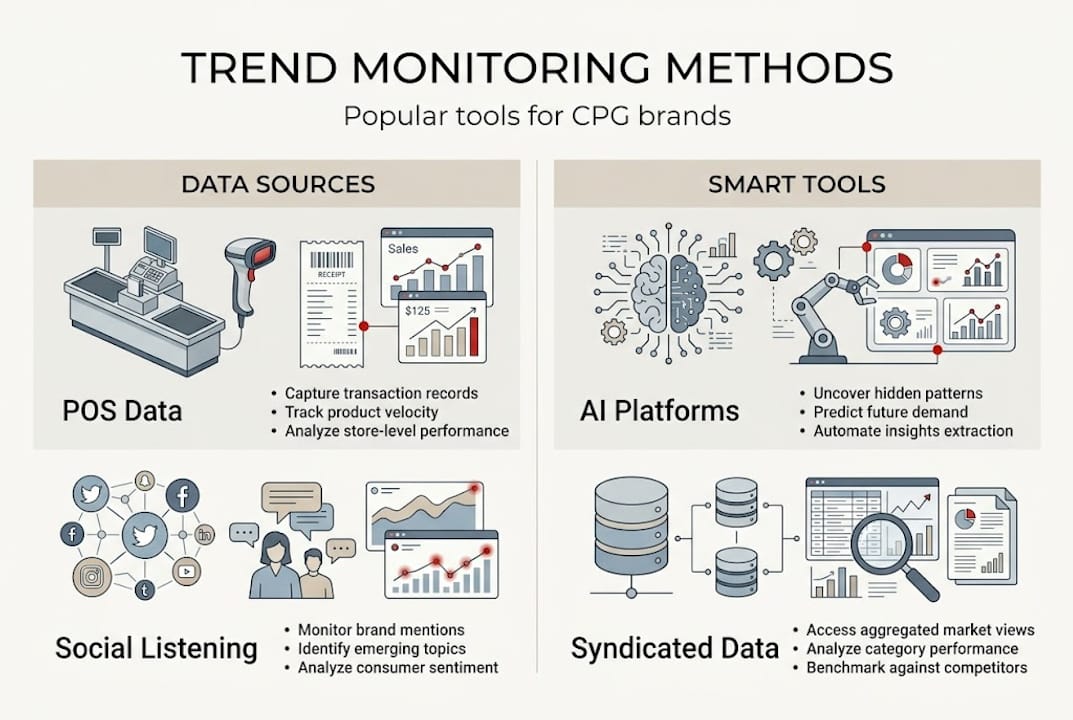
The good news is that you do not need an enterprise data team to do this well. You need the right mix of sources and a consistent process for reviewing them. Market research methodologies include syndicated data for market share and velocity tracking, AI-powered brand tracking, social listening, and concept testing to validate innovations before launch.
The core data sources every $500K–$20M CPG brand should be working with:
Here is how these tools compare for a mid-market brand:
| Data source | Strength | Limitation for $500K–$20M brands |
|---|---|---|
| POS/scan data | Real sell-through accuracy | Lags by weeks, no forward signal |
| Syndicated panels | Category benchmarking | Expensive, often overkill at this stage |
| Social listening | Fast, consumer-direct signal | Noisy, needs filtering |
| AI benchmarking | Real-time marketplace view | Requires platform integration |
| Competitor tracking | Actionable competitive intel | Manual effort without automation |
For more on how AI is reshaping this space, our piece on AI in CPG ecommerce covers the practical applications. And if you are thinking about channel expansion, our CPG marketplace growth strategies article addresses how trend monitoring feeds into that decision. AI and market research are converging in ways that make real-time insight far more affordable than it was even three years ago.
Pro Tip: Integrate at least two trend data sources. Brands using combined data inputs see significantly faster decision cycles and fewer costly missteps than those relying on a single source.
Once you understand what the data is telling you, here is how to make sure each insight results in real impact across every channel.
Data without action is just noise. The brands that win are the ones with a clear process for moving from insight to execution, fast. For $500K–$20M CPG operators, prioritizing AI tools for real-time marketplace monitoring and integrating syndicated sales data with social listening delivers faster, more confident decisions.
Here is the action framework we recommend:
Omnichannel actions that typically follow from trend insights include:
Cross-functional buy-in matters here. If your sales team, marketing team, and operations team are not reviewing the same trend data together, you will get siloed decisions that undermine each other. Monthly reviews that bring these groups together around shared data create alignment and faster execution.
For practical examples of how this plays out, our CPG market analysis examples article walks through real scenarios. And if you are optimizing for search visibility alongside trend responsiveness, our marketplace SEO tips are a natural next step. For brands evaluating research partners, CPG market research partners can accelerate the setup phase significantly.
Here is the uncomfortable truth: most CPG brands have access to enough data. They fail at interpretation and action, not collection.
The most common breakdown we see is brands chasing competitors instead of consumers. They react to what a competitor launched last quarter rather than asking what their own buyer is moving toward. That is a rearview mirror strategy, and it keeps you permanently one step behind.
The second failure is treating trend reports as a periodic event rather than an ongoing discipline. A quarterly trend review does not help you when a competitor drops a new SKU in week six. The brands that win treat trend monitoring as a standing operational rhythm, not a project.
We have worked with brands that shifted from reactive to proactive by doing one simple thing: scheduling a monthly cross-department review where trend data is pressure-tested against current assumptions. It sounds basic. But it forces the kind of honest conversation that prevents expensive mistakes.
Building customer retention for CPG also depends on this discipline. Retention erodes when your product or messaging falls out of step with what your buyer actually wants right now.
Pro Tip: Schedule a monthly 60-minute cross-department review. Bring sales, marketing, and ops together around the same trend data. The goal is not a report. It is a decision.
If you are serious about protecting your margins and capturing category growth, trend monitoring cannot be an afterthought. It has to be built into how your brand operates every week.
At RedDog Group, we help $500K–$20M CPG brands build real-time monitoring systems that connect marketplace data to margin-focused decisions. Our omnichannel growth solutions are designed for operators who want clarity, not just dashboards. If you are ready to stop reacting and start leading in your category, book a CPG retail strategy session and let’s map out exactly where your trend gaps are costing you profit.
It means tracking changes in consumer, competitor, and channel activity so you can make faster, data-driven product and marketing decisions before your competitors do.
Monthly or even weekly checks help growing brands act on fast-changing trends before competitors do. AI tools for real-time marketplace monitoring make this cadence achievable even for lean teams.
Combining syndicated data, social listening, and AI-driven platforms gives the best real-time visibility across consumer sentiment and competitive activity.
Brands risk high product failure rates and margin erosion by relying on outdated assumptions. Without trend monitoring, unvalidated concepts reach market and fail at a rate that compounds over time.
Leave a comment: