
Published: March 2020 | Last Updated:April 2026
© Copyright 2026, Reddog Consulting Group.

TL;DR:
- Marketplace SEO prioritizes conversion, sales velocity, and listing completeness over keyword stuffing.
- Operational factors like stock availability, pricing, and return rates heavily influence product ranking.
- Consistent listing maintenance and routine operational checks are essential for sustained marketplace visibility.
Most CPG brands assume marketplace SEO is just about stuffing titles with keywords. It isn’t. The platforms where your products live, primarily Amazon and Walmart, use algorithms that weigh conversion rate, inventory health, and listing completeness as heavily as keyword relevance. Incomplete attributes or stockouts can quietly destroy your search visibility before you even realize what’s happening. If you’re running a brand in the $500K to $20M range and relying on the same SEO instincts you’d apply to a blog post, you’re leaving ranking power and margin on the table. This guide breaks down what marketplace SEO actually is, how the algorithms work, and what you can do right now to grow smarter.
| Point | Details |
|---|---|
| Marketplace SEO is unique | Retailer platforms rank by conversion, content, and availability—not just keywords. |
| Small details drive big results | Completeness of attributes and inventory monitoring can dramatically improve visibility and sales. |
| Conversion rate is everything | Boosting conversion through A+ content and competitive pricing is the fastest path to higher ranking. |
| Avoid hidden pitfalls | Common mistakes like stockouts, high returns, or overpricing can erase months of marketplace progress. |
Marketplace SEO is the practice of optimizing product listings and brand presence on retailer platforms like Amazon, Walmart, and TikTok Shop so that your products appear prominently when shoppers search. It’s a discipline that borrows concepts from traditional search optimization but operates by entirely different rules.
Traditional web SEO, the kind you’d apply to a company website or blog, rewards backlinks, domain authority, and content depth. Marketplace SEO rewards conversion rate, sales velocity, listing completeness, and pricing competitiveness. Google doesn’t care if your product is in stock. Amazon absolutely does.
Here’s a quick comparison to make the distinction clear:
| Factor | Traditional SEO | Marketplace SEO |
|---|---|---|
| Primary goal | Website traffic | Product discoverability and sales |
| Key signals | Backlinks, content | Conversion rate, velocity, inventory |
| Ranking platform | Google, Bing | Amazon, Walmart, TikTok Shop |
| Content focus | Long-form articles | Titles, bullets, attributes, images |
| Penalized by | Thin content | Stockouts, returns, incomplete data |
The core elements you need to manage include:
Incomplete attributes decrease filtered search visibility, meaning a shopper filtering by size, flavor, or material may never see your product even if it’s perfectly relevant. That’s a hidden revenue leak most brands never audit. Building strong marketplace management strategies from the start prevents these blind spots from compounding over time. If you’re serious about scaling, exploring marketplace strategies for growth will show you how leading brands structure their approach across channels.
With marketplace SEO defined, we need to understand how these platforms actually rank and surface your brand’s products.

Both Amazon and Walmart use algorithms that score listings across multiple dimensions simultaneously. Relevance matters, but it’s only the entry ticket. What separates page one from page five is a combination of behavioral and operational signals that most brands underestimate.
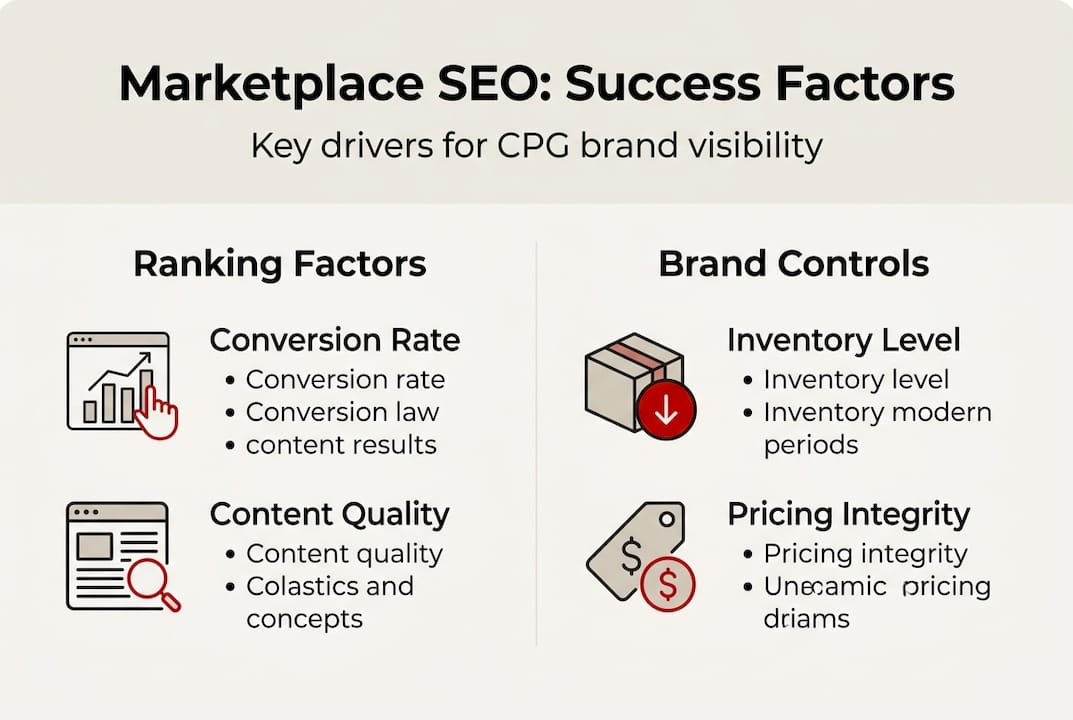
Key ranking factors across major platforms:
Stockouts reset search velocity, high returns suppress rankings, and overpricing kills conversion. Each of these is an operational issue, not a content issue, which is exactly why treating marketplace SEO as purely a copywriting exercise misses the point.
Walmart adds another layer: local inventory proximity. If your product is stocked in a fulfillment center near a shopper, Walmart may prioritize your listing for same-day or next-day pickup. That means your distribution strategy directly affects your search ranking, a connection most marketing teams never make.
“Conversion rate is king on marketplaces. Overpricing versus your competitors doesn’t just lose the sale, it signals to the algorithm that your listing underperforms, and your ranking drops accordingly.”
Here’s how the major ranking factors stack up in terms of impact:
| Ranking factor | Impact level | Brand control |
|---|---|---|
| Conversion rate | Very high | High |
| Sales velocity | Very high | Medium |
| Inventory availability | High | High |
| Listing completeness | High | High |
| Price competitiveness | High | High |
| Return rate | Medium | Medium |
| Review rating | Medium | Low |
Improving online visibility for retail brands requires treating these factors as a system, not individual checkboxes. Brands that invest in omnichannel retail growth understand that operational decisions and marketing decisions are the same decision.
Knowing what the algorithms value, let’s break down how to structure marketplace listings for maximum impact.
Winning marketplace SEO isn’t complicated, but it does require consistency and discipline across several areas. Here’s how to build a foundation that compounds over time:
Optimize your title with data-driven keywords. Your title is the single most important piece of real estate on any listing. Lead with your primary keyword, include key product attributes like size, count, or flavor, and keep it readable. Don’t keyword-stuff. Algorithms and shoppers both penalize it.
Complete every attribute field without exception. Attributes feed filtered search. If a shopper filters by “gluten-free” or “12-pack” and your attribute field is blank, you’re invisible to that search. Fill in every field the platform offers, even if it feels redundant.
Invest in high-quality images and A+ content. Enhanced content, called A+ Content on Amazon and Enhanced Content on Walmart, gives shoppers richer visuals, comparison charts, and brand storytelling. A+ content drives a 10 to 20% CVR lift based on empirical meta-analysis data. That’s not a small gain at scale.
Monitor inventory and pricing on a consistent schedule. Set weekly or biweekly reviews of your stock levels and price positioning. Running out of inventory mid-momentum is one of the most costly mistakes a growing brand can make.
Refresh listings regularly based on performance data. Keyword trends shift, competitor positioning changes, and shopper language evolves. Treat your listings as living assets, not set-and-forget pages.
Pro Tip: Pull your listing performance data monthly and cross-reference it with your conversion rate by ASIN or item ID. If a listing has strong impressions but weak conversion, the problem is usually content or pricing, not traffic. Fix those two things before spending on ads.
Building optimized listings is a skill. Resources on Amazon product listings optimization and product listings for sales can help you apply these principles with precision.
Great tactics are only as effective as your ability to avoid critical mistakes. Let’s spotlight the most damaging, and how to sidestep them.
Even brands with strong products and solid content lose ground because of operational and structural errors that fly under the radar. Here are the pitfalls that consistently hurt CPG brands on marketplaces:
Incomplete attributes. Missing a single attribute field can make your product invisible in filtered searches. This is one of the most common and most fixable problems. Audit every listing for completeness at least quarterly.
Stockouts during high-velocity periods. Running out of inventory doesn’t just pause your sales. It resets your sales velocity score, which directly affects your ranking. Recovering that momentum takes weeks. Plan inventory around promotional windows and seasonal demand.
High return rates. Returns signal to the algorithm that your product doesn’t match shopper expectations. Whether the issue is misleading content, packaging damage, or a product quality problem, high return rates suppress your listing in search results.
Overpricing relative to competitors. Incomplete attributes, stockouts, high returns, and overpricing are the four fastest ways to tank your marketplace SEO. Overpricing is particularly dangerous because it lowers conversion rate, which then lowers your ranking, which then reduces visibility, creating a downward spiral.
Neglecting listing maintenance after launch. Many brands invest heavily in launch optimization and then ignore their listings for months. Competitors update their content, prices shift, and your once-strong listing starts to erode.
Pro Tip: Create a simple monthly audit checklist that covers attribute completeness, inventory levels, pricing versus top three competitors, return rate trends, and content freshness. Fifteen minutes per listing per month can prevent months of ranking recovery.
Working with an experienced Amazon marketplace consultant can surface issues you’d never catch on your own. Detailed guidance on Amazon product listings for sales can also sharpen your execution.
After working with CPG brands across a wide range of categories, we’ve noticed a consistent pattern: brands that struggle with marketplace SEO aren’t failing because they lack effort. They’re failing because they’re solving the wrong problem.
Most teams treat marketplace SEO as a one-time content project. Write the title, fill in the bullets, upload the images, and move on. But the platforms reward systems, not sprints. The brands that consistently rank well build routines: weekly inventory checks, monthly content audits, cross-functional alignment between their marketing and operations teams so that a stockout doesn’t blindside a campaign.
The other misconception is that paid ads can substitute for organic SEO. They can’t. Ads amplify a well-optimized listing. They can’t rescue a broken one. If your conversion rate is low because your content is weak or your price is off, spending more on ads just burns budget faster.
The real competitive advantage in marketplace SEO isn’t any single tactic. It’s the discipline to master the fundamentals, conversion, velocity, and discoverability, and to protect them consistently. Brands that build this into their operating rhythm, rather than treating it as a quarterly project, are the ones that compound their ranking gains over time. Investing in marketplace optimization strategies as a core business function, not a marketing afterthought, is what separates growing brands from stalling ones.
If you’re ready to turn marketplace SEO from a question mark into a competitive advantage, here’s where to get help.
RedDog Group provides end-to-end support for CPG brands scaling across omnichannel marketplace growth channels including Amazon, Walmart, and TikTok Shop. We don’t just audit listings. We identify the operational and structural issues that are quietly suppressing your rankings and margin.
Our consultants specialize in Amazon growth consulting and cross-channel marketplace strategy, helping brands fix the hidden SEO gaps that cost them sales every single day. From attribute audits to pricing strategy to A+ content builds, we bring a margin-first lens to every recommendation. If your brand is in the $500K to $20M range and you’re ready to compete at a higher level, connect with our team to start building a marketplace presence that actually converts.
Marketplace SEO focuses on optimizing product listings for discovery and conversion within retailer platforms, not just for web search engines. Unlike Google, attribute completeness and sales velocity directly shape whether your product surfaces at all.
Product content, pricing, inventory, conversion rate, and return rates are all critical ranking factors for CPG brands. Stockouts, high returns, and overpricing consistently drag rankings down faster than most brands expect.
Optimized content and listings can lift conversion rates by 10 to 20% or more based on empirical research. A meta-analysis on SEO effectiveness confirms that quality content and keyword alignment produce a high measurable effect on conversion performance.
The most common mistake is incomplete or neglected product attributes, leading to invisible or underperforming listings. Incomplete attributes tank filtered search visibility, meaning shoppers using filters will simply never see your product.
Leave a comment: