
Published: March 2020 | Last Updated:May 2026
© Copyright 2026, Reddog Consulting Group.

TL;DR:
- Most growth-stage CPG brands stall due to poor marketplace management structures rather than product issues.
- Clear KPI setting, data-driven listing optimization, strategic fulfillment choices, targeted channel selection, and compliance are essential for profitable scaling.
- Operational infrastructure and proactive risk management are critical; brands that build these early support sustainable growth and profitability.
Scaling a CPG brand across Amazon and Walmart sounds straightforward until the margin math stops working and your team is buried in fulfillment exceptions, suppressed listings, and inventory forecasting fires. The reality is that most growth-stage brands between $500K and $20M in revenue stall not because their product is wrong, but because their marketplace management lacks structure. This article lays out a practical framework, covering goal-setting, listing optimization, fulfillment, channel selection, and compliance, so you can move from reactive firefighting to a repeatable, margin-positive growth operation.
| Point | Details |
|---|---|
| Set focused KPIs | Clear objectives and key metrics drive performance on every marketplace. |
| Optimize listings continuously | Regular improvements to product listings maximize conversion and sales growth. |
| Prioritize strong fulfillment | Seamless inventory and delivery systems are crucial for scaling and satisfaction. |
| Choose platforms wisely | Select the right marketplaces that fit your brand’s reach and operational capacity. |
| Guard against compliance risks | Proactive compliance and risk management safeguard your multi-channel revenue. |
With the challenge set, start by clarifying what success actually looks like so all teams can rally around concrete goals. This sounds obvious, but most CPG founders are running on gut feel and top-line revenue numbers, which hides a lot of costly margin erosion underneath.
Setting clear KPIs is central to marketplace management success. Without measurable targets, you cannot tell if a new promotion is building profitable velocity or just burning ad spend to inflate gross sales. The first step is to use the SMART framework: every objective must be Specific, Measurable, Attainable, Relevant, and Time-bound. “Grow Amazon sales” is not a KPI. “Increase Amazon net revenue by 18% in Q3 while maintaining a contribution margin above 28%” is.
The KPIs that matter most for CPG marketplace management strategies fall into four core categories:
Team alignment is just as critical as the KPIs themselves. Your sales team optimizing for velocity will conflict with your logistics team optimizing for lean inventory if they are not working from the same dashboard. Build a shared reporting cadence, ideally weekly, where marketing, operations, and finance review the same numbers.
“Monthly targets give you direction. Weekly reviews give you the ability to course-correct before a bad trend becomes an expensive quarter.” This is especially true during peak demand periods when a small forecasting error can cascade into out-of-stocks or overstock fees within days.
Pro Tip: Set annual KPI targets as your North Star, but break them into monthly milestones and review them weekly. If your Buy Box percentage drops below 85% for two consecutive weeks, that is a signal to investigate pricing, seller competition, or inventory position immediately, not at quarter-end.
Once KPIs are set, focus on product listings, the first impression customers get. A poorly optimized listing is like a great product sitting in the back corner of a store with no signage. You might have the best sauce in Texas, but if your title, imagery, and search terms are weak, you are invisible.
Product listing optimization drives higher conversion and marketplace share. Here is a repeatable process for auditing and improving listings on both Amazon and Walmart:
Strong e-commerce SEO approaches apply directly to marketplace listings. The same principles that help a product page rank on Google, relevance, keyword placement, and structured content, also determine where your product lands in Amazon and Walmart search results.
Stat callout: Listings with A+ content on Amazon convert at rates that can be 3 to 10 percent higher than standard listings, depending on the category. For a brand doing $2M annually on Amazon, that conversion lift can translate into hundreds of thousands in incremental revenue without adding a dollar of ad spend.
Pro Tip: Use bulk editing tools inside Seller Central or a third-party platform like Listing Mirror to update multiple listings simultaneously. This is especially valuable when reformulating a product or updating seasonal packaging, where a single change needs to cascade across dozens of ASINs efficiently.
After optimizing product visibility, seamless fulfillment keeps the momentum and profits flowing. Inventory and fulfillment are where many growth-stage CPG brands bleed margin without realizing it. The choice between fulfillment models, and how well you execute within them, has a direct line to your contribution margin.

Strong fulfillment systems lower supply chain disruptions for brands. Here is a clear comparison of the two primary models:
| Factor | FBA/WFS (Amazon/Walmart fulfillment) | FBM (Fulfilled by Merchant) |
|---|---|---|
| Speed to customer | Prime/2-day delivery | Variable, based on your 3PL or warehouse |
| Fees | Fulfillment + monthly storage fees | Your own pick, pack, and ship costs |
| Buy Box impact | Strong advantage on Amazon | Less competitive without Prime badge |
| Inventory control | Amazon/Walmart holds stock | You control stock location and velocity |
| Best for | High-velocity, standardized SKUs | Heavy, oversized, or seasonal products |
| Risk | Long-term storage fees, stranded inventory | Shipping errors, carrier delays |
The choice is rarely all-or-nothing. Many brands use FBA for their top five SKUs and FBM for slower-moving or heavier items where Amazon’s storage fees would destroy the margin. The same logic applies to Walmart Fulfillment Services (WFS) versus Walmart’s drop-ship vendor program.
Common fulfillment roadblocks and how to handle them:
CPG fulfillment strategies that work at scale all share one trait: they are built around data, not memory. If your inventory decisions are still happening in spreadsheets updated manually, you are one busy quarter away from a serious operational failure.
As fulfillment scales up, channel selection becomes the next lever for growth. The temptation at this stage is to launch everywhere simultaneously. That is almost always a mistake. Every new marketplace adds operational surface area, and spreading your team too thin leads to mediocre execution on all channels instead of excellent execution on a few.
Smart channel selection prevents operational overload and fuels sustainable growth. Here is a practical comparison of major US marketplaces relevant to CPG brands:
| Marketplace | Estimated US reach | Average seller fees | Integration complexity | Best CPG fit |
|---|---|---|---|---|
| Amazon | 200M+ Prime members | 8 to 15% referral + FBA fees | Moderate | Broad CPG, all categories |
| Walmart Marketplace | 120M+ monthly visitors | 6 to 15% referral, WFS fees | Moderate | Grocery, household, health |
| Target Plus | Invite-only | Negotiated | Lower (curated) | Premium, natural, specialty |
| Instacart | 5,500+ retailers | CPG ad model | Low | Grocery, perishable |
| Thrive Market | Membership-based | Negotiated | Low | Organic, natural, wellness |
When deciding whether to add a new channel, evaluate these criteria before committing resources:
Staying current on marketplace management in 2026 is important because fee structures, algorithm changes, and fulfillment requirements shift faster than most brands anticipate. What worked on Walmart last year may require a strategy adjustment today.
When evaluating multi-vendor marketplace platforms for your brand, look at technical architecture and integration flexibility, not just surface-level category reach.
Pro Tip: Expand in waves. Fully stabilize Amazon before launching Walmart. Stabilize Walmart before adding a third channel. Each wave should include a defined ramp-up period of 60 to 90 days before you commit to that channel as part of your core operating model.
Effective channel management also means foreseeing and controlling the risks that threaten multi-marketplace operations. For CPG brands in food, personal care, or supplements, compliance is not a back-office function. It is a revenue protection strategy.
Proactive compliance averts listing suspensions and account lockouts that can freeze your cash flow overnight. Here is a practical audit checklist for maintaining marketplace compliance best practices:
Common pitfalls by category:
“One brand we worked with had a single word in a supplement bullet point, the word ‘treats,’ flag the listing for drug claim review. Within 48 hours, six ASINs were suppressed and $340,000 in monthly revenue was frozen while the appeal was processed. The fix took 11 days.”
Risk management also means building financial buffers into your operating model. Marketplace suspensions, chargeback disputes, and inventory holds are not rare events for growing CPG brands. They are predictable risks that you can prepare for with 60 to 90 days of operating capital reserved and a documented escalation process for account issues.
Here is the uncomfortable truth: most CPG founders approach marketplace management as a sales and marketing problem when it is fundamentally an operational and financial problem. They invest in advertising before fixing listing quality. They launch new channels before stabilizing fulfillment on existing ones. They chase revenue numbers while contribution margin quietly collapses.
The brands that scale profitably past the $5M and $10M revenue marks are almost always the ones that built their operations to support growth before they chased it. They know their margin by channel, by SKU, and by fulfillment method. They have documented processes for listing audits, inventory reviews, and compliance checks. They treat marketplace management as a system, not a collection of one-off decisions.
The other thing we see consistently is that founders wait too long to bring in structured support. By the time they recognize the problem, they are already dealing with suppressed listings, overstock fees, and a cash flow crunch from an account hold. The operational infrastructure for marketplace management should be built when things are going well, not when they are falling apart.
Scaling across Amazon and Walmart without losing margin control requires both analytical rigor and operational experience. At RedDog Group, we work specifically with CPG brands in the $500K to $20M revenue range that need more than surface-level marketplace advice.
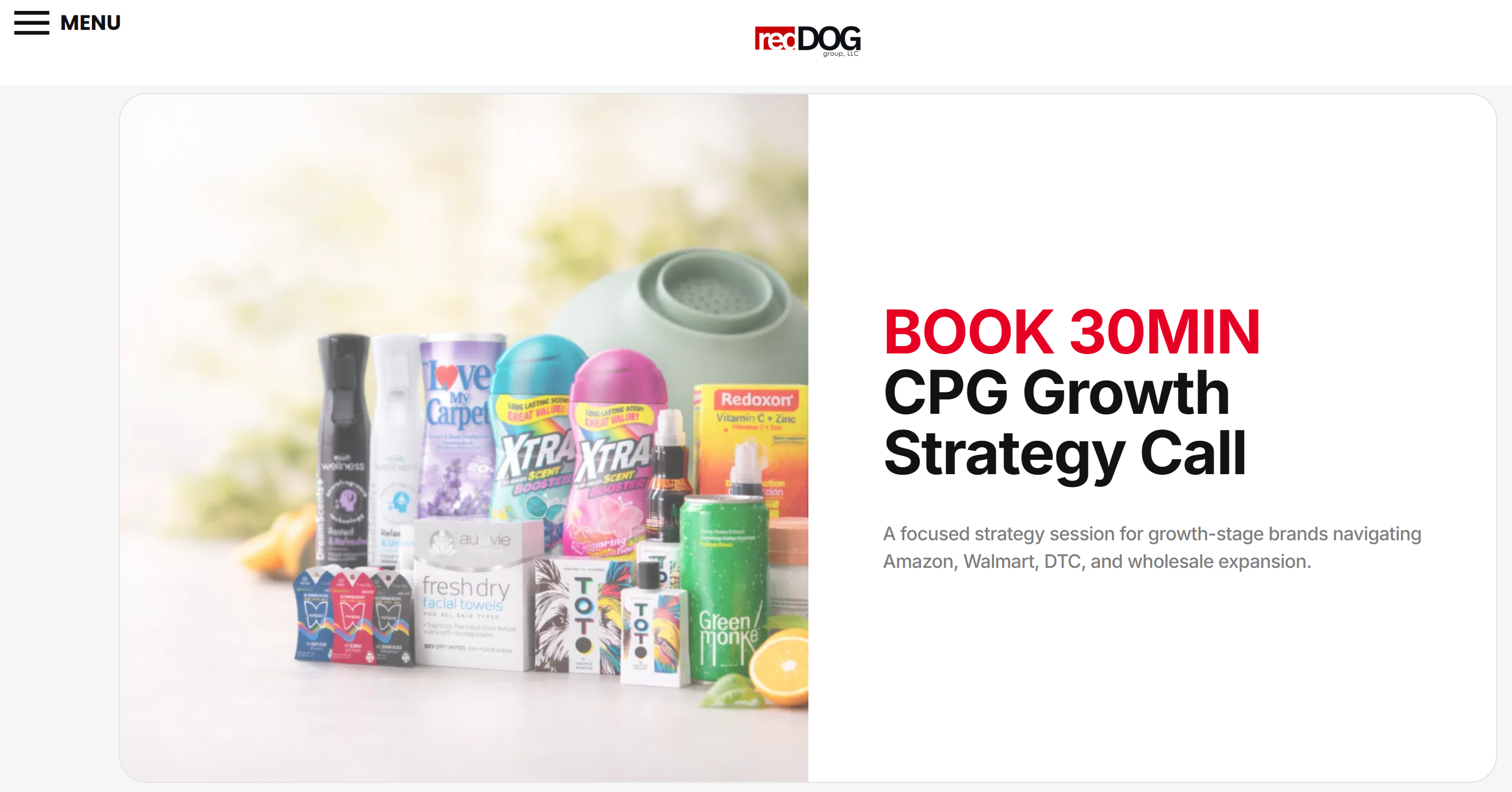
Our approach starts with contribution margin analysis at the channel and SKU level, identifying exactly where profit is leaking before we recommend any growth strategy. From there, we build structured marketplace management strategies that cover listing performance, fulfillment economics, channel selection, and compliance frameworks. Whether you are navigating Amazon FBA fee increases, Walmart WFS margin compression, or preparing for retail expansion, we bring the analytical depth and practical execution experience to help you grow with precision. Explore how we work with brands at reddog.group.
Net revenue, margin, inventory turns, and Buy Box percentage are the most important KPIs for managing CPG marketplace performance, as setting clear KPIs determines whether your team can identify and respond to problems before they become expensive.
Compare costs, control, and scalability: FBA offers simplicity at a fee while FBM provides flexibility and margin control, and strong fulfillment systems that match your SKU velocity and product size will determine which model protects margin better.
The biggest risk is account or listing suspension from failing to follow each marketplace’s compliance policies, which can freeze revenue across multiple channels simultaneously.
Yes, if the marketplace audience matches the product and the brand can maintain operational quality and compliance, as smart channel selection prevents overextension that dilutes execution quality across all active channels.
Leave a comment: