
Published: March 2020 | Last Updated:April 2026
© Copyright 2026, Reddog Consulting Group.

TL;DR:
- Compliance affects 2-5% of CPG revenue through penalties and lost sales.
- Marketplace compliance involves platform policies, regulations, and operational standards across channels.
- Automating compliance processes transforms it from a cost to a growth leverage.
Non-compliance quietly drains 2-5% of CPG revenue, yet 80% of CPG CEOs now list compliance as a top priority. For brand founders and operators managing Amazon, Walmart, and DTC channels simultaneously, marketplace compliance is not a legal checkbox. It is a direct lever on your margin, your channel access, and your ability to stay on shelf. This article breaks down what compliance actually means for CPG brands, the mechanics you must get right, how to build efficient workflows, and where the biggest risks hide. More importantly, it shows you how treating compliance as a growth asset can separate your brand from the competition.
| Point | Details |
|---|---|
| Compliance drives profit | Mastering marketplace compliance shields revenue and unlocks premium sales channels. |
| Details matter | Accurate listings, proper documentation, and verified claims prevent costly suspensions and chargebacks. |
| Automation boosts efficiency | Digital tools and 3PL partners make ongoing compliance manageable, even across multiple platforms. |
| Strategic edge | Brands treating compliance as growth infrastructure outperform laggards on new and existing channels. |
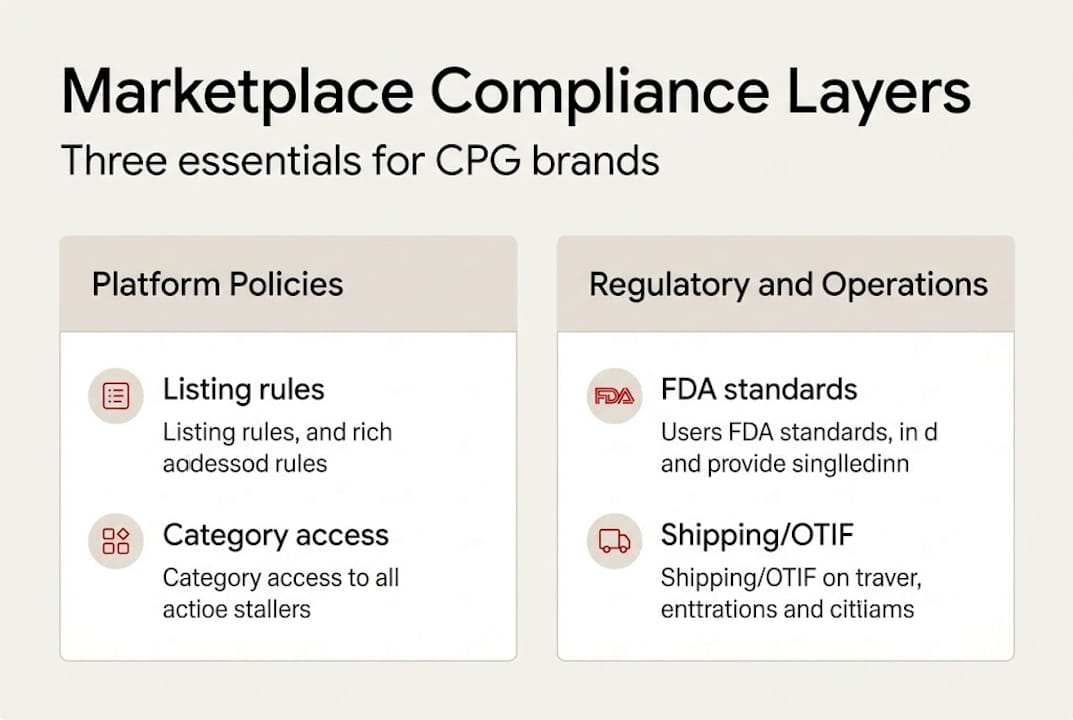
Marketplace compliance is the practice of meeting every rule, standard, and requirement that governs how your product is listed, labeled, fulfilled, and marketed across retail channels. For CPG (consumer packaged goods) brands, that means satisfying three overlapping layers at once.
The first layer is platform policy. Amazon, Walmart, and other marketplaces publish detailed rules covering product listings, pricing, content accuracy, and restricted categories. Walmart Marketplace policies require sellers to adhere to platform standards on prohibited products, operational requirements, and listing integrity. Violate these and your listing gets suppressed or your account gets suspended.
The second layer is federal and state regulation. The FDA (Food and Drug Administration) governs product labeling, ingredient claims, and safety disclosures. The FTC (Federal Trade Commission) enforces truth-in-advertising rules, meaning every claim on your listing must be substantiated. State-level rules like California’s Proposition 65 add another dimension entirely.
The third layer is operational standards. This includes how you ship, how fast you fulfill, how accurately you document, and how consistently you update your content. These are not abstract legal concerns. They directly affect your chargebacks, your seller ratings, and your margin.
Here is where most CPG founders get it wrong: they treat compliance as a legal function handled by a lawyer once a year. In reality, compliance touches your catalog team, your supply chain, your 3PL (third-party logistics provider), and your marketing copy every single week.
The most common pitfalls include:
Compliance is not a department. It is a discipline embedded in every part of your operation, from your product formulation to your last-mile delivery.
For brands pursuing growth strategies for CPG marketplace expansion, compliance is the foundation. Without it, every growth initiative carries hidden risk.
Understanding the scope is one thing. Executing the mechanics daily is another. Here are the five areas where CPG brands must be precise.
1. Product listings Titles must be under 150 characters, accurate, and free of unsubstantiated claims. Bullet points and descriptions must reflect what is physically in the package. Platforms flag keyword stuffing and misleading content, and both can trigger suppression.
2. Restricted and regulated categories Supplements, cosmetics, medical devices, and food products all require special documentation. Supplier requirements for cosmetics include safety assessments, ingredient disclosures, and specific labeling formats. If you sell in these categories without complete documentation, you are one audit away from a delisting.
3. Labeling and regulatory documentation FDA standards require accurate ingredient lists, net quantity statements, and allergen disclosures. Many brands underestimate how granular this gets. Your barcode must match your GS1 registration. Your COA must be current. Your label claims must align with your formulation.
4. Shipping and OTIF performance OTIF stands for On Time and In Full. Walmart requires 98% OTIF compliance, and missing that threshold triggers chargebacks worth 2 to 5% of your order value. That is not a rounding error. That is real margin erosion.
5. Content and language compliance All marketplace content must be in English for U.S. listings. Claims must be substantiated. Prohibited terms (like “cures” or “treats” for non-drug products) will trigger enforcement.
Pro Tip: Build a compliance comparison table for every channel you sell on. Track the specific requirements for listings, labeling, shipping, and claims side by side. Gaps become visible fast.
| Compliance area | Amazon requirement | Walmart requirement |
|---|---|---|
| Listing title length | 200 characters max | 150 characters max |
| OTIF threshold | Not publicly fixed | 98% required |
| Supplement documentation | COA, ingredient list | COA, safety data sheet |
| Prohibited claims | FTC/FDA enforced | FTC/FDA enforced |
| Cosmetic labeling | FDA compliant | Full supplier requirements |
For a broader view of how compliance fits into your marketplace growth strategy, it helps to see it as part of your channel economics, not separate from them. Brands that master compliance on Walmart Marketplace for CPG profit consistently outperform those that treat it as an afterthought.
Also, review Walmart prohibited products policies regularly. They update without notice.
Fast-growing CPG brands do not manage compliance manually at scale. They build systems. Here is how the best operators do it.

DAM systems (Digital Asset Management) automate content compliance by storing approved images, copy, and label files in one place. When platform requirements change, you update the master asset and push it everywhere. DAM systems help CPG brands stay consistent across Amazon, Walmart, and retail partners without relying on individual team members to remember every rule.
EDI (Electronic Data Interchange) automates the operational side, syncing purchase orders, shipping confirmations, and invoices between you and your retail partners. EDI errors are a leading cause of OTIF failures and chargebacks. Getting this right is not optional at scale.
3PLs with FBA prep capabilities reduce human error in labeling, bundling, and shipping. A good 3PL that understands marketplace requirements is worth more than a cheaper one that creates compliance headaches. Review the legal compliance checklist for third-party prep partners before you sign a contract.
Your master compliance workflow should cover:
Pro Tip: Assign a single owner for compliance updates inside your team. When everyone is responsible, no one is. One person tracking policy changes and owning the audit calendar prevents costly surprises.
| Tool type | Primary function | Compliance benefit |
|---|---|---|
| DAM system | Asset management | Consistent, approved content across channels |
| EDI software | Order and shipment sync | Reduces OTIF failures and chargebacks |
| 3PL with prep services | Fulfillment | Accurate labeling and packaging |
| Seller health dashboards | Account monitoring | Early warning on policy violations |
Brands focused on marketplace management for CPG brands in 2026 are investing in these tools not just to avoid penalties but to free up team bandwidth for growth. If your team spends 20 hours a week firefighting compliance issues, that is 20 hours not spent on increasing ecommerce sales for CPG brands.
Even brands doing most things right get caught off guard. Here is what the landscape looks like in 2026.
Suspension rates are higher than most founders expect. Estimates show 22 to 35% of sellers face at least one suspension, often triggered by minor or false technical violations. A single keyword flagged as a drug claim can suspend a supplement listing overnight. Recovery takes days or weeks, and lost sales during that window are gone forever.
Regulatory frameworks keep shifting. The FDA updates food labeling guidance. The UFLPA (Uyghur Forced Labor Prevention Act) affects supply chain documentation for imported goods. California Prop 65 adds warning requirements that many brands discover only after a retailer flags them. Staying current is not optional.
Supplements and health products face dual scrutiny. DSHEA (Dietary Supplement Health and Education Act) governs what you can say about supplements, but the FTC independently enforces advertising claims. A claim that passes DSHEA review can still trigger FTC and DSHEA scrutiny if it appears in your Amazon listing without adequate substantiation.
Cross-border growth adds new traps. Expanding internationally through Amazon Global or other channels means navigating EU labeling rules, country-specific ingredient restrictions, and import documentation. Brands pursuing navigating global retail growth need a compliance framework that scales with their geography.
The brands that avoid these pitfalls share one trait: they build a flexible, regularly updated compliance workflow rather than a static policy document.
The biggest compliance risk is not what you know about and manage. It is the rule that changed last quarter that no one on your team noticed.
Strategic moves to reduce downside:
Most CPG founders treat compliance as a cost center. That framing is limiting and, frankly, expensive in the long run.
Here is the contrarian view: the brands that invest in compliance infrastructure early are the ones that get invited into premium channels. Whole Foods, Target, and Walmart’s premium assortments do not take a chance on brands with messy documentation or unverified claims. Full compliance is the entry ticket.
Certifications like organic, Non-GMO Project Verified, and NSF (National Sanitation Foundation) are compliance achievements that double as marketing assets. They expand shelf space and justify premium pricing simultaneously. That is not a cost. That is leverage.
Automating your compliance processes also frees your team to focus on conversion optimization for CPG brands and product innovation instead of chasing paperwork. The operational clarity that comes from a well-run compliance program shows up in your contribution margin, your seller ratings, and your ability to move fast when a new channel opens.
Treating compliance as a core competency is a long-term brand differentiator. It is not glamorous. But it compounds.
Compliance does not have to feel like a burden your team manages reactively. With the right structure, it becomes a competitive advantage that protects margin and opens doors.
At RedDog Group, we help CPG brands build compliance programs that are built into their growth strategy, not bolted on after a suspension. From Amazon and Walmart to TikTok Shop and emerging channels, our team helps you stay ahead of platform changes, protect your revenue, and scale with confidence. Explore our omnichannel CPG growth solutions or take a closer look at our CPG retail growth offer to see how we can support your next stage of growth.
Top mistakes include missing documentation for restricted categories, unsubstantiated health or efficacy claims, and failing to track platform policy updates before they trigger enforcement.
Estimates show 22 to 35% of sellers face at least one suspension, often from minor or false technical violations that could have been caught with routine account monitoring.
Marketplace compliance spans both: legal handles regulatory requirements, while operations owns documentation, shipping standards, and day-to-day platform requirements.
Yes. Fully compliant brands unlock premium retail channels, face fewer suspensions, and avoid the 2 to 5% revenue loss that non-compliance consistently causes through chargebacks, delisting, and lost shelf access.
Leave a comment: