
Published: March 2020 | Last Updated:February 2026
© Copyright 2026, Reddog Consulting Group.

Running a CPG brand today means juggling Amazon, Walmart, and direct-to-consumer channels, each with their own fast-changing demands. You want to grow sales, but confusing cost structures and hidden profit leaks make it hard to know where your business is actually making money. A jump in revenue does not always mean a jump in profit—sometimes, expanding into a new channel quietly eats away at your bottom line.
The good news is, there are proven methods for uncovering true profitability, spotting margin leaks before they drain cash, and making smarter decisions about where and how to expand. This guide breaks down the exact steps and frameworks operators use to protect profit and build for sustainable success.
You are about to discover actionable insights that show you which numbers to track, which pitfalls to avoid, and which strategies set growth brands apart in highly competitive markets. Ready to see what separates winning multi-channel CPG operators from those flying blind? Read on for practical tools you can put to work right away.
| Takeaway | Explanation |
|---|---|
| 1. Analyze Channel Contribution Carefully | Understanding profitability per channel helps in making informed investment decisions and identifying margin leaks. |
| 2. Identify Margin Leaks Regularly | Conduct routine audits on fees and deductions to catch hidden costs affecting overall profitability. |
| 3. Benchmark Pricing Against Competitors | Regularly compare your product pricing to competitors to avoid losing sales and ensure optimal margin. |
| 4. Map Regional Retail Dynamics | Understand unique retail environments in Texas metros to effectively target your market and avoid saturation. |
| 5. Assess Readiness Before Expanding | Evaluate your operational capacity and financial health before entering new sales channels to avoid chaos. |
You run a CPG brand selling across Amazon, Walmart, and direct-to-consumer channels. But which channel actually makes you money? That’s the question channel contribution analysis answers.
Most CPG operators focus on revenue. They celebrate a 30% jump in Amazon sales or a new Walmart placement without asking what those sales cost to achieve. The result? You can have growing revenue and shrinking profit.
Channel contribution analysis breaks down the real profitability of each sales channel by accounting for cost structures, operational expenses, and fees unique to that channel. Amazon FBA fees, Walmart WFS margins, 3PL storage, fulfillment costs, and payment processing all vary dramatically across channels.
When you understand channel economics and performance metrics, you make smarter decisions about where to invest, which channels to scale, and where margin leaks hide.
Consider this: A brand might see $100,000 in Amazon revenue but only $15,000 in contribution margin after accounting for FBA fees (45%), referral fees (15%), and cost of goods sold. Compare that to a wholesale channel generating $60,000 in revenue with $18,000 in contribution margin. The wholesale channel wins, but revenue data alone would mislead you.
Channel contribution analysis reveals:
Understanding your channel’s true contribution to profit fundamentally changes how you allocate resources and growth capital.
Start by mapping revenue, cost of goods sold, and channel-specific expenses for each channel over a defined period (typically 90 days or one fiscal quarter).
For Amazon FBA, track referral fees, fulfillment fees, storage fees, and advertising spend. For Walmart, document WFS fees, scan-based trading discounts, and freight costs. For direct-to-consumer, calculate payment processing fees, customer acquisition cost, and fulfillment labor.
Subtract all these costs from gross margin to calculate net contribution margin for each channel. This is the profit that flows back to your business after all direct channel costs.
A practical framework includes:
This simple calculation transforms how you view growth. You’ll stop chasing revenue and start chasing profit.
Pro tip: Build a quarterly contribution margin dashboard tracking each channel side-by-side. Update it monthly so you catch margin erosion before it becomes a cash flow crisis. This single tool informs every growth decision your team makes.
Amazon and Walmart are often treated as identical channels. They are not. The fee structures, fulfillment models, and cost dynamics differ dramatically, and those differences are where your margin leaks.
A product generating healthy margins on Amazon might hemorrhage money on Walmart. Or vice versa. Without understanding where margin actually disappears on each platform, you are flying blind.
Amazon FBA charges referral fees, fulfillment fees, storage fees, and fuel surcharges. Walmart WFS applies a fulfillment service fee, deducts co-op obligations, and negotiates promotional support requirements. These are not just “costs of doing business.” They are the primary drivers of your real profitability.
Comparative financial analysis reveals distinct cost structures between these platforms. Understanding where each channel’s economics differ helps you identify leaks before they drain cash.
Common margin leak sources include:
Margin leaks are often invisible until you audit each channel’s fee structure month by month.
Start by pulling detailed sales reports from both platforms covering at least 90 days. Capture every fee, deduction, and charge line-by-line.
For each product SKU, calculate the true contribution margin by platform. You need actual data, not assumptions. Many operators think their Walmart margins are higher because they see fewer obvious fees. Then they discover co-op deductions and missed scan-based trading targets hiding in footnotes.
Break down your analysis by:
When you compare side-by-side, patterns emerge. You might discover that your top-selling product on Amazon barely breaks even after fees, while a slower seller on Walmart contributes significantly more profit per unit sold.
Pro tip: Audit your top 20 SKUs across both platforms quarterly, tracking fee changes and deduction trends. Walmart’s promotional expectations and Amazon’s fee increases shift seasonally, so yesterday’s profitable product might leak margin tomorrow without active monitoring.
Pricing is not a guess. It is not based on what feels right or what you used last year. Effective pricing comes from understanding your costs, your market, and what competitors charge for similar products.
Benchmarking your pricing against competitors and market standards ensures you stay competitive while protecting margin. Get it wrong and you either undercut your profitability or price yourself out of the market.
Transparent pricing in online markets means customers compare your price to competitors instantly. If you price at $24.99 and a competitor sells the same product for $19.99, you lose sales. If you price at $14.99 when competitors charge $24.99, you leave money on the table.
Competitive pricing benchmarks inform strategic decisions about whether to compete on price, emphasize value, or target different customer segments. Benchmarking also reveals gaps where you can differentiate instead of competing directly on price alone.
Pricing benchmarking helps you:
Benchmarking is the difference between strategic pricing and reactive discounting.
Start by collecting actual pricing data from direct competitors. On Amazon and Walmart, this is visible. Track at least 10-15 competing products in your category for 30 days.
Record the competitor’s list price, current promotional price, and any bundle or volume discounts. Also note their review count and average rating, which signal market acceptance and volume.
Next, analyze your own cost structure. You need to know your true cost of goods sold, freight, and channel fees for each product. This reveals your pricing floor.
Then compare your price positioning:
Do not simply match competitor pricing. Instead, understand what price maximizes your contribution margin while remaining competitive. Sometimes that means pricing higher because your product has better reviews or faster shipping.
Pro tip: Run monthly pricing audits on your top 20 SKUs, comparing list price, promotional pricing, and sell-through velocity against 3-5 direct competitors. Use this data to inform quarterly pricing reviews before peak seasons like Q4.
Texas is massive. It’s also fragmented. A retail opportunity in Austin looks nothing like one in Houston or San Antonio. Mapping regional differences is how you find the right markets for your brand.
Most CPG brands think regionally in terms of “Texas” as a single market. That approach leaves money on the table. Each major Texas metro has distinct retail dynamics, customer demographics, and growth patterns.
Texas retail is not uniform. Texas retail market analysis reveals resilient growth across major metros despite national store closure trends. The state’s population growth, strong economic fundamentals, and regional shopping preferences create different opportunities in each market.
Dallas-Fort Worth, Houston, Austin, and San Antonio each have unique characteristics:
Regional retail mapping separates successful expansion from expensive mistakes.
Start by identifying which Texas metro aligns with your target customer. A premium health-focused CPG brand might find better prospects in Austin. A value-oriented product might perform better in San Antonio or Houston wholesale channels.
Next, research retail vacancy rates and leasing activity in your category. Retail real estate reports show where new space is opening and where retailers are actively leasing. Low vacancy often signals strong competition and higher rent. High vacancy might indicate weak demand or opportunity for the right tenant.
Map your expansion priorities by analyzing:
For example, if your product targets health-conscious consumers, Austin’s growth in specialty fitness and wellness retail is more relevant than Houston’s wholesale-heavy market. Conversely, if you distribute through regional grocers, Houston’s established wholesale networks offer faster path to scale.
Regional mapping also reveals timing. Some metros are expanding retail space aggressively. Others are consolidating. Understanding where your category is growing prevents you from entering saturated markets at high cost.
Pro tip: Before committing to a new Texas market, spend 2-3 weeks researching that metro’s retail landscape. Talk to local brokers, visit competitors’ retail locations, and map foot traffic patterns. This ground-level research prevents costly expansion into mismatched markets.
Inventory sitting in a warehouse costs money every single day. Storage fees, holding costs, and obsolescence risk all drain profit. Yet most CPG brands order based on guesses rather than data about how fast products actually sell.
Inventory velocity measures how quickly your product sells through retailers and fulfillment channels. High velocity means cash converts to sales fast. Low velocity means dead capital tied up in unsold stock.
You can have $100,000 in inventory that generates $5,000 in monthly revenue. Or you can have $50,000 in inventory that generates $10,000 in monthly revenue. Which scenario is better? The second one, because your inventory turns faster and requires less working capital.
Slow-moving inventory creates a cascade of problems. Amazon charges long-term storage fees. 3PL warehouses charge by the pallet month. Walmart expects regular replenishment, not bulk stockpiling. Most critically, slow inventory means your cash is frozen instead of funding growth.
Real-time inventory management with predictive analytics helps brands balance velocity to reduce both stockouts and overstocks.
Tracking velocity reveals:
Inventory velocity is your window into whether working capital is fueling growth or funding waste.
Start by calculating inventory days. This is simple but powerful. Take total inventory value and divide by daily cost of goods sold. If your daily COGS is $1,000 and you hold $30,000 in inventory, your inventory days is 30.
Next, track velocity by product and channel. Amazon shows daily sales data. Walmart provides point-of-sale feeds. Your 3PL reports inventory movements. Aggregate this data to see which SKUs move fast and which stagnate.
Compare velocity across channels. A product might turn every 20 days on Amazon but every 45 days through wholesale. This gap tells you to invest more in Amazon inventory and reduce wholesale orders until demand increases.
Assess velocity patterns:
With visibility into velocity, you shift from ordering based on sales projections to ordering based on actual turnover data. This prevents the classic CPG mistake of overcommitting capital to slow-moving products.
Pro tip: Build a monthly inventory velocity dashboard tracking days inventory outstanding by SKU and channel. Set automatic alerts when any SKU exceeds 50 days without movement, triggering a review of pricing, promotion, or discontinuation before overstock penalties hit your margin.
Expanding to a new sales channel sounds exciting. It also sounds like growth. But many CPG brands expand too fast, without the operational infrastructure to support multiple channels profitably.
Expansion readiness means honestly assessing whether your business can handle the complexity, costs, and coordination demands of selling across Amazon, Walmart, wholesale, and direct-to-consumer simultaneously.
Adding a channel is not just adding revenue. It multiplies operational complexity. Each channel has different inventory requirements, fulfillment models, pricing strategies, and reporting systems.
Amazon FBA requires forecasting 60-90 days out. Walmart WFS demands scan-based trading and promotional compliance. Wholesale distributors expect order minimums and payment terms. Direct-to-consumer requires customer acquisition and last-mile fulfillment.
Managing multi-channel systems and channel conflicts requires clear governance, coordination mechanisms, and incentive alignment across your organization.
Readiness includes:
Expansion readiness is the difference between growth and chaos.
Start with an honest financial assessment. Adding Walmart requires inventory investment, compliance costs, and promotional funding. Adding Amazon requires cash for FBA storage and potential markdown risk. Most underfunded brands expand too fast and run out of working capital mid-expansion.
Calculate whether you have 6-12 months of operating expenses plus channel-specific inventory funding. If not, you are not ready for expansion.
Next, assess your operational systems. Can you track inventory across channels? Do you know which channel generates profit? Can you replenish orders accurately based on real-time sales data? Many early-stage brands rely on spreadsheets and tribal knowledge. Multi-channel operations require systems.
Evaluate your team capacity. Expanding channels requires someone owning that relationship and meeting channel-specific requirements. Walmart demands vendor compliance. Amazon requires monitoring account health. If your team is already stretched, adding channels means dropping quality elsewhere.
Readiness assessment checklist:
Be realistic. Many successful brands stay focused on 1-2 channels until they reach $5-10 million in revenue. They build operational strength first, then expand. Rushing expansion before operations are solid creates expensive problems.
Pro tip: Before expanding to a new channel, run a 90-day pilot with minimal inventory. This reveals operational challenges, true economics, and team capacity constraints without betting the company. Only expand broadly once the pilot proves profitable and operationally sustainable.
Below is a comprehensive table summarizing the key topics, strategies, and takeaways from the article.
| Section | Description | Insights Gained |
|---|---|---|
| Analyzing Channel Contribution for Profitable Growth | Detailed assessment of revenue, costs, and profitability per sales channel is essential for understanding financial performance and maximizing profit. | Provides direct insights into profitable channels, highlights cost drivers, and identifies strategic priorities. |
| Identifying Margin Leaks Across Amazon and Walmart | Differentiating operational costs and fee structures between Amazon and Walmart can uncover hidden margin leakages. | Enables efficient resource allocation and reduces financial losses due to overlooked costs. |
| Benchmarking Pricing Strategy for Competitive Advantage | Regularly analyzing pricing against competition ensures competitive and sustainable pricing strategies. | Helps maintain market position, maximize profit, and avoid price wars. |
| Mapping Regional Retail Opportunities in Texas | Tailoring business approaches for distinct retail dynamics in Texas cities enhances market penetration. | Optimizes market expansion and resource utilization by targeting relevant demographics and regions. |
| Assessing Inventory Velocity to Prevent Overstocks | Monitoring inventory turnover rates prevents overstocking and associated financial burdens. | Reduces wastage, lowers storage costs, and better allocates working capital. |
| Evaluating Expansion Readiness for Multi-Channel Success | Assessing operational capabilities and financial readiness ensures successful channel expansions. | Minimizes risk, ensures profitability, and prepares for sustainable growth through structured scaling. |
Struggling to pinpoint which sales channels truly drive profit or battling hidden margin leaks from Amazon and Walmart fees Understanding your market position and pricing dynamics is critical to scaling your CPG brand with confidence. This article highlights the essential insights you need around channel contribution, margin leaks, pricing benchmarks, inventory velocity, and expansion readiness. These challenges demand more than guesswork — they require a margin-focused, data-driven strategy that aligns operational clarity with marketplace economics.
Digital & Business Consulting Services by Reddog Consulting delivers tailored solutions grounded in exactly these principles.
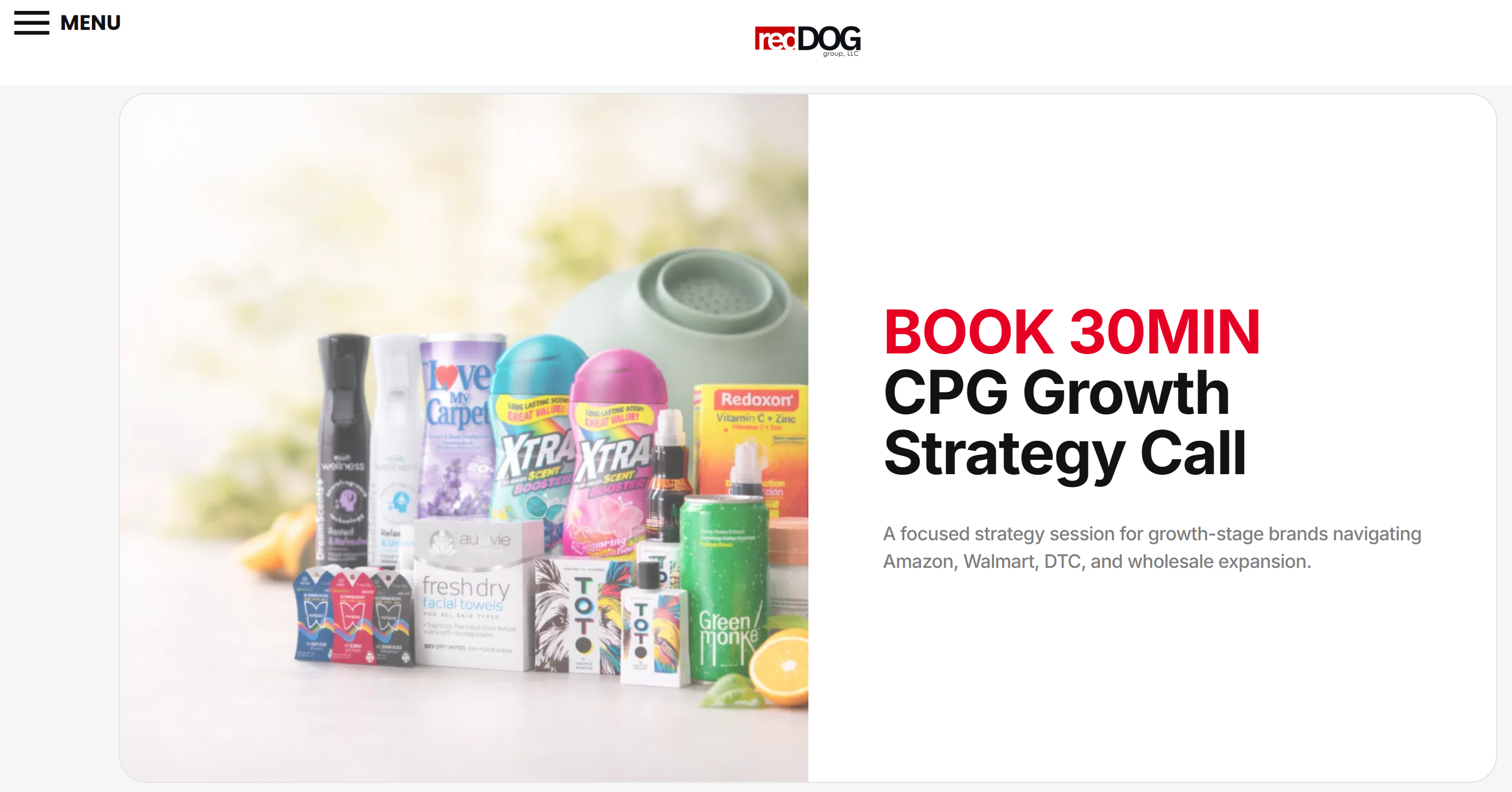
Ready to stop chasing revenue and start scaling profitable growth? Let RedDog Group guide your path with proven frameworks and expert support designed for emerging and growth-stage CPG brands. Explore our comprehensive CPG retail growth offer today to uncover how smart channel analysis and strategic market mapping can transform your business. Visit our Home page to learn more about partnering with a Houston-based consultancy rooted in real market understanding and measurable results.
Channel contribution analysis evaluates the true profitability of different sales channels by factoring in costs like operational expenses, fees, and cost of goods sold. To conduct this analysis, gather data on revenue and channel-specific expenses over a defined period, such as 90 days.
Identifying margin leaks involves analyzing detailed sales reports to track fees, deductions, and charges on each product SKU by sales channel. Start by pulling sales data for at least 90 days and itemize all direct fees to calculate the net contribution margin accurately.
To benchmark your pricing strategy, collect pricing data from key competitors and analyze your cost structure. Track how your prices align with competitors’ prices and assess your contribution margin at various price points to ensure competitiveness.
Understanding regional retail dynamics requires analyzing customer demographics, retail saturation, and competitor presence within different markets. Start by researching economic trends and retail space availability in each region to identify the best opportunities for expansion.
To assess inventory velocity, calculate your inventory days by dividing total inventory value by daily cost of goods sold. Monitor the velocity by product and channel to determine which items sell quickly and which may lead to overstock risks, allowing you to adjust orders accordingly.
Evaluate your readiness for multi-channel expansion by conducting a financial assessment and reviewing your operational systems for tracking inventory and profitability. Ensure you have sufficient working capital for at least 6-12 months and dedicated team resources to manage new channel relationships effectively.
Leave a comment: