
Published: March 2020 | Last Updated:April 2026
© Copyright 2026, Reddog Consulting Group.

TL;DR:
- Optimizing backend attributes and operational metrics is crucial for search visibility and ranking.
- Regular audits and updates tailored to each platform’s unique algorithm improve multichannel performance.
- Consistent review and refinement of listings ensure sustained growth and competitive advantage.
Leaving money on the table is easy when your product listings are incomplete. A missing backend attribute on Walmart can suppress your item from search entirely. A weak title on Amazon costs you click-through rate before a shopper ever sees your price. For CPG brands running multichannel operations across both platforms, the stakes are compounded: every gap in one channel creates drag across your overall margin picture. This checklist cuts through the noise and gives you a structured, evidence-based framework to optimize listings on Walmart and Amazon, reduce ranking risk, and capture the revenue your products have already earned.
| Point | Details |
|---|---|
| Backend attributes are critical | Completing all backend attributes increases CTR and prevents Walmart listing suppression. |
| Regular quarterly audits boost performance | Auditing and updating listings every quarter keeps pace with shifting algorithms and competitors. |
| Walmart and Amazon need distinct approaches | Each platform ranks and suppresses listings differently, so optimization tactics must be tailored. |
| Missed steps cost sales and rank | Incomplete inventory data, poor fulfillment, or missing fields can quickly tank visibility and conversion. |
Before you can fix a listing, you need to know exactly what a high-performing one looks like. The criteria are not mysterious, but they are specific, and most brands get at least one element wrong.
For both Walmart and Amazon, a strong listing starts with the title. The proven formula for selling on Walmart Marketplace is: Brand + Primary Keyword + Core Feature + Size/Variant + Key Benefit, kept within 50 to 150 characters. Titles that front-load the primary keyword and include a clear benefit consistently outperform generic names. Bullet points should be benefit-driven, not feature-dumping. Address trust, packaging details, and compatibility in a way that answers the shopper’s real question: why this product over the one next to it?
Beyond the visible content, backend attributes are where most brands lose ground. According to a Walmart listing optimization audit, roughly 60% of sellers are missing high-impact backend attributes, which directly suppresses ranking. These fields are not optional extras. Walmart’s algorithm reads them to determine relevance, and incomplete data means your item may not surface at all for relevant searches.
Here is what every listing needs to have in place:
Pro Tip: Schedule a quarterly listing audit as a standing calendar event. Algorithms change, competitors adjust pricing, and your own product specs may evolve. A listing that scored well six months ago may be losing ground today without a single change on your end.
Images deserve their own emphasis. High-quality visuals are not just about aesthetics. They drive conversion, and conversion signals feed ranking. A blurry or incomplete image set tells both the algorithm and the shopper that this listing is not ready.

With the essential ingredients established, here is a practical checklist to ensure all critical elements are addressed for each of your channel listings. Work through this in order, and flag anything incomplete before moving to the next item.
Pro Tip: Do not copy-paste listings from Amazon to Walmart. The platforms have different attribute structures, character limits, and algorithmic priorities. A listing optimized for Amazon listing optimization will not automatically perform on Walmart. Treat each channel as its own distinct retail environment.
Keyword stuffing is a common mistake at step two. Walmart’s algorithm penalizes unnatural keyword repetition, and so does Amazon’s A9. Use keywords purposefully, once in the title and naturally within bullets, not crammed into every available field.
Optimizing listings is not a one-size-fits-all process. Walmart and Amazon use fundamentally different ranking signals, and treating one as a secondary version of the other is a costly mistake. Understanding the Walmart vs Amazon growth dynamic is essential before you build your optimization workflow.
| Factor | Walmart | Amazon |
|---|---|---|
| Price weighting | Very high | Moderate |
| Fulfillment impact | High (WFS) | High (FBA) |
| Content depth | Moderate | Very high |
| AI-driven ranking | Developing | Advanced |
| Attribute strictness | Very strict | Moderate |
| Buy Box driver | Price + fulfillment | Content + conversion |
Walmart’s ranking algorithm, measured through the O-Score, targets above 95% for top placement. The O-Score factors include content quality (titles, descriptions, images, attributes), offer competitiveness (price and stock), and performance metrics (fulfillment and reviews). Price competitiveness carries significantly more weight on Walmart than on Amazon.
Amazon, by contrast, leans heavily on content depth and AI-driven conversion signals. A well-written A+ Content page, strong review velocity, and click-through rate all feed Amazon’s algorithm in ways that Walmart’s system does not yet fully replicate.
The biggest mistake multichannel brands make is treating Walmart as a secondary Amazon. The platforms have different shoppers, different algorithms, and different margin dynamics. Your strategy should reflect that reality, not ignore it.
According to marketplace optimization research, Walmart’s algorithm is price and fulfillment heavy while Amazon’s is content and AI-driven. Marketplace SEO is conversion-focused, not relevance-focused the way Google search is. That distinction matters when you are deciding where to invest optimization effort.
Top missteps to avoid on each platform:
Knowing the key differences is only half the battle. Many sellers still leave value on the table by missing crucial steps. Here is how to avoid those mistakes.
The highest-ROI fixes are almost always the least glamorous ones. Backend attributes, missed by roughly 60% of audited sellers, are the single biggest lever most brands are not pulling. Completing them fully can lift search visibility immediately without any change to your creative assets.
| Pitfall | Impact | Fix |
|---|---|---|
| Incomplete backend attributes | Listing suppression | Fill every applicable field |
| Stale pricing | Lost Buy Box | Reprice weekly or automate |
| Fulfillment gaps | Ranking drop | Enroll in WFS or FBA |
| Low inventory coverage | Stockout penalty | Maintain 21 to 28 days |
| Category errors | Wrong search placement | Audit category quarterly |
Operational metrics are another area where CPG brands consistently underinvest. Walmart requires less than 2% order cancellation rate and greater than 98% on-time shipping to maintain strong seller health. Falling below these benchmarks damages your ranking directly, not just your seller score.
Fix the operational gaps first, then layer in content improvements. Brands that address fulfillment and inventory before creative typically see faster ranking recovery because the algorithm rewards reliability above all else.
For profitable Walmart CPG growth, competitive repricing and WFS enrollment are two of the highest-return moves available. Repricing does not mean racing to the bottom. It means staying within the competitive range that keeps you Buy Box eligible without destroying your margin.
Practical actions to prevent the most-missed items:
Here is the uncomfortable truth: most CPG teams complete a listing checklist once and then move on. They treat optimization as a launch task, not an ongoing discipline. That is exactly why their rankings plateau and their competitors quietly pull ahead.
The brands that consistently outperform are not using a better checklist. They are running structured audits on a fixed cadence, reviewing operational metrics alongside content scores, and treating each platform as a living system that needs regular attention. They understand that a Walmart growth strategy built on iteration beats one built on a single optimized launch.
What separates top performers is audit discipline combined with platform-specific thinking. They do not apply a template across channels. They recognize that Walmart’s algorithm rewards operational reliability as much as content quality, while Amazon rewards conversion signals and content depth. Treating those as the same problem produces mediocre results on both.
For emerging CPG brands in the $500K to $20M range, the priority should be: fix the operational metrics first, complete the backend attributes second, then invest in content and creative. That sequence delivers faster, more measurable results than starting with a beautiful title and ignoring fulfillment.
Checklists are a starting point. What they cannot do is catch the nuanced gaps that only show up when you dig into your actual data, your category dynamics, and your margin structure across channels.
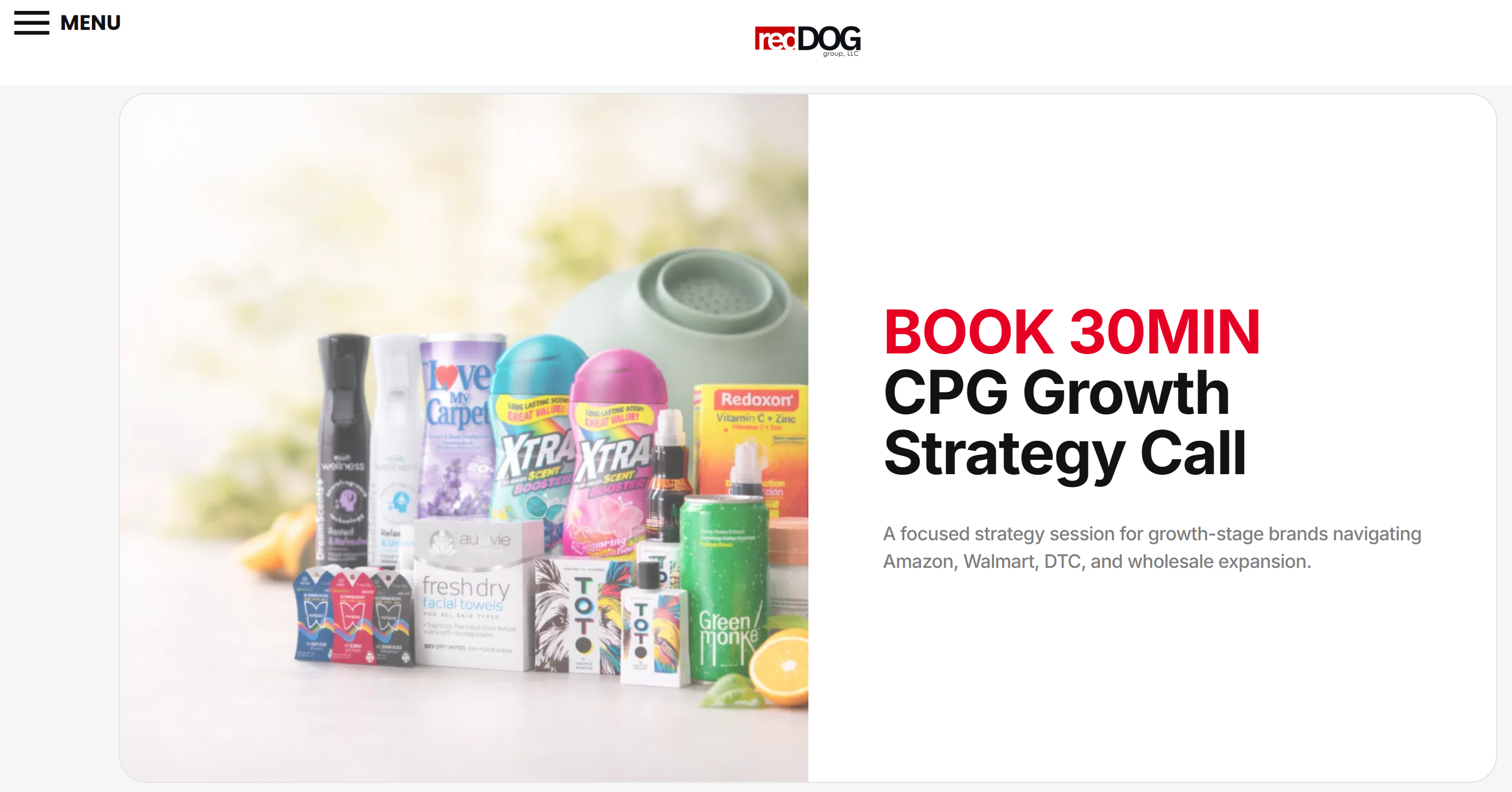
At RedDog Group, we work with CPG brands to identify exactly where listing gaps are costing visibility and margin, and we build the fixes into a structured growth plan. Our approach covers Walmart, Amazon, and emerging channels with the same margin-first discipline. If you are ready to stop guessing and start optimizing with real data behind every decision, explore our multichannel growth solutions or take a closer look at our CPG growth offer built specifically for brands at your stage.
The most overlooked are backend attributes, accurate inventory coverage, and regular quarterly updates. On Walmart specifically, missing attributes trigger listing suppression, making this the highest-impact fix available to most brands.
Listings should be audited and refreshed at least every quarter. A quarterly refresh cadence keeps your content aligned with algorithm changes and competitive shifts in your category.
The proven structure is Brand + Primary Keyword + Core Feature + Size/Variant + Key Benefit. Keep it within 50 to 150 characters for maximum search relevance and readability.
A high O-Score signals that your listing is complete and price-competitive, which directly drives Walmart ranking and Buy Box eligibility. Brands targeting O-Score above 95% consistently see stronger organic placement and conversion rates.
Leave a comment: