
Published: March 2020 | Last Updated:August 2026
© Copyright 2026, Reddog Consulting Group.

Digital transformation increases revenue, cuts operating costs, and raises competitive market value, but only when technology investment gets paired with leadership commitment and real change capability. McKinsey has measured 6 to 10% revenue uplift and 3 to 5 percentage points of EBITDA improvement in comprehensive CPG transformations. Deloitte finds that combining strategy, technology, and change capability can lift competitive market capitalization by roughly 5% relative to peers. IMD and Deloitte both frame success the same way: alignment between strategy, tech, and people, not the software purchase itself, decides the outcome.
Quick stat: Deloitte’s research on the “digital trifecta” shows that misaligned strategy and technology combinations can erode competitive value by up to 9%, almost double the potential 5% upside when the three elements are aligned.
TL;DR:
- Successful digital transformation requires alignment of strategy, technology, and change capability; neglecting this reduces potential gains by up to 9%.
- Revenue and margin improvements focus on demand shaping, supply chain efficiency, and channel economics, not just back-office automation.
- The highest returns come from diagnosing contribution margins by channel before investing in new tools or scaling pilots.
- Measurable success depends on broad KPIs across financial, customer, process, workforce, and strategic alignment, avoiding a reliance on productivity alone.
- Building lasting advantage relies on owning first-party data, sharing ecosystem information, adopting modular architecture, and fostering organizational agility.
Digital transformation matters because it converts operational friction into measurable margin, and the gains show up in specific, countable places. Automated order processing and warehouse robotics reduce manual handling time and speed fulfillment, which shows up directly in lower cost-to-serve. Personalization engines and omnichannel inventory visibility improve retention because customers get relevant offers instead of generic ones, and they can buy the way they want to buy.
The benefits cluster into five categories worth tracking separately:
Pro Tip: Before buying any new platform, map where your team currently loses hours to manual reconciliation. The tool that eliminates the biggest time sink almost always pays for itself faster than the flashiest AI feature.
None of this happens by accident. IBM’s framing of digital transformation ties customer loyalty and talent attraction directly to how modern the operating model feels to the people using it, both customers and employees. A clunky internal system doesn’t just slow down staff. It pushes good people toward competitors with better tools.
The numbers are specific enough to plan around, and vague enough in application that leaders still misuse them constantly. McKinsey’s analysis of CPG companies found that comprehensive digital and AI transformations produce a 6 to 10% incremental revenue uplift and a 3 to 5 percentage-point EBITDA improvement over three to five years, with the largest gains concentrated in consumer insight and customer/channel management rather than back-office automation alone.
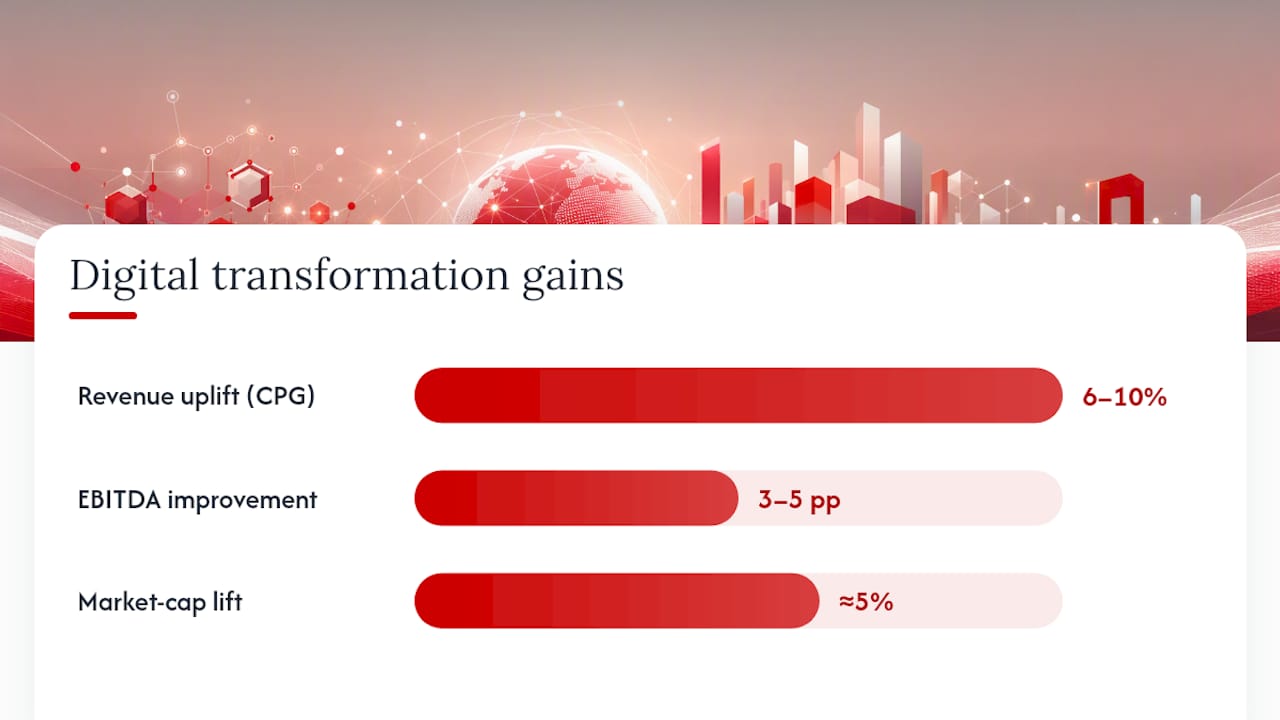
Deloitte’s research adds the mechanism behind that number. Digital strategy, technology aligned to that strategy, and organizational change capability, the “digital trifecta,” together can raise competitive market capitalization by up to roughly 5% relative to peers. Get the combination wrong, and the same research shows value erosion instead of gain.
Callout figure: Only 27% of respondents in Deloitte’s measurement study said they could reliably tie digital investment to financial outcomes, even though 81% default to productivity as their primary KPI.
The gap between the upside and the erosion risk is the whole argument for doing this carefully instead of quickly.
Technology alone doesn’t create an advantage competitors can’t copy. What builds durability is how a company turns technology into capability, and that runs through four specific levers.
Research on organizational agility and knowledge sharing backs this up directly: digital transformation by itself has a limited effect on sustainable competitive advantage. It becomes a real enabler only when paired with organizational agility and deliberate knowledge sharing across teams. A company with excellent software and siloed departments still loses to a company with decent software and people who actually talk to each other.
Most transformation budgets get spent in the wrong order: technology first, governance second, measurement as an afterthought. Reversing that sequence changes outcomes.
Pro Tip: Treat the first pilot as a test of your measurement discipline, not just your technology. If you can’t prove the pilot’s impact on margin within 90 days, you have a metrics problem that will scale with the next project.
A structured framework for technology adoption sequencing reinforces this: transformation succeeds when engagement and transition capabilities get built deliberately into the rollout, not bolted on after a system goes live. Reddog’s 7-step retail transformation checklist walks through this same sequencing for retail-specific operations.
Most companies measure the wrong thing, not because they’re careless, but because productivity is the easiest number to grab. Deloitte’s research found 81% of organizations default to productivity as their primary KPI, yet the companies reporting the highest perceived value track a broader mix across five categories.
| KPI Category | Sample Metric |
|---|---|
| Financial | Operating margin, cost-to-serve |
| Customer | Customer lifetime value, retention rate |
| Process | Forecast accuracy, order cycle time |
| Workforce | Adoption rate, output per employee |
| Purpose | Strategy-to-investment alignment |
Siloed metrics, where finance tracks margin and marketing tracks engagement with no shared dashboard, are the single biggest reason 73% of leaders say they can’t define transformation value clearly.
Value destruction rarely comes from bad technology. It comes from four specific, avoidable failures that show up across nearly every stalled transformation.
Organizational agility and cross-team knowledge sharing act as the real safeguard here. Research on firm-level digital transformation shows these two factors determine whether the investment compounds into advantage or just sits on the balance sheet as a sunk cost.
For CPG founders and operators, the theory matters less than the specific dollars. Margin capture in this category concentrates in three places: inventory velocity (avoiding both stockouts and overstock), promotion effectiveness (knowing which deals actually lift incremental volume versus cannibalize full-price sales), and channel economics (understanding what Amazon FBA fees, Walmart WFS charges, and 3PL storage costs actually do to unit economics before scaling a SKU).
Priority plays for CPG brands typically follow this order: forecast accuracy first, marketplace-specific fee and margin analysis second, then SKU and catalog optimization once the first two are stable.
Reddog structures its diagnostic reviews around exactly this sequence, starting with contribution margin by channel before recommending any new tooling. Case examples summarized by EY on CPG digital transformation show similar patterns: the biggest working-capital gains came from digitizing supply chain and sales planning together, not from either one alone.
The brands that capture the most margin from digital transformation are rarely the ones with the most advanced technology. They’re the ones that know exactly what each channel contributes to profit before they invest another dollar in software.
Digital transformation is the redesign of how a business operates, serves customers, and creates value, using digital technology as the mechanism rather than the goal. IMD’s framing captures this precisely: it’s organizational change enabled by technology, not technology adoption for its own sake. A company that buys new software but keeps the same approval chains, the same siloed data, and the same customer touchpoints hasn’t transformed anything. It has just spent money.
This distinction matters because so many failed initiatives get labeled “digital transformation” when they’re really just digitization, converting a paper process into a digital one without rethinking the process itself. Scanning invoices into a PDF isn’t transformation. Rebuilding the invoicing workflow so approvals happen automatically based on preset rules, freeing finance staff to focus on exceptions, is.
Three elements distinguish genuine transformation from surface-level tech spending:
For a CPG brand, this might mean replacing a monthly spreadsheet-based demand forecast with a system that updates weekly based on actual sell-through data. The technology is secondary. The change in how decisions get made is the actual transformation, and it’s the piece most companies skip.
Customer expectations have shifted permanently, and the shift didn’t happen gradually. It happened because a handful of companies made same-day delivery, personalized recommendations, and instant customer service the baseline, and everyone else got measured against that baseline whether they invested in it or not.
Three behavioral shifts matter most for CPG and retail brands specifically. First, customers now expect consistent pricing and product availability across every channel they touch, online, in-store, and marketplace, and a mismatch erodes trust faster than almost any other failure. Second, personalization has moved from a nice-to-have to an expectation; a generic email blast reads as neglect when competitors are sending relevant, behavior-triggered offers. Third, patience for friction has collapsed. A slow checkout page, an out-of-stock item with no restock estimate, or a customer service response that takes days instead of hours now pushes buyers toward a competitor within the same session.
IBM’s research on digital transformation ties this directly to loyalty: companies that modernize customer-facing operations don’t just retain customers better, they also become more attractive to the talent needed to keep improving those operations. The two reinforce each other.
For decision-makers, the practical takeaway is that customer expectations set the floor, not the ceiling. Meeting last year’s standard for omnichannel consistency or personalization isn’t enough, because the standard itself keeps moving upward every quarter a competitor invests in the experience.
Some of the clearest evidence comes from CPG-specific case work rather than abstract theory. The EY case study on a major CPG transformation documented meaningful working-capital and cost improvements after digitizing supply chain planning and sales operations together, rather than tackling either function in isolation. The pattern that emerges across successful cases is consistent: gains compound when digital investment touches how decisions get made across departments, not just how one department automates its own tasks.
Retail examples follow a similar shape. Brands that unify inventory visibility across DTC, marketplace, and wholesale channels typically see fewer stockouts and less markdown pressure, because a single view of true available inventory lets pricing and promotion decisions reflect real-time supply rather than last week’s warehouse count.
Manufacturing and logistics-heavy CPG operations show a slightly different pattern: the biggest wins often come from demand forecasting accuracy rather than customer-facing technology. A more accurate forecast reduces both the cost of excess inventory and the revenue lost to stockouts, and that dual benefit is why McKinsey’s research on CPG transformations points to consumer insight and demand shaping as the domains with the highest incremental revenue impact.
The common thread across industries isn’t the specific technology chosen. It’s whether the transformation touched a genuine decision bottleneck or just added a new tool on top of an unchanged process. Reddog’s guide to retail digital transformation walks through several of these operational patterns in more depth for retail-specific operators.
AI and cloud infrastructure dominate the digital transformation conversation, but two other technology categories are quietly reshaping CPG and retail operations in ways that deserve more attention than they typically get.
Internet of Things (IoT) sensors have moved well past novelty status in supply chain operations. Temperature and humidity sensors in cold-chain logistics catch spoilage risk before it becomes a write-off. Shelf-level sensors in retail partner locations feed real-time sell-through data back to brand teams faster than any point-of-sale report cycle, closing the gap between what actually happened on a shelf and what a brand’s forecasting team sees.

Blockchain’s role is narrower but genuinely useful in specific applications: supply chain provenance tracking, particularly for food safety and sustainability claims that retailers and consumers increasingly demand proof of. A brand claiming a specific sourcing standard can use blockchain-based tracking to make that claim verifiable rather than aspirational, which matters more every year as retailers tighten supplier documentation requirements.
Neither technology replaces the core work of AI-driven forecasting or cloud-based data infrastructure. They extend it. IoT feeds cleaner, faster data into the same demand-shaping models McKinsey identifies as the highest-value domain for CPG transformation, and blockchain closes credibility gaps that no amount of forecasting accuracy can solve on its own. Brands evaluating where to invest next should treat these as complements to a data and AI foundation, not substitutes for building one.
Technology rollouts fail more often from culture than from code. The single biggest predictor of whether a transformation sticks is whether the people using the new systems were involved in designing how those systems fit into their actual workflow, rather than having a new tool handed down with a training deck and a deadline.
Three cultural shifts show up repeatedly in transformations that succeed. First, decision-making authority has to move closer to the data. If a regional sales manager can see real-time inventory and demand signals but still needs three approval layers to adjust a promotion, the technology investment gets neutralized by the organizational chart. Second, cross-functional collaboration has to become a default, not an exception; the squads recommended in most implementation roadmaps only work if finance, operations, and IT actually share incentives, not just meeting invites. Third, tolerance for iterative failure has to increase. A pilot that reveals a flawed assumption in month two is a successful pilot, not a failed one, but plenty of organizational cultures still punish that outcome as if it were a mistake.

Workforce changes follow from these cultural shifts rather than preceding them. Training budgets matter, but research on organizational agility suggests the deeper requirement is building genuine knowledge-sharing habits across teams that previously operated in isolation. A company can train every employee on a new platform and still fail to transform if the sales team and the operations team never learn to act on the same data at the same time. Reddog’s business transformation overview covers how operating model and governance changes need to move together with these cultural shifts, not after them.
Most of the advice circulating about digital transformation treats it as a technology decision with a financial outcome attached. That framing gets the causality backward. The research consistently shows technology as the least important variable in the equation; strategy alignment and change capability do the heavy lifting, and Deloitte’s finding that misaligned combinations can erode value by more than the potential upside proves the point sharply.
The conventional advice tends to lead with tools: which AI platform, which cloud provider, which analytics dashboard. That’s the wrong starting question for a CPG operator managing real margin pressure across Amazon FBA fees, Walmart WFS charges, and wholesale terms. The right starting question is where contribution margin is actually leaking, channel by channel, SKU by SKU, before a single technology decision gets made.
What we’d prioritize first, based on everything the data shows, is a value diagnosis before a vendor conversation. Brands that reverse this order, buying the platform first and figuring out the use case later, are the ones showing up in Deloitte’s statistic as unable to define their own metrics. That’s not a measurement problem. It’s a sequencing problem dressed up as one.
— Reddog
Digital transformation only pays off when it starts with a clear view of contribution margin by channel, and that’s the exact review Reddog runs with CPG founders and operators before recommending a single tool or platform.

If you’re running a CPG brand generating $500K to $20M in revenue and trying to figure out whether your margin problem is really a pricing problem, an inventory velocity problem, or a channel economics problem, a fresh set of eyes on the numbers often finds what internal teams are too close to see. Reddog offers a free 30-minute strategy call built as a practical review session: contribution margin by channel, Amazon and Walmart fee structures, inventory velocity, and where growth planning should focus next. No sales pressure, just a structured look at where your dollars are actually going. You can book your strategy call here or explore Reddog’s growth consulting approach first if you want more context on how the review works.
Digital transformation raises revenue, margin, and competitive value most reliably when strategy, technology, and change capability move together, not when technology gets purchased alone.
| Point | Details |
|---|---|
| Alignment beats technology alone | McKinsey and Deloitte both show change capability and strategy alignment determine most of the financial upside. |
| Expect measurable ranges, not guarantees | CPG transformations show 6 to 10% revenue uplift and 3 to 5 points of EBITDA gain over three to five years. |
| Measure broadly, not just productivity | Track financial, customer, process, workforce, and purpose KPIs to avoid the 73% metrics-definition gap Deloitte identified. |
| Sequence pilots to scale from day one | Diagnose margin leaks first, then pilot narrowly with a scaling plan attached before launch. |
| Start with a margin diagnosis | Reddog’s free strategy call reviews contribution margin, channel economics, and inventory velocity before any tech recommendation. |
Leave a comment: