
Published: March 2020 | Last Updated:July 2026
© Copyright 2026, Reddog Consulting Group.

TL;DR:
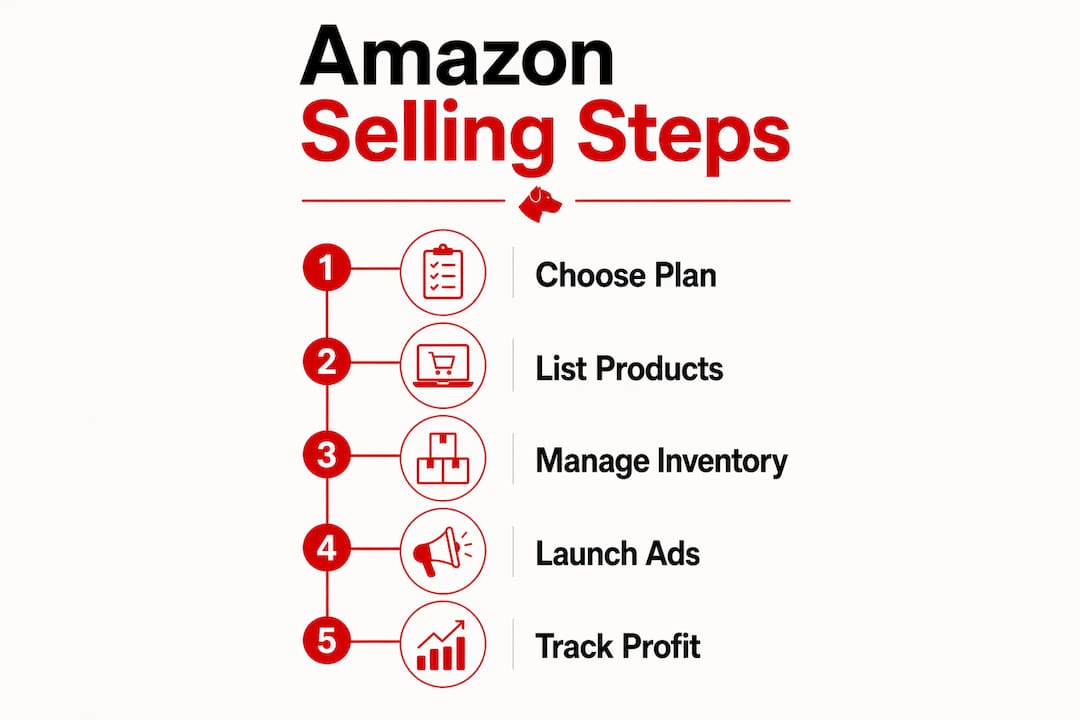
- Making money on Amazon requires understanding and managing all fees, costs, and profit margins from the start.
- Choosing the correct selling plan and accurately tracking contribution margin are crucial to long-term success.
Selling on Amazon and making money requires more than listing a product and waiting for orders. Amazon’s marketplace operates on a fee structure that can quietly consume your margins if you don’t understand it from day one. The Professional selling plan costs $39.99 per month, the Individual plan charges $0.99 per sale, and referral fees range from 8% to 45% depending on your product category. Real profit is what remains after every fee, every ad dollar, and every return is subtracted from your revenue. This guide walks you through the selling plans, fee structures, sourcing models, and profit tracking methods you need to build a sustainable Amazon business.
Amazon offers two selling plans with meaningfully different cost structures. Picking the wrong one from the start costs you money every month.
| Plan | Cost | Best For |
|---|---|---|
| Individual | $0.99 per item sold | Sellers moving fewer than 40 units monthly |
| Professional | $39.99 per month | Sellers moving 40+ units monthly |
The math is straightforward. At 40 units per month, both plans cost the same. Above that threshold, the Professional plan saves you money on a per-unit basis. Below it, the Individual plan keeps your fixed costs low while you test product demand.
The Professional plan also unlocks tools the Individual plan does not. You get access to bulk listing uploads, Amazon advertising, the Buy Box, and advanced inventory management. These features directly affect your ability to grow sales and protect margins.
Pro Tip: Start on the Individual plan to validate your first product. Switch to Professional the moment you hit 35 consistent units per month. Waiting longer costs you Buy Box access and advertising capability.
Amazon referral fees average around 15% but range from 8% to 45% depending on your product category. Electronics typically sit near the lower end. Jewelry and Amazon device accessories can hit the top of that range. That spread alone can make or break a product’s viability.
Fulfillment costs add another layer. Fulfillment by Amazon (FBA) handles storage, packing, shipping, returns, and customer service on your behalf. That convenience comes with fulfillment fees, monthly storage fees, and long-term storage fees for slow-moving inventory. Fulfillment by Merchant (FBM) keeps those costs off Amazon’s invoice but shifts the logistics burden to you.
Your true net profit per unit follows this equation:
Revenue minus product cost, referral fee, fulfillment cost, advertising spend, storage fees, and return costs equals net profit.
Here is how that looks on a real product:
| Cost Item | Example Amount |
|---|---|
| Selling price | $29.99 |
| Product cost (landed) | $8.00 |
| Referral fee (15%) | $4.50 |
| FBA fulfillment fee | $4.25 |
| PPC advertising cost | $2.50 |
| Storage fee (monthly share) | $0.75 |
| Net profit per unit | $9.99 |
That $29.99 sale produces roughly $10 in profit. Sellers who track only revenue see $29.99 and feel good. Sellers who track contribution margin see $9.99 and know exactly what they are working with.
Hidden costs such as returns, chargebacks, and aging inventory can consume 15–25% of margin if left unmanaged. That is not a rounding error. It is the difference between a profitable product and one that slowly drains your cash.
Pro Tip: Build your profit model before you source a single unit. If the math only works under perfect conditions, the product will not survive real-world returns and ad costs.
Multiple selling models exist on Amazon, and each one carries a different risk profile, capital requirement, and profit ceiling. Choosing the right model for your situation matters as much as choosing the right product.
Private label with Brand Registry gives you the strongest long-term position. You control the listing, you own the Buy Box by default, and you can run A+ Content to improve conversion rates. The tradeoff is that you carry more upfront risk and need a longer runway to profitability.
For sellers who want to make money on Amazon without holding inventory, the Amazon Associates affiliate program pays up to 10% commission on qualifying purchases. It requires no product sourcing, no fulfillment, and no customer service. The ceiling is lower, but so is the floor.
A well-built product listing does two jobs: it ranks in Amazon search and it converts browsers into buyers. Most sellers focus on one at the expense of the other.
Listing and advertising optimization starts with your product title. Your title should lead with your primary keyword, include key product attributes (size, material, quantity), and stay within Amazon’s character limits for your category. Keyword stuffing hurts readability and conversion. Write for the buyer first, the algorithm second.
Pro Tip: Calculate your break-even ACoS before you launch any ad campaign. If your net margin is 33%, your break-even ACoS is 33%. Any campaign running above that number is spending more on ads than the sale is worth.
Tracking net profit per unit and per ASIN is the single most important habit for long-term Amazon success. Revenue growth without margin visibility is how sellers scale themselves into cash flow problems.
Beginners consistently mistake high revenue for high profit. The sellers who build durable Amazon businesses are the ones who know their contribution margin per unit before they place their first purchase order. Revenue is vanity. Contribution margin is the number that actually tells you whether the business is working.
Profitable Amazon selling depends on understanding your true cost structure before you source a single product, not after your first month of losses.
| Point | Details |
|---|---|
| Choose the right plan | Switch to the Professional plan at 40+ monthly units to unlock advertising and Buy Box access. |
| Know your real fees | Referral fees range from 8–45%; always model FBA costs, storage, and returns before sourcing. |
| Pick the right selling model | Private label offers the highest margin ceiling; affiliate and arbitrage suit lower-capital starts. |
| Optimize listings for conversion | Lead titles with keywords, use all image slots, and set PPC campaigns against your break-even ACoS. |
| Track contribution margin | Monitor net profit per ASIN, not total revenue, to catch margin leaks before they compound. |
The advice I see repeated most often is “find a winning product and scale it.” That framing skips the part that actually determines whether you make money: understanding what the product costs you to sell at every volume level.
At Reddog, we work with CPG founders who have already built real revenue on Amazon. Many of them come to us because their sales are growing but their cash position is not improving. When we pull apart the numbers, the pattern is almost always the same. Advertising spend has crept up without a corresponding increase in organic rank. Storage fees are accumulating on SKUs that were launched but never fully optimized. Return rates on one or two ASINs are quietly eating the margin that the rest of the catalog is generating.
The fix is not a new product or a bigger ad budget. The fix is contribution-margin-first thinking applied to every SKU, every channel, and every fulfillment decision. Amazon’s tools are genuinely useful. FBA removes enormous operational friction. PPC can accelerate a product that already converts. Brand Registry protects your listing and unlocks content that improves conversion rates. But none of those tools substitute for knowing your numbers at the unit level.
The sellers who make real money on Amazon are not the ones who found the best product. They are the ones who built the tightest cost model and refused to scale anything that did not clear their margin threshold.
— Reddog
Building a profitable Amazon business requires more than good products. It requires a clear view of what each SKU actually contributes to your bottom line after every fee, every ad dollar, and every return is accounted for.
Reddog works with CPG founders and operators in the $500K–$20M revenue range who need structured Amazon growth consulting built around contribution margin, not just top-line sales. If your Amazon revenue is growing but your margins are not, or if you are preparing to launch and want to model your costs before you commit capital, a focused strategy session can clarify exactly where your profit is going and what to do about it. Book a free 30-minute strategy call with Reddog to review your channel economics, fee structure, and growth plan with no pressure and no pitch.
The Individual plan charges $0.99 per item sold with no monthly fee, making it the lowest-cost entry point for new sellers testing their first product.
Referral fees range from 8% to 45% depending on your product category, with an average around 15% across most categories.
FBA means Amazon handles storage, packing, shipping, and returns for a fee. FBM means you manage fulfillment yourself, which reduces Amazon fees but increases your operational workload.
The Amazon Associates affiliate program pays up to 10% commission on qualifying purchases, letting you earn without sourcing or shipping any inventory.
Most sellers confuse revenue with profit and fail to account for all fees, advertising costs, and returns when calculating whether a product is actually earning money.
Leave a comment: