
Published: March 2020 | Last Updated:June 2026
© Copyright 2026, Reddog Consulting Group.

TL;DR:
- Selling books on Amazon can reach millions without traditional publishing.
- Choosing the right path between Kindle Direct Publishing and Seller Central depends on your goals and volume.
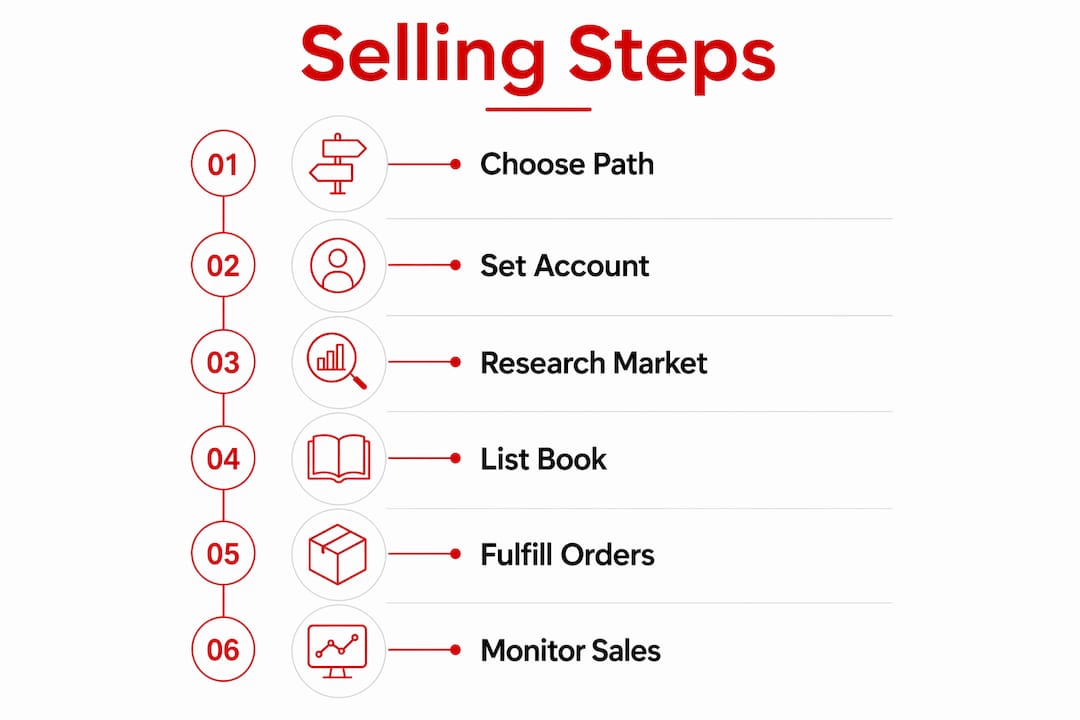
Selling books on Amazon is one of the most direct paths to reaching millions of readers without a traditional publishing deal. Amazon offers two distinct routes: Kindle Direct Publishing (KDP) for self-published authors and Seller Central for resellers of new or used books. Each path has its own fee structure, royalty model, and operational demands. Understanding which route fits your goals before you create an account saves weeks of costly trial and error.
Two main paths exist for authors and resellers on Amazon. KDP lets you self-publish with no upfront cost and earn royalties directly. Seller Central lets you list physical books, new or used, and reach buyers through Amazon’s marketplace.

KDP pays 70% royalties on ebooks priced between $2.99 and $9.99. Ebooks priced outside that range earn only 35%. That royalty gap is significant. A $4.99 ebook earns you roughly $3.49 per sale. The same book priced at $0.99 earns only $0.35.
Seller Central works differently. You pay a 15% referral fee plus a flat $1.80 closing fee on every media item sold. The Professional Seller Plan costs $39.99 per month. The Individual Plan charges $0.99 per unit sold instead. For sellers moving fewer than 40 books per month, the Individual Plan is the lower-cost starting point.
Account setup is the step most sellers rush through and later regret. Amazon requires identity verification, tax information, and valid bank details before any payments are released. Skipping or incorrectly completing the tax interview causes automatic payment holds that can last weeks.
For KDP authors, the tax interview is mandatory. Payment holds occur automatically until your tax and banking information is verified and correct. Complete this step before you publish your first title, not after.
For Seller Central accounts, choose your plan based on volume:
Pro Tip: Complete your tax interview and bank setup on day one. Amazon will not release a single payment until both are verified, and the process can take several business days.
Research tools matter before you list a single book. Use Amazon’s own Best Sellers Rank (BSR) data to gauge category demand. BSR is a real-time sales rank assigned to every product. A book ranked below 100,000 in its category sells at least a few copies per day. A book ranked above 1,000,000 may sell only a few copies per month.
A well-prepared listing sells more books than a rushed one. Structured pre-launch preparation correlates with up to 34% higher first-month revenue. That gap comes from better keyword placement, accurate category selection, and competitive pricing set before launch.
Pro Tip: For used book resellers, check the sales rank before buying inventory. A book ranked above 2,000,000 on Amazon may sit in your storage for months before selling.
Fulfillment choice directly affects your conversion rate, storage costs, and net margin. The two options are Fulfillment by Amazon (FBA) and Fulfillment by Merchant (FBM). Each fits a different seller profile.
FBA increases conversion rates by 25–30% because FBA listings qualify for Prime shipping. Prime buyers convert at a significantly higher rate than non-Prime listings. That conversion lift is the primary reason resellers scaling past 50 units typically move to FBA.
| Feature | FBA | FBM |
|---|---|---|
| Prime eligibility | Yes | No (unless Seller Fulfilled Prime) |
| Conversion rate impact | 25–30% higher | Baseline |
| Storage fees | ~$0.87 per cubic foot per month | None |
| Shipping control | Amazon handles it | Seller handles it |
| Best for | High-volume sellers | Low-volume or specialty sellers |
FBM gives you full control over shipping speed and packaging. For sellers with fewer than 20 books per month, FBM avoids the storage fees that can erode margins on slow-moving inventory. For a deeper look at whether FBA makes financial sense for your situation, Reddog’s analysis of FBA worth for your brand breaks down the real numbers.
Pro Tip: Track your inventory velocity every 30 days if you use FBA. FBA storage fees of approximately $0.87 per cubic foot per month compound quickly on slow-moving titles.
Pricing below your total fee load is the fastest way to lose money on Amazon. The math is straightforward but easy to miss when you are focused on beating competitors.
For Seller Central, every book sale carries two mandatory fees: a 15% referral fee on the sale price and a flat $1.80 closing fee. On a book priced at $5.00, the referral fee is $0.75 and the closing fee is $1.80. That is $2.55 in fees before shipping costs. Pricing below $8–$10 on many used books produces negative margins once fees and shipping are included.
Key pricing rules for profitable book selling:
For KDP authors, the royalty structure is the pricing framework. A $6.99 ebook earns $4.89 at 70%. The same book priced at $1.99 earns only $0.70 at 35%. The difference in earnings per sale is nearly seven times larger at the higher price point, even though the price difference is only $5.00.
Most early failures on Amazon trace back to four avoidable errors.
“The sellers who build sustainable book businesses on Amazon are the ones who treat it like a business from day one. That means knowing your fees, tracking your inventory, and pricing with margin in mind.”
For resellers expanding beyond Amazon, cross-listing to additional platforms reduces dependence on a single channel and improves overall sell-through rates on slower-moving titles.
Selling books on Amazon profitably requires choosing the right path, completing account setup fully, and managing fees and inventory with discipline from the start.
| Point | Details |
|---|---|
| Choose your path first | KDP suits self-published authors; Seller Central suits resellers of physical books. |
| Complete setup before launch | Tax interview and bank details must be verified before Amazon releases any payment. |
| Price above your fee floor | The 15% referral fee plus $1.80 closing fee makes low-priced books unprofitable without careful math. |
| Match fulfillment to volume | FBA lifts conversions 25–30% but adds storage fees that hurt slow-moving inventory. |
| Prepare before you list | Pre-launch keyword research and pricing analysis correlate with up to 34% higher first-month revenue. |
Here is what most guides will not tell you: Amazon is a discovery engine, not a business model. Authors who treat it as their primary sales channel hand over their customer data, their pricing control, and a significant share of their margin to a platform they do not own.
The sellers I see build real, durable book businesses use Amazon to get found and then direct readers to their own websites, email lists, and direct sales channels. That is where the margin is. A $14.99 book sold directly on your own site keeps far more per unit than the same book sold through Seller Central after fees.
That does not mean ignoring Amazon. It means using it deliberately. Run a structured launch, build your BSR in a specific category, collect reviews, and then use that social proof to drive direct sales. The launch strategy framework Reddog uses with product brands applies directly to book launches too. The principles are identical: research first, price with margin in mind, and never let a single channel own your entire revenue.
The authors who struggle are the ones who publish, set a price, and wait. Amazon rewards activity, not patience. Reprice, update keywords, and run promotions with intention. Treat your book listing like a product, because on Amazon, that is exactly what it is.
— Reddog
Amazon book selling sits at the intersection of content strategy and marketplace economics. The same margin discipline that separates profitable CPG brands from struggling ones applies directly to book sellers managing fees, fulfillment costs, and pricing decisions. Reddog works with founders and operators who want clarity on what their Amazon channel actually contributes to profit, not just top-line revenue.
If you are a self-publisher or reseller ready to build a structured, margin-focused approach to Amazon sales growth, a free 30-minute strategy call with Reddog covers your channel economics, fee structure, and inventory velocity in practical terms. No generic advice. Just a focused review of your numbers and a clear picture of where your margin is going.
KDP has no upfront cost. Seller Central charges either $0.99 per unit sold on the Individual Plan or $39.99 per month on the Professional Plan, plus a 15% referral fee and $1.80 closing fee per sale.
KDP books typically go live within 72 hours after submission, provided all compliance checks pass. Incomplete files or metadata errors can extend that timeline.
FBA increases conversion rates by 25–30% due to Prime eligibility, but storage fees of approximately $0.87 per cubic foot per month make it costly for slow-moving inventory. It works best for sellers moving consistent volume.
KDP pays 70% royalties on ebooks priced between $2.99 and $9.99. Ebooks priced outside that range earn 35%. Paperback royalties follow a separate calculation based on printing costs.
Yes. Through Seller Central, you can list and sell physical books you already own, whether new or used, without publishing anything. You find the existing listing by ISBN and add your offer to it.
Leave a comment: