
Published: March 2020 | Last Updated:August 2026
© Copyright 2026, Reddog Consulting Group.

Yes, you can resell your CPG products on Amazon profitably — if your unit economics clear the fee stack before you spend a dollar on ads. The path runs through three gates: a Professional Seller Central account with Brand Registry enrolled, UPC/GTIN identifiers on every SKU, and a contribution-margin check that accounts for referral fees, FBA fulfillment, storage, and a realistic ad allowance. If margin survives all three, you have a launchable SKU.
Quick preflight checklist:
Pro Tip: *Run the contribution-margin math before you build a single listing.
Selling your CPG products on Amazon profitably requires a contribution-margin-first approach, operational discipline, and a phased ad strategy tied to SKU-level economics — not generic benchmarks.
| Point | Details |
|---|---|
| Run the margin waterfall first | Calculate contribution margin per SKU before listing; the full fee stack commonly exceeds 50% of revenue. |
| Fix FBA tier leaks early | Re-measure packaged dimensions; dropping one size tier can recover $1.50–$2.50 per unit immediately. |
| Set TACoS from margin, not benchmarks | SKU-level contribution margin determines your TACoS ceiling; a generic target is meaningless without the math. |
| Audit reimbursements monthly | Systematic FBA reimbursement audits recover 1–3% of annual revenue most brands leave unclaimed. |
| Reddog for margin clarity | Reddog’s SKU profitability audits and Amazon consulting help CPG brands identify where margin leaks before scaling. |
Not every product belongs on Amazon, and listing a SKU with thin margins is one of the fastest ways to burn cash. Screen each SKU against these filters before investing in creative or ad spend.
SKU-level filters:
Brand prerequisites:
Operational prerequisites:
Pro Tip: Re-measure every SKU in its actual shipping carton before submitting dimensions to Amazon. Dropping from a Large Standard to a Small Standard FBA tier can save $1.50–$2.50 per unit, which is often more impactful than a price increase.
Start with a Professional Seller Central account. The Individual plan ($0.99 per sale) has no access to advertising, Buy Box eligibility is limited, and you cannot enroll in Brand Registry — none of which work for a CPG brand at launch.
Account and brand setup steps:
Brand Registry approval typically takes 2–10 business days once your trademark is verified. The payoff is immediate: A+ content, brand analytics, counterfeit reporting tools, and access to Amazon Vine for early reviews. For a deeper look at Amazon brand guidelines and how they apply across channels, Reddog’s resource library covers the full creative and compliance picture.
Fulfillment model choice is a margin decision, not a logistics decision. Here is how the three models compare for CPG:
FBA gives you Prime badge, Buy Box priority, and Subscribe & Save eligibility. It is the right call for fast-moving consumables. FBM via 3PL preserves margin on slow movers, oversized SKUs, or products with long shelf life that would accumulate storage fees. Seller-Fulfilled Prime (SFP) requires strict ship-speed SLAs most emerging brands cannot meet without a dedicated fulfillment partner.

For most CPG brands under $5M in Amazon revenue, FBA for core SKUs and FBM for tail SKUs is the right hybrid.
Sample FBA fee waterfall — standard consumable SKU at $24.99:
According to SellerForge’s FBA margin benchmarks, the full Amazon fee stack commonly exceeds 50% of revenue once referral, fulfillment, storage, advertising, returns, and overhead are included, with net margins by category spanning roughly 11%–35%.
Pro Tip: Packaging redesign to drop an FBA size tier is often faster ROI than negotiating a supplier price reduction. A 0.1-inch reduction in one dimension can shift a SKU from Large Standard to Small Standard and recover $1.50+ per unit immediately.
A listing that ranks but does not convert wastes every ad dollar behind it. For CPG, conversion and compliance are inseparable — a prohibited claim can delist a top-performing ASIN overnight.
Listing essentials:
Amazon’s Rufus AI surfaces listing content in generative answers, so listing copy must answer “what the product does, who it’s for, and in what context” — not just stuff keywords. Write for a person first, then layer in search terms. For a technical deep dive on optimizing Amazon product listings, Reddog’s listing guide covers title architecture and A+ module sequencing.
Variation strategy: Use parent/child ASINs for flavor, size, or scent variations. Each child ASIN carries its own inventory, but reviews pool at the parent level — a significant advantage for new SKUs launching under an established parent.
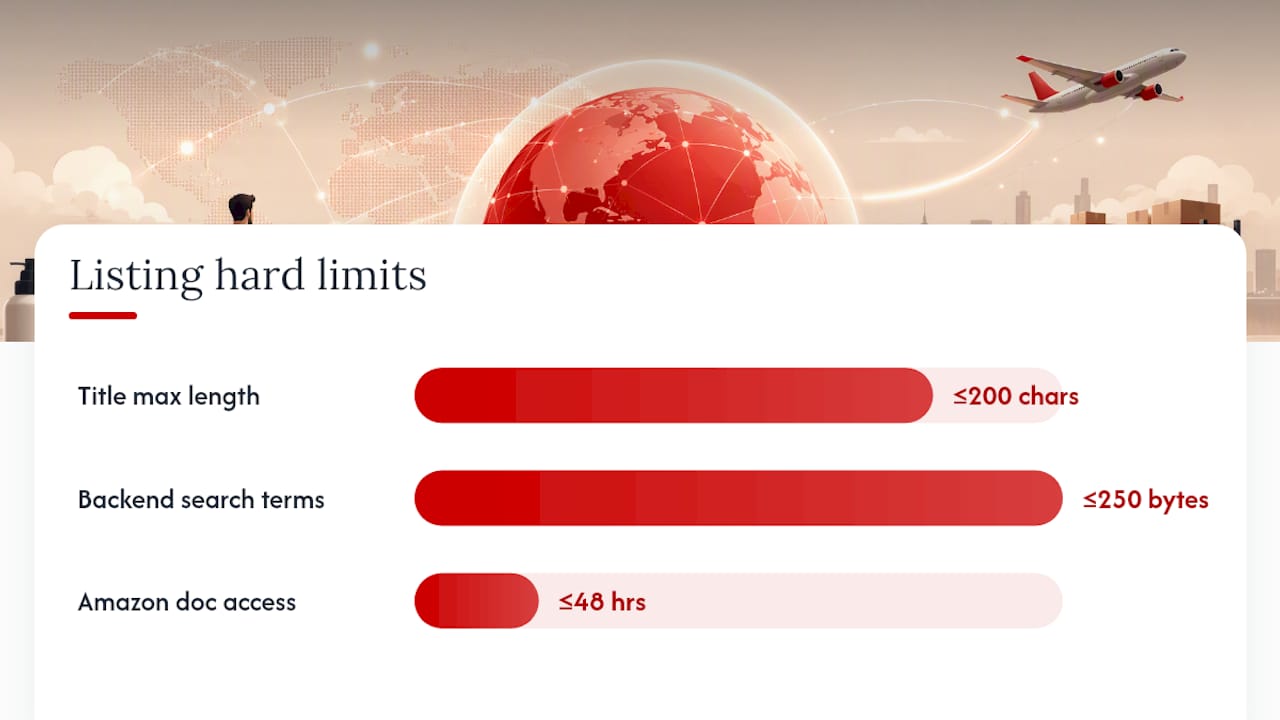
Compliance non-negotiables: No structure/function claims that imply disease treatment (FDA territory). No “clinically proven” without a cited, accessible study. Keep your SDS sheets, CoAs, and label files in a shared folder Amazon can access within 48 hours of a request.
The three-phase launch model — honeymoon harvesting, surgical tightening, and steady-state profitability — gives you a structured path from data collection to margin control.
Review generation: Use Amazon’s “Request a Review” button for every eligible order. If brand-registered, enroll new ASINs in Amazon Vine to seed 5–30 authentic reviews before organic velocity builds.
Inventory planning for CPG on Amazon runs on three numbers: days of cover, lead time, and safety stock. A stockout does not just lose a sale — it collapses organic rank and resets the algorithm’s confidence in your ASIN.
Reorder cadence example for a consumable SKU:
Use a 3PL for slow movers and bulky SKUs to avoid long-term Amazon storage fees. Inbound placement fees have added a new cost layer in 2026 — consolidating shipments to a single FC reduces that exposure. For brands navigating Amazon’s drop ship and hybrid fulfillment policies, Reddog’s compliance guide covers the policy boundaries clearly.
Operational checklist:
Pro Tip: Set a calendar reminder for the first business day of each month to run your FBA reimbursement report. Most brands recover meaningful dollars within the first audit cycle.
Track these seven metrics weekly for every active SKU:
SKU-level P&L example (same $24.99 SKU):
Run this waterfall on your top 10 SKUs. SellerForge’s category benchmarks show the typical net profit landing around $15 on $100 of revenue — the “100→15 waterfall” — after the full fee stack. SKUs below that threshold need a fix (packaging, pricing, supplier negotiation, or ad spend cuts) before you scale spend. As Ecommerce Fastlane’s contribution-margin framework makes clear, ACoS benchmarks are meaningless without SKU-level margin math underneath them.
Most CPG brands lose money on Amazon through the same five errors:
Quick fixes:
For brands dealing with unauthorized sellers and channel leakage, Reddog’s seller legitimacy guide walks through the detection and reporting process step by step.
Days 1–30: Foundation
Milestone: listings live, campaigns active, first shipment received at FC.
Days 31–60: Tighten and learn
Days 61–90: Profitability and scale
Milestone: positive contribution margin on core SKUs, TACoS within ceiling, 60+ days of cover on top movers.
A campaign that is profitable at $1.20 CPC can go negative at $1.56 without a bid ceiling in place.
Third-party marketplace share rose in 2026 while organic visibility declined for CPG brands, which means paid traffic is no longer optional at launch — it is the primary discovery mechanism. Plan accordingly.
The brands we see struggle on Amazon share one pattern: they optimized for revenue before they understood their margin. They scaled ad spend, celebrated top-line growth, and discovered six months later that Amazon was consuming more cash than it was generating. The channel looked like a growth engine; the P&L said otherwise.
The margin-first approach flips that sequence. You run the contribution-margin waterfall before you build a listing, set TACoS ceilings before you launch campaigns, and treat Amazon as a customer-acquisition channel with a known CAC — not a pure profit center. When a brand we worked with reclassified Amazon as a CAC channel and reallocated ad spend from low-margin SKUs to high-margin ones, their blended TACoS dropped and contribution margin per unit improved within 60 days, without a single price increase. The fix was sequencing, not spending.
Operational discipline compounds that gain. Monthly reimbursement audits, FBA tier remeasurements on every packaging change, and a 3PL buffer for slow movers are not glamorous tactics — but they are the ones that protect margin at scale. As CPG marketplace dynamics in 2026 make clear, brands that choose a deliberate operating model outperform those that react to the algorithm.
Reddog’s Amazon growth consulting is built for exactly this situation: a CPG brand with real products and real potential that needs margin clarity before it scales spend.
We work with founders and operators in the $500K–$20M revenue range on SKU-level profitability audits, FBA fee waterfall analysis, ad campaign architecture, and inventory planning. The work is analytical, specific to your category, and focused on contribution margin — not vanity metrics. If you want to know whether your top SKUs are actually profitable on Amazon, or where the margin is leaking, a 30-minute strategy call is the right starting point. Book a free strategy session and we will review your contribution margin, channel economics, or inventory velocity together.
Authoritative references:
Research and keyword tools:
Reddog resources:
Leave a comment: