
Published: March 2020 | Last Updated:July 2026
© Copyright 2026, Reddog Consulting Group.

TL;DR:
- Profitable Amazon FBA businesses manage contribution margins carefully, focusing on costs from fees to advertising. Starting with $5,000 to $10,000 in capital and maintaining a 20% cash buffer improves survival chances. Sellers targeting 15–30% net margins ensure profitability despite Amazon’s fees and refunds.
Making money on Amazon FBA is defined as generating net profit from product sales after subtracting all Amazon fees, inventory costs, shipping, advertising, and returns. Fulfillment by Amazon (FBA) is the program where Amazon stores your inventory, picks and packs orders, and handles customer service on your behalf. The model works, but only when you treat it as a margin business from day one. Sellers who profit from Amazon FBA consistently target net margins between 15% and 30%, not just top-line revenue. This guide covers the startup costs, fee structures, product selection, inventory practices, and advertising tactics you need to build a real business in 2026.
Launching a viable private-label Amazon FBA business in 2026 requires $5,000 to $10,000 in starting capital. That range covers inventory, inbound shipping, account setup, product photography, trademarks, and early advertising. Trying to launch for less is one of the most common reasons new sellers fail before they gain traction.
Starting with less than $5,000 is a documented cause of early failure. Thin working capital limits the inventory you can hold, reduces your ability to run ads, and leaves no cushion when Amazon’s biweekly disbursement cycle creates a cash gap. Amazon pays out sales revenue every two weeks, but you pay for inventory, shipping, and storage upfront. That timing mismatch catches undercapitalized sellers off guard.
Here is a realistic breakdown of where your startup budget goes:
| Cost Category | Typical Range |
|---|---|
| Inventory (first order) | $2,000 – $5,000 |
| Inbound shipping to Amazon | $500 – $1,500 |
| Professional Selling Plan | $39.99/month |
| Product photography and listing assets | $300 – $800 |
| Trademark registration | $250 – $400 |
| Initial PPC advertising budget | $500 – $1,500 |
| Miscellaneous (samples, tools, UPC codes) | $200 – $500 |
Pro Tip: Build a 20% cash buffer on top of your projected startup costs. Unexpected fee changes, a slow first month, or a supplier delay can drain your runway fast. That buffer is not waste. It is insurance.
Net profit per unit is calculated as: selling price minus referral fee, minus fulfillment fee, minus product cost, minus inbound shipping, minus storage fees, minus PPC allocation, minus a reserve for returns. Every one of those line items compounds. Sellers who skip even one category end up with a margin number that looks healthy on paper and bleeds cash in practice.
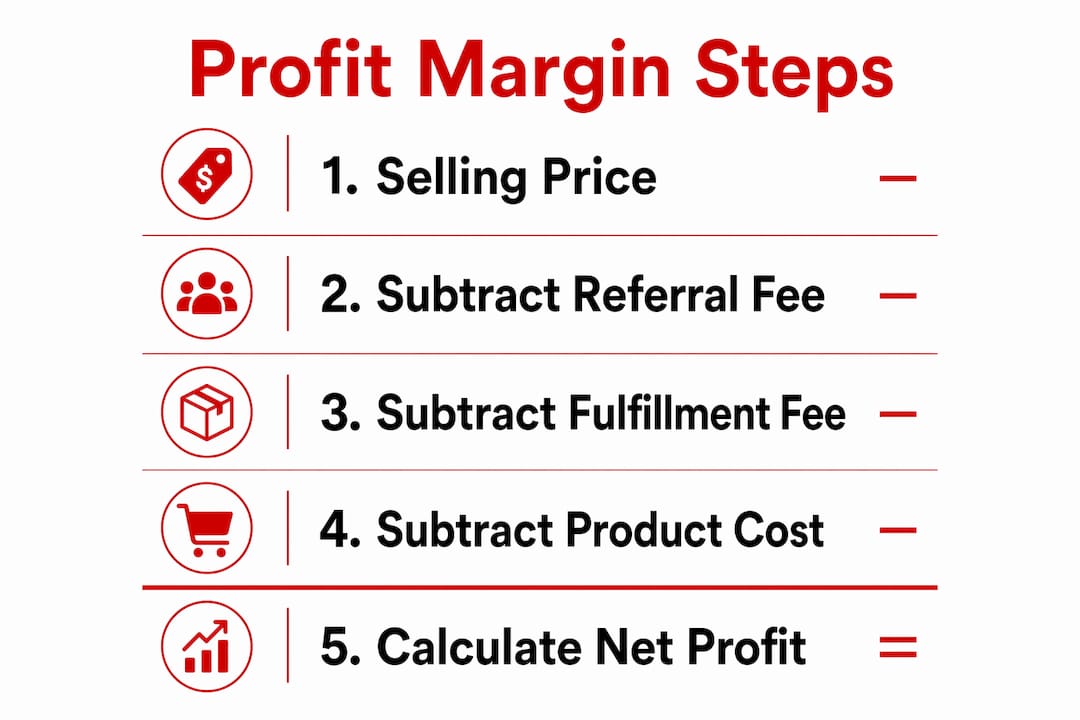
Amazon fees typically sum to 25–40% of the selling price, including referral, fulfillment, and storage fees. Small, lightweight items pay roughly $3.50 per unit in fulfillment fees alone, with larger or heavier products paying considerably more. You can review the full Amazon fee structure to model your specific product category before ordering inventory.
Products priced between $20 and $80 tend to hit the sweet spot for FBA profitability. Below $20, fees consume too large a share of revenue. Above $80, conversion rates drop and return rates often rise. Staying in this range gives you room to absorb fees and still hit a 15–30% net margin target.
The cost components that move your margin most are:
Operators with less than 10% net margins frequently end in losses once returns, refunds, and fee changes hit. A 15–30% target gives you a real buffer. Tracking contribution margin, not just gross revenue, gives you the clearest picture of business health.
Product selection is where most Amazon FBA businesses are won or lost before a single unit ships. The best products for Amazon FBA share four traits: consistent demand, strong margin potential, manageable size and weight, and a competition level you can realistically enter.

The three main FBA business models each carry different capital requirements and profit profiles:
| Sourcing Model | Startup Capital Needed | Typical Net Margin |
|---|---|---|
| Private label | $5,000 – $10,000+ | 20–35% |
| Wholesale | $3,000 – $8,000 | 8–15% |
| Retail/online arbitrage | $500 – $2,000 | 10–20% |
Private label gives you the most control over pricing and branding, but requires the most upfront capital and time. Wholesale is faster to launch but margin compression is real. Arbitrage works at small scale but rarely builds a durable business.
Most Amazon sales flow through the Featured Offer, commonly called the Buy Box, and winning it requires a Professional Selling Plan at $39.99 per month. The Buy Box drives more than 80% of sales on the platform. Staying on the Individual plan to save $40 a month is a false economy that costs you far more in lost conversions.
Validate a product before committing to a full inventory order. Order samples, check competitor reviews for recurring complaints, and use Amazon’s own Best Seller Rank data to confirm demand. A product with 200 reviews and a BSR under 50,000 in its subcategory is a signal worth investigating further.
Pro Tip: Start with a product that turns inventory in 30–60 days. Fast turnover keeps your cash moving and minimizes storage fees while you learn the platform. Slow-moving inventory is expensive in ways that don’t show up until your storage bill arrives.
Inventory management is the operational discipline that separates sellers who scale from those who stall. Amazon charges aged inventory surcharges for items stored 181 days or longer, and inbound placement fees apply when your shipment gets distributed across multiple fulfillment centers. Both costs are avoidable with proactive planning.
New sellers have access to credits that reduce early costs. Amazon’s new seller program offers up to $400 in inventory placement credits and $100 off inbound shipments through the Partner Carrier program. These credits are time-limited, so using them in your first months lowers your effective cost basis while you build sales history.
Proactive inventory turnover monitoring reduces storage fees and prevents aged inventory penalties. Experienced sellers set reorder points based on lead time and sales velocity, not gut feel. You can also review Reddog’s guide to Amazon FBA inventory management for a structured approach to avoiding stockouts without overstocking.
Operational costs to monitor every month:
Stockouts are just as damaging as overstock. Losing your sales rank during a stockout can take weeks to recover. Build your reorder schedule around your supplier’s lead time plus a buffer for customs delays or carrier disruptions.
Pay-per-click advertising on Amazon, known as Sponsored Products PPC, is the primary tool for driving visibility on new listings. The key metric is Advertising Cost of Sale (ACOS), which measures ad spend as a percentage of ad-attributed revenue. A 10% or lower ACOS is the target for maintaining profitability while growing sales. Higher ACOS is acceptable during a launch phase, but only if you have calculated your break-even ACOS first.
Break-even ACOS is calculated by dividing your net margin percentage by your gross margin percentage. If your net margin is 25% and your gross margin is 40%, your break-even ACOS is 62.5%. Spending above that number means ads are costing you money, not making it.
Here are the steps to run ads without burning margin:
Pricing strategy works alongside advertising. Raising your price by $2–$3 often improves perceived value and can increase conversion rate, especially when your listing has strong reviews. Cutting price to chase volume almost always compresses margin faster than it grows profit. Optimizing your product pages for search relevance and conversion rate reduces your dependence on paid traffic over time.
Pro Tip: Test price changes in $1–$2 increments and wait at least 14 days before evaluating results. Amazon’s algorithm needs time to reflect changes in conversion rate and ranking. Impatient price cuts are one of the fastest ways to train yourself into a race to the bottom.
Profitable Amazon FBA requires managing contribution margin across every cost layer, from fees and inventory to advertising and returns, not just hitting a revenue target.
| Point | Details |
|---|---|
| Startup capital matters | Budget $5,000–$10,000 and maintain a 20% cash buffer to survive the launch period. |
| Fees consume 25–40% of revenue | Model all fee categories before ordering inventory to confirm your margin is viable. |
| Target 15–30% net margin | Margins below 10% leave no room for returns, fee changes, or slow months. |
| Buy Box requires a Pro plan | The $39.99/month Professional Selling Plan is necessary to compete for the majority of sales. |
| Inventory turnover drives profit | Fast-moving stock reduces storage fees and keeps cash available for reinvestment. |
The sellers I see struggle most are not the ones who picked a bad product. They are the ones who picked a decent product and then ran the business on optimism instead of numbers. YouTube tutorials on how to sell on Amazon tend to show the revenue screenshot, not the fee breakdown, the return rate, or the cash flow gap between shipping inventory and receiving the first disbursement.
Contribution margin is the number that tells you whether your business is actually working. Gross revenue is a vanity metric until you subtract every cost that touches that unit. At Reddog, we work with founders who are generating real sales volume and still losing money because their fee structure was never properly modeled. That is not a product problem. It is a financial clarity problem.
The other mistake I see constantly is treating advertising as a growth tool before the listing is ready to convert. Sending paid traffic to a listing with three reviews and mediocre photos is burning money. Fix the listing first. Build reviews through legitimate post-purchase follow-up. Then scale ads on a listing that already converts organically.
Starting an Amazon FBA business in 2026 is still a real opportunity. The platform has more competition than it did five years ago, but it also has more tools, more data, and more seller resources. The sellers who win are the ones who treat it like a real business with real financial discipline, not a side hustle they figure out as they go.
— Reddog
Reddog is a Houston-based CPG retail growth consultancy that works with founders and operators navigating the real economics of Amazon FBA, including fee modeling, contribution margin analysis, inventory velocity, and channel growth planning.
If you are building or scaling an Amazon FBA business and want a clear picture of where your margin is going, Reddog offers a free 30-minute strategy call focused on contribution margin, channel economics, and growth planning. The call is practical and specific to your numbers, not a generic pitch. Qualified CPG founders and operators in the $500K–$20M revenue range can book a strategy call to review what your channel is actually contributing to profit and where the leaks are hiding.
Profitable FBA sellers target net margins of 15–30%, meaning a seller generating $20,000 in monthly revenue could net $3,000–$6,000 after all fees and costs. Actual earnings depend on product selection, fee management, and advertising efficiency.
A viable private-label FBA business requires $5,000 to $10,000 to launch properly in 2026, covering inventory, shipping, fees, and initial advertising. Starting with less significantly increases the risk of running out of working capital before generating consistent sales.
Yes. The Professional Selling Plan at $39.99/month is effectively required because it makes you eligible for the Buy Box, which drives more than 80% of Amazon sales. Without it, you cannot compete for the majority of conversions on the platform.
A 10% or lower ACOS is the standard profitability target for established listings. Calculate your break-even ACOS first, then work to bring your actual ACOS below that threshold as your campaign data matures.
Monitor inventory turnover proactively and set reorder points based on sales velocity and supplier lead time. Amazon charges aged inventory surcharges on items stored 181 days or longer, so keeping stock moving is the most direct way to avoid those fees.
Leave a comment: