
Published: March 2020 | Last Updated:November 2025
© Copyright 2026, Reddog Consulting Group.

Growing your brand boils down to a simple formula: get customers to buy more often, spend more each time, and stick around longer. The real growth happens when you shift from chasing one-off sales to building relationships that drive sustainable, profitable growth across all your channels.
In a world obsessed with customer acquisition, it’s easy to get trapped in the endless cycle of finding new buyers. While bringing in fresh faces is always part of the plan, the engine for long-term success is maximizing the value of the customers you already have.
This is where Customer Lifetime Value (CLV) becomes your true north.
CLV isn’t just a number for a dashboard; it’s a mindset that reframes your entire business strategy. It forces a shift from short-term revenue spikes to long-term profitability and brand health. Instead of asking, "How much did this customer spend today?" you start asking, "What is the total potential value this customer represents over their entire relationship with us?"
That simple change in perspective has massive implications for your whole omnichannel strategy.
When you break it down, boosting CLV is about pulling three fundamental levers. Each one directly impacts the total value a customer brings, and even small improvements can create a significant ripple effect on your bottom line.
To make this clear, here's a breakdown of the three core metrics that drive CLV:
| Metric | What It Measures | How It Boosts CLV |
|---|---|---|
| Average Order Value (AOV) | The average amount a customer spends per transaction. | Higher spending per purchase directly increases the value of each transaction. |
| Purchase Frequency | How often a customer comes back to buy from you. | More frequent purchases multiply the number of transactions over the customer's lifespan. |
| Customer Lifespan | The total time a customer actively buys from you. | A longer relationship creates more opportunities for repeat purchases and upselling. |
By focusing your efforts on these three areas, you're not just hoping for growth—you're engineering it. Improving one lever is good, but improving all three at once creates compounding returns.
This flow chart gives you a great visual of how these pieces fit together.
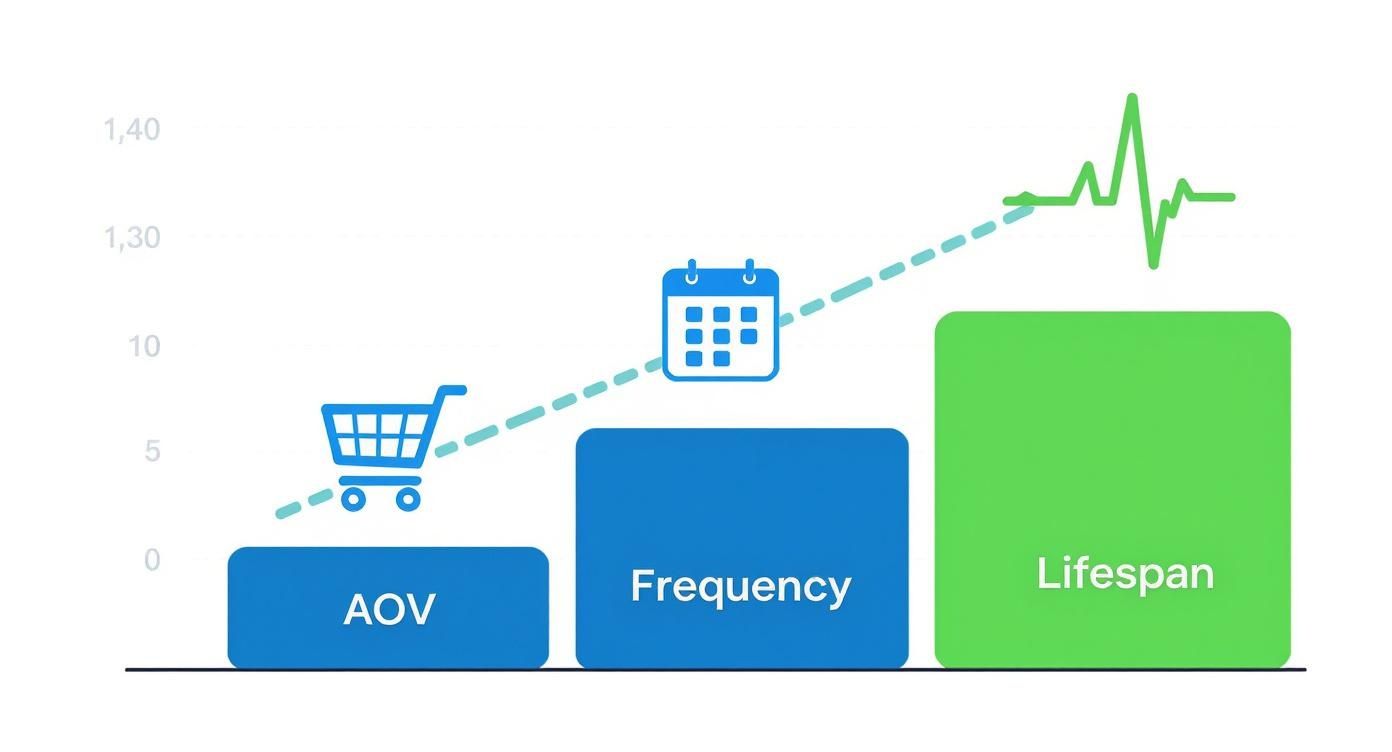
As you can see, a winning CLV strategy isn't about doing one thing right. It’s about integrating tactics that lift AOV, frequency, and lifespan simultaneously.
Getting a handle on these levers is the absolute Foundation of any solid growth framework. Before you can think about optimizing campaigns or amplifying your reach, you need a deep, data-backed understanding of who your most valuable customers are and what drives their behavior.
Focusing on retention isn't just good practice; it's a powerful financial strategy. Research from Bain & Company shows that increasing CLV by just 10% can elevate overall revenue by approximately 30%, underscoring the disproportionate impact of nurturing existing customer relationships.
This makes perfect sense when you remember that acquiring a new customer can cost up to five times more than keeping an existing one.
When you truly know your CLV, you can start making much smarter decisions about your marketing spend, customer service investments, and product development. Every dollar gets put to work where it will have the biggest impact. For a deeper dive, check out this expert guide on increasing customer lifetime value.
Once you’ve established your foundational CLV metrics, it’s time to shift into the Optimization phase. This is where the magic happens—turning raw customer data into measurable revenue by creating experiences that are personal, relevant, and perfectly timed.
Let's be clear: generic, one-size-fits-all marketing doesn’t work anymore. Customers expect you to know them, and smart personalization is the most direct path to showing them you do. It's about making each person feel seen and understood, which builds the brand affinity that drives repeat purchases and deepens loyalty. This isn’t about guesswork; it's about using your data to make strategic, human-centric decisions.

The impact of getting this right is massive. Companies that excel at personalization generate 40% more revenue from those activities than their slower-moving peers. Why? Because 76% of consumers get frustrated when they don’t find it, and 80% are more likely to buy from brands that deliver personalized experiences.
Before you can personalize anything, you need to know who you're talking to. That’s where segmentation comes in. It means grouping customers based on shared behaviors or characteristics, so you can have meaningful conversations instead of shouting into a void.
This lets you move beyond basic demographics and focus on what people actually do. Some of the most valuable segments we see brands build are:
By segmenting your audience, you create the ability to send the right message to the right person at the right time. This simple act of relevance is the core of how to increase customer lifetime value.
With your segments defined, you can start tailoring your marketing. This goes beyond plugging [First Name] into an email. True omnichannel personalization means creating a cohesive and relevant experience across every touchpoint.
For a much deeper dive into the mechanics of this, check out our complete omnichannel guide to personalized marketing explained.
Here are a few practical tactics you can implement right away:
This level of detail makes customers feel like you’re paying attention. It’s what transforms a transactional relationship into a loyal, long-lasting one.
Once you’ve nailed personalization, it's time to build a moat around your brand. This is about fostering genuine loyalty—the kind that turns one-time buyers into passionate advocates. The goal is to make your customer experience so valuable and rewarding that shopping anywhere else feels like a step down.
This isn’t about just throwing discounts around. It's about creating a powerful feedback loop where great experiences drive repeat purchases, and those repeat purchases build an even deeper connection to your brand. Get this right, and you're not just making sales; you're building a community.

A common mistake is treating a loyalty program like another discount channel. An effective program must be more than a simple points-for-purchase system. It should make your best customers feel like true insiders.
Think beyond monetary rewards and focus on adding genuine, non-transactional value. Here’s what works:
The key is to offer perks your competitors can't easily copy. A 10% discount is forgettable. Early access to a product everyone is waiting for? That’s an experience that builds real loyalty.
A well-designed loyalty program isn't just a nice-to-have; it's a retention powerhouse. Companies with strong loyalty programs see, on average, 4.9 times more revenue from members than what they spend on the program itself. It’s a direct investment in your bottom line.
Even your most loyal customers are busy. If you’re not talking to them, someone else will be. This is where automated retention flows come in, keeping your brand relevant and top-of-mind long after a purchase.
These aren't generic marketing blasts. We're talking about timely, context-aware messages that add value and gently nudge customers toward their next purchase. Your CRM is the engine here, triggering messages based on specific customer actions. For a deeper dive, our guide on the role of CRM in eCommerce walks through setting this up.
Here are three essential flows every brand should have running:
By building these systems, you create an ecosystem that nurtures customers from their first purchase to their tenth, constantly proving why they were right to choose you in the first place.
Beyond building loyalty, one of the most direct ways to increase customer lifetime value is to strategically raise your Average Order Value (AOV). This is where the classic commercial levers of cross-selling and upselling come into play.
When done right, they feel less like a sales pitch and more like a helpful recommendation that improves the customer’s experience. It’s not about being pushy; it’s about using data to anticipate needs and present a logical next step, turning a good purchase into a great one.
The first step is a thoughtful deep-dive into your product catalog and customer data. You’re looking for natural product pairings and logical upgrade paths. Simply throwing random products at customers will only create friction and erode the trust you've built.
Instead, look for clear patterns in your sales data. What products do people constantly buy together? What’s the next logical item a customer buys after their initial purchase? This data-driven approach is the foundation for recommendations that work.
A few solid methods for spotting these opportunities include:
By grounding your strategy in real behavior and logic, your suggestions will feel genuinely helpful. This approach not only boosts AOV but also reinforces your brand's expertise.
The power of focusing on existing customers is immense. Research shows that a mere 5% increase in retention rates can boost profits anywhere from 25% to an astonishing 95%. Cross-selling and upselling are direct tactics that strengthen that retention by increasing the value a customer gets from each transaction. Discover more insights on the financial impact of CLV at Saras Analytics.
It's easy to mix up cross-selling and upselling, but they serve distinct purposes. Cross-selling encourages customers to buy related or complementary items, while upselling nudges them toward a better, more expensive version of what they're already considering.
Here’s a simple breakdown to clarify the difference and where each strategy shines:
| Strategy Type | Core Goal | Real-World Example |
|---|---|---|
| Cross-Sell | Increase cart size with related items. | A customer adds a new phone to their cart, and you suggest a compatible phone case and screen protector before checkout. |
| Upsell | Increase cart value with a premium version. | A customer is viewing a 50" 4K TV, and you show them a 55" OLED model with better picture quality for just $200 more. |
Both tactics are powerful ways to increase AOV, but knowing when and where to deploy each one is key. An effective strategy will use a smart mix of both to guide customers toward a better, more complete purchase.
Once you’ve identified your opportunities, the next step is to weave them into the customer journey at the right moments, without being disruptive. Timing and placement are everything.
Here’s a breakdown of the most effective touchpoints to make your move:
On the Product Page: This is your first and best shot. Offer complementary items (cross-sell) or a premium version of the product (upsell). For example, on a page for a basic tent, you could show a bundle with a sleeping bag and lantern, while also displaying a more durable, all-season tent as an upgraded option.
In the Cart: Right before checkout is the perfect time to suggest small, impulse-buy additions (cross-sell). When a customer adds a dress to their cart, a pop-up could suggest a matching belt or a fabric care spray.
Post-Purchase: Don't stop at the "buy" button. Use the thank-you page or confirmation email to offer a related product (cross-sell), often sweetened with a limited-time discount. After someone buys a set of workout bands, their confirmation email could include a 15% off coupon for a yoga mat, valid for the next 48 hours.
Implementing these tactics across your online and offline channels creates a cohesive experience that consistently presents opportunities to increase order value. It’s a core part of any Optimization strategy, turning every transaction into another chance to deepen the customer relationship and drive measurable growth.
Today’s customer journey isn't a straight line—it’s a channel-hopping adventure. A shopper might discover your brand on Instagram, browse products on their laptop, and then visit your retail store to see an item in person before finally making a purchase.
If each of those touchpoints operates in a silo, you're creating friction and leaving money on the table. Real growth happens when you build a seamless, integrated omnichannel experience where every channel works together. This cohesion is crucial for boosting customer lifetime value because it makes it incredibly easy for customers to engage with you, however they choose to shop.
An effective omnichannel strategy is about building bridges. The data you gather on one channel should directly inform the experience on another, creating a unified customer view that strengthens the relationship at every turn. You have to stop thinking of online and offline as separate battlegrounds—they're a single, interconnected ecosystem.
Here’s how you can start connecting the dots:
This constant flow of information makes the customer feel seen and understood, regardless of where they interact with you. To nail this, you need a solid framework. For a step-by-step walkthrough, check out our complete omnichannel retail strategy guide to boost your sales.
Companies with strong omnichannel customer engagement strategies retain an average of 89% of their customers, compared to just 33% for companies with weak omnichannel strategies. That's not just a minor improvement; it's a game-changer for long-term profitability and CLV.
Beyond sharing data, a winning omnichannel presence depends on consistency. Your brand’s voice, messaging, and visual identity need to feel the same everywhere, from a social media ad to your in-store signage to a customer service email.
This consistency builds trust and makes your brand instantly recognizable. It means a promotion advertised on Facebook should be easy to redeem in-store without friction. It also means your customer service team needs a unified customer profile, so a shopper doesn't have to repeat their life story when they switch from a live chat to a phone call.
The goal is to eliminate any sense of disjointedness. When every interaction feels like a natural continuation of the last, you create a frictionless journey that keeps customers coming back. This unified experience is a powerful driver for increasing customer lifetime value, turning your brand from a simple seller of products into a reliable, cohesive part of your customer's life.
Executing brilliant strategies to boost customer value is only half the battle. If you aren't measuring your progress, you're flying blind.
To truly understand the impact of your efforts, you need a clear, consistent way to track growth and prove the ROI of your retention marketing. This means moving beyond just the top-line CLV number and monitoring the core metrics that feed into it.
Setting up a simple dashboard to visualize these key performance indicators (KPIs) is essential for turning raw data into actionable insights. It helps you see not just what is happening, but why.
To get a complete picture, your dashboard should focus on a handful of critical KPIs. These metrics provide a holistic view of customer behavior and business health, telling you the full story of your CLV growth.
CLV-to-CAC Ratio: This is your profitability north star. It measures the total value of a customer against the cost to acquire them. A healthy ratio—ideally 3:1 or higher—proves your acquisition and retention strategies are working in harmony.
Customer Retention Rate: This shows the percentage of customers who stick with your brand over a specific period. It’s a direct reflection of loyalty and satisfaction.
Repeat Purchase Rate: This metric tracks the percentage of customers who have made more than one purchase. It’s a leading indicator that your products and post-purchase experience are resonating.
Average Time Between Purchases: This KPI helps you understand your customers' buying cycle. A decreasing average time suggests your retention efforts, like replenishment reminders, are successfully increasing purchase frequency.
To get these numbers right, it's vital to master the calculation. This easy guide on How to Calculate Customer LTV: Easy Guide & Examples breaks down the formulas and provides clear examples.
Tracking these numbers is the first step, but the real value comes from interpreting the trends.
Are you seeing your repeat purchase rate climb after launching a new loyalty tier? Did your CLV-to-CAC ratio improve after optimizing your post-purchase email flows? These are the questions that lead to smarter, data-informed decisions.
The data confirms that an integrated approach yields the best results. Companies deploying strong omnichannel strategies retain up to 89% of their customers, a stark contrast to the 33% retention for those with weak strategies. Furthermore, customers who engage across multiple channels have a 30% higher lifetime value, proving that a seamless, measurable experience is key to growth.
By consistently measuring these KPIs, you create a powerful feedback loop. You can test new ideas, see their direct impact on CLV, and continuously refine your strategy for maximum growth.
Even with a solid strategy, you’re bound to run into practical questions once you start digging into customer lifetime value. Let's clear up some of the most common hurdles omnichannel brands face.
For most eCommerce and retail brands, calculating CLV on a quarterly or semi-annual basis hits the sweet spot. This gives your strategies enough time to take hold and show up in the numbers.
That said, you should keep a closer eye on the building blocks of CLV—like Average Order Value and Purchase Frequency. We recommend tracking these monthly. They’re your leading indicators, telling you in near real-time if your tactics are moving the needle.
A healthy CLV to Customer Acquisition Cost (CAC) ratio is the clearest sign you have a sustainable business. The magic number to aim for is 3:1 or higher. In plain English, this means for every dollar you spend to get a customer, you’re getting at least three dollars back over their lifetime with your brand.
A ratio below 1:1 is a red flag—it means you're losing money on every new customer. On the flip side, a super high ratio, like 5:1 or more, might mean you're being too conservative. It could be a sign you’re underinvesting in growth and leaving profitable customers on the table.
Absolutely. If you don't have a deep catalog for cross-selling, your focus simply shifts. It all comes down to maximizing how often customers buy and how long they stick around. This is where building a killer brand and a tight-knit community becomes your most powerful tool.
A few strategies work exceptionally well for single-product businesses:
Ready to turn these insights into measurable growth for your brand? The team at RedDog Group specializes in building and executing omnichannel strategies that boost profitability. Let’s Talk Growth and build your customized plan today.
Leave a comment: