
Published: March 2020 | Last Updated:July 2026
© Copyright 2026, Reddog Consulting Group.

To get a product selling profitably on Amazon, a CPG founder must do four things in sequence: validate demand and unit economics in Amazon Seller Central, secure Brand Registry and IP protection, lock in sourcing and FBA fulfillment, and execute a margin-first launch with PPC and compliant review programs.
Your 48–72 hour action checklist:
Pro Tip: Book a 30-minute strategy call with Reddog before you order your first production run. A margin review at this stage costs nothing and can save you from a launch that looks great on velocity but bleeds cash.
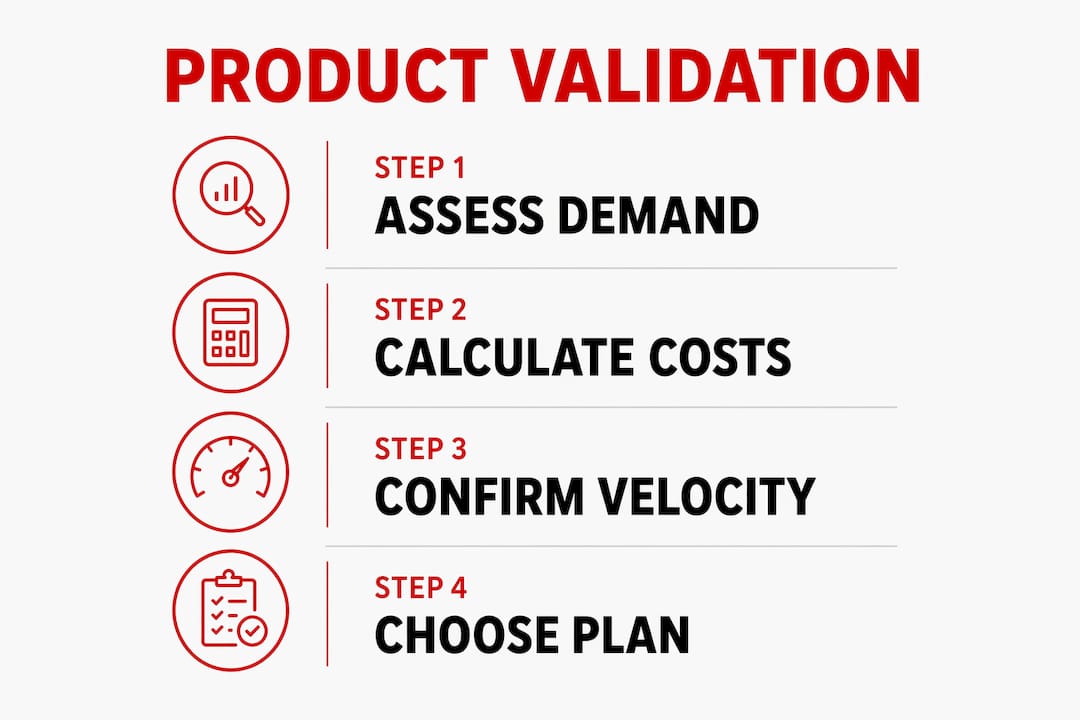
Validation is a go/no-go decision, not a research project. The minimum you need: 30–90 day search demand for your core keywords, a category growth signal, a proxy for competitor velocity, and a target contribution margin that survives Amazon’s fee structure.
Start with the math. Your landed unit cost plus Amazon’s referral fee (typically 8–15% of the selling price depending on category), FBA fulfillment fee, storage fee, and a PPC allowance must leave a positive contribution margin. If your break-even ACOS sits above 30–35% for a competitive CPG category, the unit economics need work before you launch.
For velocity benchmarks, treat the first 90 days conservatively. New CPG listings without Brand Registry, A+ Content, or review history typically convert at lower rates than established competitors. Build your cash flow model around a ramp, not a spike.
Amazon recommends the Professional selling plan for sellers expecting more than roughly 40 units per month, since it unlocks advertising features and automated pricing tools you will need from day one.
Pro Tip: Size and weight are margin killers in FBA. A snack product under 1 lb in a standard-size box pays dramatically lower fulfillment fees than a supplement in an oversized container. Run the FBA fee calculator on every SKU before you finalize packaging dimensions.
Sourcing choice shapes your margin, your timeline, and your risk profile. There is no universal right answer, but there is a right answer for your stage.
Private label (contract manufacturing): You own the formula or spec, a co-manufacturer produces it under your brand. Highest margin potential, longest lead time (typically 90–180 days from spec to FBA-ready inventory), and the most IP to protect. Reddog recommends this path for founders with a differentiated product concept and at least 6 months of cash runway.
White-label: A manufacturer’s existing formula, your brand applied. Faster to market (30–60 days), lower MOQ, but limited differentiation. Works well for category testing before investing in a proprietary formula.
Co-packing: You supply the formula or key ingredients; a co-packer handles production and packaging. Common in food and beverage. Preserves your recipe IP while outsourcing production complexity.
Wholesale/reseller: Buying finished branded goods to resell on Amazon. Lowest barrier to entry, but thin margins and no Brand Registry access unless you own the brand. Not a path Reddog recommends for founders building long-term equity.
Brand acquisition: Buying an existing Amazon brand with velocity and reviews. Fastest path to rank, but requires capital and due diligence on listing health, review authenticity, and supplier relationships.
Pro Tip: Always order samples before committing to an MOQ. Run a pilot production run of 200–500 units if your co-manufacturer allows it. Negotiate net-30 or net-45 payment terms on your first full run to protect cash runway during the FBA inbound and launch window.
Brand Registry is not just a defensive tool. It is a conversion and advertising unlock that materially changes what you can do on the platform.
Step-by-step enrollment:
Once enrolled, you unlock A+ Content, Brand Stores, Brand Analytics, Sponsored Brands, Sponsored Display, and predictive anti-counterfeit protections. For CPG brands, A+ Content alone can lift conversion meaningfully by letting you tell your ingredient story, show usage occasions, and build trust with shoppers comparing multiple options. Learn more about Brand Registry for FBA and how it fits your omnichannel growth plan.
| Path | Typical Timeline | Key Requirement |
|---|---|---|
| Direct USPTO trademark | 8–12 months | Filed application number |
| IP Accelerator | Faster Brand Registry access while pending | Vetted law firm engagement |
FBA vs. FBM is fundamentally an inventory and service tradeoff. FBA speeds delivery and offloads returns handling, but adds storage and fulfillment fees that must be modeled into contribution margin before you commit.
Decision rules of thumb:
FBA prep checklist for CPG:
Pro Tip: A light, high-velocity snack at $12 retail with a $3.50 FBA fee and a 10% referral fee leaves room for margin. A 3 lb supplement at $35 retail with a $9+ FBA fee and the same referral rate tells a very different story. Model both before you finalize your fulfillment strategy. See Reddog’s FBA beginner guide for CPG brands for a full operational checklist.
Your listing is your shelf. Build it before your inventory ships, not after.
Pre-launch asset checklist:
Copy and content priorities:
For FDA-regulated products (food, supplements, OTC), your label copy must comply with FDA labeling requirements. Amazon also prohibits disease claims on supplements. Review Amazon’s restricted product policies before finalizing copy. For detailed guidance on listing optimization, Reddog’s resource covers images, bullets, and backend keyword strategy in depth.
A margin-first launch sequences tactics to build rank without burning budget on unqualified traffic.
For a deeper look at Sponsored Products strategy and budget pacing for CPG brands, Reddog’s 2026 guide covers ACOS targets and bid structure in detail.
| Line Item | Typical Range | Timeline |
|---|---|---|
| Supplier samples | $100–$500 | 2–4 weeks |
| Pilot/MOQ production run | — | 6–12 weeks |
| GS1 UPC (single brand prefix) | — | 1–3 days |
| USPTO trademark filing fee | — | File now; 8–12 months to register |
| IP Accelerator (law firm fees) | Varies by firm | Faster Brand Registry access |
| Inbound freight to FBA | — | 1–3 weeks domestic |
| Initial PPC/launch budget | — | Ongoing from launch day |
Launch readiness checklist:
Account verification through Amazon’s KYC process requires government photo ID, business documents, proof of business address, and tax identification. Offers may remain inactive until verification is approved, so submit documents early.
You need a short, high-signal dashboard, not a spreadsheet with 40 tabs.
Amazon’s compliance requirements for CPG products extend well beyond trademark. Food and beverage products must meet FDA labeling standards, including Nutrition Facts panels, ingredient lists, allergen declarations, and net quantity statements. Dietary supplements fall under FDA’s DSHEA framework and require structure/function claim disclaimers.
Product safety certifications matter too. Children’s products require CPSC testing and a Children’s Product Certificate. Some categories require a Certificate of Analysis (COA) from an accredited third-party lab before Amazon will allow listing. Hazardous materials (aerosols, certain cleaning products) require Safety Data Sheets and may be restricted from FBA entirely.
Amazon’s own policies layer on top of federal requirements. Check Amazon’s restricted products list and category-specific guidelines before listing. Policy violations can result in listing removal or account suspension, which is far more disruptive than the time it takes to get compliant upfront.
This article is general information, not legal or regulatory advice. Confirm current requirements with the FDA, CPSC, or a qualified regulatory professional for your specific product and category.
The first SKU is a proof of concept. Scaling it means adding SKUs that share your existing infrastructure, not starting from scratch each time.
The most capital-efficient path is line extension within your proven category: new flavors, sizes, or formats that reuse your existing supplier relationship, packaging structure, and Brand Registry. Each new SKU benefits from your existing brand equity and review history on the parent brand.
Once you have 3–5 SKUs with stable velocity and positive contribution margin, look at adjacent categories where your brand story translates. A snack brand with strong Amazon performance can expand into a complementary beverage or ingredient line using the same Brand Store and A+ Content framework.
Catalog scaling also means SKU rationalization. Not every extension will perform. Set a 90-day velocity and margin threshold for new SKUs and discontinue those that miss it before they accumulate long-term storage fees or dilute your advertising budget. Reddog’s marketplace selling tips cover catalog management and margin protection across Amazon and Walmart in more depth.
Supplier vetting is due diligence, not a favor. Start with directories like Thomasnet for domestic manufacturers or Alibaba for international sourcing, but treat them as a starting point, not a shortlist.
Request a COA, facility audit report, and references from existing CPG clients before you discuss pricing. A supplier who hesitates on any of these is a risk. For food and supplement manufacturers, confirm FDA registration and GMP (Good Manufacturing Practice) certification. For packaging suppliers, confirm food-contact compliance if relevant.
Sample ordering is non-negotiable. Order samples from at least 3 suppliers for any SKU you plan to launch. Evaluate consistency, packaging quality, and label accuracy, not just the product itself. Run a second sample order after you negotiate final terms to confirm the production-run quality matches the sample.
On payment terms: a 30% deposit with 70% on delivery is standard for first-time orders. Once you have 2–3 successful runs, negotiate net-30 terms to improve cash flow timing against your FBA reorder cycle.
Amazon’s packaging requirements and US regulatory requirements overlap but are not identical. You need to satisfy both.
For FBA, every unit needs a scannable barcode (FNSKU or UPC, depending on your settings), an expiration date on consumables (MM/YYYY format, visible without opening the case), and packaging that survives a 3-foot drop test. Poly-bag requirements apply to any product that could leak, spill, or contaminate other inventory.
US regulatory requirements depend on your category. Food products need FDA-compliant labels with all required elements in the correct format and minimum type size. Supplement labels need a Supplement Facts panel and a structure/function claim disclaimer. OTC drug products follow a different labeling monograph entirely.
One practical rule: design your packaging to meet the most stringent requirement across Amazon, FDA, and your retail channel simultaneously. Redesigning packaging after launch is expensive and disrupts your listing continuity.
Getting a CPG product to sell profitably on Amazon requires validating unit economics first, securing Brand Registry before launch, and treating every fulfillment and listing decision as a margin decision.
| Point | Details |
|---|---|
| Validate margin before sourcing | Model contribution margin after FBA fees, referral fees, and PPC before committing to an MOQ. |
| Secure Brand Registry early | File your trademark or use IP Accelerator to unlock A+ Content, Brand Stores, and anti-counterfeit tools. |
| Match fulfillment to product economics | FBA fits lightweight, high-velocity CPG; heavy or slow-moving SKUs often margin better through FBM or 3PL. |
| Build listing assets before inventory ships | GS1 UPC, compliant images, copy, and backend keywords must be ready before your first FBA shipment. |
| Reddog’s margin-first approach | Reddog works with CPG founders to model channel economics, prep Brand Registry, and plan launches that protect contribution margin from day one. |
The most common mistake we see is founders who treat Amazon as a marketing experiment rather than a retail channel with real economics. They optimize for velocity and rank without ever modeling what each unit actually contributes to profit after fees, ads, and inventory carrying costs. By the time they notice the margin problem, they have already committed to a second production run.
Three specific pitfalls come up repeatedly. First, undercapitalized launches: a founder sends 500 units, runs out of stock in week 3, loses rank, and restarts from zero. The math on a sustainable launch requires modeling your reorder cycle against your supplier lead time before you place your first order. Second, packaging and labeling treated as an afterthought: a label that fails Amazon’s FBA prep requirements or FDA’s minimum standards creates delays that cost more than getting it right the first time. Third, poor inventory pacing: sending 6 months of inventory on a first shipment to save on freight, then paying long-term storage fees when velocity comes in below forecast.
The brands that scale well on Amazon share one habit: they run the numbers before they run the launch. Contribution margin, break-even ACOS, days of cover, and reorder timing are not metrics you check after launch. They are the plan.
CPG founders who get the most from a strategy conversation come in with a clear picture of their landed cost, target retail price, and current supplier terms. That’s the starting point for a real margin review.
Reddog works with emerging and growth-stage CPG brands in the $500K–$20M revenue range that need structured growth planning, not generic tactics. A 30-minute strategy call covers your contribution margin by channel, your Brand Registry and IP readiness, your fulfillment economics, and your launch sequencing. No pitch, no pressure. Just a focused review of where your numbers stand and what to do next.
If you are a CPG founder or operator ready to build a margin-first Amazon presence, book your free strategy call and bring your COA, landed cost, and target retail price. We will tell you exactly where the opportunity is and where the risk is hiding.
Save these links to your launch checklist and consult them at the milestone indicated.
Leave a comment: