
Published: March 2020 | Last Updated:March 2026
© Copyright 2026, Reddog Consulting Group.

Amazon represents a massive growth channel for CPG brands, but most founders stumble during expansion. Poor listing optimization, inventory missteps, and wasted ad spend can turn a promising launch into a profit drain. This guide walks you through the exact steps to prepare, launch, and scale profitably on Amazon. You’ll learn how to assess readiness, optimize listings, structure advertising, and avoid the common pitfalls that stall growth. Whether you’re launching your first product or scaling an existing catalog, these frameworks will help you maximize marketplace performance while protecting margins.
| Point | Details |
|---|---|
| Readiness is critical | Set up brand logistics and ensure product-market fit before launching on Amazon. |
| Listing quality drives sales | Optimized listings with A+ Content and reviews win organic placement and conversions. |
| FBA unlocks Prime growth | Fulfillment by Amazon ensures Prime-eligible status and access to millions of buyers. |
| Profitable ads require structure | A disciplined campaign setup and ongoing optimization prevent wasted spend. |
| Continuous optimization wins | Ongoing KPI tracking and proactive audits are essential for long-term CPG success on Amazon. |
Before investing in Amazon expansion, evaluate whether your products, margins, and operations can support profitable growth. Not every CPG brand is ready for marketplace economics, and launching prematurely wastes capital.
Start with a product readiness checklist. Are your items Prime-friendly in size and weight? Can your margins absorb Amazon’s referral fees (typically 8-15% for grocery and consumables) plus FBA fulfillment costs? Calculate your landed cost per unit, add all Amazon fees, and ensure you maintain at least 30% contribution margin after advertising.
Next, verify you have the required infrastructure. You’ll need valid UPCs for each product variant, compliant packaging that meets Amazon’s prep requirements, and reliable inventory planning to avoid stockouts. Core steps start with a Professional Seller account and strong listings for algorithm relevance.
Pro Tip: Consult with an Amazon marketplace consultant before setup to identify margin risks and operational gaps that could derail your launch.
| Readiness Factor | What to Verify | Red Flag |
|---|---|---|
| Product margins | 30%+ after all fees | Margins under 20% |
| Inventory capacity | 90+ days on hand | Less than 60 days |
| Packaging compliance | Meets Amazon prep standards | Non-compliant labels |
| Brand registry | Enrolled or eligible | No trademark |
Once readiness is confirmed, secure your Professional Seller account and configure the foundational settings that enable growth. Account errors during setup can delay launch by weeks or trigger compliance holds.
Gather required documents first: your EIN, business banking information, DUNS number, and brand registry documentation if you own trademarks. Enrolling as a Professional Seller is foundational for scaling and performance on Amazon.
Follow this setup sequence:
Double-check every entry. Mismatched business names, incorrect tax IDs, or incomplete banking information can freeze your account or delay payouts. Amazon’s verification process is automated and unforgiving.
Critical configuration: Enable FBA from day one if you want Prime eligibility. Seller-fulfilled options rarely compete effectively for CPG products where Prime badges drive conversion. Review launching a product on Amazon for detailed launch frameworks.
| Setup Element | Required Action | Timeline |
|---|---|---|
| Seller account | Professional registration | 1-2 days |
| Brand Registry | Trademark enrollment | 5-7 days |
| FBA activation | Configure shipping templates | Same day |
| Tax settings | Complete interview | 1 day |
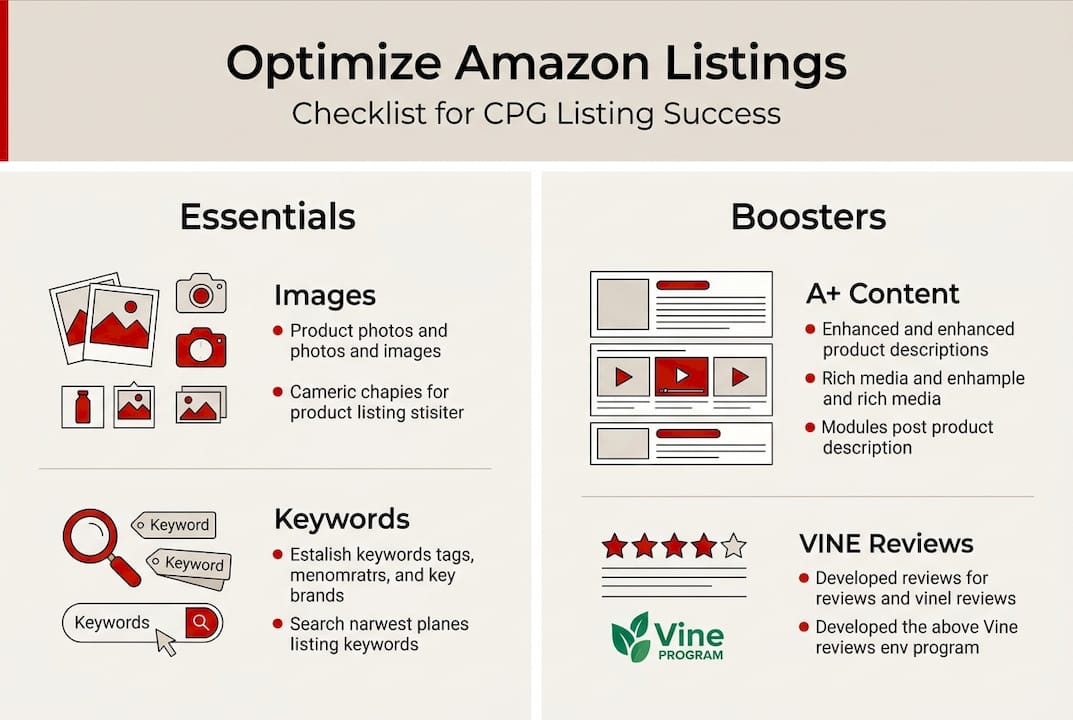
Your listing quality determines both search visibility and conversion rate. Amazon’s algorithm prioritizes listings that demonstrate relevance and performance, while shoppers buy based on images, content clarity, and social proof.
Build each listing with these essential elements:
Leverage VINE early to generate high-quality reviews. VINE reviews can boost sales up to 30% by providing algorithmic signals and social proof that new listings desperately need.
Pro Tip: Run split tests on your main image and title within the first 30 days. Small improvements in click-through rate compound dramatically over time as Amazon rewards engagement.
Review optimizing product listings and Amazon listing optimization strategies for advanced tactics on keyword research, content hierarchy, and conversion optimization.
| Listing Type | Images | A+ Content | Reviews | Typical CVR |
|---|---|---|---|---|
| Standard | 3-4 basic | None | 0-5 | 8-12% |
| Optimized | 7+ enhanced | Full module | 15+ VINE | 18-25% |
Fulfillment and inventory management directly impact profitability and search ranking. Poor execution here undermines even the best listings and advertising.
Set up FBA correctly from the start:
FBA enables Prime eligibility and boosts conversion, but fees and stockouts can erode profit. Monitor inventory levels daily using Amazon’s restock recommendations, but validate against your actual sales velocity and lead times.
Avoid these costly inventory mistakes:
Pro Tip: Maintain 60-90 days of inventory in FBA at all times. This buffer protects against supply chain delays and supports promotional spikes without stockouts. Review using FBA effectively for margin-focused fulfillment strategies. Consider dropshipping and fulfillment models for alternative approaches.
Advertising structure determines whether you scale profitably or waste spend chasing vanity metrics. Most CPG brands launch campaigns without strategic architecture, leading to inflated ACoS and poor attribution.
Follow this campaign structure sequence:
Brands saw 90% ROAS improvement and 26% CPM reduction through advanced ad structure and AMC insights. The difference between profitable and wasteful advertising is campaign architecture, not budget size.
Pro Tip: Use Amazon Marketing Cloud (AMC) and Brand Referral Bonus for advanced tracking. External traffic can earn up to 10% bonus while providing attribution data that improves overall campaign performance.
Many brands waste ad spend due to poor structure. Audit before scaling to identify keyword cannibalization, negative keyword gaps, and bid inefficiencies.
| Campaign Type | Best For | Target ACoS | Scaling Threshold |
|---|---|---|---|
| Manual exact | High-intent keywords | 15-25% | 20+ conversions |
| Auto targeting | Keyword discovery | 30-40% | Ongoing |
| External traffic | Brand building + bonus | 20-30% | Established listings |
Explore Amazon growth consulting, Amazon advertising management, and real cost of Amazon advertising for deeper campaign optimization frameworks. Amazon’s advertiser success guide provides additional platform-specific tactics.
Ongoing monitoring prevents small issues from becoming profit-killing problems. Most brands only review performance when sales drop, missing early warning signs that compound over time.
Track these KPIs weekly:
Common mistakes that stall growth:
Pro Tip: Audit campaigns and listings monthly to prevent scale stalls. Advanced audits and ongoing optimization prevent the common stall at six-figure sales.
When you identify problems, act immediately. Amazon’s algorithm penalizes hesitation. Suppressed listings lose rank permanently. Stockouts reset your sales history. Review maximizing Amazon profits for troubleshooting frameworks and profit optimization tactics.
You now have the frameworks to assess readiness, launch listings, structure advertising, and scale profitably on Amazon. But implementation is where most brands struggle. Translating strategy into execution requires experience with Amazon’s constantly shifting policies, algorithm updates, and competitive dynamics.
RedDog Group helps CPG brands navigate this complexity with margin-focused consulting that bridges marketplace performance with retail economics. We work with founders in the $500K to $20M range who need structured growth planning, not generic tactics.
Our approach starts with contribution margin analysis across all channels, identifying where Amazon fits in your omnichannel strategy and where margin leaks hide. We then build custom playbooks for listing optimization, advertising structure, inventory planning, and retail expansion readiness.
Whether you’re launching your first Amazon product or scaling an established catalog, we provide the operational clarity and marketplace expertise to expand profitably. Explore our Amazon omnichannel consulting services or review our CPG retail growth offer to see how we support brands nationwide.
Most CPG brands should budget at least $2,500 to $5,000 upfront for account setup, FBA inventory, and initial advertising. Amazon Professional Seller account plus strong listings and initial ad spend are required.
Enroll in Fulfillment by Amazon (FBA), follow all prep and labeling requirements, and keep inventory in Amazon’s warehouses. FBA enables Prime eligibility and boosts conversion.
High-quality images, keyword-rich titles, bulleted benefits, A+ Content, and early VINE reviews matter most. A+ Content can increase conversions 5-10% and VINE reviews can boost sales up to 30%.
Start Sponsored Products campaigns as soon as listings are live and optimized for best results. Sponsored Products are core to traffic generation and scaling on Amazon.
The Brand Referral Bonus gives brands up to a 10% rebate for sales driven by external traffic to Amazon listings. This incentivizes driving your own audience to Amazon while improving attribution.
Leave a comment: