
Published: March 2020 | Last Updated:June 2026
© Copyright 2026, Reddog Consulting Group.

TL;DR:
- Expanding online presence involves creating a coordinated ecosystem of digital touchpoints that reinforce each other. Building a fast, mobile-first website with consistent brand identity and proper technical setup lays the essential foundation for growth. Focusing on two to three core channels, measuring effort-based KPIs, and integrating messaging across platforms build momentum and maximize visibility.
Online presence is defined as a coordinated ecosystem of digital touchpoints, including your website, SEO, social media, and content, that work together to attract, engage, and convert customers. For CPG founders and marketers, knowing how to expand online presence is not about adding more channels. It is about making every channel reinforce the others. The brands that grow fastest treat digital visibility as a system, not a checklist. This guide gives you the exact framework to build that system, from foundational assets through multichannel coordination and measurable execution.
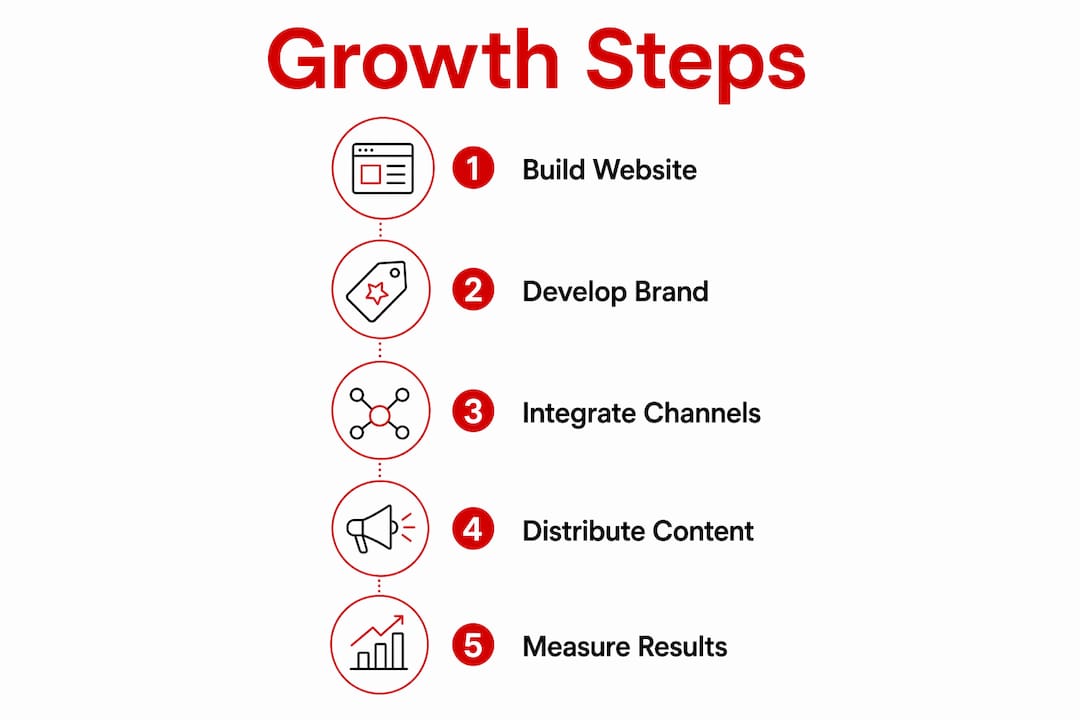
Before you run a single ad or post on Instagram, you need a digital headquarters that works. Your website is that headquarters. It must load fast, display correctly on mobile, communicate your value proposition in the first five seconds, and carry an SSL certificate. If any of those four conditions fail, every other channel you build sends traffic into a leaky bucket.
Brand identity is the second non-negotiable. Visual consistency across your logo, color palette, typography, and tone of voice signals professionalism and builds recall. Verbal identity matters just as much. The way you describe your product on your homepage should match how you describe it in an email, a TikTok caption, or a Google Business Profile listing. NAP consistency across your website, Google Business Profile, and third-party directories directly affects local SEO ranking and trust signals. Google cross-references these citations, and any mismatch reduces your map-pack eligibility.
The technical layer completes the foundation. Install Google Analytics 4 and Google Search Console before you publish a single piece of content. These two free tools give you the baseline data you will need to measure growth. Choose a hosting provider with 99.9% uptime guarantees, and confirm your site passes Google’s Core Web Vitals thresholds for loading speed, interactivity, and visual stability.
Pro Tip: WordPress recommends defining your business in one sentence and focusing on one specific audience before building any assets. If you cannot describe who you serve and what problem you solve in a single sentence, your website copy, social profiles, and content will all pull in different directions.
The most common mistake in digital marketing is treating each channel as a separate campaign. SEO runs in one silo, social media in another, email in a third. The result is fragmented messaging that confuses customers and wastes budget. Online presence as an ecosystem means every channel plays a defined role in a single customer journey, and each one reinforces the others.

The practical way to build this is to map channels to funnel stages. Demand creation happens at the top: organic social content, YouTube videos, and SEO-optimized blog posts introduce your brand to people who have never heard of you. Demand capture happens in the middle: Google Search ads, retargeting campaigns, and email sequences convert people who already know they have a problem. Conversion and retention happen at the bottom: product pages, reviews, and loyalty programs close and keep customers. Coordinated messaging by funnel stage with cross-channel attribution prevents budget blind spots and maximizes return on every dollar spent.
Content distribution is where most brands leave money on the table. A single long-form blog post can become a YouTube script, three LinkedIn posts, five short-form social clips, and an email newsletter segment. A primary asset plus derivatives across platforms improves discoverability and reinforces your message without requiring you to create original content for every channel from scratch. This is how brands with lean teams punch above their weight in visibility.
Measurement ties the ecosystem together. Share of voice, defined as your brand’s percentage of total market visibility across a given channel, gives you a competitive benchmark that vanity metrics like follower count cannot provide. Channel-specific share of voice tracked monthly tells you exactly where you are winning visibility and where a competitor is outranking you. Track it separately for organic search, paid search, social, and PR rather than rolling everything into one number.
Pro Tip: Start with two or three core channels before expanding. A brand that executes SEO and email marketing with discipline will outperform a brand spreading thin effort across six platforms. Master the channels where your audience already spends time, then add.
| Channel | Funnel stage | Primary metric |
|---|---|---|
| SEO blog content | Awareness and education | Organic sessions, keyword rankings |
| Google Search ads | Demand capture | Click-through rate, cost per acquisition |
| Email marketing | Nurture and conversion | Open rate, revenue per email |
| Social media (organic) | Awareness and community | Reach, engagement rate |
| Retargeting ads | Conversion | Return on ad spend, conversion rate |
For a deeper look at coordinating these channels, Reddog’s guide on omnichannel platform selection covers the tools that make cross-channel execution manageable at the brand level.
Execution without sequence produces noise. Follow these steps in order to build digital visibility that compounds over time.
Write your one-sentence business definition. Name your product, your customer, and the specific problem you solve. “We make grain-free dog treats for pet owners managing food allergies” is a business definition. “We make premium pet snacks” is not. Every piece of content you create flows from this sentence.
Audit your current presence. Run brand and keyword searches across Google, Instagram, TikTok, Amazon, and any AI tools like ChatGPT or Perplexity. Auditing across search and social before scaling content establishes the baseline you need to prove growth later. Document where you appear, where competitors appear, and where gaps exist.
Build your website core pages. Homepage, product or service pages, an About page, and a Contact page are the minimum. Each page needs one clear call to action. Niche-specific landing pages targeting long-tail keywords drive organic traffic that a generic homepage never will.
Establish social profiles aligned with your audience. A B2C food brand belongs on Instagram and TikTok. A B2B CPG supplier belongs on LinkedIn. Do not create profiles on platforms your customers do not use. An abandoned profile signals neglect faster than no profile at all.
Publish content on a consistent schedule. One high-quality blog post per week outperforms five rushed posts. Quality content supports SEO, gives social media something to distribute, and builds the credibility that converts browsers into buyers.
Engage in community and external contributions. Guest posts on industry publications, podcast appearances, and active participation in LinkedIn groups or Reddit communities build backlinks and brand authority simultaneously. These contributions also generate the real conversations that WordPress founders identify as the most meaningful early indicators of online presence growth.
Measure effort-based KPIs first, then business outcomes. In the first 90 days, track content published, collaborations initiated, and community interactions. After 90 days, layer in organic traffic, lead volume, and revenue attribution. Chasing revenue metrics before you have built the content engine is a reliable path to discouragement.
For retail brands specifically, Reddog’s resource on increasing online visibility breaks down channel-specific tactics tailored to the CPG context.
The most expensive mistake is building channels in silos. A brand that runs its SEO program, social media, and email marketing as three separate workstreams with three separate messaging strategies will confuse customers and dilute every channel’s effectiveness. Cross-channel synergy builds trust precisely because customers encounter a consistent story at every touchpoint, from a Google search result to an Instagram story to a product page.
Ignoring mobile-first design is the second critical error. More than half of all web traffic arrives on mobile devices, and Google indexes the mobile version of your site first. A site that looks polished on desktop but breaks on a phone is invisible to the majority of your potential customers.
A third pattern that stalls growth is confusing activity with strategy. Publishing content without keyword research, posting on social without audience analysis, and running ads without conversion tracking are all forms of motion that do not produce momentum. Every channel needs a defined role, a target metric, and a review cadence.
“One unified brand message does not equal one format. Adapt messaging creatively per platform to maintain narrative consistency and enhance user experience.” — Multi-channel playbook 2026
To identify visibility gaps, pull your channel-specific share of voice data monthly. If your organic search share of voice is growing but your social share is flat, you know exactly where to redirect effort. Data removes the guesswork that causes most brands to either over-invest in underperforming channels or abandon channels that simply need better execution.
Expanding online presence works when every channel plays a defined role in a single customer journey, with consistent messaging and measurable KPIs connecting effort to outcome.
| Point | Details |
|---|---|
| Build the foundation first | A fast, mobile-first website with consistent brand identity is the prerequisite for every other channel. |
| Map channels to funnel stages | Assign each channel a specific role in awareness, capture, or conversion before adding new platforms. |
| Distribute content as a system | Turn one primary asset into multiple derivatives across platforms to maximize reach without multiplying workload. |
| Avoid siloed channel management | Channels that reinforce each other produce better customer journeys and higher conversion rates than isolated campaigns. |
| Measure effort before outcomes | Track content published, collaborations, and community engagement in the first 90 days before shifting focus to revenue metrics. |
The brands I see struggle most are not the ones with bad products. They are the ones that treat online presence as a launch event rather than an ongoing operating system. They build a website, set up social profiles, publish a few posts, and then wonder why nothing is moving six months later.
The uncomfortable truth is that digital visibility is a compounding asset. The SEO work you do in month one pays dividends in month twelve. The email list you build slowly becomes your most profitable channel by year two. But none of that happens if you treat it as a project with a finish line.
The other thing I have seen consistently is that clarity beats scale every time. A brand that speaks directly to one specific customer with one specific message will outperform a brand trying to reach everyone. This is especially true for CPG founders in the $500K to $20M range, where resources are finite and every channel decision carries real opportunity cost.
The multichannel retailing guide we put together at Reddog reflects this philosophy. Start narrow, execute with discipline, measure honestly, and expand from a position of proven performance rather than optimism.
— Reddog
If you are a CPG founder or operator looking to build a more profitable online presence, Reddog works with brands in the $500K to $20M range to map channel economics, identify margin leaks, and build growth plans grounded in contribution margin rather than top-line noise.
Book a free 30-minute strategy call with the Reddog team. The session covers your current channel mix, where visibility gaps are costing you revenue, and what a structured expansion plan looks like for your specific stage and category. No pitch. No pressure. Just a focused review of what your brand actually needs to grow.
Book your free strategy call and walk away with a clearer picture of where your online presence is working and where it is not.
Expanding online presence means building a coordinated ecosystem of digital touchpoints, including your website, SEO, social media, and content, that work together to increase visibility, engagement, and conversions. It is an ongoing system, not a one-time setup.
Start with two or three channels where your audience already spends time and execute them with consistency before adding more. A focused approach on SEO and email, for example, will outperform a scattered presence across six platforms.
Track effort-based KPIs first: content published, community interactions, and collaborations. After 90 days, layer in organic traffic, keyword rankings, share of voice per channel, and revenue attribution to connect activity to business outcomes.
Share of voice measures your brand’s percentage of total market visibility within a specific channel, such as organic search or social media. Tracking it monthly per channel reveals where competitors are outranking you and where to redirect budget.
Channels that operate independently produce fragmented messaging that confuses customers and reduces conversion rates. When SEO, social, and email reinforce a single consistent narrative, each channel amplifies the others and builds cumulative trust with your audience.
Leave a comment: