
Published: March 2020 | Last Updated:March 2026
© Copyright 2026, Reddog Consulting Group.

Choosing the right brand positioning can make or break an emerging CPG brand. Many founders in the $500K to $20M revenue range struggle to find positioning that resonates across retail channels while protecting margins. This article walks you through a proven framework for evaluating brand positioning examples, featuring real CPG case studies that delivered measurable growth. You’ll learn how to assess positioning criteria, avoid common pitfalls, and sequence your multichannel expansion to build durable brand equity.
| Point | Details |
|---|---|
| Economic alignment | Positioning must support pricing that delivers a 40%+ contribution margin after trade spend and channel costs. |
| Clear positioning framework | Craft a positioning statement that defines who you serve, what they need, how your brand fits the category, the benefit, and the reason to buy. |
| Channel sequencing plan | Start with direct to consumer to test messaging and response before expanding to independent retailers and then national chains. |
| Differentiation through white space | Competitive mapping helps identify where you truly stand and reveal meaningful gaps others do not occupy with similar price points. |
Effective brand positioning starts with a clear framework. You need to define who you serve, what makes you different, and how your positioning translates into profitable retail economics. The role of brand positioning extends beyond marketing into channel strategy, pricing architecture, and margin protection.
Start by crafting a positioning statement that follows this structure: “For [customer] who [need], [brand] is the [category] that [benefit] because [reason].” This forces clarity on your ideal customer, their unmet needs, your category context, and your unique benefit. Without this foundation, you’re guessing.
Next, conduct competitive mapping to identify where you truly differentiate. Plot competitors on axes that matter to your target customer, whether that’s price versus quality, convenience versus premium experience, or health focus versus indulgence. Your positioning should occupy white space that aligns with a real customer segment willing to pay your price.
Assess alignment with retailer margin requirements and your product economics. Your positioning must support pricing that delivers 40%+ contribution margin after trade spend, discounts, and channel costs. If your positioning forces you into a price point that compresses margins below viability, you’ll struggle to scale profitably.
Sequence your channel expansion to validate positioning durability. Start with DTC to test messaging and customer response without retailer intermediaries. Move to independent retail to validate broader appeal. Only then consider national chains where margin pressure intensifies and positioning must work at scale.
Pro Tip: Map your positioning against both customer perception and retail economics simultaneously. A positioning that resonates with customers but can’t support retailer margin requirements will stall your growth.
Real CPG brands offer the best lessons in positioning. Here are four success stories and one cautionary tale that illustrate what works and what fails.
Chomps repositioned meat snacks from a niche paleo product to an inclusive, health-focused snack brand. They used bright, approachable packaging to signal accessibility rather than hardcore fitness. This shift drove 53% new customer acquisition by expanding beyond their original core audience. The lesson: broadening your positioning without diluting your core benefit can unlock new segments.
Olipop pivoted from positioning as a gut health tonic to a healthier soda alternative. This repositioning grew sales from $70M to $400M by tapping into the massive soda category while maintaining functional benefits. They sequenced carefully, building DTC proof before retail expansion. The takeaway: category repositioning works when you maintain credibility while accessing a larger addressable market.
Graza innovated olive oil positioning as an “everyday flex” product with squeeze bottles and playful branding. This approach differentiated them in a commoditized category, helping them become the 5th largest olive oil brand by 2025. Their positioning made premium olive oil approachable for daily cooking, not just special occasions. The insight: format innovation combined with positioning can redefine category expectations.

Magic Spoon positioned cereal as a high-protein, low-carb nostalgic indulgence for adults. They leveraged childhood cereal memories while delivering adult nutritional priorities. This dual positioning created a unique space in a crowded category, driving strong DTC growth before retail expansion. The principle: emotional resonance plus functional benefit creates powerful positioning.
Brandless serves as a cautionary example. They positioned as a generic, low-cost alternative across categories but failed due to premature retail expansion and lack of differentiation. Without a clear unique value proposition, they couldn’t sustain customer loyalty or justify retail shelf space. The warning: generic positioning and premature scaling kill brands.
Here’s how these brand positioning strategies compare:
| Brand | Positioning shift | Measurable outcome | Key tactic |
|---|---|---|---|
| Chomps | Paleo niche to health-inclusive | 53% new customers | Bright, accessible packaging |
| Olipop | Gut tonic to soda alternative | $70M to $400M sales | Category repositioning |
| Graza | Premium to everyday flex | 5th largest brand | Format and packaging innovation |
| Magic Spoon | Kids’ cereal to adult indulgence | Strong DTC growth | Nostalgia plus function |
| Brandless | Generic low-cost | Business failure | Lack of differentiation |
Pro Tip: Study brands in adjacent categories, not just direct competitors. The best positioning insights often come from how other CPG brands solved similar customer problems in different contexts.
Different positioning approaches work better for specific channels and growth stages. Understanding what is brand positioning in a multichannel context helps you adapt your strategy as you scale.
Your positioning must align with retail math. Brands in the $500K to $20M range need to maintain 40%+ contribution margin after trade spend and discounts. This means your positioning must support a price point that covers retailer margin requirements, typically 25% to 35% depending on channel, while preserving your profitability.
Channel sequencing matters for positioning validation. Start with DTC where you control the narrative and capture full margin. This validates customer response to your positioning without retailer intermediaries. Move to independent retail to test broader appeal with real shelf competition. Only then consider national chains where margin compression intensifies and positioning must work at scale without heavy support.
Elasticity varies by positioning approach. Premium positioning typically shows lower price elasticity, meaning you can maintain pricing power during promotions. Value positioning requires higher velocity to offset lower margins, making you more vulnerable to competitive pressure. Your branding strategy for multichannel growth should account for these dynamics.
| Positioning approach | Best channel fit | Margin impact | Sequencing advice |
|---|---|---|---|
| Premium differentiated | DTC, specialty retail | High margin, lower velocity | Validate DTC first, expand selectively |
| Better-for-you mainstream | Amazon, Walmart, grocery | Moderate margin, higher velocity | Build DTC proof, then marketplace |
| Value innovation | Mass retail, club | Lower margin, requires scale | Delay national retail until proven |
| Niche/functional | DTC, natural channel | High margin, limited scale | Stay focused, resist premature expansion |
Key implications for founders:
Selecting the right positioning requires matching your brand strengths to market opportunities while respecting channel economics. Here’s a step-by-step approach:
Define your ideal customer with demographic and psychographic precision. Avoid broad targets like “health-conscious consumers.” Get specific: “millennial parents prioritizing clean ingredients who shop at Whole Foods and Thrive Market.”
Identify the unmet need your product solves better than alternatives. This should be a real pain point, not a manufactured benefit. Test it with actual customers through interviews and purchase behavior, not surveys.
Craft your positioning statement using the framework: “For [customer] who [need], [brand] is the [category] that [benefit] because [reason].” Share it with 10 target customers and see if it resonates.
Map your competitive landscape to find white space. Plot competitors on axes that matter to your customer. Your positioning should occupy a space that’s both differentiated and valued by a meaningful segment.
Validate positioning through DTC before retail scaling. Build a founder’s go-to-market strategy that tests messaging, pricing, and customer acquisition economics in a controlled environment.
Calculate your unit economics across channels. Ensure your positioning supports pricing that delivers 40%+ contribution margin after all channel costs. If it doesn’t, refine your positioning or product to close the gap.
Sequence channel expansion based on positioning validation and margin protection. Premature multi-channel expansion without DTC validation kills margins and dilutes brand equity.
Monitor velocity and customer acquisition metrics rigorously. Your positioning works if it drives repeat purchases and attracts new customers at acceptable costs. If not, iterate quickly.
Pro Tip: Review your positioning quarterly as you scale. What worked at $500K in revenue may need refinement at $5M when you’re navigating different channels and competitive dynamics. Stay flexible but maintain core brand identity.
Common pitfalls to avoid:
Choosing the right brand positioning is just the start. Executing it across Amazon, Walmart, DTC, and retail channels requires specialized expertise in marketplace economics, pricing architecture, and channel sequencing.
RedDog Group helps CPG brands in the $500K to $20M revenue range translate positioning into profitable multichannel growth. We focus on contribution margin, not vanity metrics, ensuring your positioning supports sustainable scaling.
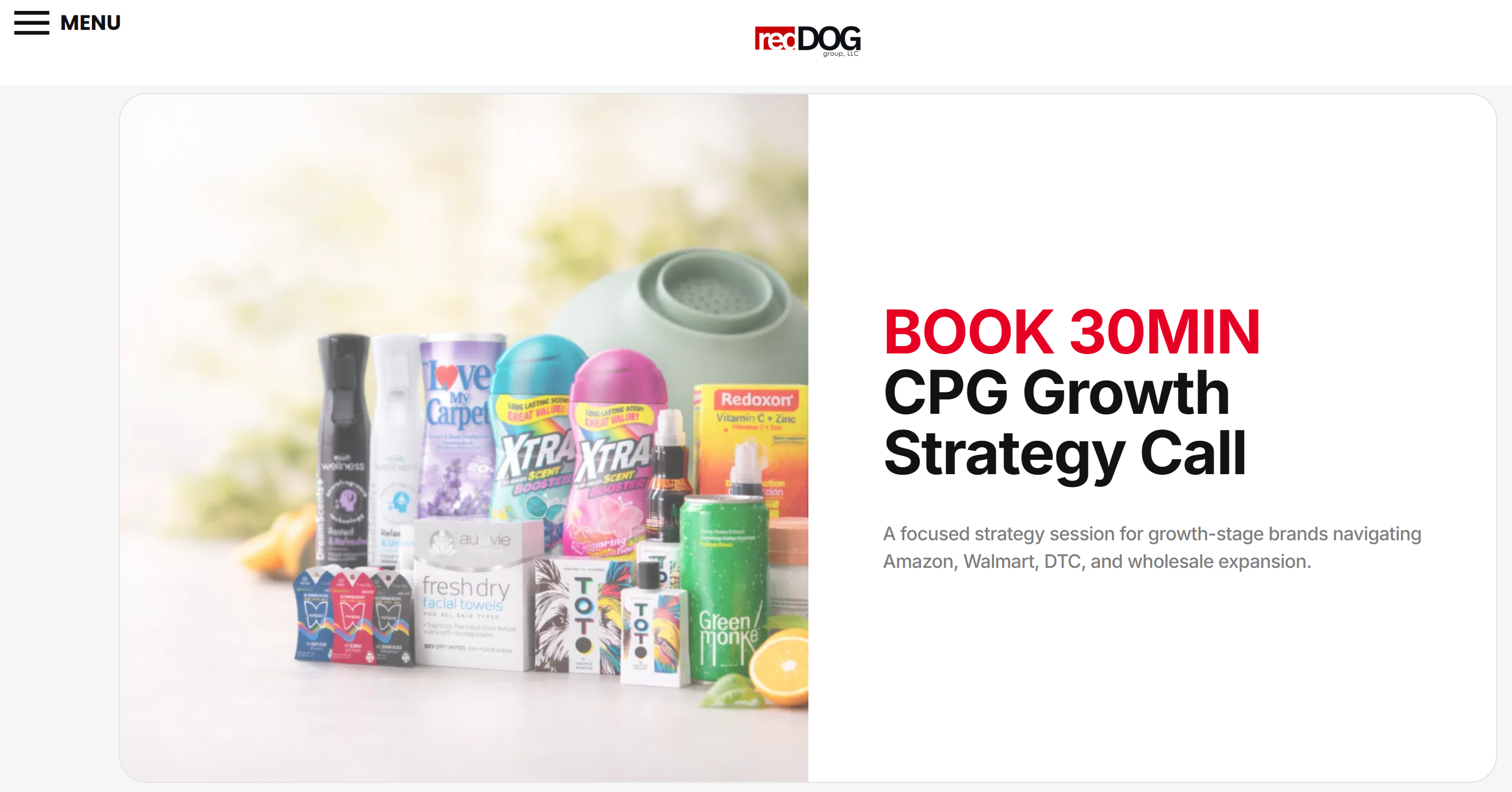
Our omnichannel growth consulting covers positioning validation, pricing strategy, marketplace optimization, and retail readiness assessments. We help you understand what each channel actually contributes to profit and where positioning adjustments protect margin.
Whether you’re refining positioning for Amazon growth, preparing for Walmart expansion, or building a DTC foundation, we bring analytical rigor and CPG expertise to your growth strategy. Let’s build positioning that drives measurable results across every channel.
Brand positioning defines how customers perceive your product relative to competitors in a specific category. It matters because clear positioning drives customer acquisition, supports pricing power, and guides channel expansion decisions. Without it, you’re competing on price alone, which compresses margins and limits growth.
Track new customer acquisition rates, repeat purchase velocity, and contribution margin by channel. Successful positioning shows growing customer base, strong retention, and healthy unit economics. Monitor retailer feedback on velocity and customer reviews for qualitative validation. If you’re constantly discounting to move product, your positioning likely needs refinement.
Avoid scaling to retail without proven DTC market fit and validated unit economics. Don’t position your brand as generic or lacking unique value, as Brandless demonstrated with its failure. Other mistakes include copying competitors, positioning too broadly, and ignoring retail margin requirements when crafting customer messaging.
Adjust messaging and pricing to fit retailer expectations and customer segments while maintaining core brand identity. Amazon customers respond to different cues than Whole Foods shoppers, so tailor your presentation without changing your fundamental positioning. Sequence channel expansion through your branding strategy for multichannel growth to validate and protect brand equity at each stage.
Leave a comment: