
Published: March 2020 | Last Updated:August 2026
© Copyright 2026, Reddog Consulting Group.

The highest-impact email marketing best practices you can apply right now come down to ten core actions: authenticate your sending domain (SPF, DKIM, DMARC), segment by behavior and lifecycle stage, build only permissioned lists, test subject lines before every major send, automate your highest-value flows (welcome, cart abandonment, post-purchase, re-engagement), process unsubscribes within 10 business days, maintain active list hygiene, track revenue per recipient alongside opens and clicks, align every campaign to a single measurable business goal, and verify compliance with CAN-SPAM’s seven requirements on every commercial send.
Pro Tip: Suppression-list automation is the single most overlooked lever in email programs. Syncing your suppression list in real time across your ESP, CRM, and any third-party sending partners eliminates cross-brand opt-out failures, reduces spam complaints, and protects deliverability faster than any creative change.
These practices reflect CAN-SPAM compliance standards and Reddog’s direct experience building email workflows for CPG brands.
Effective email programs are built on authentication, behavioral segmentation, automated lifecycle flows, disciplined testing, and CAN-SPAM compliance, in that order of operational priority.
| Point | Details |
|---|---|
| Authenticate before anything else | SPF, DKIM, and DMARC records protect inbox placement and must be verified before scaling send volume. |
| Segment by behavior, not just demographics | Lifecycle-based segments (new subscribers, recent buyers, VIPs, dormant) drive materially higher conversion than broadcast sends. |
| Automate the four core flows | Welcome, cart abandonment, post-purchase, and re-engagement flows generate the majority of incremental email revenue at low operational cost. |
| Test one variable at a time | Subject line, from name, and CTA tests produce reliable lifts only when isolated; multi-variable tests produce noise. |
| CAN-SPAM compliance is the legal floor | Each violating email can incur penalties up to $53,088; honor opt-outs within 10 business days and sync suppression lists in real time. |
| Reddog’s CPG workflow | A Reddog email workflow drove 494% more orders by combining behavior-triggered flows, post-purchase cross-sell, and VIP segmentation. |
Email remains the most cost-efficient owned channel in the marketing mix. You control the list, the message, and the timing, with no algorithm deciding who sees what. For CPG brands specifically, that ownership translates directly into repeat purchase velocity, subscriber-first promotions, and lifecycle monetization that paid social simply cannot replicate at the same margin.
The core use cases that make email indispensable:
For CPG operators managing thin margins across Amazon, DTC, and wholesale, email’s ability to drive direct repeat purchases without incremental ad spend makes it a margin-positive channel when built correctly. The key phrase is “built correctly.” A poorly managed list with low engagement and high complaint rates costs you more in deliverability damage than it generates in revenue.
Every high-performing email program begins with one prioritized business goal. Not five goals. One. Whether that’s increasing customer lifetime value, improving repeat purchase rate, or lifting conversion on a specific product line, every campaign decision flows from that anchor.
Setting goals and capturing the right data
Map your email types to your goal before you write a single subject line. If your goal is repeat purchase rate, your highest-priority flows are post-purchase cross-sell and re-engagement, not promotional broadcasts. If it’s first-purchase conversion, your welcome series and cart abandonment flows deserve the most attention and budget.
Subscriber capture must be explicit and documented. For high-risk segments or any list you plan to use for cold outreach, double opt-in is the right call. Log consent with a timestamp, IP address, and source URL. Your preference center should always include a global “stop all” option, not just category-level toggles.
The audience data fields worth capturing at signup or first purchase: purchase recency, product affinity, acquisition channel, and lifecycle stage. Platforms like Klaviyo, HubSpot, Mailchimp, and SendGrid all support these fields natively and connect them to segmentation and automation rules. The 5 Ts framework (Targeting, Timing, Teasing, Teaching, Tracking) offers a useful pre-send discipline that keeps these data points connected to campaign decisions.
KPI benchmarks to plan against
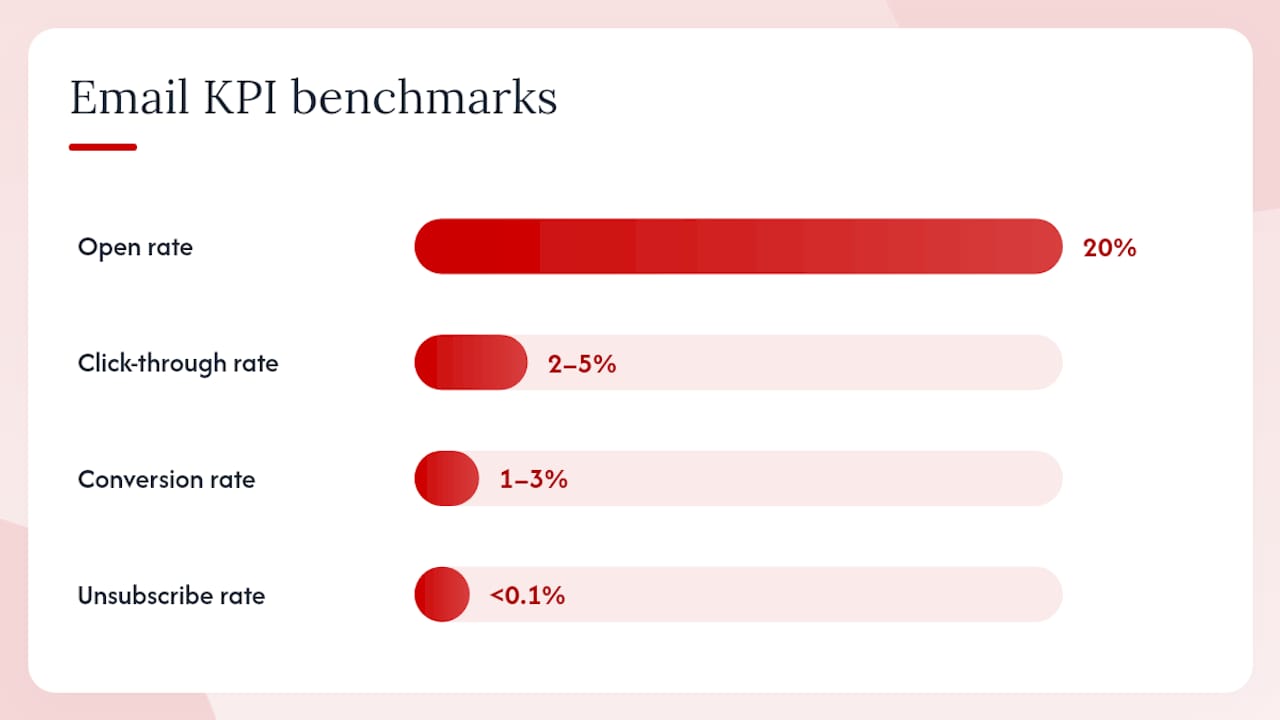
| KPI | How to calculate | Typical benchmark | Reporting cadence |
|---|---|---|---|
| Open rate | Unique opens / emails delivered | 20% (varies by industry) | Weekly |
| Click-through rate | Unique clicks / emails delivered | 2%–5% | Weekly |
| Conversion rate | Conversions / emails delivered | 1%–3% | Per campaign |
| Revenue per recipient | Total revenue / emails delivered | Varies by AOV and segment | Monthly |
| Unsubscribe rate | Unsubscribes / emails delivered | Below 0.1% | Weekly |
| Spam complaint rate | Complaints / emails delivered | A recognized low level | Daily during sends |
Campaign cadence planning works best on a rolling multi-month calendar. Block out your welcome series (days 0–14 post-signup), your promotional cadence (typically 1–2 sends per week for active buyers), and lifecycle touches (post-purchase at day 3, day 14, and day 45). Build suppression rules into the calendar so promotional sends don’t overlap with transactional flows.
Authentication and sender reputation drive inbox placement more than any creative decision you’ll make. Fix SPF, DKIM, and DMARC first. Everything else is secondary.
SPF (Sender Policy Framework) authorizes which servers can send on your domain’s behalf. DKIM (DomainKeys Identified Mail) adds a cryptographic signature that receiving servers verify. DMARC (Domain-based Message Authentication, Reporting, and Conformance) tells receiving servers what to do when SPF or DKIM fail, and it gives you visibility into who is sending on your domain. BIMI (Brand Indicators for Message Identification) is the next layer, displaying your logo in supported inboxes, but it requires a valid DMARC policy at enforcement level first.
IP warming and shared vs. dedicated IPs
New sending domains and IPs need a gradual warm-up. Start with your most engaged subscribers, small volumes, and work up over several weeks. Shared IPs (standard on entry-level ESP plans) work fine for senders under roughly 50,000 emails per month. Above that volume, or if your list quality is variable, a dedicated IP gives you full control over your sender reputation. Proper authentication and warm-up reduce ISP-level throttling faster than creative changes alone.
List hygiene non-negotiables
Deceptive subject lines that imply a personal relationship on first-touch emails are frequently flagged as abuse by recipients. The IC3 complaint process exists precisely for this kind of deceptive practice, and abuse reports at scale will trigger ISP-level blocks before any regulatory action occurs.
Pro Tip: Maintain a single source of truth for your suppression list and sync it in real time across your ESP, CRM, and any third-party sending partners. Cross-brand opt-out failures are one of the fastest ways to accumulate spam complaints and CAN-SPAM exposure simultaneously.
Behavior-based and lifecycle-based segments consistently outperform demographic-only segmentation for both engagement and conversion. Knowing that a subscriber is a 34-year-old woman tells you far less than knowing she bought twice in the last 60 days and abandoned a cart last week.
The five segments to build first
Personalization tactics that scale without breaking your operations: first-name merge fields (table stakes, but still effective), dynamic product blocks pulling recently viewed or purchased items, and conditional content blocks that show different hero offers based on purchase history. Klaviyo and HubSpot both handle conditional content natively. Mailchimp and SendGrid support it through merge tags and dynamic content blocks.
A practical two-block dynamic layout: Block 1 is a hero offer personalized to the subscriber’s most recent product category. Block 2 is an individualized product recommendation drawn from browse or purchase history. Keep real-time data calls to one or two per send. More than that and you risk rendering latency or blank blocks when the data call fails.
Limit your active segments to what your team can actually maintain. Five well-maintained segments outperform twenty poorly governed ones every time.
A mobile-first brief and a tested subject-line framework are the fastest creative wins for opens and click-through rate. Most email opens happen on mobile, which means your subject line is the entire first impression before a single pixel of design loads.
Subject line principles
Keep subject lines between 30–50 characters for mobile preview. Emoji use works when it’s relevant and not overused; one emoji per subject line is a reasonable ceiling. Urgency and scarcity work, but clarity beats cleverness every time. A subject line that tells the reader exactly what’s inside will outperform a cryptic teaser for most audiences.
Your preheader should complement the subject line, not repeat it. A formula that works: [Subject line = what’s in it] + [Preheader = why it matters now]. Example: Subject: “Your reorder is ready” / Preheader: “Stock is limited — we held yours for 48 hours.”
Misleading subject lines that imply a personal message on a first-touch commercial email are a CAN-SPAM violation and a deliverability risk. The FTC’s “overall impression” test applies: if the subject line creates a false impression of a personal relationship, it’s deceptive regardless of what the body says.
Design and copy rules
One clear CTA per message. Not two, not three. One. The hierarchy of information should move from the most important point (the offer or the reason to act) to supporting detail, not the other way around. Structure your content so the reader reaches the CTA quickly, with minimal friction between the subject line promise and the action you want them to take.
Accessibility is not optional. A meaningful percentage of email recipients use screen readers or have visual impairments. WCAG-relevant practices for email:
Statistic to watch: Mobile accounts for the majority of email opens across most consumer categories. Design for a 375px viewport first, then scale up for desktop.
Rigorous A/B testing focused on one variable at a time produces replicable wins. Testing two variables simultaneously makes it impossible to know which change drove the result.
What to test first, in priority order:
A/B test plan structure
For each test, define: the hypothesis (“Changing the subject line from benefit-led to curiosity-led will increase open rate by at least 5 percentage points”), the success metric (open rate for subject line tests, click rate for CTA tests, conversion rate for offer tests), and the sample size.
A practical threshold: if the winning variant shows a consistent lift across three separate tests, treat it as directionally valid and implement it.
Holdout groups (sending nothing to a control segment) are most useful for measuring the true incremental lift of automated flows, not individual broadcast tests. For broadcast A/B tests, a full 50/50 split with a 24-hour window is the standard approach.
The 5 Ts framework treats Tracking as the fifth discipline precisely because neglecting measurement undermines everything else. Build your test log before you build your test.
Guardrail thresholds to watch:
Automated lifecycle flows generate the majority of incremental email revenue at a fraction of the operational cost of manual campaigns. The math is simple: a welcome series runs once per new subscriber, forever, with no additional effort after setup.
The four flows to build in order:
Welcome series (3–5 messages, days 0–14): Message 1 delivers the promised incentive and sets expectations. Message 2 introduces your brand story and best-sellers. Message 3 captures product preferences or asks a qualifying question. Messages 4–5 (optional) push toward first purchase with social proof or a time-limited offer.
Cart abandonment (3 touches): Touch 1 at 1 hour (reminder, no discount). Touch 2 at 24 hours (add social proof or a review). Touch 3 at 72 hours (progressive offer if the margin supports it). Suppress anyone who purchases between touches.
Post-purchase (care and cross-sell): Day 3 confirms the order and sets delivery expectations. Day 14 asks for a review and introduces a complementary product. Day 45 is a replenishment reminder for consumable CPG products.
Re-engagement (graduated reactivation): Message 1 at 90 days dormant: “We miss you” with your best current offer. Message 2 at 120 days: last-chance framing. Suppress and prune at 150 days if no response.
Workflow governance checklist:
Pro Tip: *Build your re-engagement flow before you need it.
Track a small set of primary KPIs tied to business outcomes. Revenue per recipient and conversion rate tell you whether email is actually driving the business. Open rate and click rate tell you whether the creative is working. Deliverability metrics tell you whether the program is healthy enough to keep running.
Attribution models for CPG
Last-click attribution is the default in most ESPs and it overstates email’s contribution for multi-session purchase paths. For CPG brands selling across DTC and retail, a practical adjustment is to use a 7-day click window and a 1-day open window, then cross-reference against in-store lift data where available. Multi-touch attribution models (linear, time-decay) give a more accurate picture of email’s role in longer consideration cycles.
Dashboard minimum fields: revenue per recipient, open rate, click rate, bounce rate, spam complaint rate, and unsubscribe rate. An unsubscribe spike is often the first signal that a segment received a message that wasn’t relevant to them, which is a segmentation problem, not a creative one.
CAN-SPAM is the legal floor for U.S. commercial email. It applies to every commercial message, including B2B outreach and cold email, and each separate violating email can incur penalties of up to $53,088. The law does not require opt-in consent (unlike GDPR and CASL), but it sets seven requirements that every send must meet.
The seven CAN-SPAM requirements:
Compliance checklist:
One-line legal note: If you send to recipients in Canada or the EU, GDPR and CASL both require explicit opt-in consent before sending, which is a materially higher bar than CAN-SPAM. The IAPP’s country-by-country overview is the right starting point for cross-border compliance planning.
Legal specialists warn that the “overall impression” test can convert a transactional-looking email into a commercial message if it contains promotional copy, triggering full CAN-SPAM obligations. Be careful when mixing promotional content into transactional templates.
Pro Tip: The 10-business-day opt-out window is a ceiling, not a target. Processing opt-outs in real time reduces both compliance risk and the deliverability damage that comes from sending to someone who already asked to stop.
A short, repeatable pre-send checklist prevents the most common deliverability and compliance issues. Most send-day errors are checklist failures, not creative failures.
Pre-send checklist:
Recommended launch timeline:
In small teams, one person can own the full checklist, but the T-1 test send should always go to at least one other person for a fresh-eyes review. The 5 Ts framework treats this pre-flight discipline as the difference between a program that compounds results and one that generates cascading failures between targeting, timing, and tracking.
A structured email workflow produces measurable order lift when the flows are built around purchase behavior rather than broadcast cadence. Reddog’s work with CPG brands demonstrates this directly.
A Reddog email marketing workflow drove 494% more orders for CPG clients by combining a behavior-triggered welcome series, automated post-purchase cross-sell, and targeted VIP offers built around purchase recency and product affinity data.
The workflow structure at a high level:
Metrics that improved: order volume, repeat purchase rate, and revenue per recipient. The repeat purchase rate lift came primarily from the post-purchase flow, not the promotional calendar.
Practical takeaways for small teams:
For deeper context on CPG-specific email strategy, Reddog’s email marketing strategies for CPG brands covers the tactical layer in detail.
We’ve seen email programs that generate impressive open rates and mediocre margins. The two are not the same thing, and conflating them is one of the most common mistakes we see in CPG email programs.
Our orientation is margin-first. That means we evaluate every email tactic through the lens of what it actually contributes to profit, not just what it does to top-line revenue.
The clearest example of this tradeoff is promotional frequency. Increasing send frequency typically lifts short-term revenue. It also accelerates list fatigue, raises unsubscribe rates, and trains your best customers to wait for the next discount before buying. The math on contribution margin looked dramatically better. That’s the tradeoff we help operators navigate: not just how to send more email, but how to send the right email to the right segment at a frequency that protects both the customer relationship and the margin.
CPG founders managing email alongside Amazon, DTC, and wholesale channels often find that email is their most underleveraged margin asset. The flows exist, the list is there, but the contribution margin picture is unclear because attribution, segmentation, and suppression logic haven’t been connected to channel economics.
Reddog offers a free 30-minute strategy call for qualified CPG founders and operators in the $500K–$20M revenue range. The session is a practical diagnostic focused on your channel economics, contribution margin by flow, and inventory velocity signals that email can support. We’ll identify where margin is leaking in your current program and give you a short action list you can implement immediately, whether or not we work together beyond that call.
To schedule your session, visit Reddog’s CPG growth offer page and book directly. No pitch deck, no sales process. Just a focused review of your numbers.
The sources below are the most authoritative references used throughout this article. Each is worth bookmarking for ongoing compliance and strategy work.
U.S. law (CAN-SPAM) governs all commercial email sent to U.S. recipients regardless of where the sender is located. For cross-border programs, consult the IAPP resource above and work with qualified legal counsel to confirm which consent regime applies to each recipient geography.
Leave a comment: