
Published: March 2020 | Last Updated:July 2026
© Copyright 2026, Reddog Consulting Group.

Choosing a consulting partner for CPG retail growth is hard when DTC ecommerce solutions ignore channel economics and inventory strategy. Many DTC platforms skip hands-on margin analysis and fail to support Amazon, Walmart, or wholesale execution for small brands. This comparison highlights margin-first consulting firms so founders and operators can pick one that matches their operational needs and business stage.
Reddog reports a track record of greater than 25% year over year revenue growth for clients. That claim is the most specific performance metric the firm lists. The company operates from Houston Texas and focuses on CPG retail growth across online and physical channels. Its work targets measurable profit improvement beyond simple top line gains.
Reddog delivers omnichannel sales integration and marketplace management, with hands-on work across Amazon and Walmart listings and operations. The firm runs data driven marketing campaigns, optimizes SKU and catalog structure, and manages brand registry and listing quality. Consulting includes operational clarity on marketplace economics, fees, and inventory velocity so teams can make profit focused channel decisions.
Specialized focus on omnichannel strategies tailored for small retail brands, delivering measurable revenue growth. The practice combines marketplace optimization with physical retail readiness and distribution planning. That focus ties marketplace economics to pricing strategy and 3PL cost awareness so channel choices reflect contribution margin.
Deep expertise in omnichannel retail strategy helps brands align online and in-store priorities. Reddog emphasizes contribution margin and marketplace economics, so teams get analysis around Amazon FBA fees and Walmart WFS margin compression. The firm offers personalized solutions for small businesses and reports the revenue growth figure above as evidence of outcome oriented work.
Small to medium sized CPG brands and retail owners seeking to scale across DTC, marketplaces, wholesale, and distribution. The firm fits brands roughly in the $500,000–$20,000,000 revenue range that need clearer channel economics and inventory velocity planning. Founders or operators facing margin pressure from marketplace fees will find the firm’s retail and marketplace focus directly relevant.
The firm starts with a contribution margin first strategy that forces channel decisions to favor profit over raw growth. That approach directly addresses Amazon FBA fees, Walmart WFS margin compression, 3PL storage costs, and cash flow timing. For brands balancing DTC, marketplace, and wholesale, this produces clearer trade offs between revenue and net margin.
A local CPG brand used Reddog to expand into Amazon and Walmart while keeping retail distribution. Reddog optimized listings, adjusted pricing for fee pressure, and launched targeted marketing to raise visibility. The brand reported improved sales and clearer margin reporting after the engagement.
Reddog does not publish standard rates. Pricing is consultative and depends on scope, channels, and inventory complexity. Expect an initial scoping call to get a written proposal and service estimate.
Website: https://reddog.group
The Growth Foundation reports a proprietary growth software in beta that aims to increase sales by 2–4%. The consultancy pairs that tool with strategic audits, executive advisory, and talent acquisition for ecommerce brands. Their team lists deep experience across brand, marketing, trading, operations, tech, people, legal, and insight.
The Growth Foundation performs business growth assessments and builds tailored strategic plans that align marketing, trading, and operations. They recruit and onboard critical hires, and they support leadership with executive advisory and legal input. Their proprietary growth software is offered alongside these consulting services during the beta phase.
The firm combines full spectrum advisory work with its own growth tool. That combination lets clients use consultancy deliverables and trial software within a single engagement. The sales claim above is the most concrete product signal the firm promotes.
The Growth Foundation brings a wide set of capabilities that cover both strategy and execution, from brand positioning to operations fixes. Their talent acquisition work reduces hiring friction for founder led teams and fills senior roles quickly. Client testimonials emphasize practical results and partnership, and the leadership team shows experience from major companies that helps with enterprise level problems.
If you need a self serve SaaS package with published plans and transparent feature lists, this consultancy may not match your needs. If you require immediate, documented software functionality rather than beta trials, look elsewhere. Small micro brands with budgets below typical growth consultancy retainers may find the engagement scale too large.
Brands and investors seeking comprehensive ecommerce advice and hiring support will find the offering relevant. The Growth Foundation fits founder led scale ups and larger ecommerce operations that need cross functional fixes. Use it when you want combined advisory and access to an early stage growth tool.
A mid sized DTC brand contracts The Growth Foundation for a business audit and a hiring push for head of trading and head of operations. The firm delivers a prioritized growth plan, recruits two senior hires, and pilots its beta growth software as part of a broader test. The combined effort aims to improve sales and operational clarity.
The Growth Foundation lists its site as informational only and does not publish standard pricing. Prospective clients must request proposals for consultancy retainers or project fees. Software subscription terms and cost models for the beta product are not publicly listed.
Website: https://thegrowth.foundation
Inventory planning and reconciliation processes factor product shelf life and working capital impacts. That specificity shows up across their finance and operations work. EAV Partners focuses on aligning growth activity with margin and cash flow for early stage companies.
EAV Partners builds financial modeling and gross margin analysis that link to demand forecasts and working capital estimates. The agency combines customer lifetime value analysis with supply chain management and fulfillment recommendations. They also define inventory planning processes and reconciliation methods tied to sales forecasts.
The firm positions itself as operational partners rather than a traditional agency. They combine finance, marketing, and supply chain expertise into integrated support for startups. That end to end alignment aims to keep growth efforts tied to profitability and capital efficiency.
According to the company, client testimonials indicate high satisfaction. Their model-driven approach lets founders see how marketing spend affects margin and cash flow. The team supports both financial diligence and hands-on operational tasks such as fulfillment planning and inventory reconciliation. That mix reduces finger pointing between finance, growth, and operations teams.
If your company needs an off the shelf SaaS platform for inventory or marketing automation, this agency model is the wrong fit. Large enterprises needing a vendor with published platform integrations may find the documentation thin. Teams requiring fixed, menu style pricing will need to budget for custom proposals instead.
Founders and executive teams at early stage startups seeking combined finance, operations, and growth marketing support. Companies preparing for investor diligence or refining contribution margin will get the most value. Teams that prefer partner level involvement over transactional consulting will find alignment here.
A seed stage consumer brand hires EAV Partners to build multi scenario financial models and plan inventory by shelf life. The engagement ties marketing budgets to customer lifetime value and working capital needs. That work prepares the company for smarter spending and clearer conversations with investors.
Not applicable for public listing. Pricing appears consultation based and custom per engagement. Prospective clients should request a scope and fee estimate directly from the team.
Website: https://eavpartners.com

Hatchery Group concentrates its services on Walmart and Sam’s Club retail growth. Their suite includes HatchCore®, Hatch+®, and HatchAnalytics®, each aimed at different stages of store and online performance. The agency combines listing and advertising work with operations and data to drive measurable retail outcomes.
Hatchery Group builds retail strategy tailored for scale and category leadership, then aligns execution across content, advertising, and supply chain. The offering pairs hands-on support for listings and in-stock management with an end-to-end operational model that addresses distribution and store readiness. Analytics turn Walmart transaction and assortment data into repeatable growth plans and priority roadmaps.
The firm’s narrow focus on Walmart and Sam’s Club separates it from generalist retail consultancies. That focus produces deep retailer-native expertise and operational playbooks specific to those environments. Clients get a partner that speaks Walmart processes and reporting fluently rather than translating across many retailers.
Hatchery Group brings focused retailer knowledge that shortens ramp time when entering Walmart or Sam’s Club. Their mix of content, advertising, and supply chain support reduces handoffs between creative and operations teams. The analytics capability helps brands convert Walmart data into concrete category and assortment moves rather than vague recommendations.
If you need broad retailer coverage across Walmart, Target, Amazon, and wholesale, this firm may not meet that multi-channel requirement. Brands that require published, tiered pricing will find limited public detail and must request a proposal. Teams that want an off-the-shelf integration platform may need to layer in third-party tooling.
Brands aiming to grow distribution and sales specifically at Walmart and Sam’s Club will find the most value. That includes consumer packaged goods teams scaling from regional to national distribution and brands that must improve in-store presence and online discoverability. Operationally focused founders and channel managers will benefit from the hands-on execution support.
A consumer goods brand hires Hatchery Group to optimize its Walmart listings, reduce out-of-stocks, and improve on-shelf placement. The agency updates content, manages advertising cadence, and uses Walmart sales data to adjust replenishment. The result is clearer category positioning and prioritized operational fixes for distribution partners.
Not applicable — informational only. Hatchery Group does not publish standard public pricing or fixed tiers. Prospective clients request a scoped proposal to learn fee structure and engagement terms.
Website: https://hatcherygroup.com
Compass Rose Ventures embeds senior operators directly inside client teams to drive execution across DTC, retail, Amazon, and wholesale. The firm pairs strategic advisory with hands on operational leadership to move plans into revenue. Rose Hamilton founded the company and leads engagements that emphasize implementation rather than slide decks.
CRV offers embedded operational support across marketing, operations, and leadership while delivering customized strategies for market clarity, investor readiness, and team alignment. Services include strategic advisory, growth sprints, fractional leadership, and brand positioning to support cross channel expansion. Senior operators join client squads to run or oversee execution until milestones are met.
The defining trait is embedding senior operators inside client teams to drive execution and close the gap between plan and outcome. That model moves responsibility for delivery onto experienced leaders rather than handing plans back to internal teams. For brands that need both strategy and execution, this approach removes the common coordination gap between consultants and operators.
Deep industry experience combines with a long term partnership model so recommendations get implemented and not shelved. The offering spans short sprint projects and longer fractional leadership placements which lets brands pick a tempo that matches their resourcing and urgency. CRV also lists a strong track record with CPG brands and investors, which helps when prepping for fundraising or retail conversations.
Potentially higher cost because engagements rely on senior level operators and extended embedding.
Requires active collaboration from the brand; CRV is not a plug and play vendor for teams wanting light touch support.
Less suitable for very early stage startups that have not yet validated product market fit.
If you want an off the shelf playbook or a one time audit, this embedded model will feel heavy and expensive. Brands that lack internal bandwidth to collaborate will struggle to capture value from an embedded operator. Very early stage founders looking only for initial market fit support should look for lighter advisory options.
Mid to late stage consumer brands and investors who need hands on growth support and operational clarity will get the most from CRV. Teams facing growth plateaus, channel expansion, or investor readiness work benefit from senior operators joining day to day execution. Leaders that prefer a partner who stays through implementation will find the model aligns with their priorities.
A CPG brand with flat revenue hires CRV to rework operations, sharpen positioning, and run an omnichannel expansion plan. CRV embeds a fractional leader to coordinate marketing, retail buys, and Amazon execution across teams. The brand gains clearer channel priorities, tighter operations, and improved go to market follow through.
Pricing is not publicly listed and CRV describes engagements as tailored and consultative. Expect custom fees based on scope, duration, and seniority of the embedded operator. The firm commonly uses a mix of sprint projects, retainers, and fractional leadership arrangements rather than fixed menu pricing.
Website: https://compassroseventures.com
Choosing the right partner for optimizing CPG retail growth requires understanding their core focus, differentiators, and suitability for specific business needs.
| Product Name | Core Feature | Key Differentiator | Best For | Notable Limitation |
|---|---|---|---|---|
| Reddog | Omnichannel sales integration and management | Focus on omnichannel revenue and margin growth | Small to medium-sized CPG brands scaling multi-channel | Limited pricing transparency |
| The Growth Foundation | Strategic audits paired with beta software | Proprietary growth software for strategic insights | Larger eCommerce brands needing comprehensive advisory | Sparse documentation on beta software functionality |
| EAV Partners | Financial modeling and margin linkage | Operational integration across finance and logistics | Early stage startups aligning growth with profitability | Consultation required for feature and pricing details |
| Hatchery Group | Walmart and Sam’s Club retail strategies | Retailer-specific operational playbooks | Brands expanding in Walmart/Sam’s Club channels | Limited multi-retailer coverage |
| Compass Rose Ventures | Embedded operational support | Senior operators embedded in-client for delivery | Mid-to-late stage brands needing operational execution | Higher engagement costs due to senior-level involvement |
Many small to medium sized consumer packaged goods brands struggle to connect sales growth with true profit. Reddog helps brands like yours focus on contribution margin, marketplace fees, and inventory velocity so growth actually boosts net income. This focus addresses common challenges highlighted in top DTC ecommerce solutions for 2025, including managing Amazon FBA fees and Walmart margin pressure.
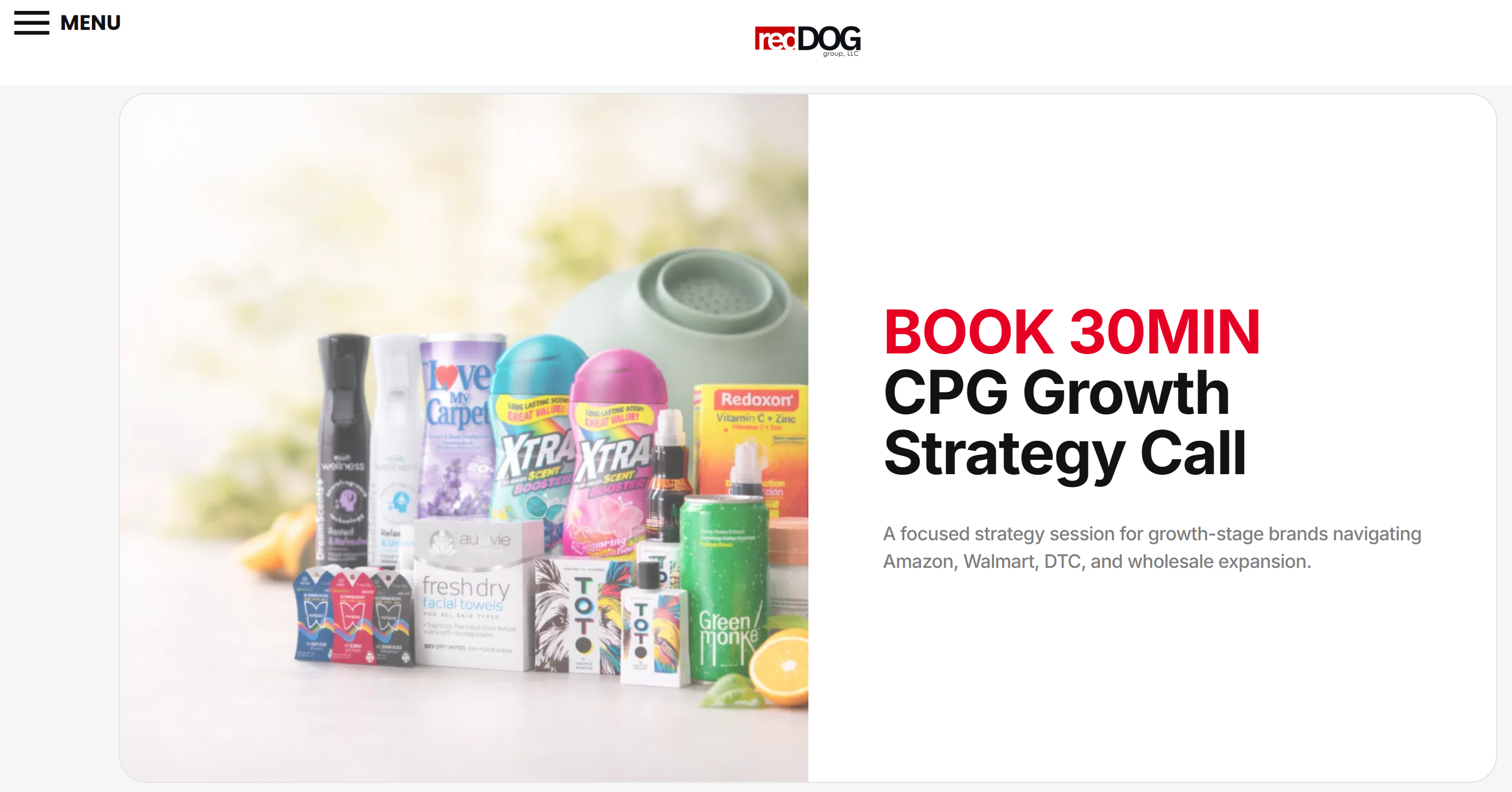
If your brand operates across Amazon, Walmart, DTC, wholesale, or distribution, Reddog’s tailored retail growth strategies can clarify your channel economics and reduce margin leaks. Book a free 30-minute strategy call to review your current growth plan and identify opportunities to improve profit and inventory flow. Learn more about our CPG retail growth offer or check out our services designed for brands like yours.
Reddog enhances marketplace operations by optimizing SKU and catalog structure. The firm delivers data-driven marketing campaigns and manages brand registry and listing quality, ensuring a clear focus on driving profit improvements. As a result, clients can expect measurable growth in both online and physical channels.
The Growth Foundation combines strategic audits with its proprietary growth software, which aims to increase sales by 2–4%. In contrast, Reddog specializes in omnichannel sales integration and marketplace management, particularly for small to medium-sized CPG brands looking for profit-focused channel decisions. This makes Reddog a better fit for clients needing hands-on support specifically in retail growth.
Reddog offers operational clarity on marketplace economics, fees, and inventory velocity. This helps teams make informed decisions about which channels to prioritize based on their contribution margin. Clients can expect precise insights that directly impact their profitability.
Reddog primarily targets small to medium-sized CPG brands in the $500,000–$20,000,000 revenue range. If your brand is below this threshold but faces margin pressure, it may still benefit from the firm’s specialized focus on retail and marketplace support. However, it’s advisable to check for optimal fit given your specific needs.
Reddog employs a contribution margin-first strategy that connects marketplace economics to pricing strategy and distribution planning. This approach balances raw growth with profit considerations, ensuring that brands make financially sound channel decisions. Clients can expect actionable insights that steer them toward sustainable revenue growth.
Leave a comment: