
Published: March 2020 | Last Updated:July 2026
© Copyright 2026, Reddog Consulting Group.

The most effective customer retention techniques are personalization, omnichannel support, loyalty programs, proactive feedback collection, and customer segmentation. Used together, they reduce churn, increase repeat purchase rates, and grow customer lifetime value faster than any acquisition campaign can offset.
Here is the short list of where to start:
These techniques are not theoretical. Each one is grounded in measurable outcomes, and the sections below explain exactly how to put them to work.
Generic messaging is one of the fastest ways to lose a customer’s attention. Brands that use purchase history, browsing behavior, and lifecycle stage to personalize emails and product recommendations consistently see higher open rates and repeat purchases. A CRM platform like Salesforce, Klaviyo, or HubSpot makes this practical even for mid-market brands by automating segmented flows without requiring a dedicated data science team.
Customers expect to pick up a conversation where they left it, whether that is on Instagram, a live chat window, or a phone call. Omnichannel commerce reduces friction by connecting every channel into a single view of the customer, so your team never asks someone to repeat themselves. That consistency is what turns a one-time buyer into a regular.

Feedback is only useful when you act on it visibly. Send a short post-purchase survey within 48 hours of delivery, track the responses by product line or channel, and then tell customers what changed because of what they said. That last step, closing the loop, is what most brands skip, and it is exactly what builds trust.
Rewards programs that target specific purchasing occasions, like a first repeat buy or a seasonal reorder, build long-term habits more effectively than blanket point systems. The goal is to reward behavior you want to see more of, not to discount purchases that would have happened regardless. Brands that get this right spend less on incentives while retaining more customers.
Not every customer needs the same retention effort. High-frequency buyers need recognition and early access. Occasional buyers need a reason to come back sooner. Lapsed customers need a reactivation trigger. Segmenting by recency, frequency, and monetary value (the RFM model) lets you allocate retention spend where it has the most impact, rather than spreading it thin across your entire list.
Customer journey mapping is the practice of documenting every interaction a customer has with your brand, from first discovery through post-purchase support, and identifying where satisfaction drops. For CPG brands, common drop-off points include the second purchase window, subscription renewal dates, and post-complaint resolution. Fixing those specific moments does more for retention than a broad loyalty push.
True customer churn is often silent. A customer stops buying without ever saying why, and by the time you notice, they have moved on. Automated win-back sequences, triggered by a set number of days since last purchase, catch these customers at the right moment. A well-timed email with a relevant offer or a reminder of what they loved about your product can recover a meaningful share of would-be lost revenue.
For brands with subscription or replenishment models, pause-before-cancel features recover an average of 9.6% of customers who would otherwise churn. Giving subscribers the ability to skip a shipment or pause their plan acknowledges that life changes, and it keeps the relationship intact through financial or logistical disruptions that would otherwise end it.
A customer service team that listens without getting defensive, escalates with empathy, and resolves issues on the first contact is one of the highest-return retention investments a brand can make. Empathy-led service reduces churn risk at the exact moment a customer is most likely to leave. Scripted, reactive responses do the opposite.
Community is one of the few retention assets that compounds over time. A private Facebook group, a brand ambassador program, or a user-generated content campaign on Instagram creates social ties that make switching to a competitor feel like leaving a group, not just changing a product. For CPG brands especially, community turns customers into advocates who recruit new buyers at no acquisition cost.
Predictive analytics tools analyze purchase cadence, support ticket frequency, and engagement signals to flag customers who are likely to churn before they do. Acting on those signals with a proactive outreach, a personalized offer, or a check-in call is far cheaper than trying to win someone back after they have already left.

For brands selling across multiple channels, retail leakage analysis identifies where customers are switching to competitors or dropping out of the purchase cycle entirely. Targeted regional price and pack adjustments based on that analysis reduce churn more sustainably than broad discount campaigns, which often erode margin without fixing the underlying reason customers leave.
Increasing customer retention by just 5% can boost profits by 25% to 85%. That range reflects how dramatically retention compounds over time: a retained customer spends more per transaction, tolerates price increases better, and refers others at a higher rate than a new customer does in their first year.
The financial case goes deeper than revenue. Research tracking customer satisfaction and loyalty across more than one million customers found a correlation of r=0.60 between satisfaction and retention, and r=0.68 between satisfaction and word-of-mouth. That means a satisfied customer is nearly as likely to bring in new buyers as they are to return themselves.
| Business benefit | What it means in practice |
|---|---|
| Lower acquisition cost | Retained customers eliminate the need to replace lost revenue with expensive paid acquisition |
| Higher lifetime value | Repeat buyers spend more per order and buy more frequently over time |
| Price tolerance | Loyal customers are less likely to switch when prices rise modestly |
| Word-of-mouth growth | Satisfied customers refer others, reducing your effective cost per new customer |
| Competitive insulation | Strong retention makes it harder for competitors to poach your customer base |
The retention elasticity principle: A 1% improvement in customer retention improves customer and firm value by 2.45–6.75%, making retention investment roughly five times more impactful on firm value than an equivalent reduction in cost of capital. Retention is not a marketing expense. It is a durable asset.
Customer lifetime value also rises as retention improves, with loyal customers generating more frequent and higher-value purchases over time. For CPG brands in the $500K–$20M revenue range, that compounding effect is often the difference between a brand that grows and one that runs in place, replacing churned customers with new ones at a constant, expensive rate.
Retention is only manageable when it is measurable. The core metrics every brand should track are:
Pro Tip: Segment your retention metrics by acquisition channel. A customer acquired through Amazon often has a very different retention profile than one acquired through your DTC site. Treating them as one group masks the real drivers of churn.
Beyond the metrics themselves, the tracking infrastructure matters. A CRM that connects purchase data, support history, and campaign engagement gives your team a single source of truth. Without that integration, you are making retention decisions based on incomplete information. Dashboards built in tools like Google Looker Studio or Tableau can surface churn risk signals in near real time, giving your team the lead time to intervene.
Journey analysis adds another layer. By mapping where customers drop off in the purchase cycle, you can identify whether churn is happening at the first reorder window, after a negative support interaction, or at subscription renewal. Each of those moments calls for a different fix.
For CPG brands, retention is as much an operations problem as a marketing one. Supply chain fragility and billing errors are among the leading structural causes of churn, and no loyalty program can compensate for a customer who received the wrong product or was charged incorrectly. Brands lose an estimated $158 billion annually due to poor partner connections affecting retention.
Omnichannel integrity is the operational foundation of retention. When a customer’s experience on Amazon differs from what they get on your DTC site or at a retail shelf, trust erodes. Consistent pricing, accurate inventory signals, and real-time fulfillment updates across every channel are what keep customers from switching to a competitor who feels more reliable.
Pro Tip: Before investing in a new loyalty program, audit your order accuracy rate, return resolution time, and subscription billing error rate. Fixing operational leaks retains more customers per dollar than any incentive campaign.
Subscription and replenishment models deserve special attention. Brands that give subscribers control over their cadence, through skip, pause, and resume features, see meaningfully lower churn than those with rigid cancel-or-stay structures. The pause-before-cancel feature referenced earlier recovers customers who are not dissatisfied with the product but are managing a temporary change in their budget or routine.
AI-driven customer service is changing the speed at which operational issues get resolved. Chatbots trained on your product catalog and order management system can resolve shipping inquiries, process exchanges, and flag escalation-worthy complaints in real time, before a frustrated customer decides to leave. The brands getting the most out of this are the ones that use AI for speed and human agents for empathy, not one or the other.
Operational excellence in logistics and real-time communication underpins CPG retention success more than any marketing campaign. Customers forgive a brand that resolves problems fast. They rarely forgive one that makes them chase a resolution.
Retail leakage analysis is an underused tool in the CPG retention toolkit. By identifying the specific geographic markets or retail channels where customers are switching to alternatives, brands can make targeted pack-size or price adjustments that address the actual switching trigger. That is a far more margin-friendly approach than running a sitewide discount that rewards customers who were not at risk of leaving.
For CPG retention strategy to work at scale, it has to be built into operations, not bolted on top of them. That means aligning your supply chain, customer service, and channel pricing around the same goal: making it easier for a satisfied customer to keep buying from you than to look elsewhere.
Retention is where margin is made or lost. If your brand is growing top-line revenue but watching contribution margin compress, the answer is rarely more acquisition spend. It is usually a retention problem hiding inside your channel economics.
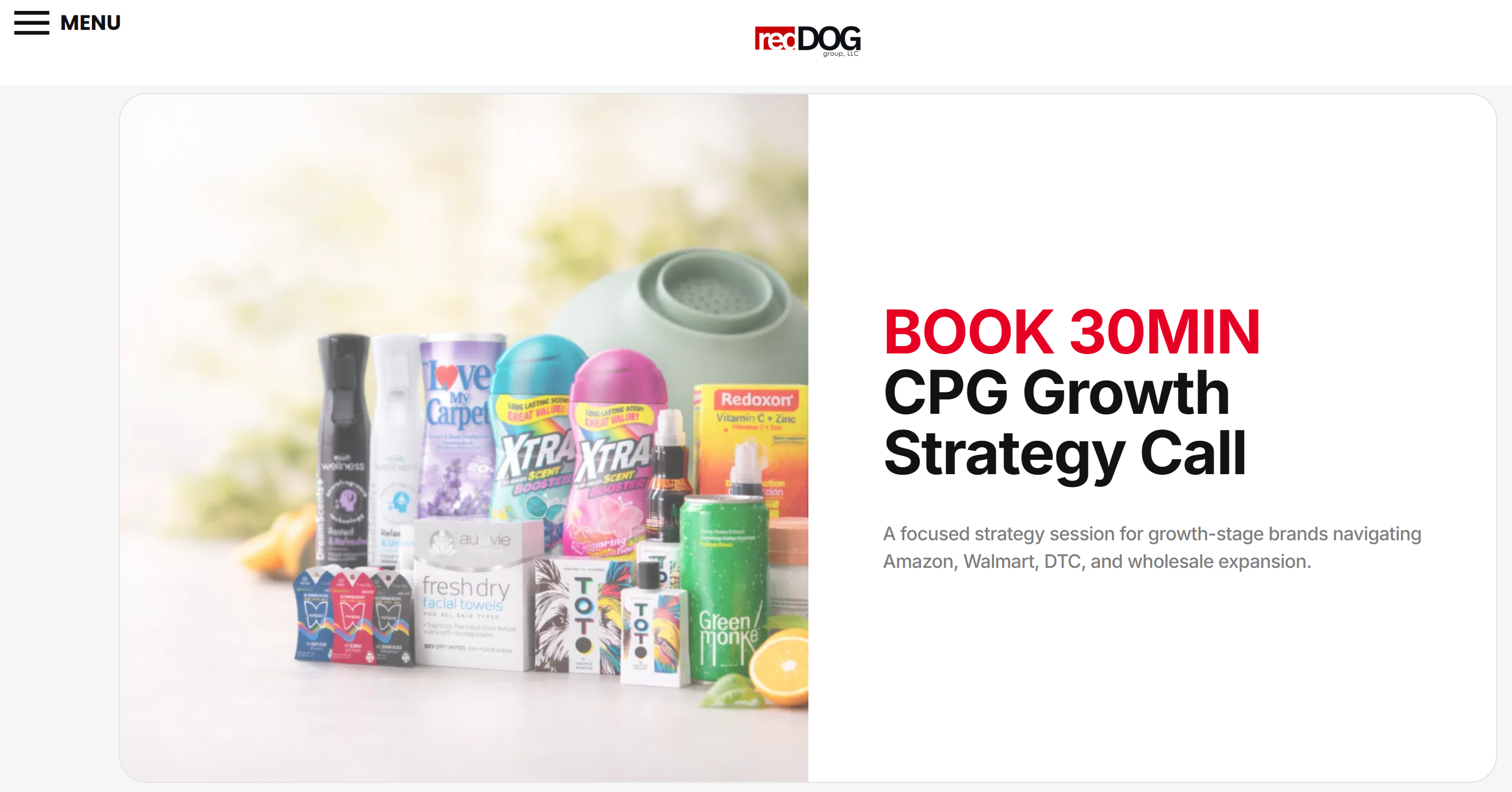
Reddog works with CPG brands in the $500K–$20M revenue range to build growth plans grounded in contribution-margin-first thinking. We look at where your customers are churning, which channels are actually profitable after fees and fulfillment costs, and where operational gaps are costing you repeat buyers. Our approach is analytical and specific to your brand’s situation, not a generic playbook. If you want to understand what your customer lifetime value actually looks like by channel, and where the biggest retention levers are hiding, a focused strategy session is the right starting point.
Qualified CPG founders and operators are welcome to book a free 30-minute strategy call with the Reddog team. We will review your contribution margin, channel economics, or inventory velocity together and give you a clear picture of where to focus next.
The most durable path to profit in CPG is not acquiring more customers. It is keeping the ones you already have and maximizing what each one contributes over time.
| Point | Details |
|---|---|
| Retention drives profit disproportionately | A 5% retention increase can boost profits by 25%–85%, far outpacing equivalent acquisition investment. |
| Operational gaps cause silent churn | Billing errors, supply chain failures, and inconsistent channel experiences are leading structural churn drivers in CPG. |
| Loyalty programs need occasion targeting | Rewarding specific purchasing occasions builds habits; rewarding all spend subsidizes customers who would have bought anyway. |
| Measure retention by channel and cohort | Blended retention metrics hide the real drivers of churn; segment by acquisition source and lifecycle stage for accurate insight. |
| Reddog builds margin-first retention plans | Reddog helps CPG brands identify retention leaks across channels and build growth plans grounded in contribution-margin economics. |
Leave a comment: