
Published: March 2020 | Last Updated:February 2026
© Copyright 2026, Reddog Consulting Group.

Every Texas-based CPG founder knows that expanding beyond American borders comes with a unique set of challenges and rewards. As digital commerce transforms the way brands connect with customers, the pressure to tap into global markets is stronger than ever. This article unpacks cross-border ecommerce fundamentals and strategic models, empowering your team to navigate payment, shipping, and compliance complexities while optimizing control and growth across every channel.
| Point | Details |
|---|---|
| Cross-Border Ecommerce Growth | CPG brands can expand globally by utilizing cross-border ecommerce, bypassing traditional market entry barriers. |
| Strategic Models | Brands can choose between marketplace, direct-to-consumer, or hybrid models based on control preferences and investment levels. |
| Core Operational Processes | Success depends on managing payments, shipping logistics, and regulatory compliance effectively to enhance international retail strategies. |
| Risk Management | Financial risks must be mitigated through dynamic pricing, fixed-rate shipping contracts, and comprehensive risk management practices. |
Cross-border ecommerce represents a strategic expansion pathway for Consumer Packaged Goods (CPG) brands seeking global market penetration. At its core, cross-border ecommerce enables companies to sell products directly to international consumers through digital platforms, transcending traditional geographic limitations.
The World Customs Organization highlights that cross-border ecommerce offers significant growth opportunities by reducing international market entry barriers. This digital commerce model allows CPG brands to reach consumers across national boundaries without establishing physical retail infrastructure in each market.
Key characteristics of cross-border ecommerce for CPG brands include:
Research from academic sources demonstrates that cross-border ecommerce development trends are being driven by technological advancements and shifting consumer behaviors. Digital platforms now enable seamless transactions across complex international ecosystems, fundamentally transforming how brands approach global retail expansion.
Pro Tip: Invest in robust international payment gateways and logistics partnerships to effectively manage cross-border transaction complexities and reduce potential friction points.
Cross-border ecommerce presents three primary strategic models for CPG brands seeking global market expansion: marketplace, direct-to-consumer (DTC), and hybrid approaches. Each model offers unique advantages and challenges for brands navigating international retail landscapes.

Digital strategies for cross-border commerce reveal distinct operational characteristics across these models. Marketplace models leverage existing digital platforms, while DTC approaches provide brands maximum control over customer relationships and brand experience.
Key characteristics of each cross-border ecommerce model include:
Marketplace Model:
Direct-to-Consumer (DTC) Model:
Hybrid Model:
E-commerce business model research indicates that technological advancements like big data and blockchain are increasingly enabling sophisticated cross-border commerce strategies, particularly for hybrid and DTC approaches.
Pro Tip: Conduct thorough market research and start with a low-risk hybrid model to test international markets before fully committing to a single cross-border ecommerce approach.
Here is a comparison of key cross-border ecommerce models with their strategic value for CPG brands:
| Model Type | Control Over Customer Experience | Investment Level | Speed to International Market |
|---|---|---|---|
| Marketplace | Minimal control, dictated by platform | Low initial investment | Fast, immediate global reach |
| DTC | Full control, direct interaction | High investment in tech/marketing | Slower, requires market building |
| Hybrid | Moderate control, flexible balance | Medium, shared across channels | Moderate, scalable with experience |
Cross-border ecommerce success hinges on three critical operational processes: payments, shipping, and regulatory compliance. These interconnected elements form the foundation of effective international retail strategies for Consumer Packaged Goods (CPG) brands expanding globally.
Cross-border e-commerce operational standards highlight the complex ecosystem of international transactions that brands must navigate carefully. Each process presents unique challenges and requires sophisticated technological and strategic approaches.
Key considerations for core cross-border ecommerce processes include:
Payment Processing:
Shipping Logistics:
Regulatory Compliance:
Procedural standards for international commerce demonstrate that successful cross-border ecommerce requires robust risk management and enforcement mechanisms to protect all stakeholders involved in global transactions.
Pro Tip: Invest in flexible, integrated compliance and logistics technologies that can adapt to varying international regulatory requirements and streamline cross-border transaction processes.
The following table summarizes how each core cross-border process can impact business growth:
| Core Process | Business Impact | Common Challenges |
|---|---|---|
| Payment Processing | Expands buyer options, drives sales | Fraud, payment localization hurdles |
| Shipping Logistics | Enables timely delivery and satisfaction | Customs delays, extra costs |
| Regulatory Compliance | Enables market entry and trust | Legal variances, documentation errors |
Cross-border ecommerce introduces a labyrinth of regulatory and tax challenges that vary dramatically across different international markets. Consumer Packaged Goods (CPG) brands must navigate an intricate landscape of legal requirements, tax obligations, and compliance standards that differ significantly from one jurisdiction to another.
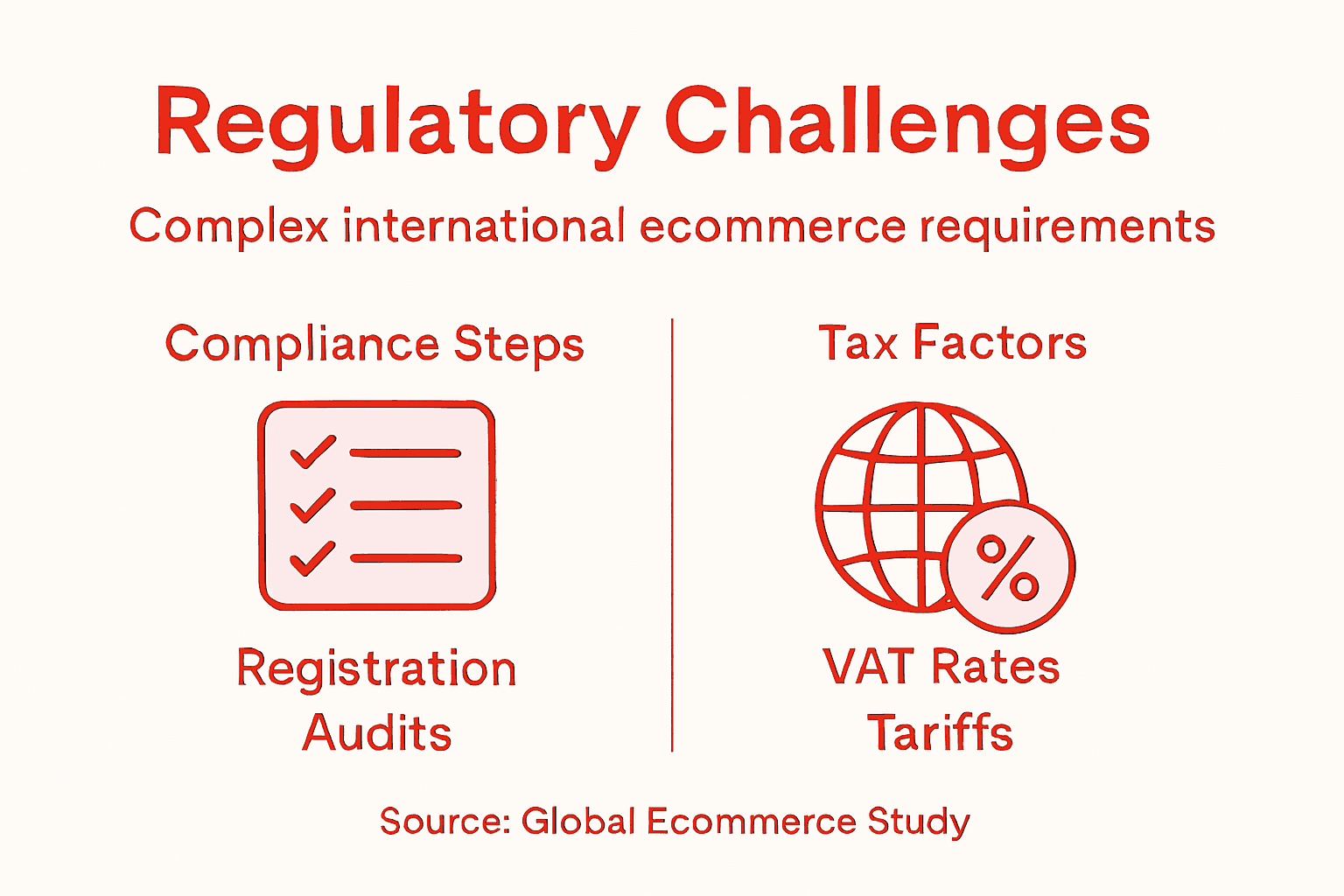
Cross-border trade regulatory frameworks reveal the complex international legal environment that brands must understand to successfully expand their global operations. Each country presents unique obstacles in areas like consumer protection, data privacy, customs duties, and sales tax collection.
Key regulatory and tax complexities include:
Customs and Import Regulations:
Tax Collection Challenges:
Compliance Risk Areas:
Customs procedure harmonization efforts demonstrate ongoing international attempts to simplify regulatory environments, though significant variations remain between national jurisdictions.
Pro Tip: Develop a flexible compliance strategy with localized expertise in each target market, and invest in adaptable technology platforms that can automatically manage complex international regulatory requirements.
Cross-border ecommerce introduces complex financial risks and margin challenges that can rapidly erode profitability for Consumer Packaged Goods (CPG) brands expanding internationally. Understanding and mitigating these risks requires a strategic, multi-dimensional approach to cost management and operational efficiency.
E-commerce global economic risks demonstrate how unpredictable economic conditions can create significant margin pressure for international retailers. Currency fluctuations, shipping costs, and complex customs regulations represent critical areas where brands can experience unexpected financial leakage.
Key risk and margin management strategies include:
Financial Risk Categories:
Margin Leak Prevention Tactics:
Cost Control Approaches:
Supply chain resilience strategies emphasize the importance of adaptive logistics models and data-driven forecasting to minimize operational risks and protect contribution margins in cross-border commerce.
Pro Tip: Develop a comprehensive risk management dashboard that integrates financial, logistical, and compliance metrics to proactively identify and mitigate potential margin erosion points.
Expanding your Consumer Packaged Goods brand into international markets comes with challenges like navigating complex payment systems, managing shipping logistics, and overcoming regulatory hurdles. If you want to avoid margin leaks and ensure operational clarity, you need a partner who understands these core issues and helps you focus on contribution-margin-first strategies that drive sustainable growth.

Discover how our Digital & Business Consulting Services by Reddog Consulting help brands like yours master global retail complexity across channels such as Amazon, Walmart, and DTC. Our proven approach blends marketplace economics with physical retail insights for scalable expansion. Start optimizing your international ecommerce operations today by visiting our main offering at CPG Retail Growth Offer. Take control of your margins now and turn cross-border ecommerce challenges into profitable opportunities.
Cross-border ecommerce allows Consumer Packaged Goods (CPG) brands to sell directly to international consumers via digital platforms, offering significant growth opportunities by reducing market entry barriers and expanding their reach to global customers without needing physical retail locations.
The three primary models for cross-border ecommerce are marketplace models, direct-to-consumer (DTC) models, and hybrid models. Marketplace models leverage established platforms, DTC models give brands full control over customer relationships, and hybrid models combine both strategies for greater flexibility and risk diversification.
The core processes involved in cross-border ecommerce include payment processing, shipping logistics, and regulatory compliance. These processes are interconnected and essential for ensuring smooth international transactions and customer satisfaction.
CPG brands can manage regulatory and tax complexities by developing a flexible compliance strategy, investing in technology platforms that adapt to various international regulations, and ensuring they have localized expertise in each target market to navigate customs, taxes, and legal requirements effectively.
Leave a comment: