
Published: March 2020 | Last Updated:May 2026
© Copyright 2026, Reddog Consulting Group.

TL;DR:
- Expanding into new markets requires a disciplined, diagnostic approach based on customer insights and operational readiness.
- Most failures stem from incorrect assumptions rather than execution, emphasizing the importance of local validation and feedback.
Expanding into a new market feels like the obvious next move when your core channels are humming. But for CPG brands in the $500K to $20M range, new market entry is where growth plans quietly fall apart. The costs are higher than projected, the timelines stretch, and consumer behavior rarely matches the assumptions baked into the original pitch deck. Brands that win aren’t the ones with the biggest budgets. They’re the ones that move with a repeatable, diagnostic process rather than gut instinct and optimism. This guide walks you through exactly that process.
| Point | Details |
|---|---|
| Start with readiness | Success begins by precisely defining your market and segment, grounded in benchmarks and peer results. |
| Localize with insights | Go beyond basic demographics by using real consumer insights to adapt products and marketing effectively. |
| Plan capital and sequence | Factor upfront trade spend, inventory, and working capital needs before scaling your retail partnerships. |
| Unify measurement and execution | Coordinate omnichannel and offline efforts using store-level and omnichannel velocity metrics monitored weekly. |
| Make diagnostics your playbook | Routinely reallocate investment based on responsiveness to ensure you scale what truly works, not what was planned. |
Every successful market expansion starts long before you talk to a distributor or pitch a buyer. It starts with a hard look at who you’re actually selling to in the new market, and whether your brand has the operational foundation to support that sale.
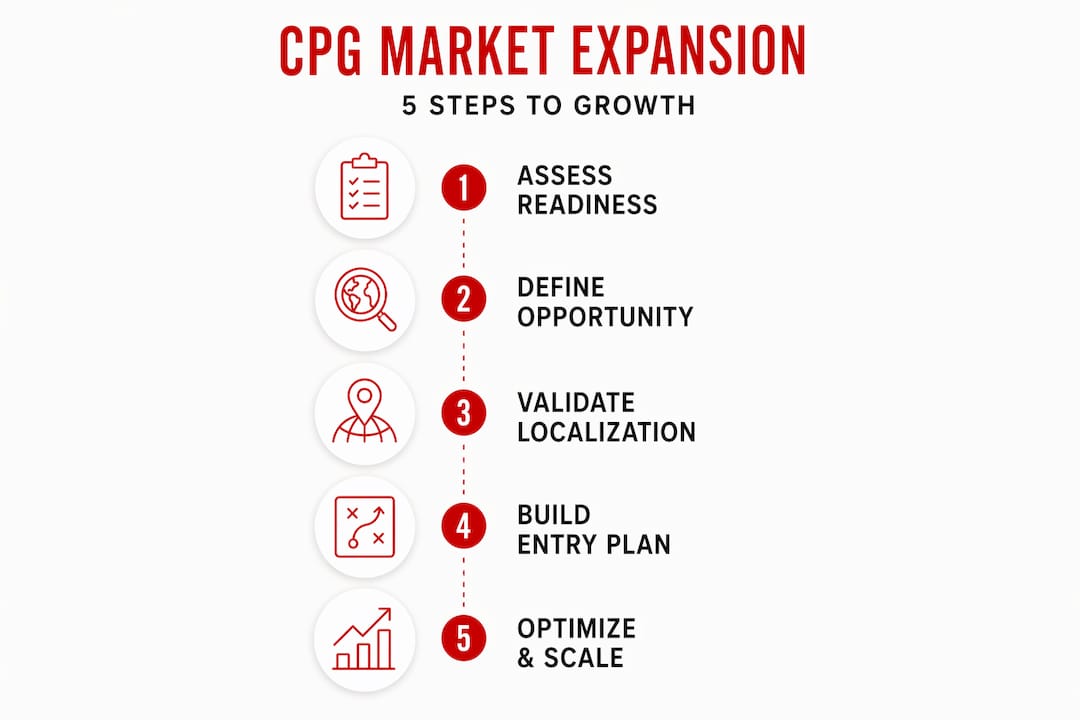
The revenue engine approach to market entry is clear on this: the first move is defining your target customer segment and Ideal Customer Profile (ICP) for the new market specifically, not just porting over your existing one. A Texas shopper buying your snack at H-E-B has different habits, price sensitivity, and channel preferences than a shopper in the Pacific Northwest discovering you through a natural grocery chain. Those differences matter enormously for your go-to-market design.
Once your ICP is set, the next mistake to avoid is sizing the market based on total addressable market (TAM) alone. TAM numbers look impressive in a slide deck but they tell you almost nothing about what’s actually penetrable. Market expansion guidance suggests grounding your goals in peer performance at your scale, not category-level projections that assume you have the distribution, brand awareness, and trade spend of an established player.
Here’s a practical way to pressure-test your entry assumptions:
| Factor | What to measure | Why it matters |
|---|---|---|
| Competitive density | SKU count and shelf space of direct peers | Tells you how crowded the shelf is |
| Velocity benchmarks | Sales per store per week for comparable brands | Sets realistic volume expectations |
| Distribution gaps | Regional broker and distributor coverage | Reveals infrastructure readiness |
| Margin at shelf | Retailer margin, slotting, and trade spend requirements | Confirms whether entry is profitable |
Before committing resources, review these prerequisites honestly:
Pro Tip: Don’t benchmark your entry goals against the category leader. Benchmark against brands at a similar stage and revenue level. Peer performance is a far more honest target for CPG marketplace growth strategies than category averages.
Understanding go-to-market strategy basics before you design your entry approach will save you from the most common sequencing errors founders make when they rush toward execution.
Once you’ve identified a high-potential market, you need to validate fit through localization. Not just language. The entire consumer experience.

Demographics are a starting point, not a destination. Knowing that your target market skews 25 to 45, urban, and health-conscious doesn’t tell you whether they prefer a 12-count multipack or single-serve grab-and-go. It doesn’t tell you whether they discover new products through TikTok, in-store demos, or word of mouth. Behavioral and channel insights are where CPG success in new markets is actually built.
The goal here is to baseline your metrics before you change anything, so that when you do adjust product, packaging, or messaging, you can measure what actually moved the needle. Without a pre-launch baseline, you’re optimizing blindly.
Here’s how an insights-driven approach compares to the standard playbook:
| Approach | Standard method | Insights-driven method |
|---|---|---|
| Consumer research | Post-launch sales review | Pre-launch qualitative + quantitative |
| Product adaptation | Copy existing SKU into new market | Adjust format, size, claims based on local behavior |
| Pricing strategy | Match existing channel pricing | Test price sensitivity against local competitive set |
| Marketing messaging | Reuse national campaign assets | Develop regional messaging tied to local values |
| Launch measurement | Track top-line revenue | Baseline velocity, trial, and repeat metrics |
Elements of your product experience worth localizing include:
Pro Tip: Build a simple pre-launch measurement card with five to seven KPIs specific to the new market before spending a dollar on activation. That card becomes your truth benchmark throughout the entry period. It’s one of the most underused tools in local marketing strategies.
Validated localization paves the way for the most intense work: building your entry plan with disciplined capital and sequencing.
The biggest financial blind spot for growing CPG brands is the gap between when product ships and when cash comes back. Retailers pay on 30, 60, sometimes 90-day terms. Your broker needs to be compensated. Your distributor needs margin. Your 3PL is charging storage and pick fees from day one. Capital discipline is non-negotiable here, and the numbers are significant.
“Founders consistently underestimate pipeline fill and 60–90 day working capital gaps before cash receipts. The inventory and funding requirement can be $75,000 to $150,000 for a 100-door regional launch and $500,000 to $2 million for a national rollout.”
That’s not a reason to avoid expansion. It’s a reason to plan for it explicitly rather than discover it mid-launch.
Here is a five-step sequence we recommend for disciplined market entry:
Supporting scaling CPG businesses at this stage requires operational rigor that most brands underestimate until they’re already in the middle of it. Pair this plan with solid marketplace management best practices to keep your digital channels coordinated with physical retail timing.
With a plan in place and capital allocated, next is activation, where omnichannel coordination and execution with retail partners determine whether you build staying power or flame out after the first reset.
The biggest measurement mistake in new market execution is optimizing for return on ad spend (ROAS) alone. ROAS is a useful signal in your existing markets where you have baseline data. In a new market, retail media measurement should center on velocity: sales per store per week. That metric tells you whether the shelf is working, whether shoppers are finding you, and whether the consumer experience is converting trial into repeat.
Here’s a sample measurement framework for new market entry:
| Data source | Cadence | What you’re measuring |
|---|---|---|
| Weekly POS data from retailer | Weekly | Velocity, out-of-stocks, promotional lift |
| Third-party panel or syndicated data | Monthly | Household penetration, trial vs. repeat |
| Digital media performance | Weekly | Click-through, conversion, regional ROAS |
| CRM and DTC order data | Weekly | Retention, subscription, and repurchase rate |
| Broker/distributor sell-through | Biweekly | Distribution fill rate and in-store availability |
Retailer partnership in emerging markets requires a proactive approach. GTM strategies for emerging markets are clear that building retailer databases and maintaining a digital backbone for performance data is critical when consumer data is limited or incomplete.
Steps for effective retailer outreach:
Pro Tip: Invest early in a unified measurement dashboard that connects your omnichannel retail platforms with in-store POS data. This “digital backbone” becomes the single source of truth when you’re managing multiple retail partners and channel formats simultaneously. It also surfaces margin leaks faster than any spreadsheet review. See how it fits into omnichannel growth analysis at the brand level.
To ensure you’ve built a repeatable revenue engine, it’s essential to diagnose which levers actually create growth, then double down on those. Here’s how best-in-class brands do it.
Not all spend is equal in a new market. Some brands move with price investment. Others respond to distribution density. Some need media to drive trial; others need sampling and in-store demos. The only way to know which is true for your brand in a specific market is to build what brand responsiveness profiling describes as a structured diagnostic of your marketing levers.
| Investment approach | Broad budget allocation | Diagnostic lever-specific allocation |
|---|---|---|
| Pricing | Flat discount across channels | Test price elasticity by channel and pack size |
| Promotion | Standard TPR schedule | Correlate promotional lift to actual velocity change |
| Distribution | Add doors as fast as possible | Gate door expansion on confirmed velocity thresholds |
| Media | Allocate by channel size | Invest where responsiveness data shows actual trial conversion |
Common signs your spend isn’t driving velocity in the new market:
Pro Tip: Schedule a monthly performance review that specifically evaluates lever performance, not just top-line results. If a lever isn’t moving velocity after two or three cycles, reallocate before the quarter closes. Product life cycle marketing decisions made monthly compound faster than those made quarterly.
Here’s the uncomfortable reality: most market expansion failures are not failures of execution. They’re failures of assumption.
The most cited example in CPG and retail strategy is Walmart’s entry into Germany. By any operational metric, Walmart did everything right. Scale, logistics, pricing discipline. But misreading local market context turned a logically sound expansion into an expensive retreat. German shoppers had different service expectations, competitive loyalty patterns, and retail norms that Walmart’s existing playbook simply could not accommodate.
That story isn’t unique to global giants. We see versions of it with $2M CPG brands entering Texas from the Midwest, or $8M brands moving from natural grocery into conventional retail. The playbook that worked in one context carries silent assumptions that break in a new one.
The CPG operating model reinvention perspective is instructive here: winning brands don’t just add distribution broadly and wait for results. They unify brand ownership across functions, apply lever elasticity thinking, and build feedback loops that surface local realities quickly.
That last part is what separates brands that build repeatable revenue engines from brands that win one market launch and then struggle to replicate it. Repeatability is diagnostic by nature. It asks: what did we learn about this market that we didn’t know going in, and how do we hardwire that learning into the next entry? The brands that answer that question honestly are the ones still growing five years later.
The true advantage isn’t a better playbook. It’s leadership that stays curious about local realities and course-corrects faster than the market can punish them for being wrong. Mapping out your marketing distribution channels with that mindset changes every conversation you have with brokers, buyers, and retail partners.
Expanding into a new market is one of the highest-leverage and highest-risk moves a CPG brand can make. The difference between a successful entry and an expensive retreat often comes down to the quality of the planning, the discipline of the capital allocation, and the speed of the diagnostic feedback loop.
RedDog Group works directly with CPG founders and operators in the $500K to $20M range who are navigating exactly this kind of expansion. We bring structured frameworks, margin-first analysis, and hands-on retail experience to your entry planning, whether that’s regional brick-and-mortar, Amazon, Walmart, or a coordinated omnichannel launch. If you’re ready to move from ambition to a concrete, executable market entry plan, explore how RedDog Group partners with brands like yours to make expansion both systematic and profitable.
Identify your target segment and assess accessible market space using peer benchmarks and local insights. A repeatable entry approach starts with defining your ICP for the new market before designing commercial execution.
Set a disciplined investment plan with explicit buffer for pipeline inventory and 60 to 90 day retailer pay cycles. Inventory and funding needs can reach $75,000 to $150,000 for a regional rollout and up to $2 million for national expansion.
Basic demographics no longer predict purchase behavior with enough precision. Actionable local consumer insights drive product format, pack size, messaging, and promotional decisions that national assumptions will miss.
Velocity (sales per store per week) and incremental contribution margin are the most meaningful metrics for retail expansion. Success measurement should prioritize shelf performance over digital ROAS alone.
Assuming a generic playbook will transfer without testing local context. Misreading cultural or market dynamics has turned logically sound expansions into underperformance and costly retreats for brands at every scale.
Leave a comment: