
Published: March 2020 | Last Updated:June 2026
© Copyright 2026, Reddog Consulting Group.

TL;DR:
- Effective content marketing in 2026 relies on structured pillars, consistent repurposing, and platform-specific strategies to boost reach, trust, and sales. Creating authentic, specific content and engaging actively with audiences enhances trust and long-term growth. Monitoring AI citations helps refine strategies by focusing on high-quality, targeted content that drives real business results.
Content marketing ideas are strategic themes and formats that marketers use to consistently engage audiences, build brand visibility, and convert attention into revenue. The discipline has a formal name in the industry: content strategy. Whether you call it content strategy or content marketing planning, the mechanics are the same. You pick formats, assign them to platforms, and execute with enough consistency to build trust. In 2026, the brands winning on Instagram, Amazon, and in wholesale are not the ones posting the most. They are the ones posting with purpose, repurposing with discipline, and measuring what actually moves the needle.
The most effective content marketing ideas start with content pillars. A content pillar is a core theme that organizes everything you publish. Sprout Social identifies five standard pillars: educate, entertain, inspire, engage, and promote. Each pillar maps to a business goal, which removes the guesswork from daily content decisions.
A practical starting point for small businesses is the 2:2:1 weekly post ratio: two awareness posts, two trust posts, and one sales post. This structure keeps your feed commercially useful without turning every post into a pitch. Vanity metrics like follower counts stop mattering when you build around this ratio.
Small businesses should target 12–16 posts per month, split 70% evergreen and 30% trending. Evergreen content holds value for months. Trending content captures short-term attention. Together, they balance consistency with relevance.
Pro Tip: Build your content pillars before you plan a single post. Pillars cut decision fatigue and make batch creation faster because every idea already has a home.
94% of marketers use content repurposing, achieving 40% higher content output without a proportional increase in creation time. That output gain is the clearest argument for repurposing as a core method, not an afterthought.

Take a 1,500-word blog post and extract three to five key insights. Turn each into a 30-second video script for Instagram Reels or TikTok. The blog post does the heavy thinking. The video does the distributing. One piece of content becomes five touchpoints across platforms.
Instagram Reels boost reach by 25% compared to standard feed posts. That is not a minor bump. For a brand with 5,000 followers, a 25% reach increase means your content reaches people who have never heard of you.
Reels work best when they teach something fast or show something surprising. A CPG brand can film a 20-second behind-the-scenes clip of product sourcing, a quick recipe using their product, or a before-and-after comparison. The format rewards authenticity over production value.
60% of users prefer interactive formats like polls, quizzes, and challenges over passive content. Interaction signals to platform algorithms that your content is worth distributing further. It also tells you what your audience actually cares about.
A poll on Instagram Stories asking “Which flavor should we launch next?” does two things at once. It generates engagement data and makes customers feel like co-creators. That feeling builds loyalty faster than any promotional post.
An expert roundup collects short quotes or opinions from five to ten industry voices on a single question. The format works because each contributor shares the post with their own audience, multiplying your distribution without paid spend.
For CPG brands, a roundup like “What do retail buyers look for in a new product pitch?” pulls in perspectives from brokers, buyers, and founders. That content serves your audience and positions your brand as a connector in the industry. It is one of the most underused social media marketing content ideas in the CPG space.
Authentic, raw content outperforms heavily produced posts, especially for small businesses. A photo of your warehouse, a video of your team packing orders, or a candid clip of a product development meeting all perform better than polished brand photography in most small business contexts.
Behind-the-scenes content works because it is inherently specific. No two brands have the same warehouse, the same team, or the same process. That specificity is what makes it credible and shareable.
User-generated content (UGC) is any post, photo, or video created by your customers rather than your brand. It is free creative production and social proof at the same time. Brands that actively request UGC by running hashtag campaigns or offering small incentives build a library of authentic content they can reshare across channels.
A CPG brand selling on Amazon can encourage buyers to post unboxing videos with a branded hashtag. Those videos then feed Instagram, the brand’s website, and even Amazon listing images. One customer post becomes a multi-channel asset.
Daily posting creators get up to 3x more reach than those posting two to three times per week. The compounding effect is real. Each post builds on the last in terms of algorithmic momentum and audience familiarity.
Daily posting sounds exhausting until you build a repurposing system. If you batch-create content once a week using tools like Canva for graphics and ChatGPT for copy drafts, you can produce seven days of posts in two to three hours. The system does the work, not the daily scramble.
Pro Tip: Use Canva’s content planner and ChatGPT to batch-create a full week of posts in one session. Repurpose one core idea into three formats: a graphic, a caption, and a short video script.
AI-influenced search in 2026 pushes marketers to create experience-first, data-driven content that goes beyond what AI tools generate on their own. Generic posts get ignored by both human readers and AI citation engines. Posts that cite real numbers, name real outcomes, and share genuine analysis get referenced.
A brand that publishes a post like “We tested three Amazon listing formats and here is what happened to our conversion rate” creates content that no AI can replicate. That specificity is the competitive advantage in 2026.
Challenges and contests generate concentrated bursts of engagement and UGC. A 7-day challenge tied to your product category, such as “7 days of high-protein breakfasts” for a protein brand, gives your audience a reason to post daily and tag your brand each time.
The mechanics are simple. Set a clear theme, pick a hashtag, offer a prize worth entering for, and post daily prompts. The challenge format works across Instagram, TikTok, and Facebook Groups. It is one of the most repeatable social media marketing ideas for small businesses with limited ad budgets.
A customer success story is not a testimonial. A testimonial is a quote. A success story is a narrative: who the customer was, what problem they had, how they used your product, and what changed. That narrative structure makes the content useful to prospects who are still deciding.
For a CPG brand, a success story might follow a retailer who added the product to their shelves and saw category sales lift. That story speaks directly to other retail buyers who are evaluating the brand. It is content that does sales work without reading like a sales pitch.
Cross-posting the same content to every platform is the fastest way to underperform on all of them. LinkedIn rewards long-form professional insight. Instagram rewards visual storytelling. TikTok rewards personality and speed. Each platform has a distinct content grammar.
A modern SEO content strategy treats each channel as its own distribution system with its own rules. Adapt the core message to each platform’s format rather than copying and pasting. The extra effort pays off in reach and engagement metrics.
A content calendar is not a scheduling tool. It is a planning tool that forces you to allocate posts across pillars before the week starts. When you plan by pillar, you catch imbalances early. If you have five promotional posts and zero educational posts planned for the week, the calendar shows you that before you publish.
The content marketing workflow that works for CPG brands maps each calendar slot to a pillar, a format, and a platform. That three-part assignment removes ambiguity and makes content review faster.
Active engagement outperforms one-way brand publishing by building human-led communication that audiences trust. Replying to every comment in the first hour after posting signals to the algorithm that the post is generating conversation. It also signals to your audience that a real person is behind the brand.
This is one of the most overlooked social media tips for small businesses. You do not need a bigger budget. You need to show up in the conversation your content starts.
Monitoring AI engine citations guides content creation toward high-intent traffic topics. When ChatGPT, Perplexity, or Claude cites your content, it means your writing answered a question clearly enough to be referenced. That is a measurable signal of content quality.
Tools like Perplexity’s citation tracker and manual searches for your brand name in AI tools give you a feedback loop. If your content is not being cited, it is likely too generic. Sharpen the specificity and add original data.
Not every content idea serves every goal. The table below maps the ideas in this article to their primary strength.
| Content idea | Best platform | Primary goal | Ease of creation |
|---|---|---|---|
| Repurposed blog clips | Instagram, TikTok | Reach | Medium |
| Instagram Reels | Reach, awareness | Medium | |
| Polls and quizzes | Instagram, LinkedIn | Engagement | Easy |
| Expert roundups | LinkedIn, blog | Trust, authority | Medium |
| Behind-the-scenes | Instagram, TikTok | Trust, authenticity | Easy |
| UGC programs | Instagram, Amazon | Social proof | Low effort |
| Daily posting | All platforms | Compounding reach | High (with systems) |
| Data-driven posts | LinkedIn, blog | Authority, AI citation | Hard |
| Challenges and contests | Instagram, TikTok | Engagement, UGC | Medium |
| Customer success stories | LinkedIn, website | Conversion | Medium |
The ideas that require the most effort, data-driven posts and expert roundups, tend to deliver the strongest long-term authority. The ideas that require the least effort, polls and behind-the-scenes clips, deliver the fastest engagement. A balanced content marketing approach uses both categories in rotation.
The most effective content marketing strategy in 2026 combines structured content pillars, consistent repurposing, and platform-specific execution to build reach, trust, and revenue simultaneously.
| Point | Details |
|---|---|
| Start with content pillars | Assign every post to one of five pillars: educate, entertain, inspire, engage, or promote. |
| Repurpose to multiply output | 94% of marketers repurpose content, gaining 40% more output without proportional extra work. |
| Use interactive formats | 60% of users prefer polls, quizzes, and challenges over passive posts. |
| Post daily with a system | Daily posting generates up to 3x more reach when supported by batch-creation workflows. |
| Track AI citations | Monitor AI engine citations to identify which content topics drive high-intent traffic. |
The brands I watch struggle most are not the ones with bad ideas. They are the ones with too many ideas and no framework to organize them. They post when inspired, chase every trending audio clip, and wonder why their engagement is flat after six months of effort.
The shift that actually moves the needle is going from volume-first to experience-first. Content marketing tied to brand growth requires that every post earns its place by serving a specific audience need or business goal. Not every post needs to go viral. Every post needs to be worth the time of the person who reads it.
The other mistake I see constantly is treating authenticity as a style choice rather than a strategy. Raw, specific, honest content outperforms polished content in CPG and small business categories because buyers are skeptical of perfection. A shaky video of your founder explaining why they started the company will outperform a $2,000 brand video in most cases. That is not a budget issue. It is a trust issue.
Engagement is the metric that matters most, not reach. A post seen by 10,000 people who scroll past it is worth less than a post seen by 1,000 people who comment, share, and buy. Build content that earns a response, and the reach will follow.
— Reddog
Content strategy only creates value when it connects to the channels where your customers actually buy. For CPG brands scaling on Amazon, Walmart, or into wholesale, the content you publish shapes how buyers and consumers perceive your brand before they ever see your listing.
Reddog works with CPG founders and operators in the $500K–$20M revenue range who need more than marketing tactics. We focus on contribution margin, channel economics, and growth planning that connects your content efforts to real revenue outcomes. If you want to understand what your Amazon channel actually contributes to profit and where your margin is leaking, our Amazon growth consulting is the right starting point.
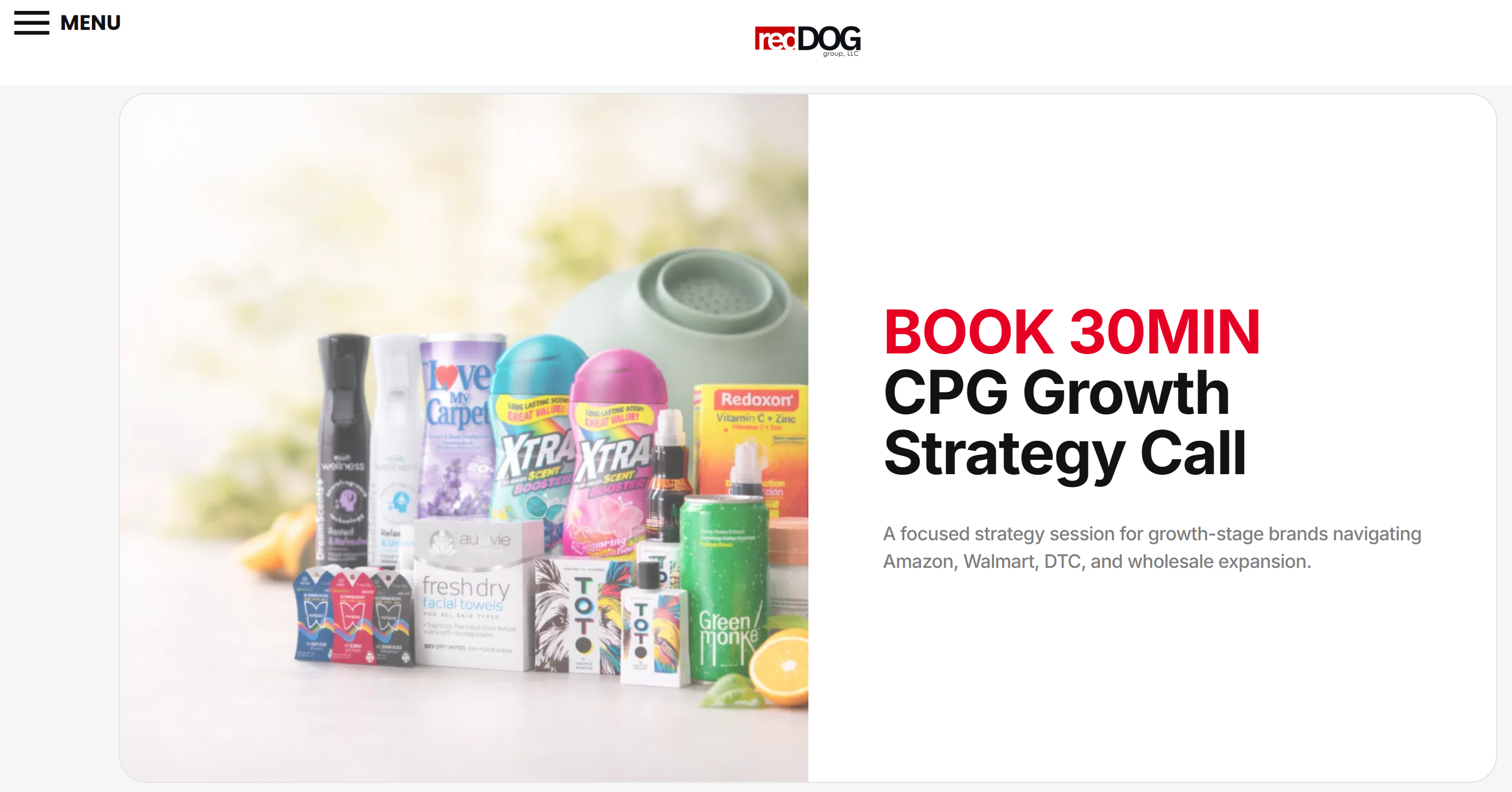
Book a free 30-minute strategy call with Reddog. We will review your channel economics, content-to-conversion gaps, and growth priorities without a sales pitch.
Content pillars are three to five core themes that organize all of your content. Common pillars include educate, entertain, inspire, engage, and promote. They reduce decision fatigue and keep your publishing consistent with your business goals.
Small businesses should target 12–16 posts per month. A 70% evergreen and 30% trending split keeps content relevant without requiring constant trend-chasing.
Instagram Reels generate 25% more reach than standard feed posts because the platform’s algorithm prioritizes short video in its discovery feed. Reels reach audiences who do not already follow your account.
Content repurposing is the fastest method. Turning one blog post into video clips, graphics, and social captions produces multiple assets from a single creation session. Marketers who repurpose consistently report 40% higher output.
Track engagement rate, not just reach. Also monitor whether your content appears in AI engine responses from tools like ChatGPT or Perplexity. AI citations signal that your content is specific and authoritative enough to be referenced as a source.
Leave a comment: