
Published: March 2020 | Last Updated:April 2026
© Copyright 2026, Reddog Consulting Group.

TL;DR:
- Consistent and accurate product data is crucial for fast, compliant retail launches and avoiding penalties.
- Master data management ensures omnichannel data uniformity, reducing errors, delays, and chargebacks.
- Prioritizing compliance early builds scalable growth, stronger retailer relationships, and higher margins.
A single mismatched product title or wrong UPC between your Amazon listing and Walmart item setup can delay a launch by weeks, trigger a compliance flag, or quietly suppress your search ranking. For emerging CPG brands in the $500K to $20M revenue range, these aren’t minor annoyances. They’re margin killers. Consistent product data across every retail channel is the foundation of a scalable, profitable product launch strategy. Most founders discover this too late, usually after a costly suppression or a retailer chargeback. This guide breaks down what channel compliance actually means, why it matters more than you think, and how to build it into your operations before it becomes an emergency.
| Point | Details |
|---|---|
| Accelerate product launches | Mastering channel compliance helps you launch products faster on Amazon and Walmart by ensuring data consistency. |
| Reduce regulatory risk | Consistent channel strategies lower the chance of errors and regulatory setbacks, especially with labeling requirements. |
| Boost omnichannel growth | A compliance-first workflow supports seamless sales across platforms and strengthens retailer partnerships. |
| Transform compliance into strategy | Viewing compliance as a strategic lever delivers tangible profit and brand value, not just operational wins. |
Channel compliance is the practice of maintaining accurate, consistent, and complete product data across every retail channel you sell through. That means your product titles, GTINs, ingredient lists, images, weights, dimensions, and regulatory labels all need to match precisely whether a buyer finds your product on Amazon, Walmart, or a regional distributor’s portal.
The discipline behind this is called master data management, or MDM. MDM is the system a brand uses to create a single, authoritative source of truth for all product information. Without it, product data gets fragmented fast. A team member updates the label artwork but forgets to push the change to Walmart’s item setup. Your 3PL has an old weight on file that causes a dimensional weight billing issue at the fulfillment center. These aren’t hypothetical problems.
Understanding retail compliance basics is the starting point for any operator who wants to launch at scale. Here’s why the stakes are so high for CPG brands specifically:
The concept of omnichannel commerce makes this even more complex. When the same product must live accurately across a DTC site, Amazon, Walmart, and a wholesale catalog simultaneously, the chance of a data discrepancy multiplies.
“Channel compliance ensures consistent product data for speedier launches and regulatory adherence across retail ecosystems.”
For CPG founders, channel compliance isn’t a back-office IT problem. It’s a revenue and risk issue that sits squarely in your operations and growth strategy.
Now that we know the definition, let’s explore the real-world advantages channel compliance offers for growth-stage CPG brands.
Faster SKU onboarding to retailer systems like Walmart and Amazon is one of the most immediate payoffs. When your product data is clean, complete, and formatted correctly from day one, item setup moves in days instead of weeks. That timeline difference directly affects your revenue ramp after a new product launch.
| Compliance area | With strong MDM | Without MDM |
|---|---|---|
| Retailer onboarding time | 3 to 7 days | 2 to 6 weeks |
| Compliance error rate | Low | High, repeated |
| Sales impact at launch | Immediate visibility | Delayed or suppressed |
| Regulatory risk | Managed | Unpredictable |
Beyond speed, the benefits stack up across your entire retail operation:
Using a solid product launch checklist during your pre-launch phase catches the gaps before they become problems. Pairing that with proven launch strategies helps you go to market faster and with fewer surprises.
Pro Tip: Before finalizing any new item setup, cross-check your label data against current FDA requirements for your product category. Supplement brands especially need to verify serving size formatting, nutrient content claims, and allergen disclosures. One wrong field can trigger a delisting.
Understanding benefits is only half the battle. Let’s address the recurring difficulties brands encounter when trying to get compliant and stay that way.
The biggest challenge is that Amazon and Walmart operate on fundamentally different data models. What qualifies as a compliant item setup on one platform may fail validation on the other. Operators who don’t account for this spend months troubleshooting instead of selling.

| Compliance factor | Amazon | Walmart |
|---|---|---|
| Primary data standard | Amazon catalog attributes | GS1 / Walmart item spec |
| Suppression trigger | Missing required attributes | Item quality score below threshold |
| Label compliance | ASIN-level detail | GS1 barcode and shelf-ready labeling |
| Chargeback system | Vendor Central compliance | Walmart Supplier Center scorecard |
Ensuring data consistency across channels for regulatory and omnichannel success is one of the most common hurdles we see emerging brands struggle with. The nuances between platforms catch even experienced operators off guard.
Here are the steps most brands should take to address compliance gaps when they find them:
Exploring omnichannel platform options can help you identify tools that automate compliance checks across channels. For brands already selling on Amazon, getting structured Amazon compliance support can close gaps faster than internal trial and error.
Pro Tip: Invest in an MDM platform or even a well-structured product information management (PIM) spreadsheet before you scale beyond 20 SKUs. Trying to manage compliance manually at 50 or 100 SKUs becomes a full-time job and still produces errors.
Equipped with insights on challenges, let’s focus on the concrete process for building channel compliance into your launch operations from the ground up.
Master data management is the operational backbone of both regulatory and omnichannel launch success. The brands that get this right build a repeatable process rather than reacting to problems after they surface.
Here’s a step-by-step compliance-first launch workflow:
Additional tools and resources that support a compliance-first workflow:
The brands that build this process early spend less time firefighting and more time growing. Compliance becomes a competitive advantage, not a bottleneck.
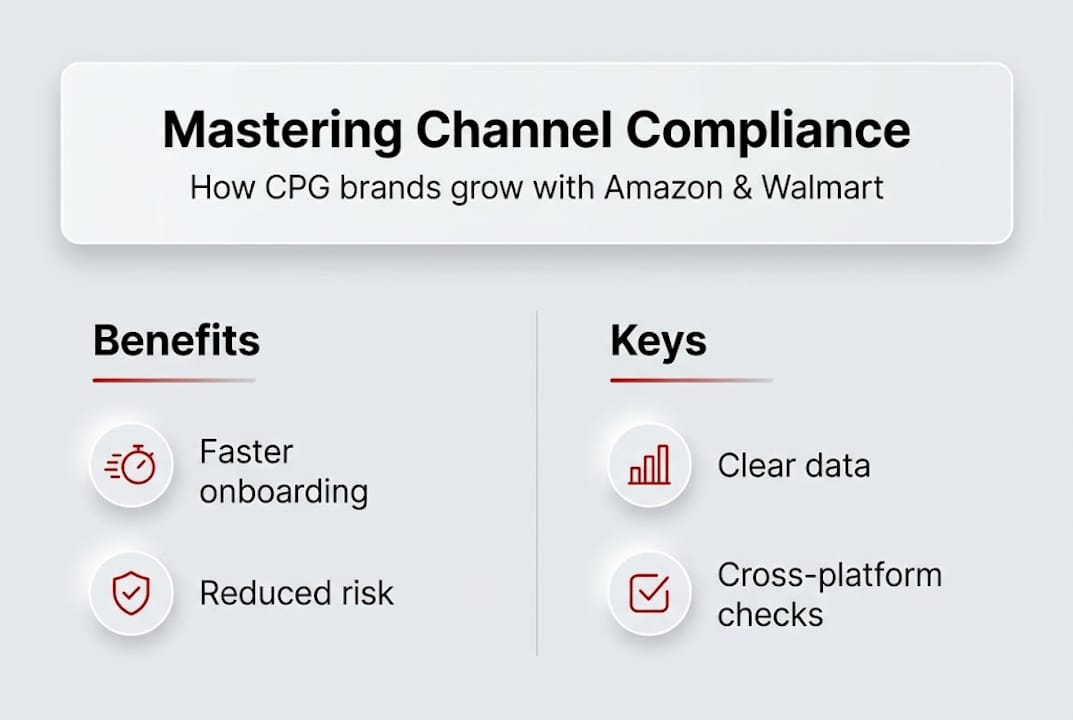
Having covered workflows, let’s reflect on how channel compliance shapes growth from a strategic angle.
Here’s the uncomfortable truth most founders don’t want to hear: channel compliance is a profit driver. Not a box-ticking exercise, not a back-office task you delegate to an intern after launch. When your data is clean, your launches move faster, your chargebacks drop, and your retailer relationships get stronger. That translates directly to margin.
We’ve worked with brands that had great products and terrible compliance practices. They were leaving real money on the table through suppressed listings, chargeback deductions, and delayed buyer reorders. Fixing the compliance infrastructure didn’t just clean up the data. It unlocked growth that the marketing spend alone never could have driven.
The brands that treat retail compliance strategy as a strategic priority from the beginning scale faster and with fewer operational fires. Investing in compliance early isn’t cautious. It’s smart growth.
Channel compliance done well creates a compounding advantage. Clean data means faster launches, fewer deductions, and stronger retailer partnerships. But getting there requires structure and experience, especially when you’re managing multiple marketplaces and a growing SKU catalog.
RedDog Group works with CPG brands in the $500K to $20M range to build the compliance infrastructure, data workflows, and launch frameworks that support profitable growth across Amazon, Walmart, and beyond. If your brand is ready to get serious about channel compliance and stop losing margin to avoidable errors, our CPG retail growth offer is a strong starting point. We help you build systems that scale, not just fix the immediate problem.
Consistent product data makes SKU onboarding faster and more reliable to platforms like Amazon and Walmart, cutting weeks off your time to market.
Brands risk regulatory violations, launch delays, and damaged retailer relationships when product data is inconsistent across channels.
MDM keeps product information uniform across Amazon, Walmart, and other channels, creating a seamless and trustworthy customer experience everywhere your brand appears.
No. Channel compliance also builds the scalable launch infrastructure, brand trust, and cross-channel data integrity that supports long-term profitable growth across every retail and DTC channel you operate in.
Leave a comment: