
Published: March 2020 | Last Updated:June 2026
© Copyright 2026, Reddog Consulting Group.

TL;DR:
- Buy box optimization is an ongoing process that enhances seller metrics, pricing, and fulfillment to secure Amazon’s Featured Offer position. It is vital because 82 to 90% of Amazon sales originate from the buy box, and losing it results in direct revenue loss. Sellers who treat buy box management as a repeatable operational system, focusing on account health, competitive pricing, and fulfillment, consistently outperform those who do not.
Buy box optimization is defined as the ongoing process of improving seller performance metrics, pricing strategy, and fulfillment operations to win and hold Amazon’s Featured Offer position. 82 to 90% of Amazon sales originate from the buy box, which means losing it to a competitor is not a minor inconvenience. It is a direct revenue cut. For CPG brands and third-party sellers, buy box optimization is not a one-time setup. It is a repeatable operational discipline built around three pillars: account health, competitive pricing, and fulfillment reliability. Sellers who treat it as a system, not a tactic, win more often and hold their position longer.
The buy box, formally called the Featured Offer, is the “Add to Cart” button on an Amazon product detail page. Only one seller wins it at a time, and that seller captures the overwhelming majority of conversions on that listing. Amazon rotates the buy box among eligible sellers based on a weighted algorithm, but the rotation is not random. It rewards sellers who consistently deliver on price, speed, and service quality.
Buy box importance extends beyond visibility. Sellers without the buy box are buried in the “Other Sellers” section, which most shoppers never click. For brands selling on Amazon, losing the buy box to an unauthorized reseller or a competitor with better fulfillment metrics means losing both revenue and brand control. The buy box as a sales driver is not an Amazon marketing claim. It is the structural reality of how the platform converts traffic into orders.
Winning involves a balanced tripartite strategy: operational excellence, fulfillment agility, and smart pricing that factors in total landed cost updated as frequently as every 15 minutes. Sellers who understand this stop chasing the lowest price and start building systems.
Before any pricing or fulfillment strategy matters, sellers must meet Amazon’s baseline eligibility criteria. Amazon does not publish a precise eligibility formula, but the performance thresholds are well established and non-negotiable.
The core requirements include:
Sellers must maintain these thresholds consistently, not just during audits. A single bad week of late shipments can suppress buy box eligibility for 30 to 60 days. Account age also plays a role. Newer accounts carry less algorithmic trust, which means newer sellers face a steeper climb even with clean metrics. Inventory status matters too. A listing flagged as out of stock loses buy box eligibility immediately and may take time to recover after restocking.
Pricing is one of the most misunderstood levers in buy box strategy. The algorithm does not simply reward the lowest price. It evaluates the landed price, which is the item price plus shipping cost. A seller offering $18.99 with $4 shipping loses to a seller at $21.99 with free Prime shipping because the landed price comparison favors the latter.
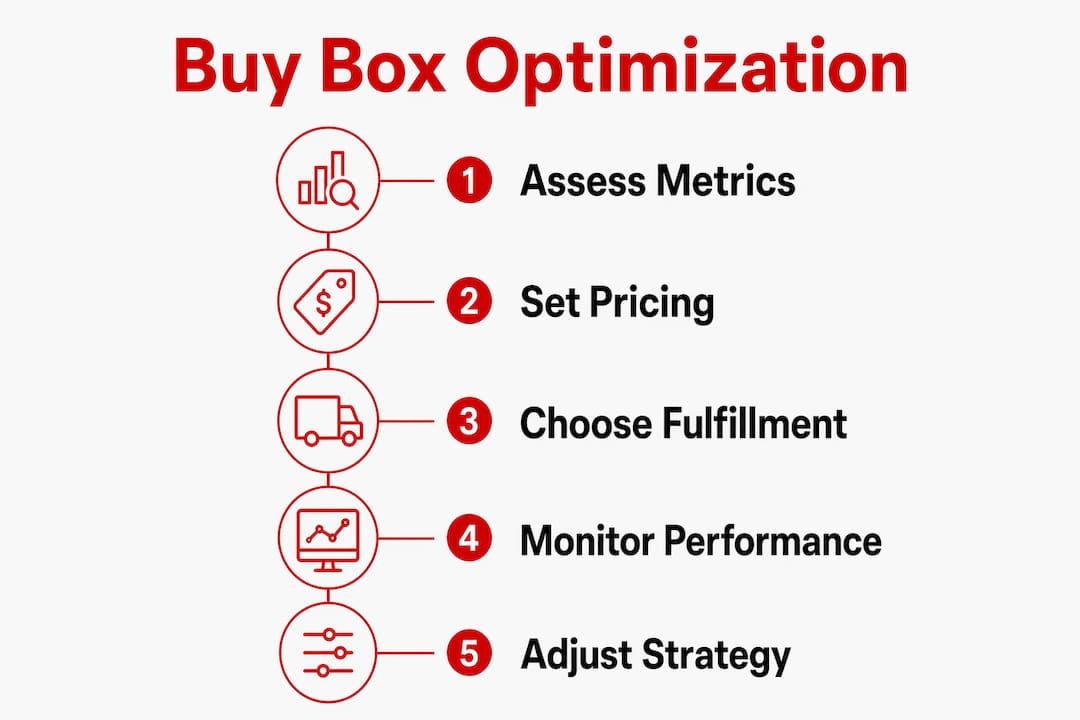
Delivery speed accounts for 25 to 30% of the buy box algorithm’s weighting, with price competitiveness representing roughly 25%. This means a seller with slightly higher prices but faster, more reliable delivery can outperform a cheaper competitor. Price alone does not win the buy box.
The most effective repricing approach follows these steps:
Pro Tip: Never activate a repricer without a hard price floor. Without one, automated tools will chase competitors down to unprofitable territory in hours, especially in categories with many third-party resellers.
The winning Amazon pricing strategies that sustain buy box ownership are built on margin discipline first, competitive positioning second.
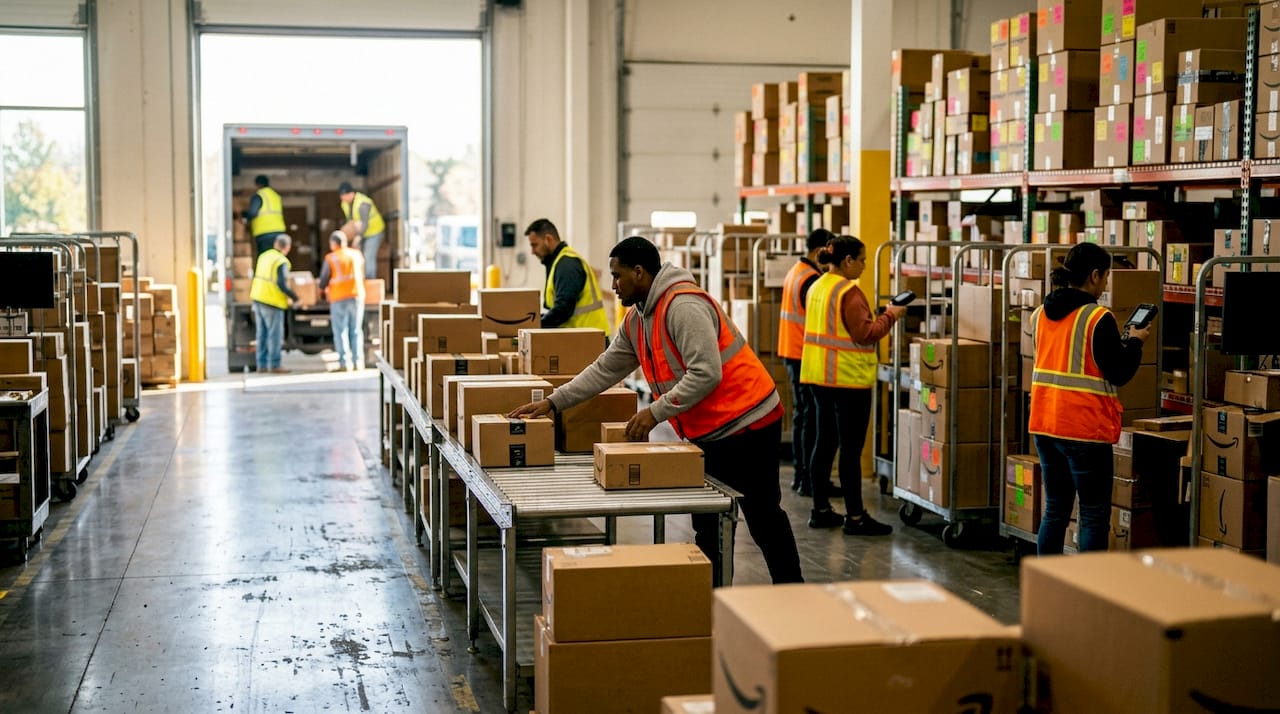
Fulfillment method is the single biggest structural advantage or disadvantage a seller carries into buy box competition. Amazon’s algorithm is built around delivery promise reliability, and FBA is the default benchmark.
| Fulfillment Method | Buy Box Advantage | Key Tradeoff |
|---|---|---|
| FBA (Fulfillment by Amazon) | Highest eligibility score; Prime badge automatic | FBA fees and storage costs compress margins |
| Seller Fulfilled Prime (SFP) | Matches FBA eligibility with 98%+ two-day delivery | Requires strict operational infrastructure |
| FBM (standard) | Lowest cost structure | Lowest buy box score; best used as backup |
| Hybrid FBA + FBM | Protects buy box during stockouts | Requires active inventory management across both |
FBA sellers hold structural advantages in buy box eligibility, but well-run SFP operations with 98% or better two-day delivery accuracy can compete directly. The catch is that SFP requires warehouse infrastructure, carrier contracts, and operational discipline that most emerging brands do not have in place.
Hybrid FBA and FBM setups solve a specific and common problem: FBA stockouts. When FBA inventory runs out, the listing loses buy box eligibility unless an active FBM offer exists on the same ASIN. Maintaining a live FBM listing as a safety net keeps the buy box alive during restock gaps, even if the FBM price is slightly higher to account for self-fulfillment costs.
Top performers maintain 60 to 90 days of inventory buffers with automated restock alerts to prevent buy box share decay during stock shortages. This is not just a logistics best practice. It is a direct buy box protection strategy.
Pro Tip: For large or heavy SKUs where FBA fees destroy margin, run FBM as the primary fulfillment method and price it to reflect the cost savings. The buy box score will be lower, but the contribution margin per unit will be significantly better than forcing every unit through FBA.
Winning the buy box once is easier than holding it. Sustained ownership requires treating buy box share as an operational KPI reviewed on a weekly cadence, not a vanity metric checked occasionally.
The most effective monitoring practices include:
Automated monitoring and dynamic repricing backed by data analytics allow sellers to react quickly to buy box shifts and maintain competitive advantage. The sellers who lose buy box share consistently are almost always the ones reacting to problems after the fact rather than catching them in real time.
The most damaging buy box mistakes are not technical errors. They are operational blind spots that compound over time.
Racing to the lowest price without a floor is the most common and most expensive mistake. Sellers activate a repricer, set no minimum, and watch their margins evaporate within days. The buy box win rate improves briefly, but the revenue per unit collapses. Winning a race to the bottom is still losing.
Ignoring ODR and account health metrics until they breach thresholds is the second major failure mode. By the time ODR hits 1%, the damage is already done. Sellers need to monitor these metrics weekly and investigate any upward trend before it becomes a suppression event. Neglecting fulfillment speed and tracking accuracy has the same effect. A few weeks of late shipments can suppress buy box eligibility for months.
Underutilizing hybrid fulfillment is a missed opportunity rather than an active mistake, but the cost is real. Brands that run FBA only and experience a stockout lose buy box share with no fallback. A live FBM listing costs almost nothing to maintain and functions as direct insurance against that scenario.
Pro Tip: Audit your listings for suppression status every Monday morning. Suppressed listings generate zero buy box impressions and zero sales. Catching a suppression on Monday instead of Friday saves five days of lost revenue.
Buy box optimization is a repeatable operational system, not a one-time configuration, and sellers who treat it as a weekly KPI consistently outperform those who treat it as a background setting.
| Point | Details |
|---|---|
| Buy box drives most sales | 82 to 90% of Amazon sales flow through the Featured Offer, making it the primary revenue lever. |
| Eligibility comes before strategy | ODR below 1%, Late Shipment Rate below 4%, and Cancellation Rate below 2.5% are non-negotiable baselines. |
| Price floors protect margin | Always set a contribution-margin-based floor before activating any repricing tool. |
| Hybrid fulfillment reduces risk | Running FBA and FBM together protects buy box eligibility during stockouts and on margin-sensitive SKUs. |
| Monitoring is the real work | Weekly account health reviews and ASIN-level buy box tracking separate sustained winners from occasional ones. |
Most sellers treat the buy box like a reward. They optimize once, check the win rate, and move on. What we see at Reddog, working with CPG brands across Amazon and other retail channels, is that the sellers who hold buy box share consistently are the ones who have built operational routines around it, not the ones who have the best repricing tool or the lowest price.
The insight that changes how most brands approach this: buy box eligibility is not a mystery. It is a repeatable operational discipline focused on clean account health and fulfillment consistency. The algorithm is not arbitrary. It rewards sellers who do the boring work well, every week, without exception.
What we push back on most often is the instinct to reprice aggressively when buy box share drops. Nine times out of ten, the root cause is a metrics problem, not a pricing problem. A late shipment spike, a return rate increase, or a listing suppression will suppress buy box share regardless of how competitive your price is. Fix the operational issue first. Then tune the repricer.
Hybrid fulfillment is also underused by brands in the $1M to $10M revenue range. Most of them are running FBA only because it is simpler. But for heavy SKUs, seasonal products, or any ASIN where FBA storage fees are compressing margin, a parallel FBM listing with a margin-adjusted price is worth the setup time. The operator’s playbook for CPG brands on buy box strategy covers this in detail, and the math usually surprises people.
The buy box is not a marketing problem. It is an operations problem. Treat it like one.
— Reddog
Reddog works with CPG brands in the $500K to $20M revenue range that need structured Amazon growth planning, not generic optimization checklists. Our Amazon growth consulting covers buy box strategy from the ground up: account health audits, repricing configuration, fulfillment structure analysis, and ASIN-level margin reviews.
We look at where buy box share is leaking, what metrics are creating eligibility risk, and whether your fulfillment setup is costing you margin it does not need to. If you are a CPG founder or operator who wants a clear picture of what your Amazon channel actually contributes to profit and where the buy box is holding you back, book a free 30-minute strategy call with the Reddog team. No pitch. Just a focused review of your numbers.
Buy box optimization is the process of improving seller performance metrics, pricing, and fulfillment to win Amazon’s Featured Offer position. Since 82 to 90% of Amazon sales flow through the buy box, holding it consistently is the primary driver of marketplace revenue.
Sellers need a Professional account and must maintain an Order Defect Rate below 1%, Late Shipment Rate below 4%, and Pre-fulfillment Cancellation Rate below 2.5%. Inventory availability and account age also factor into eligibility.
No. Amazon evaluates landed price, which includes shipping, alongside delivery speed, fulfillment method, and seller metrics. Delivery speed alone accounts for 25 to 30% of the algorithm’s weighting, so a faster seller at a higher price can outperform a cheaper one.
FBA provides the strongest structural advantage because it guarantees Prime eligibility and delivery consistency. Seller Fulfilled Prime can match FBA if two-day delivery accuracy stays above 98%. A hybrid FBA and FBM setup protects buy box eligibility during stockouts.
Weekly account health reviews and ASIN-level buy box percentage tracking are the minimum standard for sellers serious about sustaining buy box ownership. Listing suppression checks should happen at least once per week to catch eligibility issues before they compound.
Leave a comment: