
Published: March 2020 | Last Updated:April 2026
© Copyright 2026, Reddog Consulting Group.

TL;DR:
- A true CPG differentiator is a unique, defensible advantage that resonates with retailers and consumers.
- Differentiators rooted in proprietary data or supply chain advantages are more sustainable than brand stories or product quality alone.
- Activating your differentiator across channels with measurable proof and consistent messaging drives retail growth.
Most CPG founders hit a revenue ceiling somewhere between $500K and $2M and assume the fix is a better product or a lower price. It rarely is. The brands that break through to $10M and beyond almost always share one thing: a clear, defensible business differentiator that retail buyers recognize and consumers remember. Without it, you’re competing on margin you can’t afford to lose. This guide breaks down what a real business differentiator looks like in CPG, how to find yours using practical frameworks, and how to activate it across every channel you sell through.
| Point | Details |
|---|---|
| True differentiators drive growth | A genuine business differentiator is essential for profitable scaling in CPG retail and ecommerce. |
| Find what buyers value | Focus on advantages that retail buyers recognize and that meaningfully impact shelf placement or consumer loyalty. |
| Frameworks uncover your edge | Use structured analysis to pinpoint and validate your unique competitive advantage. |
| Activate across channels | Executing your differentiator in sales, marketing, and operations is key to omnichannel success. |
| Expert help accelerates impact | Outside guidance can help clarify, validate, and deploy your differentiator for faster growth. |
A business differentiator is a unique attribute, capability, or advantage that creates real value for customers and is genuinely difficult for competitors to replicate. That last part matters more than most founders realize. Being different isn’t the goal. Being relevantly different in a way that’s also defensible is the goal.
Here’s where a lot of CPG operators get stuck. They confuse novelty with differentiation. A new flavor, a bold label, or a founder’s personal story can all be interesting, but none of them are differentiators unless they translate into a reason a retailer will give you shelf space or a consumer will pay a premium. Many CPG brands remain undifferentiated and compete primarily on price, which is a race to the bottom that erodes contribution margin fast.
Let’s clear up three common myths:
A real differentiator works at two levels. It earns retailer trust because it reduces their risk and increases category velocity. And it earns consumer loyalty because it solves a specific problem better than anything else on the shelf.
“Differentiation that sticks in CPG is always tied to a defensible advantage, not just a compelling story. Retailers want proof, not promises.”
Think about what makes a retail buyer say yes. They’re not buying your brand. They’re buying a bet that your product will sell, return, and bring new shoppers into their store. Your differentiator needs to speak directly to that calculation. Brand positioning examples from successful CPG brands consistently show that the strongest differentiators are rooted in verifiable advantages, not marketing language.
Strategic brand positioning is key to CPG growth, and it starts with understanding which type of differentiator your brand can realistically own. Not all differentiators are created equal, and some are far more defensible than others.
Here are the six differentiator types most relevant to CPG brands at your stage:
| Differentiator type | CPG example | Difficulty to copy |
|---|---|---|
| Product innovation | Patented formulation or unique ingredient | High |
| Supply chain advantage | Exclusive sourcing or faster replenishment | High |
| Consumer insights | Deep loyalty data driving product decisions | Medium-High |
| Retail relationships | Preferred vendor status with regional chains | Medium |
| Unique brand story | Founder origin tied to product authenticity | Low-Medium |
| Channel dominance | First-mover advantage on Amazon or Walmart | Medium |
The table tells an important story. Brand story, while valuable, is the easiest to copy and the hardest to defend long-term. Supply chain advantages and proprietary data are far stickier. If you’re building for scale, you want your differentiator to sit in the top half of that difficulty column.
Here’s a quick self-assessment to identify where your differentiator likely lives:
Your answers will cluster around one or two of the differentiator types above. That cluster is your starting point.
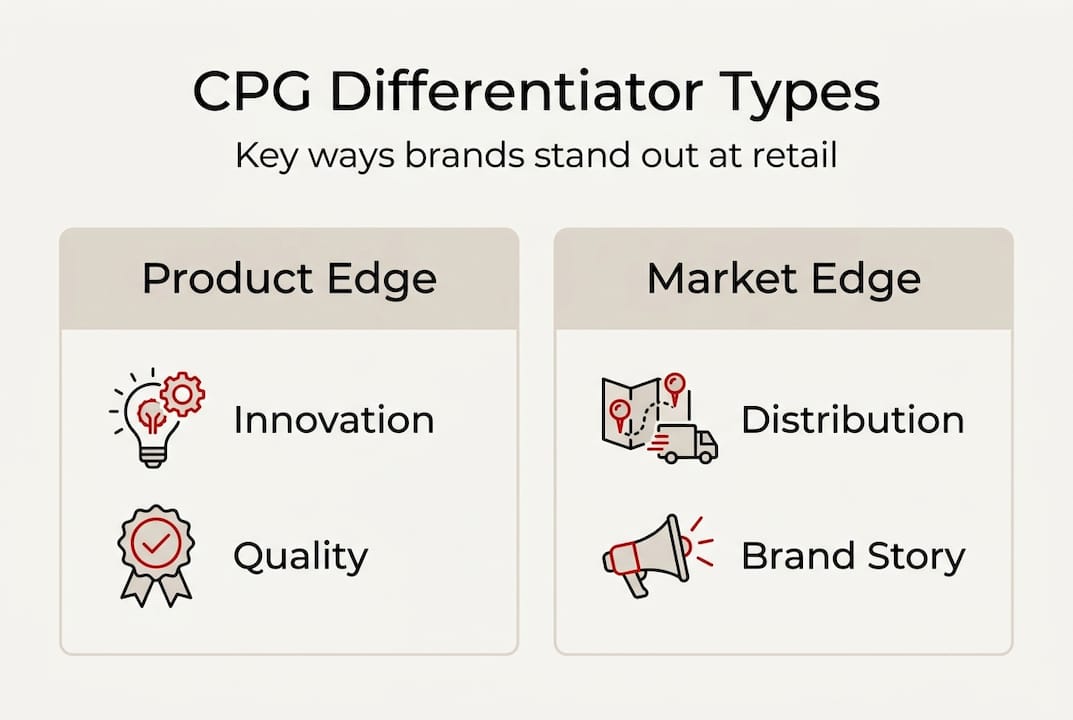
Pro Tip: Focus on differentiation that retailers recognize as valuable, not just what excites you as a founder. If your differentiator doesn’t reduce a buyer’s risk or increase their category performance, it won’t move the needle in a pitch meeting. Pair your differentiator with omnichannel platform strategies to ensure it lands consistently across every touchpoint. And always validate it against competitor strategy analysis before you commit to it as your primary positioning.
Frameworks leveraging both market and internal analysis help CPGs define their differentiator with precision instead of guesswork. The most practical starting point is what we call the intersection method.

Draw three overlapping circles. Label them: what your customers urgently need, what your business does exceptionally well, and what your competitors cannot easily replicate. Your differentiator lives at the center where all three overlap. If you can only find two overlapping circles, you have a strength, not a differentiator.
To fill in those circles accurately, ask these questions inside your business:
Once you have answers, take them outside the building. Talk to three to five retail buyers and ask them directly what they value most about working with you. Their language will be more useful than your internal assumptions. Run a simple retail competitor analysis to confirm that what you think is unique actually is unique in your category.
Pro Tip: Avoid over-indexing on founder passion when identifying your differentiator. Passion is a fuel source, not a market signal. Buyers don’t care how much you love your product. They care whether it moves. Let data and buyer feedback do the heavy lifting, and use your growth strategy workflows to document and test your differentiator hypothesis before you build your entire sales narrative around it.
Validation is the step most brands skip. Before you finalize your differentiator, test it in two or three retail pitches and measure the response. If buyers lean in when you describe it, you’re on the right track. If they nod politely and move on, you need to refine it.
Omnichannel growth requires brands to articulate and leverage their differentiator across retail and digital touchpoints consistently. Finding your differentiator is only half the work. Activating it is where the revenue actually moves.
Start by aligning your internal team around a single differentiator statement. It should be one sentence, specific, and tied to a measurable outcome. “We have the fastest replenishment cycle in our category, which means zero stockouts for our retail partners” is a differentiator statement. “We make high-quality products with great ingredients” is not.
Here’s how weak and strong differentiators compare in real retail presentations:
| Weak differentiator | Strong differentiator |
|---|---|
| “Our product is all-natural” | “We’re the only brand in this set with a 94% repeat purchase rate” |
| “We have great reviews” | “Our Amazon listing converts at 18% versus a 12% category average” |
| “Consumers love our brand” | “We drove a 22% velocity lift in our last regional chain placement” |
| “We’re a founder-led brand” | “Our supply chain delivers in 3 days versus the 10-day category norm” |
Now here’s how to execute your differentiator across specific channels:
Use omnichannel retail platforms to ensure your differentiator message is consistent across every channel. And pair it with local marketing strategies to reinforce it at the store level where purchase decisions actually happen.
“The brands that win at retail aren’t always the most innovative. They’re the ones that can explain their advantage in one sentence and back it up with numbers.”
Here’s the uncomfortable reality: most differentiation advice is written for brand marketers, not for CPG operators trying to get on a Walmart shelf or protect their Amazon margin. “Be different, be authentic, tell your story” sounds good in a branding workshop. It doesn’t hold up in a buyer meeting where you have eight minutes to justify why your product deserves a slot.
Generic differentiation advice often fails for CPG brands who must scale through retail partnerships and omnichannel execution. We’ve seen this pattern repeatedly: a founder builds a genuinely interesting brand, gets early traction at farmers markets or through DTC, then stalls when trying to scale into regional or national retail. The differentiator that worked at the direct-to-consumer level, usually a compelling personal story or a beautiful aesthetic, doesn’t translate into the language buyers speak.
Buyers speak in turns, velocity, margin, and replenishment. Your differentiator needs to be fluent in that language. The operators who scale fastest are the ones who build their differentiator from retailer feedback, not solo brainstorming sessions. They ask buyers what’s missing in the category, then position their brand as the answer with data to back it up.
Chasing trendy USPs is another trap. Functional ingredients, sustainability claims, and “clean label” positioning can all be differentiators, but only if they’re tied to a measurable consumer behavior and a retailer benefit. Otherwise, they’re just category noise. Check out real-world positioning strategies to see what actually moves the needle for brands at your stage.
Refining and deploying your business differentiator is faster and more precise with hands-on support from people who live inside CPG retail economics every day. Most founders spend months iterating on positioning that a structured outside perspective could clarify in weeks.
RedDog Group’s omnichannel growth consulting team specializes in connecting brand differentiation to real retail outcomes across Amazon, Walmart, DTC, and brick-and-mortar channels. We don’t just help you find your differentiator. We help you build the sales materials, channel strategy, and margin model to activate it at scale. If you’re ready to stop guessing and start growing with a clear competitive edge, explore our CPG growth offer and see how we work with brands at your stage.
It’s the unique value your brand offers that competitors can’t easily copy and that retailers and consumers actively value when making purchasing decisions.
If retailers reference your advantage as a reason to stock your product or it’s tied to measurable sell-through, your differentiator drives buyer trust and is likely strong enough to build on.
Yes, but one primary advantage usually drives market success at retail. Secondary advantages should support your main edge, not compete with it for attention in a buyer pitch.
Monitor market shifts regularly and update your advantage with new layers of proof or capability. Frameworks using market analysis help CPGs stay ahead by building defensibility into their positioning over time.
Leave a comment: