
Published: March 2020 | Last Updated:June 2026
© Copyright 2026, Reddog Consulting Group.

TL;DR:
- Effective Amazon SEO in 2026 emphasizes complete catalog attributes, optimized listing fields, and external traffic signals. Regularly audit your listings using AI tools and maintain operational discipline to adapt to ongoing algorithm changes and maximize rankings. A structured, customer-focused approach drives both visibility and conversion, ensuring sustainable growth.
Amazon SEO tips are actionable methods to improve your product listings’ search ranking and sales performance on Amazon’s marketplace. The rules changed significantly in 2026, with Amazon Seller Central introducing a 75-character title limit and AI-powered listing tools that reward attribute completeness over keyword density. If you’re still optimizing the way you did two years ago, your rankings are likely slipping. This guide covers the specific tactics, tools, and 2026 rule changes that matter most for eCommerce sellers and brand owners who need real results.
Amazon Seller Central is explicit: structured listing information drives visibility more than keyword tricks. That means your title, bullet points, Item Highlights, backend search terms, and catalog attributes all carry weight in how Amazon indexes and ranks your product.
Here is what each field requires in 2026:
Pro Tip: Treat catalog attributes like a product data sheet, not an afterthought. A CPG brand selling a protein bar should fill in every attribute Amazon offers: flavor, dietary claim, serving size, and allergen info. Each completed field is an additional indexing signal.
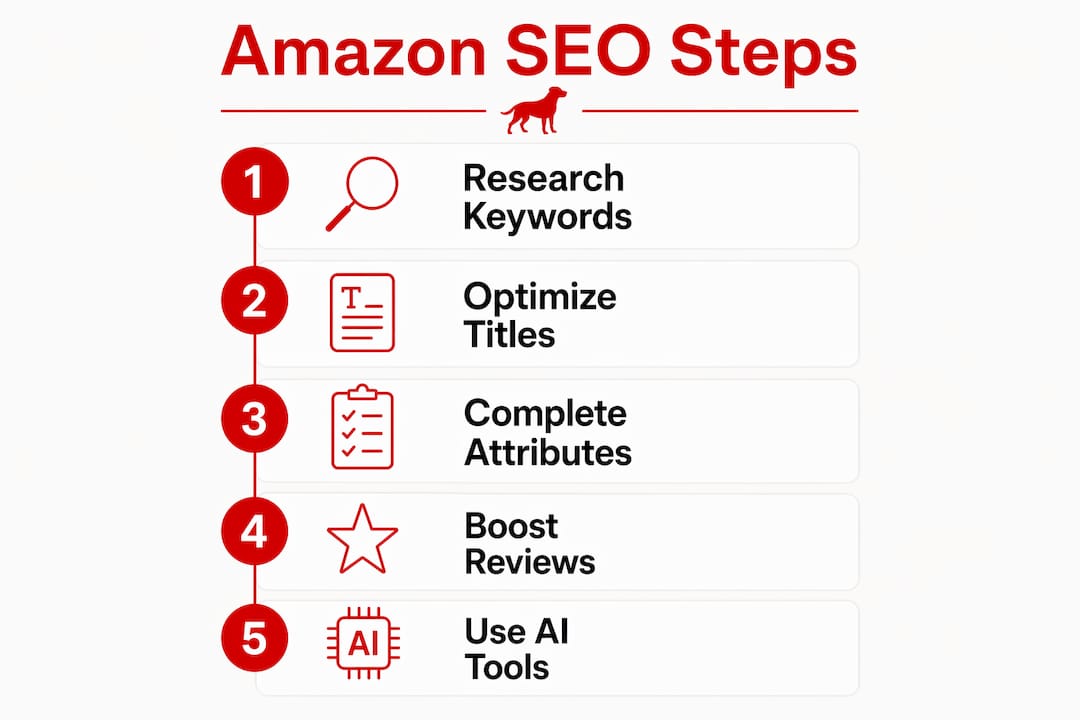
Keyword research for Amazon is not the same as Google keyword research. Amazon’s algorithm scores keywords based on conversion rate, not just search volume. A keyword with 50,000 monthly searches but a 0.5% conversion rate is worth less than a term with 8,000 searches and a 4% conversion rate.
Follow this workflow to build a keyword strategy that actually moves rank:
Pro Tip: Use Helium 10’s Cerebro on your top three competitors, then filter for keywords where your listing has zero impressions. Those are your fastest-win opportunities. Add them to backend search terms first, then test moving the strongest performers into your bullet points.

Amazon’s A10 algorithm in 2026 favors listings with high conversion rates, external traffic, and complete catalog attributes more than raw keyword density. That means non-text factors now carry more ranking weight than many sellers realize.
Here is how each factor contributes:
Reviews are not just social proof. They are an indexing signal. A verified purchase review that mentions “low-sugar chocolate protein bar” gives Amazon’s algorithm another data point to match your product to that search query.
Amazon’s AI-powered View Enhancements tool suggests listing improvements and surfaces attribute gaps that sellers often miss. It enables you to review, customize, and publish content updates directly from Seller Central, which improves listing accuracy and SEO without requiring a full listing rebuild.
The most effective way to use this tool is as a structured gap detector, not a content generator. AI tools should identify attribute gaps that prevent Amazon from fully understanding your product. When the tool flags a missing attribute, that is a ranking signal you are not sending.
Pro sellers combine AI recommendations with manual attribute updates for completeness. They use View Enhancements as a checklist rather than blindly accepting every suggestion. An AI might suggest a generic product description that technically fills the field but misses your brand voice or a key purchase driver. Review every suggestion critically before publishing.
Set a monthly calendar reminder to open View Enhancements for your top 10 SKUs. Check for new attribute fields Amazon has added to your category, review any flagged content issues, and compare AI suggestions against your current copy. This process takes about 30 minutes per SKU and consistently surfaces opportunities that manual review misses.
Pro Tip: When View Enhancements flags an attribute you have already filled, check whether your answer matches Amazon’s preferred format. A field that says “Blue” when Amazon expects “Navy Blue” can still register as incomplete in the algorithm’s taxonomy.
For a deeper look at how AI tools in eCommerce are reshaping listing optimization beyond Amazon, the landscape is expanding quickly across platforms.
Most listing problems fall into a small set of repeatable errors. Knowing them in advance saves you from discovering them through rank drops.
The fix for most of these mistakes is a structured Amazon SEO checklist run on a regular schedule. Prioritize title compliance first, then attribute completeness, then keyword mapping, then external traffic setup. That order reflects where the fastest ranking gains typically appear.
For a practical walkthrough of listing optimization steps and how to track performance improvements over time, Reddog has published a detailed guide covering the full process.
Amazon product ranking in 2026 is determined by attribute completeness, conversion signals, and external traffic quality, not keyword density alone.
| Point | Details |
|---|---|
| Title limit is now 75 characters | Restructure titles before July 27, 2026 to avoid AI truncation that hurts click-through rates. |
| Catalog attributes drive indexing | Complete every available attribute field; each one is an additional signal Amazon uses to match your product to searches. |
| Keyword research requires conversion data | Use Helium 10 Cerebro and Search Query Performance together to prioritize keywords by conversion rate, not just volume. |
| External traffic boosts organic rank | Connect off-Amazon campaigns to Amazon Attribution and enroll in the Brand Referral Bonus program. |
| AI tools work best as gap detectors | Use View Enhancements monthly to find missing attributes and content issues, then apply your own judgment before publishing. |
Most Amazon SEO content focuses on tactics. What it rarely addresses is the operational discipline required to make those tactics stick. At Reddog, we work with CPG brands in the $500K to $20M revenue range, and the pattern we see repeatedly is not that sellers lack knowledge. It is that they lack a system.
A brand might nail their title optimization in January, then let it sit untouched while Amazon adds new category attributes in March, changes indexing behavior in May, and auto-truncates their title in July. By Q3, the listing that looked strong at the start of the year is quietly underperforming, and the seller does not know why because they stopped checking.
The brands that consistently rank well treat their Amazon listings the way a good operator treats their P&L: with scheduled reviews, clear ownership, and a bias toward fixing problems before they show up in sales data. They use Helium 10, Seller Central reports, and View Enhancements not as one-time tools but as a recurring operating rhythm.
The other thing most guides miss is the margin dimension. Ranking higher drives more traffic, but if your conversion rate is low, you are paying for visibility without capturing the return. The best Amazon SEO strategy is ultimately a customer-focused process. When your listing answers the buyer’s question clearly, your conversion rate rises, your rank improves, and your cost per acquired customer drops. That is the outcome worth optimizing for.
For brands that want to build this kind of structured approach, Reddog’s ongoing optimization strategy guide is a practical starting point.
— Reddog
Ranking on Amazon in 2026 requires more than a one-time listing update. It requires a system: the right keyword data, complete catalog attributes, external traffic connected to Attribution, and a regular audit schedule that keeps pace with Amazon’s algorithm changes. Reddog helps CPG brands build exactly that, with a margin-first approach that ties listing performance to contribution economics, not just traffic metrics.
If you are a CPG founder or operator managing Amazon alongside Walmart, DTC, or wholesale channels, Reddog offers a free 30-minute strategy call focused on your channel economics, inventory velocity, and growth planning. No generic advice. Just a practical review of where your listings and margins stand today and what to prioritize next. Book your free strategy call and get a clear picture of where your Amazon performance is leaking margin.
Amazon requires product titles to be no longer than 75 characters including spaces, effective July 27, 2026. Titles that exceed this limit will be automatically adjusted by Amazon’s AI, which may remove your primary keyword or brand name.
Amazon’s A10 algorithm prioritizes listings with high conversion rates, complete catalog attributes, and external traffic quality over raw keyword density. Sellers who focus only on keyword placement without addressing these signals will see diminishing ranking returns.
The Brand Referral Bonus program rewards sellers with a percentage credit on sales generated from off-Amazon traffic sources tracked through Amazon Attribution. It provides both a ranking signal and a cost offset for external marketing spend.
Amazon SEO requires ongoing updates, not one-time optimization. A quarterly audit of titles, attributes, keywords, and AI-generated suggestions is the minimum cadence needed to stay competitive as Amazon’s algorithm and category taxonomy evolve.
View Enhancements is Amazon’s AI-powered tool that surfaces attribute gaps and suggests content improvements for your product detail pages. Use it as a structured checklist to identify missing fields and content issues, then apply your own product knowledge before accepting any suggestion.
Leave a comment: