
Published: March 2020 | Last Updated:August 2026
© Copyright 2026, Reddog Consulting Group.

Selling on Amazon gives new and growth-stage brands immediate access to the largest ready-to-buy audience in U.S. e-commerce, a fulfillment network that can cut per-unit shipping costs by up to 70%, and a structured incentive stack that can total more than $50,000 for eligible new sellers. The platform removes the infrastructure overhead of building traffic, checkout, and logistics from scratch. That said, the benefits only hold when you model margins before you launch.
Here are the five advantages that matter most:
Run every SKU through the Amazon Revenue Calculator before you commit inventory. The benefits are real, but so are the fees.
Amazon’s selling benefits are most durable when paired with a clean margin model, disciplined inventory management, and a clear understanding of which programs apply to your specific situation.
| Point | Details |
|---|---|
| FBA shipping cost advantage | Amazon cites FBA shipping at up to 70% less per unit than comparable premium U.S. carrier options. |
| New-seller incentive stack | Eligible new sellers can access over $50,000 in combined credits covering sales rebates, ad spend, and fulfillment fees. |
| Seller Central cash flow | Seller Central disburses every 14 days and preserves pricing control, making it the right structure for most brands under $20M. |
| Margin modeling is non-negotiable | Run the Revenue Calculator before launch; a contribution margin below 20% after fees and advertising is fragile under any competitive pressure. |
| Reddog’s role | Reddog helps CPG brands model channel economics, optimize FBA operations, and protect contribution margin before scaling Amazon spend. |
Amazon’s core advantage is distribution without infrastructure. A brand that would otherwise spend 12–18 months building organic traffic can list a product today and reach buyers who are already searching with purchase intent. That speed-to-market matters enormously for early-stage CPG founders who need revenue before they can fund the next production run.
Amazon’s checkout, payment processing, fraud protection, and returns handling come built in. For a small team, that removes entire operational functions. According to Network Solutions’ 2026 small-business guide, Amazon can accelerate time-to-market by eliminating traffic, logistics, and checkout infrastructure overhead — though success still requires validated product selection and margin modeling.
Three platform-level advantages drive the most value for new sellers:
For a deeper look at the benefits of selling on Amazon for early-stage brands, Reddog has covered the fundamentals in detail.
FBA outsources four functions at once: warehousing, pick-and-pack, carrier negotiation, and customer service on fulfilled orders. That combination is what makes it the default fulfillment choice for most new sellers, not just the shipping discount.
Amazon states that shipping with FBA costs up to 70% less per unit than comparable premium options from other major U.S. carriers. The savings come from Amazon’s carrier volume, not from any sacrifice in speed. FBA also automatically makes qualifying offers Prime-eligible, which raises conversion without any additional spend on your part.
Beyond cost, FBA handles Multi-Channel Fulfillment (MCF), letting you fulfill orders from your DTC site or other channels using the same FBA inventory. That flexibility matters when you’re running a hybrid channel strategy.
Here’s how the three main fulfillment paths compare:
Pro Tip: FBA storage fees escalate sharply for slow movers, especially after 365 days. If a SKU’s projected sell-through rate is under 4–6 turns per year, model FBM or a hybrid approach before defaulting to FBA. Reddog covers the full mechanics in this FBA explainer, including how inbound placement strategy affects your landed cost.
Amazon has two selling plans: the Individual plan at $0.99 per unit sold, and the Professional plan at $39.99 per month with no per-unit fee. Any seller moving more than 40 units per month should be on the Professional plan. That math is straightforward.
The fee structure beyond the plan is layered:
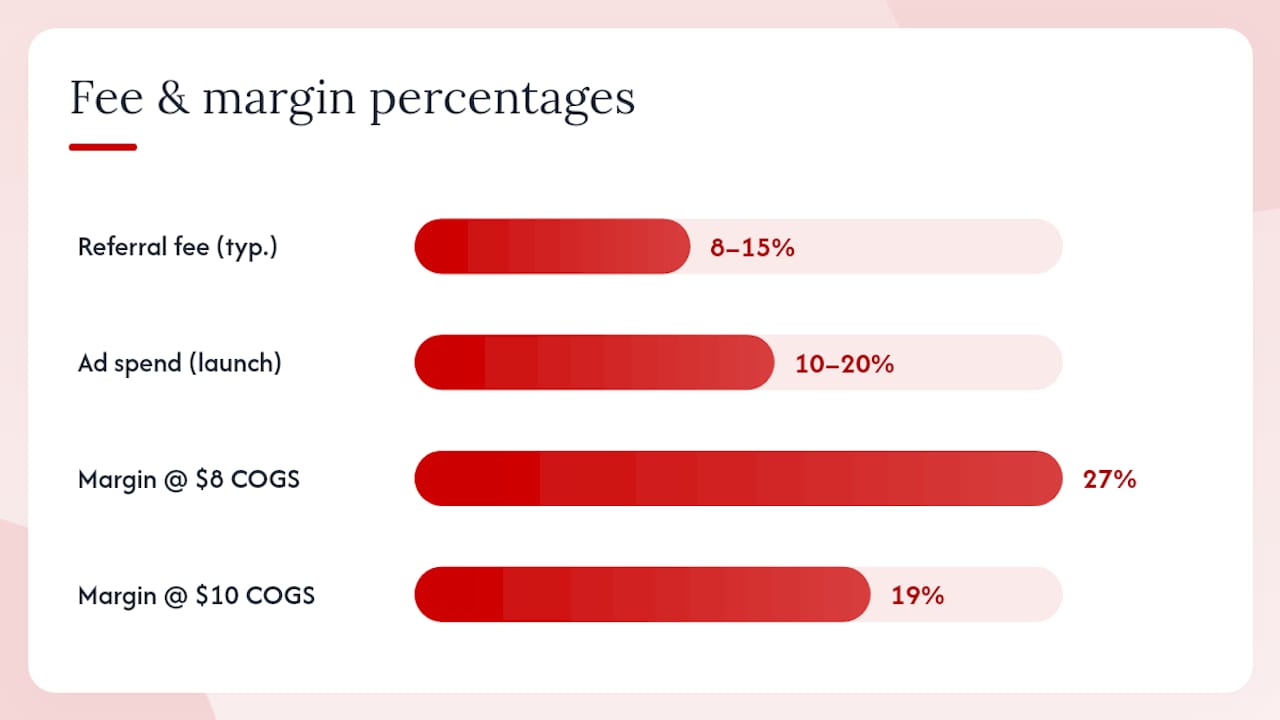
The Amazon Revenue Calculator is the right tool to model this before you list. A quick example: a $25 product with a 15% referral fee ($3.75), a $4.00 FBA fulfillment fee, and $2.50 in advertising leaves roughly $14.75 before your COGS. If your landed cost is $8.00, your contribution margin is approximately $6.75 per unit, or 27%. That’s workable. At $10.00 COGS, it’s $4.75, or 19%, which may not survive a promotional period.
Automate Pricing is Amazon’s built-in repricing tool. It adjusts your price within rules you set to stay competitive for the Buy Box without manual intervention. Use it carefully: aggressive repricing can erode margins faster than competition does.
Amazon’s native tool set is one of the most underappreciated advantages of selling on the platform. According to Amazon’s own data, small-business advertisers attributed roughly 30% of their sales to advertising, which means paid visibility is not optional for most new sellers.
Here are the primary tools and when to use each:
For a practical walkthrough of Amazon listing optimization that ties these tools to measurable conversion outcomes, Reddog’s guide covers the sequencing in detail.
Pro Tip: Test Sponsored Products first with a modest daily budget ($15–$25) and let it run for 14 days before drawing conclusions. Your early ACOS data tells you more about product-market fit than any pre-launch research can.
Understanding Amazon’s search ranking fundamentals is equally important — keyword placement in titles, bullets, and backend fields directly affects organic discoverability before you spend a dollar on ads.
Amazon’s incentive programs are one of the most concrete advantages of selling on Amazon for new entrants, yet many sellers leave credits on the table by missing enrollment windows or misunderstanding stacking rules.
Amazon advertises over $50,000 in combined new-seller incentives covering sales rebates, advertising credits, and fulfillment-related credits for eligible new sellers. The structure breaks down roughly as follows:
The FBA New Selection program adds free monthly storage and waived return processing fees for new-to-FBA ASINs, plus tiered referral-fee credits: 10% back on the first 100 units sold, then 5% on the next 100.
The 2026 New Selection Program update introduced a July 30, 2026 enrollment window with updated fee-credit caps and specific stacking rules. Notably, New Selection credits and New Seller Incentive credits can stack on qualifying ASINs, but only when enrollment timing aligns correctly.
Eligibility checklist before you enroll:
The biggest gap between sellers who scale profitably and those who don’t is operational discipline, not product quality. Platform benefits only convert to margin when you manage the mechanics underneath them.

Seller Central (3P) disburses funds every 14 days by default and preserves pricing and listing control. Vendor Central (1P) operates on Net 60–90 payment terms and shifts control of pricing, content, and purchase orders to Amazon. For most brands under $20M in annual Amazon revenue, Seller Central is the right structure in 2026. Vendor Central also introduces chargebacks, mandatory co-op fees, and freight allowances that erode margins in ways that are difficult to forecast.
Operational levers that directly affect contribution margin include:
Pro Tip: Before committing a large inventory buy to FBA, run a low-risk test with 50–100 units. Measure sell-through velocity, ACOS on Sponsored Products, and return rate over 30 days. That data is worth more than any pre-launch projection.
A practical example: a CPG brand running a 12-oz consumable at $18.99 initially chose FBA standard size. After modeling inbound placement fees, Q4 storage surcharges, and a 3.2-turn annual velocity, the contribution margin dropped below 15%. Shifting to FBM for that SKU and reserving FBA for a higher-velocity variant recovered 6 margin points.
The advantages of selling on Amazon are well-documented. The costs beyond fees are less often discussed clearly.
Expect these trade-offs as a new seller:
Mitigation for each: enroll in Brand Registry early, maintain a second sales channel, keep Order Defect Rate below 1%, monitor IPI weekly, and model Q4 storage costs before sending inventory in September.
The honest answer depends on three numbers: your margin floor, your SKU’s size/weight economics, and your cash-flow runway.
Run this quick diagnostic before you launch:
If all three pass, Amazon is likely the right first marketplace. If margin is tight, consider whether a price increase is feasible or whether FBM reduces fees enough to make the channel viable. If demand is unproven, test with a small FBA shipment before committing to a full production run.
For brands running a hybrid strategy, FBA’s MCF capability lets you fulfill DTC orders from the same inventory pool, which improves capital efficiency without requiring a separate 3PL relationship.
Getting from idea to live listing takes less time than most new sellers expect. Here’s the sequence that minimizes wasted spend and avoids early account health issues.
Set up your Seller Central account and choose your plan. Select the Professional plan ($39.99/month) if you expect more than 40 units per month. Individual plan otherwise. Have your business entity, bank account, and tax ID ready. Time: 1–2 hours.
Validate product demand. Search your category on Amazon. Check sales rank, review velocity, and pricing range for the top 10 results. Use Amazon’s own search suggestions and the Brand Analytics tool (available on Professional plans) to confirm keyword volume. Time: 2–4 hours.
Model margins with the Revenue Calculator. Input your product dimensions, weight, sale price, and COGS. Run both FBA and FBM scenarios. Confirm your contribution margin holds above 20% before proceeding. Time: 1 hour.
Create your listing. Write a keyword-rich title (under 200 characters), five benefit-focused bullet points, and a detailed product description. Upload high-resolution images (main image on white background, minimum 1,000px on the longest side). A+ Content comes after Brand Registry enrollment. Time: 3–6 hours. Reddog’s listing optimization guide covers the specifics.
Make your initial fulfillment decision. Send a test shipment of 50–100 units to FBA, or set up FBM shipping templates if your SKU economics favor merchant fulfillment. Follow Amazon’s inbound placement guidelines to minimize placement fees.
Enroll in Brand Registry if you have a registered trademark. This unlocks A+ Content, Sponsored Brands, Amazon Vine, and Brand Analytics. If your trademark is pending, apply now — the process takes 3–6 months. Time to enroll once trademark is registered: 1–2 days.
Launch with Sponsored Products and a coupon. Set a daily budget of $15–$25 on Sponsored Products targeting your top 5–10 keywords. Add a 10–15% launch coupon to improve click-through rate in search results. Run for 14 days, then review ACOS and conversion rate before scaling spend.
We work with CPG founders who are often surprised to discover that their Amazon channel is generating top-line revenue but compressing contribution margin to the point where growth costs them money. The platform’s benefits are genuine: the reach, the fulfillment infrastructure, the incentive programs. But none of them protect you from a fee structure you haven’t modeled, an inbound placement strategy you haven’t optimized, or an inventory velocity assumption that doesn’t hold in practice. Our focus at Reddog is operational clarity first. Before you scale spend or expand SKUs, you need a clean margin model at the unit level. If you’re preparing for a strategy conversation, bring your current SKU economics, your projected monthly volume, and your inbound lead times. That’s where the real work starts.
Reddog works with CPG brands in the $500K–$20M revenue range that need more than a checklist. If your Amazon channel is growing but margins are compressing, or you’re trying to decide whether FBA, FBM, or a hybrid approach fits your SKU economics, a focused 30-minute strategy call can clarify the path forward.
The call is structured as a practical review, not a sales pitch. We look at contribution margin by channel, inventory velocity, inbound placement costs, and cash-flow timing against your disbursement cycle. To make the session productive, come prepared with:
Book your free 30-minute strategy call and we’ll help you identify where margin is leaking and what to fix first.
These are the primary resources for enrollment, program terms, and calculators referenced throughout this article.
Leave a comment: