
Published: March 2020 | Last Updated:February 2026
© Copyright 2026, Reddog Consulting Group.

Every Consumer Packaged Goods founder wants to know which AI tools actually drive profit—and which are just hype. In a world of thinning margins and growing channel complexity, understanding where artificial intelligence fits can make or break your Amazon, Walmart, or direct-to-consumer strategy. This guide breaks down AI’s automated decision-making power, showing how it reduces errors, ramps up speed, and attacks margin leaks where it matters for your brand.
| Point | Details |
|---|---|
| AI Automation | AI improves operational efficiency by automating decision-making processes, leading to faster insights and reduced costs. |
| Targeted AI Solutions | Focus on implementing AI tools that directly address specific margin leaks, such as demand forecasting or dynamic pricing. |
| Channel-Specific Applications | Utilize tailored AI solutions for different retail channels—each has unique margin drivers and economic constraints. |
| Data Quality is Crucial | Ensure high-quality data integration is prioritized, as poor data leads to inaccurate AI predictions and ineffective implementations. |
AI in ecommerce isn’t a single tool—it’s a collection of capabilities solving real profit problems. For CPG brands, understanding what AI actually does (versus the hype) is critical to knowing where it creates margin and where it doesn’t.
At its core, AI automates decision-making processes that would otherwise require constant human intervention. Instead of manually adjusting inventory levels or rewriting product descriptions, algorithms handle the repetitive work. The result: faster decisions, fewer errors, and lower operational costs.
Here’s what AI does in ecommerce contexts most relevant to CPG brands:
The reason CPG founders should care: AI’s role in ecommerce extends beyond customer-facing features. It reshapes how you manage inventory velocity, forecast cash flow, and allocate budget across channels.
But there’s a critical distinction. Not all “AI” delivers the same financial impact. A chatbot that answers “What’s your return policy?” saves support labor. A demand forecasting model that predicts Walmart’s weekly order patterns can prevent a $50K margin hit from overproduction.
Likewise, personalization technologies like machine learning drive higher conversion rates, but only if your data is clean and your product assortment supports recommendations. Garbage in, garbage out applies here.
For your business specifically, AI functions in three zones:
The best CPG brands don’t deploy AI everywhere. They target it at the decisions that move contribution margin.
AI in ecommerce solves specific operational or revenue problems—not everything needs it, and not all implementations are equal.
Pro tip: Before evaluating any AI solution, ask: “What specific margin leak does this solve?” If the answer is vague, skip it. If it ties directly to inventory velocity, pricing power, or fulfillment cost, it’s worth exploring.
Not all AI solutions are created equal—and not all solve the same profit problems. For CPG founders operating on thin margins, knowing which AI applications actually move the needle is critical.
The AI solutions that matter most for CPG brands cluster into distinct categories, each addressing a different financial pain point. The best part: most don’t require building custom models from scratch.
Demand forecasting systems predict what customers will buy before inventory arrives, solving the overstock-versus-stockout problem that kills margins. These tools analyze historical sales, seasonality, promotions, and external signals to forecast demand weeks or months ahead.
For CPG brands, this matters because:
Amazon, Walmart, and DTC channels all benefit. You get more accurate replenishment, lower 3PL storage costs, and less dead inventory.
Here’s how core AI functions create value for CPG brands:
| AI Function | Main Benefit | Typical Business Impact |
|---|---|---|
| Demand Forecasting | Improved inventory accuracy | 15-30% lower overstock/stockout |
| Trade Promotion Optimization | Smarter promo budget use | 10-20% less unprofitable spend |
| Dynamic Pricing | Automated margin protection | 3-8% higher channel margin |
| Personalization | Higher order values | 15-30% increase in AOV |
| Fulfillment Automation | Lower labor cost | 8-15% lower fulfillment expense |
Trade promotions—discounts, bundles, and seasonal deals—are a major CPG expense. The problem: most brands guess at which promotions work and which waste budget. CPG leaders now use AI to optimize trade spend, testing promotions systematically and allocating budget where ROI is highest.
This directly impacts contribution margin:
Your Amazon price shouldn’t match your Walmart price, and neither should match your DTC price. Dynamic pricing AI adjusts your prices in real time based on competitor pricing, demand, inventory levels, and channel-specific economics.
Why this matters:
This is especially powerful for CPG brands managing Amazon FBA fees, Walmart WFS margin compression, and DTC fulfillment costs simultaneously.

AI-powered personalization recommends the right products to the right customer, increasing average order value and repeat purchase rates. The system learns from browsing behavior, purchase history, and similar customer segments.
For ecommerce CPG, this means:
AI optimizes warehouse operations—pick-and-pack sequences, routing, labor allocation—reducing fulfillment costs and speeding delivery. This is less glamorous than customer-facing AI, but the margin impact is real.
You save on labor, reduce fulfillment errors, and accelerate turnover. For brands managing 3PL relationships, this translates to lower per-unit fulfillment costs and faster cash conversion.
The best AI solutions for CPG aren’t the most advanced—they’re the ones solving your specific margin leak, whether that’s inventory carrying costs, promotion waste, or fulfillment labor.
Pro tip: Map your three biggest profit drains (overstock, promotional waste, fulfillment cost, or pricing errors), then prioritize AI solutions that solve those specific problems first. The tools that address your biggest leak will deliver the fastest ROI.
AI doesn’t work the same way across Amazon, Walmart, and your direct-to-consumer site. Each channel has different economics, customer expectations, and operational constraints. Smart CPG brands apply AI strategically to each.
The channels where you sell demand different AI solutions because the margin drivers are different. What maximizes Walmart WFS profitability won’t necessarily optimize Amazon FBA, and both differ from DTC strategy.
Amazon’s algorithm rewards relevance, velocity, and customer satisfaction. AI here focuses on those three things.
Key applications:
For Amazon, the AI focus is tactical and responsive. You’re protecting Buy Box position while managing FBA fees that compress margin.
Walmart demands forecast accuracy. Late shipments violate contracts; overstock wastes your margin through markdowns or return freight.
AI applications in retail supply chain optimization directly address Walmart’s requirements. These systems predict Walmart’s weekly orders, optimize your shipment schedules, and reduce excess inventory.
Walmart-specific AI focuses on:
Walmart AI is about supply chain precision and margin defense.
On DTC, AI focuses on customer acquisition efficiency and repeat purchase rates. You own the customer relationship, so the game is different.
Recommendation systems and customer behavior prediction drive AOV and repeat purchase rates. These applications are what most people think of as “AI”—product recommendations, personalized email, dynamic homepage content.
DTC AI applications:
On DTC, AI directly impacts customer lifetime value and reduces reliance on paid acquisition.
If you’re selling through distributors or regional wholesalers, AI helps you forecast their orders, manage inventory across multiple distribution points, and ensure compliance with order minimums and shelf-space requirements.
Key focus: predicting distributor reorders and optimizing your inventory position across multiple sale points.
Compare how AI focus shifts across major ecommerce channels:
| Channel | Key AI Priority | Margin Driver |
|---|---|---|
| Amazon | Search rank & Buy Box | FBA fee reduction, reviews |
| Walmart | Accurate demand prediction | Supply chain compliance |
| DTC | Personalization & retention | Customer lifetime value |
| Wholesale | Reorder forecasting | Inventory turnover, accuracy |
AI works best when applied to the specific economic constraints of each channel—what solves Amazon profitability won’t solve Walmart margin, and neither will work on DTC.
Pro tip: Audit each channel separately: What’s your biggest profit leak on Amazon? On Walmart? On DTC? Deploy AI to fix that specific problem first, rather than applying a generic solution across all channels.
Talk is cheap. The real question: what does AI actually add to your bottom line? For CPG brands operating on 10-25% contribution margins, the answer has to be measurable.
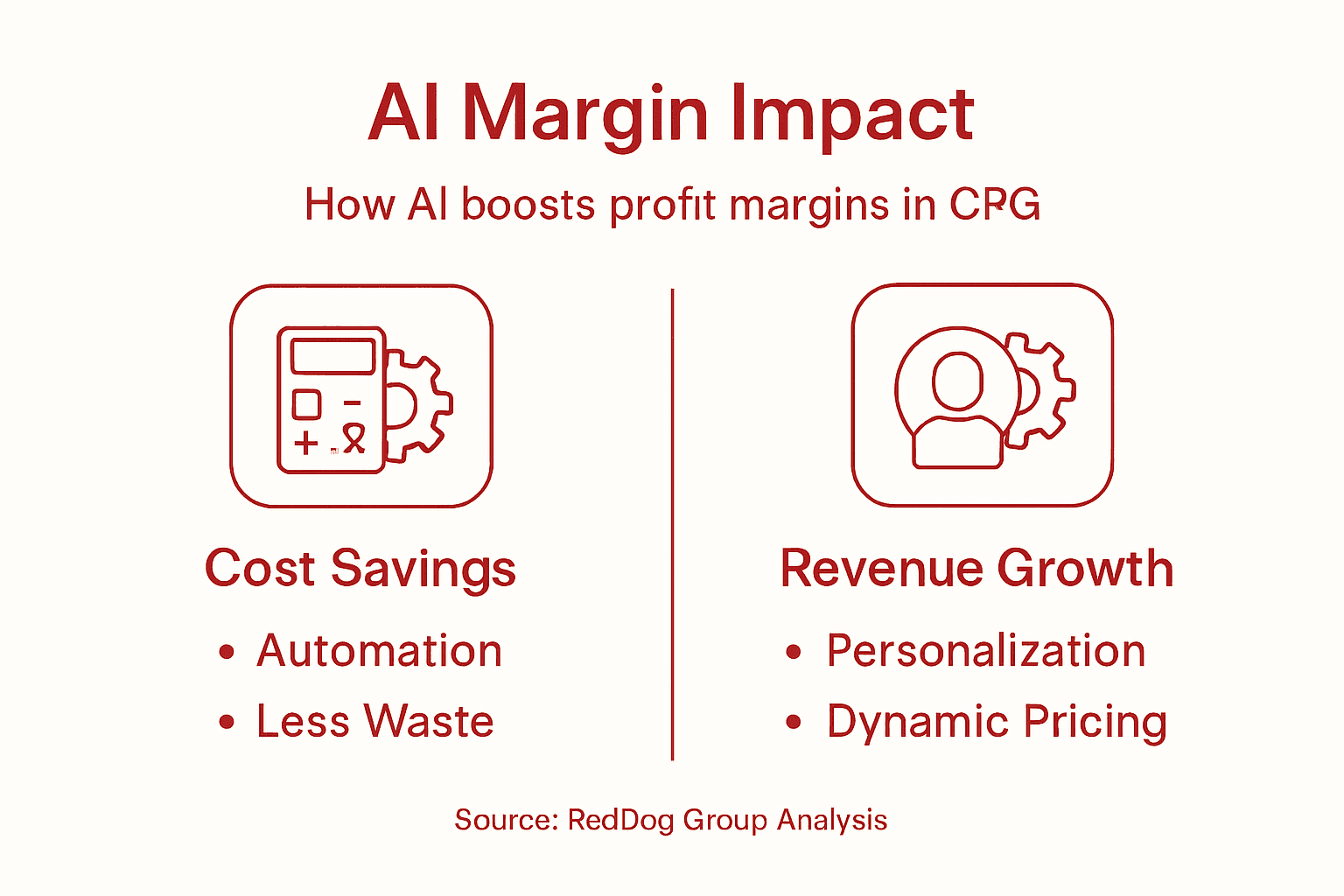
AI delivers margin impact through two mechanisms: cost reduction and revenue optimization. The best implementations do both simultaneously.
Automation cuts costs by eliminating manual work and reducing error rates. Here’s where CPG brands see real savings:
These aren’t theoretical. A CPG brand managing $2M in annual Amazon sales can save $30K-$50K annually just from better inventory forecasting and FBA fee reduction.
AI increases revenue without increasing ad spend. AI-driven price optimization and inventory management directly improve margins by capturing more value when demand is high and protecting market share when competitors undercut you.
Revenue-side impacts include:
A $5M DTC brand optimizing personalization and dynamic pricing can add $200K-$400K in annual contribution margin.
Generative AI adoption by ecommerce firms correlates with margin expansion because effective AI addresses both sides of the profit equation simultaneously. You’re lowering fulfillment costs while increasing AOV. You’re reducing inventory waste while optimizing prices.
The math compounds:
For CPG brands, this means margin expansion of 2-5 percentage points on contribution margin, depending on starting position and implementation quality.
AI doesn’t guarantee margin improvement—poor implementation wastes money. The brands winning apply AI to their biggest profit leaks first.
Pro tip: Before buying any AI solution, calculate the baseline: What’s your current fulfillment cost per unit? Your markdown rate? Your average promotional discount depth? These are your targets. Any AI tool you evaluate should promise measurable improvement to at least one of these metrics within 90 days.
AI isn’t risk-free. The brands that succeed aren’t the ones ignoring these challenges—they’re the ones managing them deliberately. For CPG founders, understanding what can go wrong is as important as understanding what can go right.
The real obstacles aren’t always technical. They’re organizational, financial, and ethical.
AI is only as good as the data feeding it. Garbage in, garbage out applies universally. Most CPG brands struggle here because their data lives in silos: sales data in one system, inventory in another, customer behavior scattered across multiple platforms.
Common data problems:
Fixing this requires upfront investment in data infrastructure, not just the AI tool itself.
Implementing AI requires more than buying software. You need people who understand both your business and the tool, plus budget for integration and ongoing maintenance.
Real obstacles include:
Addressing key integration challenges and ethical considerations requires treating AI implementation as an organizational change project, not just a software purchase.
Algorithmic bias, data privacy, and transparency matter—especially for CPG brands selling consumer products. If your pricing AI discriminates by geography or customer segment, or if customer data leaks, the reputational damage costs far more than margin gains.
Specific risks:
Start small. Pick one specific, measurable problem—not three. Begin with demand forecasting or dynamic pricing on a single SKU before rolling out to your full catalog.
Implementation sequence:
AI implementation fails when brands expect it to solve problems that require operational changes—inventory management discipline, pricing strategy clarity, or data infrastructure investment.
Pro tip: Start with a 90-day pilot focused on one metric: fulfillment cost reduction, markdown rate, or inventory velocity. If you can’t show measurable improvement in 90 days, the AI isn’t the right fit or your data needs work. Use that signal to decide before scaling.
The article highlights common challenges like inventory overstock, margin compression from Amazon FBA and Walmart WFS fees, inefficient pricing strategies, and fulfillment costs that silently drain your contribution margin. If you recognize these pain points—demand forecasting inaccuracies, promotional waste, and channel-specific margin leaks—know that you are not alone. The key lies in applying AI to target these exact profit drains with precision and operational clarity.
At RedDog Group, we specialize in guiding emerging and growth-stage CPG brands through this complex landscape. Our CPG retail growth offer focuses on margin-first strategies tailored to each channel’s economic realities, from Amazon to Walmart to direct-to-consumer. We help you harness AI-driven solutions for smarter inventory velocity, dynamic pricing, and fulfillment automation that deliver measurable margin improvements—not just top-line gains.
Ready to stop leaking profits and start scaling with confidence? Discover how our analytical, profit-focused consultancy can transform your ecommerce operations into a lean, margin-expanding engine. Visit RedDog Group to learn more and take the first step toward operational excellence and profitable growth today.
AI in ecommerce enhances operational efficiency, optimizes revenue, and increases decision speed, leading to reduced costs, higher average order value, and improved inventory management.
AI analyzes historical sales data, seasonality, promotions, and external signals to predict customer demand accurately, minimizing overstock and stockouts, which are critical for maintaining profit margins.
AI automates real-time pricing adjustments based on competitor prices, demand fluctuations, and inventory levels, enabling brands to capture more margin when demand is high and maintain competitive pricing.
AI uses browsing history, purchase patterns, and customer segmentation to recommend products tailored to individual customers, which can increase average order value and improve customer retention without additional marketing spend.
Leave a comment: