
Published: March 2020 | Last Updated:November 2025
© Copyright 2026, Reddog Consulting Group.

The success of your Amazon FBA shipment is decided long before a single box leaves your supplier's factory. This process isn't just about sourcing products; it's about engineering a supply chain that is repeatable, profitable, and ready for omnichannel growth. This is the Foundation phase, where proactive planning prevents costly reactive headaches later.
For brands aiming to scale, the devil is in the details, and those details directly impact your bottom line. Success boils down to two core elements: crystal-clear communication with your partners and absolute data accuracy.
Nothing destroys your profit margins faster than misaligned timelines. If production runs late, you might be forced into paying for expensive air freight just to avoid a stockout on Amazon—a costly, preventable error.
Always work backward from the date you need inventory live in an FBA warehouse. Factor in realistic transit times (sea freight can take 25-40 days), potential customs holds, and Amazon's own check-in delays. Share this entire schedule with your supplier to create a shared deadline and keep everyone accountable for the results.
Getting a handle on the bigger picture of international shipping is a great first step. For a solid overview, check out a complete guide to shipping from China to the US.
Never estimate your product's weight and dimensions. Get the final, packed numbers from your supplier—for both the individual unit and the master carton. These figures dictate everything from your freight quote to Amazon's FBA fees. Being off by a few grams or centimeters, multiplied across thousands of units, is a silent killer of profitability.
Just as critical is putting eyes on your product before it ships.
A pre-shipment inspection in China is one of the highest ROI moves an Amazon seller can make. Finding a defect at the factory costs a few dollars to fix. Finding it after it hits an FBA warehouse can cost you thousands in returns, negative reviews, and removal fees, directly impacting brand reputation and growth.
This foundational work ensures the products you're paying to ship are sellable and will meet customer expectations. Of course, you also need to master Amazon's side of the equation. For a deeper dive, our guide explains the benefits and process of Fulfillment by Amazon.
The entire journey requires patience. From the factory floor in China to a US-based Amazon fulfillment center, the total transit time can stretch up to 75 days when you account for all the prep, shipping, and processing.
Once production is complete, you face a critical decision: how do you get your products from China to an Amazon warehouse? This isn't just about picking the fastest or cheapest route. It’s a strategic choice that directly impacts your cash flow, inventory velocity, and overall profit margins.
Shipping from China to Amazon FBA is a constant balancing act between cost and speed. Your two main options are sea freight and air freight, and knowing when to use each is the key to building a flexible and profitable brand.
For most established products with a steady sales history, sea freight is the workhorse of your supply chain. The reason is simple: cost efficiency. You can move large volumes of inventory for a fraction of what it would cost to fly, maximizing your per-unit profit.
This cost advantage makes it the default choice for regular, planned restocks. By dialing in your inventory forecasting and planning orders 2-3 months in advance, you can leverage the low cost of sea freight to protect your margins.
Sea freight remains the primary method for bulk FBA shipments from China, with transit times typically falling between 25 and 40 days. Modern container ships have become more efficient, cutting some transit times by up to 20% in recent years. While the longer lead time demands sharp inventory planning, the savings almost always justify the wait. You can find more details on this from experts who live and breathe this stuff, like those offering insights on FBA shipping from China on chinapurchasingagent.com.
While sea freight is your go-to for routine inventory, air freight is your tool for speed and agility. In the right situations, paying a premium for air shipping isn't a failure—it's a smart investment that can fuel your brand's growth and market share.
Consider these scenarios where air freight is the clear strategic choice:
Think of air freight as a strategic expense, not a planning mistake. The true cost of a stockout—lost sales, tanked rankings, and handing market share to competitors—is often far higher than the premium you pay for faster shipping.
This flowchart provides a visual of the initial decision-making process once your goods are ready to leave the factory.
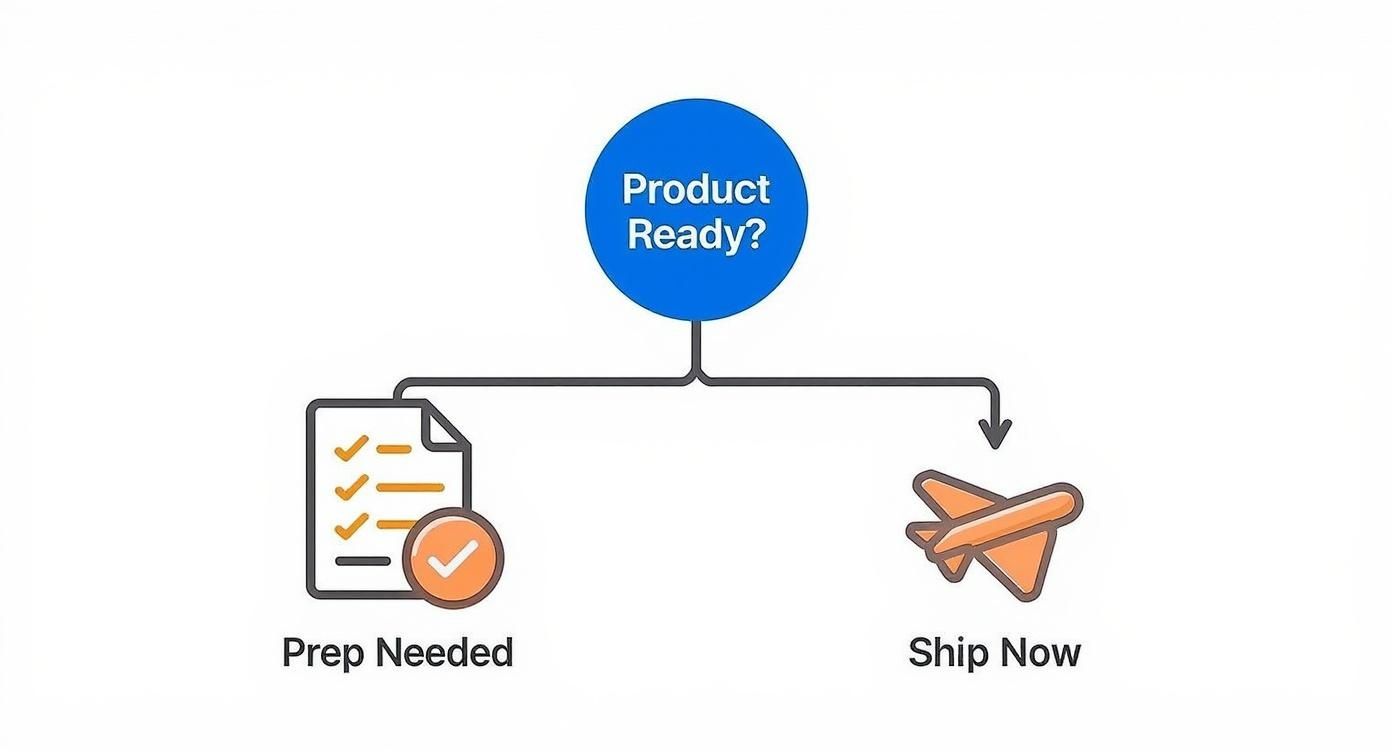
As you can see, if any prep work is needed, it must be handled before you can lock in your final shipping method.
Choosing between sea, air, and express courier isn't always straightforward. Each method has distinct trade-offs in speed, cost, and volume. This table breaks down the key differences to help you make a data-driven decision that aligns with your immediate business needs.
| Factor | Sea Freight (LCL/FCL) | Standard Air Freight | Express Shipping (e.g., DHL/FedEx) |
|---|---|---|---|
| Best For | Large, heavy, or bulk shipments where cost is the top priority. | Medium-sized shipments needing a balance of speed and cost. | Small, urgent shipments like samples, launches, or stockout emergencies. |
| Typical Transit Time | 25-40+ days port-to-door | 7-15 days airport-to-door | 3-7 days door-to-door |
| Cost | Lowest per kilogram. Extremely cost-effective for high volume. | Medium. Significantly more expensive than sea, but cheaper than express. | Highest per kilogram. Priced for speed and convenience. |
| Volume/Weight | Ideal for shipments over 200 kg or several cubic meters. | Best for shipments between 100 kg and 500 kg. | Suited for shipments under 100 kg. |
| Customs & Paperwork | More complex; often requires a customs broker and formal clearance. | Moderately complex; handled by the freight forwarder but more involved than express. | Simplest process; the courier handles customs clearance seamlessly. |
Ultimately, sea freight is your workhorse for planned restocks, standard air freight offers a middle ground for important shipments, and express is your emergency button for when speed is everything.
To make the right call, you must look beyond the freight quote and calculate the landed cost per unit for each shipping method. This is the total expense to get a single unit from the factory floor in China to a shelf in an Amazon fulfillment center, ready to sell.
Let's walk through two real-world examples.
Scenario A: Bulky, Lower-Margin Product (e.g., Yoga Mats)
Here, the choice is clear. Using air freight would eliminate any potential for profit. Sea freight is the only viable option.
Scenario B: Lightweight, High-Margin Product (e.g., Silk Pillowcases)
In this case, the difference is smaller. If paying an extra $2.10 per unit for air freight allows you to capture an entire month of peak-season sales, that premium could easily be offset by higher revenue and increased market share. This data-driven thinking transforms a simple cost comparison into a powerful strategic analysis for brand growth.
Customs clearance can feel like the most unpredictable part of shipping from China to Amazon FBA. It’s where countless shipments get stuck, accumulating fees and delaying inventory. With the right approach, however, it becomes a systematic step in your supply chain—a key part of the Optimization phase of your growth.
This isn't about becoming a customs expert. It’s about understanding the core documents and trade terms that dictate how smoothly your products move across borders. Getting this right means fewer surprises, predictable timelines, and greater control over your costs.
When your shipment arrives at the border, customs officials use a few key documents to verify its contents, value, and destination. Any inconsistency or missing information can trigger a manual inspection, which is precisely what you want to avoid.
Your freight forwarder will guide you, but you need to understand what each document does:
A simple mistake, like classifying a silicone phone case under the wrong HS code, can have a massive ripple effect. An incorrect code can lead to underpaying (or overpaying) duties, resulting in fines and a full cargo inspection that can delay your shipment for weeks.
This is why working with a freight forwarder who specializes in Amazon FBA is so critical. They can help verify your HS codes and ensure all your paperwork is flawless before your shipment leaves the port in China.
Beyond the paperwork, you and your supplier must agree on Incoterms. These are standardized international trade terms that define who is responsible for the shipment—and who pays for what—at every stage of its journey.
Choosing the right Incoterm directly impacts your costs and control. While there are many, Amazon sellers typically focus on three:
Choosing between these isn't just a logistical preference; it's a core business strategy. FOB empowers you to select your own freight forwarder, negotiate better rates, and maintain direct oversight of the shipping process. As your brand grows, this level of control becomes essential for optimizing your supply chain and protecting your margins.
Amazon's fulfillment centers are marvels of automation, but the entire system depends on every seller following the same strict rules. Deviate even slightly, and your shipment can come to a dead stop. This is where you shift from high-level logistics to the critical details of FBA compliance.
Do not underestimate this step. A single mistake here can lead to shipment rejection, expensive "unplanned service fees," and inventory being locked up for weeks. Think of FBA prep as your pre-flight checklist—every box and label must be perfect for a smooth landing.
Every single unit sent to FBA needs a unique Amazon barcode called an FNSKU (Fulfillment Network Stock Keeping Unit). This is not optional. It’s how Amazon’s systems identify that the product belongs to you, not another seller.
Crucially, the FNSKU must completely cover any other barcodes on the product, like a UPC. If it’s missing, peeling, or unscannable, Amazon’s systems won’t know what to do with your item, causing significant receiving delays.
Once labeled, your products are placed into master cartons for shipping. Amazon has strict rules for these boxes to ensure warehouse staff safety and keep their conveyor belts moving.
Ignoring these rules is a common mistake that costs money. An overweight box will be flagged instantly, and you'll be billed a fee for Amazon to handle it.
Your goal is to make it incredibly easy for Amazon to receive your inventory. The more compliant your shipment is, the faster your products move from the truck to "Available for Sale." This directly impacts your cash flow and sales momentum.
Before your freight forwarder can move your goods, you must create a Shipment Plan in your Amazon Seller Central account. This is the digital blueprint that tells Amazon exactly what you’re sending, how many units of each SKU, and how it’s packed. If you're new to the platform, our guide explains what Seller Central is and why it's so important.
This process generates two essential labels:
These FBA Box ID labels must be placed on the outside of each carton, away from the box seam and separate from any carrier labels. Without this label, your box is a mystery to the warehouse and will be set aside for a slow, manual check-in. Getting this right is the key to a fast and painless receiving process.

Selecting a freight forwarder is a make-or-break decision for your FBA business. This isn't just about finding the lowest quote to move boxes. Your forwarder is a strategic partner who can either become a massive asset or a huge liability in your supply chain.
Getting this choice right is a core part of the Optimization phase. A great partner does more than just book space on a ship; they proactively solve problems, ensure compliance, and help you navigate the complexities of international logistics.
A cheap quote might look appealing, but it often conceals issues like poor communication, surprise fees, and a lack of experience with Amazon's strict receiving requirements. The right partner helps you build a more resilient and profitable business.
While initial quotes from forwarders might seem similar, the real difference lies in their expertise and services. You need a partner who lives and breathes Amazon FBA and understands its unique challenges.
Look for a forwarder who can demonstrate deep experience shipping from China directly to Amazon FBA warehouses. They should know the ins and outs of Amazon’s appointment system, its labeling rules, and the common pitfalls that cause shipments to be delayed or rejected.
A truly valuable freight forwarder acts as an extension of your own team. They're not just a vendor; they're your operational partner, ensuring your inventory flows smoothly from the factory floor to being available for sale, which fuels your growth.
This means proactive communication is essential. If there’s a customs hold or a port closure, they should inform you immediately with a clear plan of action.
To separate the amateurs from the professionals, approach every conversation with a specific checklist. Their answers will reveal their expertise and whether they are the right fit for your brand's growth.
Here’s what you should be asking every potential partner:
Their answers to these questions will reveal their true capabilities and whether they can support your brand as it scales.
Many top-tier forwarders offer more than just freight. These value-added services can be a game-changer for optimizing your supply chain and reducing risk. For example, having your forwarder handle FBA prep in China can be far more cost-effective than using a 3PL in the US.
Another powerful service is short-term warehousing. This allows you to ship a full container by sea to their facility, then send smaller shipments into Amazon's fulfillment centers as needed. This strategy helps you avoid Amazon's high long-term storage fees and provides greater inventory flexibility. Identifying partners who can truly help you grow is essential, which is why we've compiled a list of the top Amazon FBA service providers to watch.
For time-sensitive shipments, a forwarder's expertise in express options is crucial. While these premium services can cost around $6 to $7 per kilogram, they offer incredible speed, with transit times to US FBA centers often taking just 10 to 12 working days, including customs clearance. Modern express shipping is increasingly using AI for route optimization, which helps minimize delays for urgent restocks or product launches. A good forwarder will help you run the cost-benefit analysis to determine when this premium is a smart investment.
Even with a solid plan, managing a shipment from China to Amazon FBA involves navigating many moving parts where things can go wrong.
To provide clarity, we’ve compiled straightforward answers to the most common questions we hear from sellers. Our goal is to give you the confidence to execute your shipping strategy effectively.
Your landed cost is the single most important metric for determining a product's true profitability. It represents the total cost to get one unit from the factory floor in China to a sellable position in an Amazon warehouse.
To calculate this number, you must add up every expense: the per-unit factory cost, all freight charges (air or sea), customs duties and taxes, cargo insurance, and any final delivery or prep fees.
A good freight forwarder can provide a Delivered Duty Paid (DDP) quote, which bundles many of these costs. However, don't just accept the total—always ask for a detailed breakdown. If you don't understand every line item, you leave yourself exposed to hidden fees that can silently erode your profit margins.
These are two of the most common Incoterms you'll encounter, and your choice determines who controls the shipment and when that control is transferred. This is a critical strategic decision.
It's painful to see sellers make the same preventable mistakes. After helping countless brands scale their logistics, we've identified a few key pitfalls that cause the biggest delays and financial losses when shipping from China to Amazon FBA.
Here are the top five:
Shipping directly to FBA can work well for fast-moving products with predictable sales velocity. For most brands, however, sending shipments to a Third-Party Logistics (3PL) warehouse in the destination country first is a strategic game-changer.
A 3PL acts as your inventory hub. They can receive your bulk shipment from China, perform a final quality check, handle FBA prep, and then send smaller, manageable batches of inventory into Amazon as needed.
This strategy is one of the most powerful ways to optimize your supply chain. You avoid Amazon's high long-term storage fees, gain significant control over your stock levels, and get a final opportunity to inspect products before they enter Amazon's ecosystem. It transforms your inventory from a potential liability into a flexible asset for growth.
At RedDog Group, we don't just advise—we execute. We build resilient supply chains and data-driven growth strategies that integrate your operations with your marketing, turning every shipment into a measurable, profitable opportunity.
If you're ready to move from guessing to building a scalable foundation for your brand, let's connect.
Leave a comment: